2011 AUDI A6 lock
[x] Cancel search: lockPage 161 of 370
____________________________________________ A_ u_ t_ o_ m_ a_ t_ i_ c _ t_ra _ n_s_ m __ is_s_ i_ o _ n _ __._
App lies to vehicles : wi th mul titro nic® Continu ous ly Va riable Trans missi on (CV T)
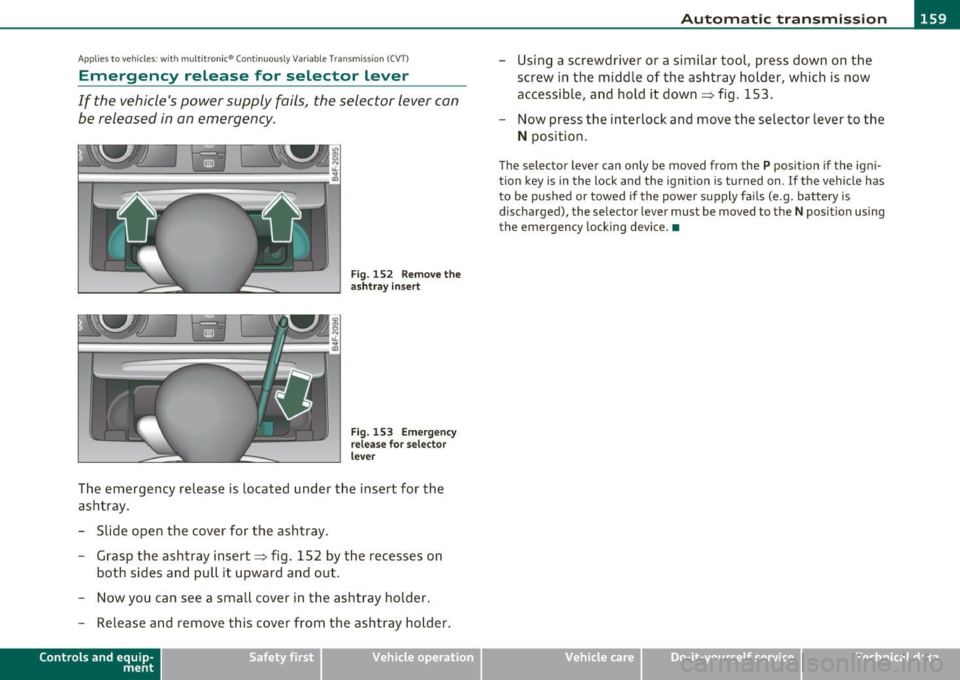
Emergency release for selector lever
If the vehicle's power supply fails, the selector lever can
be released in an emergency.
Fig. 152 Remove the
asht ray insert
F ig . 153 E mergen cy
release for se lector
l ever
The emergency release is located under the insert for the
ashtray.
- Slide open the cover for the ashtray .
- Grasp the ashtray insert~ fig. 152 by the recesses on
both sides and pull it upward and out.
- Now you can see a small cover in the ashtray holder.
- Release and remove this cover from the ashtray holder.
Con tro ls a nd e quip
m en t Vehicle
OP-eration
-Using a screwdriver or a similar tool, press down on the
screw in the middle of the ashtray holder , which is now
accessible, and hold it down~ fig. 153 .
- Now press the interlock and move the selector lever to the
N position.
The selector lever can only be moved from the P position if the igni
tion key is in the lock and the ignition is turned on. If the vehicle has
to be pushed or towed if the power supply fails (e.g. battery is
discharged), the selector lever must be moved to the
N position using
the emergency locking device. •
Vehicle care Do-it-yourselt service iTechnical data
Page 180 of 370

___ D_ r_ i_ v _i_n _.g"-- S_ a_ f_ e__. LY.__ _____________________________________________ _
Proper occupant seating positions
Proper seating position for the driver
The proper driver seating position is important for safe,
relaxed driving.
Fig. 166 The correct
distance between
driver and steering
wheel
Fig . 167 Correct head
restraint position for
driver
For your own safety and to reduce the risk of injury in the
event of an accident, we recommend that you adjust the
driver's seat to the following position:
- Adjust the driver's seat so that you can easily push the
pedals all the way to the floor while keeping your knee(s)
slightly bent==>& . -
Adjust the angle of the seatback so that it is in an upright
position so that your back comes in full contact with it
when you drive.
- Adjust the steering wheel so that there is a distance of at least 10 inches (25 cm) between the steering wheel and
your breast bone==> fig. 166. If not possible, see your
authorized Audi dealership about adaptive equipment.
- Adjust the steering wheel so that the steering wheel and airbag cover points at your chest and not at your face.
- Grasp the top of the steering wheel with your elbow(s) slightly bent.
- Adjust the head restraint so that the upper edge is as even
with the top of your head as possible but no lower than eye
level and so that it is as close to the back of your head as
possible ==> fig. 167.
- Fasten and wear safety belts correctly=>
page 191.
-Always keep both feet in the footwell so that you are in
control of the vehicle at all times.
For detailed information on how to adjust the driver's seat, see
=:>page 76 .
& WARNING
Drivers who are unbelted, out of position or too close to the airbag
can be seriously injured by an airbag as it unfolds. To help reduce
the risk of serious personal injury:
• Always adjust the driver's seat and the steering wheel so that
there are at least 10 inches (25 cm) between your breastbone and
the steering wheel.
• Always hold the steering wheel on the outside of the steering
wheel rim with your hands at the 9 o'clock and 3 o'clock positions ..
Page 181 of 370

______________________________________________ D_ ri_v _ i_n _,,g ,c.._ S_a_ f_ e_ l..:: y __ _
& WARNING (continued)
to help reduce the risk of personal injury if the driver's airbag
inflates .
• Never hold the steering wheel at the 12 o 'clock position or with
your hands at other positions inside the steering wheel rim or on
the steering wheel hub. Holding the steering wheel the wrong way can cause serious injuries to the hands, arms and head if the
driver's airbag deploys.
• Pointing the steering wheel toward your face decreases the
ability of the supplemental driver's airbag to protect you in a colli·
sion .
• Always sit in an upright position and never lean against or
place any part of your body too close to the area where the airbags
are located.
• Before driving, always adjust the front seats and head
restraints properly and make sure that all passengers are properly
restrained.
• Never adjust the seats while the vehicle is moving. Your seat
may move unexpectedly and you could lose control of the vehicle .
• Never drive with the backrest reclined or tilted far back! The
farther the backrests are tilted back, the greater the risk of injury due to incorrect positioning of the safety belt and improper
seating position.
• Children must always ride in child safety seats =>
page 219.
Special precautions apply when installing a child safety seat on
the front passenger seat =>
page 197. •
Controls and equip
ment Safety first Vehicle operation
Proper seating position for the front
passenger
The
proper front passenger seating position is important
for safe, relaxed driving.
For your own safety and to reduce the risk of injury in the
event of an accident, we recommend that you adjust the seat
for the front passenger to the following position:
- Adjust the angle of the seatback so that it is in an upright
position and your back comes in full contact with it when
ever the vehicle is moving.
- Adjust the head restraint so that the upper edge is as even
with the top of your head as possible but not lower than
eye level and so that it is as close to the back of your head
as possible=>
page 181.
- Keep both feet flat on the floor in front of the front
passenger seat.
- Fasten and wear safety belts correctly=>
page 191.
For detailed information on how to adjust the front passenger's seat,
see=>
page 75 .
& WARNING
Front seat passengers who are unbelted, out of position or too
close to the airbag can be seriously injured or killed by the airbag
as it unfolds. To help reduce the risk of serious personal injury:
• Passengers must always sit in an upright position and never
lean against or place any part of their body too close to the area
where the airbags are located.
• Passengers who are unbelted, out of position or too close to
the airbag can be seriously injured by an airbag as it unfolds with
great force in the blink of an eye. .,_
Vehicle care Do-it-yourself service Technical data
Page 186 of 370

• ....__D_ r_iv _i_ n_, g=-- S_ a _ f_e _,Ly _ ______________________________________________ _
in. WARNING
Improperly stored luggage or other items can fly through th e
vehicle c au sing seriou s per sonal injury in the event of hard braking
or an accident . To h elp reduce the risk of serious personal injury :
• Always put objects, for examp le, luggage or other heavy items
in the luggag e compartment .
• Alway s secure objects in the luggage compartment using the
tie -down eyelets and suitable straps.
& WARNING
Heavy loads will influence the way your vehicle handles. To help
reduce the ri sk of a loss of control leading to seriou s personal
injury:
• Always keep in mind when tran sporting heavy objects, that a
c hange in the center of gr avity can also cause changes in vehicle
handling:
-Always di stribute the load as evenly as po ssible.
- Place heavy objects as far forward in the luggage compart-
ment as po ssible.
• Never e xceed the Gross Axle Weight Rating or the Gross Vehicle
Weight Rating specified on the safety compliance sticker on the
left door jamb . Exceeding permissible weight standards can cause
the vehicle to slide and handle differently .
• Please observe information on safe driving =>
page 176 .
in. WARNING
To help prevent poisonous exhaust gas from being drawn into the
vehicle, always keep the rear lid closed while driving.
• Never transport objects larger than those fitting completely
into the luggage area because the rear lid cannot be fully closed.
& WARNING (c on tinued )
• If you absolutely must drive with the rear lid open , ob serve the
following note s to reduce the risk of poisoning:
- Close all windows ,
- Close the power roof*,
- Open all air outlet s in the instrument panel,
- Switch off the air recirculation ,
- Set th e fresh air fan to the high est speed .
in. WARNING
Always make sure that the doo rs , all windows, the power roof*
and the rear lid are securely clo sed and locked to reduce the risk of
i njury when the vehicle is not be ing used.
• After closing the rear lid, always make sure that it is properly
closed and locked.
• Never leave your vehicle unattended especially with the rear lid
left open. A child could c rawl into the vehicle through the luggage
c ompartment and clo se the rear lid becoming trapped and unable
to get out . Being trapped in a vehicle can lead to serious personal
injury.
• Never let children play in or around the vehicle.
• Never l et pa ssengers ride in the luggage compartment. Vehicle
occupants must always be properly restrained in one of the
vehicle 's seating positions .
(I) Tips
• Air circulation helps to re d uce win dow fogging. Sta le air es capes
to the outside through vents in the trim panel, on the left s ide of the
lugg age compa rtmen t. B e sur e to keep these s lots free and ope n.
• Th e tire pressure m ust correspond to the load . The tire pressure is
shown o n the tir e pressu re label. The tire pressu re label is loc ated o n .,_
Page 194 of 370

alll!II Safety belts Pffl _______________ _
-Ins ert t he tongue into the correct buckle of your seat unti l
you hear it latch secure ly=> fig. 176 .
- Pull on t he be lt to make sure t hat it is secure ly latched in
the buck le.
Automatic safety belt retractors
Every safety be lt is equipped with an automatic be lt retractor on the
shoulder bel t. This fea ture locks the be lt whe n the belt is pulled out
fast, during hard braking and in an acc ident. The belt may also lock
w hen you dr ive up or dow n a s teep hill or throug h a sharp curve.
During norma l dr iving the belt lets you move freely.
Safety belt pretensioners
The safety bel ts are equipped w ith a belt pretensioner that helps to
t ighten the s afety be lt and remove sla ck when the pre tensioner is
act ivated. The function of the pretensioner is monitored by a warn ing
light =>
page 14.
Switchable locking featu re
Eve ry sa fe ty be lt exc ep t the one on the driver sea t is e quipped wi th a
switchable locking feature that
must be used when the safety belt is
used to attach a child safety seat. Be s ure to read t he import ant info r
mation about this feature=>
page 229.
& WARNING
Improperly positio ned safety belts can cause serious injury in a n
accident =>
page 192, "Safety belt po sition ".
• Safety belts offer optimum p rote ction onl y when the seat back
i s upright and belts are properly positioned on the body .
• Always make sure th at the rear seat backre st to which the
center rear safety b elt is attached i s securely latched whenever the
rear center safety belt is being used. If the ba ckrest is not securely
latch ed, the passenger will move forward with the ba ckrest during
sudden br aking, in a s udden maneu ve r and e speci ally in a crash.
& WARNING (contin u ed )
• Never atta ch the safety belt to the buckle fo r another seat.
Attaching the b elt to the w rong buckle will reduce safety belt
effecti veness and can cause serious personal injury.
• A pass enger who is not properly restr ained can be s eriou sly
injured by the safety belt it self when it move s from the stronger
parts of th e body into critical
areas like the abdomen.
• Alway s lock the convertible locking retractor when y ou are
securing a child safety seat in the vehicle=>
page 231. •
Safety belt position
Correct belt posi tion is the key to get ting maximum
protection from safety belts .
Fig. 17 7 Hea d
re stra int an d safe ty
belt posi tio n as se en
fro m the s ide
Standard features on your vehicle help you adjust the position of the
safety belt to match your body size.
• belt height adj ustment for the fro nt seats,
• automatic belt height adjustment for the rear seats .
Page 211 of 370
_______________________________________________ A_ ir_ b_ a_,,,g '--- s.:.y _s _t_ e _ m ___ _
PASSENGER AIR BAG OFF light
·~ .~~I f -
-a• -· ... JI •
-a II .. ~ ----- -
• II _, -
MSSENGEIIAIRBAGOfF
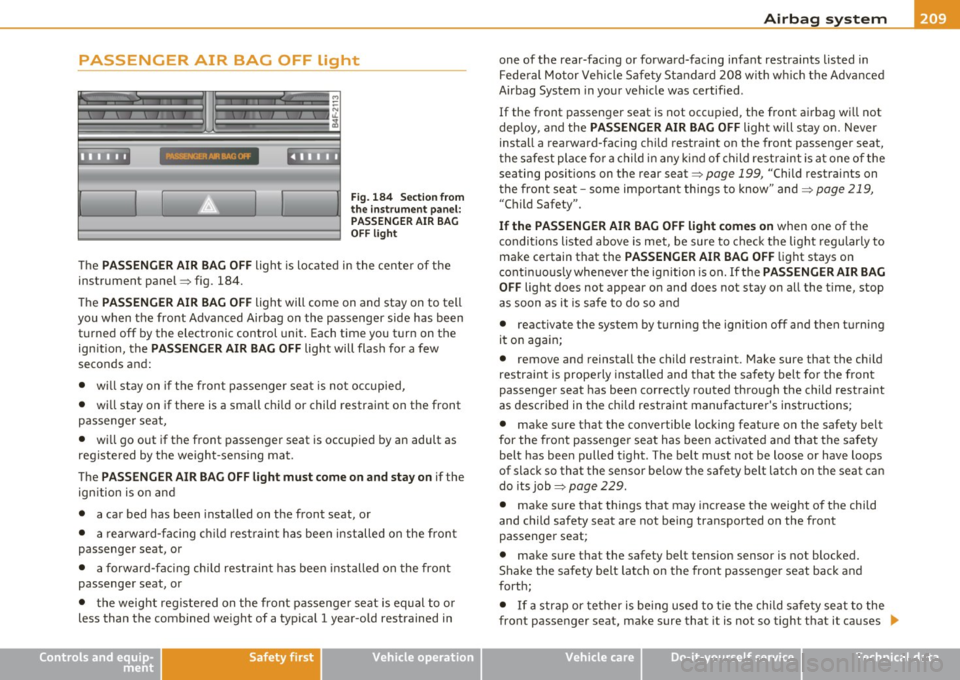
Fig. 184 Section from
the instrument panel:
PASSENGER AIR BAG
OFF light
The PASSENGER AIR BAG OFF light is located in the center of the
instrument panel~ fig. 184.
Th e
PASSENGER AIR BAG OFF light will come on and stay on to tell
you when the front Advanced Airbag on the passenger side has been turned
off by the electronic control unit. Each time you turn on the
ign ition, the
PASSENGER AIR BAG OFF light will flash fo r a few
seconds and:
• will stay on if the front passenger seat is not occupied,
• will stay on if there is a small child or child restraint on the front
passenge r seat,
• will go out if the front passenger seat is occupied by an adult as
registe red by the weight-sens ing mat.
The
PASSENGER AIR BAG OFF light must come on and stay on if the
ign ition is on and
• a car bed has been installed on the front seat, or
• a rearward-facing child restraint has been installed on the front
passengerseat,or
• a forward-facing child restraint has been insta lled on the front
passenger seat, or
• the weight registe red on the front passenger seat is equal to or
less than the combined weight of a typical 1 year-o ld restrained in
Controls and equip
ment Safety first
Vehicle operation
one of the rear-facing or forward-facing infa nt restraints listed in
Federal Motor Vehicle Safety Standard 208 with w hich the Adva nced
Airbag System in your vehicle was certified .
If the front passenger seat is not occupied, the front airbag wi ll not
dep loy, and the
PASSENGER AIR BAG OFF light will stay on. Never
install a rearward-facing child restraint on the front passenger seat,
the safest pla ce fo r a child in any kind of chi ld restraint is at one of the
seating positions on the rear seat~
page 199, "Child restraints on
t he front seat-some impo rtant things to know" and~
page 219,
"Child Safety" .
If the PASSENGER AIR BAG OFF light comes on when one of the
conditions listed above is met, be sure to check the light regu larly to
make certain that the
PASSENGER AIR BAG OFF lig ht stays on
continuously whenever the ignition is on.
If the PASSENGER AIR BAG
OFF
light does not appear on and does not stay on all the t ime, stop
as soon as it is safe to do so and
• reactivate the system by turning the ignition
off and then turning
it on again;
• remove and reinstall the ch ild restraint. Make sure that the child
restraint is properly installed and that the safety belt fo r the front
passenger seat has been correctly routed through the child restraint
as described in the child restraint manufacturer's instructions;
• make sure that the convertible locking feature on the safety belt
for the front passenge r seat has been activated and that the safety
belt has been pulled t ight. The belt must not be loose or have loops
of slack so that the senso r be low the safety belt latch on the seat can
do its job~
page 229.
• make sure that things that may increase the weight o f the chi ld
and child safety seat are not being transported on the front
passenger seat;
• make sure that the safety belt tension sensor is not blocked.
Shake the safety belt latch on the front passenge r seat back and
forth;
• If a strap or tether is be ing used to tie the child safety seat to the
front passenger seat, make sure that it is not so tight that it causes .,
Vehicle care Do-it-yourself service Technical data
Page 224 of 370

.,,___C_ h_ il_d _ S_a _ f_ e _ t-= y ;....._ ____________________________________________ _
C. Forward-facing convertible child restraint
systems, manufactured on or after September 1,
2004:
• Britax Roundabout 161
• Century Encore 4612
• Century STE 1000 4416
• Cosco Olympian 02803
• Cosco Touriva 02519
• Evenflo Horizon V 425
• Evenflo Medallion 254
• Safety First Comfort Ride 22-400
& WARNING
To reduce the risk of serious injury, make sure that the
PASSENGER AIR BAG OFF light comes on and stays on whenever a
child restraint is installed on the front passenger seat and the ignition is switched on.
• Take the child restraint off the front passenger seat and install
it properly at one of the rear seat positions if the PASSENGER AIR BAG OFF light does not stay on.
• Have the airbag system inspected by your authorized Audi
dealer immediately.
W Tips
The child seats listed in categories A to C have been tested by Audi
only for the Advanced Airbag function. •
Important safety instructions for using
child safety seats
Correct use of child safety seats substantially reduces the
risk of injury in an accident!
As the driver, you are responsible for the safety of everybody
in the vehicle, especially children:
Always use the right child safety seat for each child and
always use it properly~
page 224.
-Always carefully follow the child safety seat manufac
turer's instructions on how to route the safety belt prop
erly through the child safety seat.
- When using the vehicle safety belt to install a child safety
seat, you must first activate the convertible locking retractor on the safety belt to prevent the child safety seat
from moving ~
page 229.
-Push the child safety seat down with your full weight to
get the safety belt really tight so that the seat cannot
move forward or sideways more than one inch (2.5 cm).
- If a strap or tether is being used to tie the child safety seat
to the front passenger seat, make sure that it is not so
tight that it causes the weight-sensing mat to measure more weight than is actually on the seat.
Always remember: Even though your vehicle is equipped with an
Advanced Airbag system, all children, especially those 12 years and
younger, should always ride in the back seat properly restrained for
their age and size . _,,
Page 226 of 370

Ill Child Safety __ .,.___ ____________ _
& WARNING (continued)
-Always move the front passenger seat into the rearmost
position of the passenger seat's fore and aft adjustment range,
and as far away from the airbag as possible before installing
the child restraint.
- Always make sure that nothing prevents the front
passenger's seat from being moved to the rearmost position in
its fore and aft adjustment range.
- Always make sure that the backrest is in the upright posi
tion.
• Always buckle the child safety seat firmly in place even if a
child is not sitting in it. A loose child safety seat can fly around
during a sudden stop or in a collision.
• Always read and heed all WARNINGS whenever using a child
restrained in a vehicle is being used=>
page 187, "Safety belts",
=>
page 197, "Airbag system" and=> page 219, "Child Safety".
& WARNING
To reduce the risk of serious injury, make sure that the
PASSENGER AIR BAG OFF light comes on and stays on whenever a
child restraint is installed on the front passenger seat and the
ignition is switched on.
• Take the child restraint off the front passenger seat and install
it properly at one of the rear seat positions if the PASSENGER AIR
BAG OFF light does not stay on.
• Have the airbag system inspected by your authorized Audi
dealer immediately .
& WARNING
A child in a child restraint installed with the LATCH lower anchor
ages or with the standard safety belt on the rear seat may play
& WARNING (continued)
with unused rear seat safety belts and become entangled
resulting in serious personal injury and even death.
• Always buckle unused rear seat safety belts out of reach of chil
dren in child seats and properly activate the convertible locking
retractor so that the child cannot unreel the safety belt from the
retractor. •
Child safety seats
Infant seats
Babies and infants up to about one year old and 20 lbs. or
9 kg need special rearward-facing child restraints that
support the back, neck and head in a crash.
Fig. 189 Schematic
ove rview : rearward
facing infant seat,
properly installed on
the rear seat
-When using the vehicle safety belt to install a child safety
seat, you must first activate the convertible locking
retractor on the safety belt to prevent the child safety seat
from moving =>
page 229 or install the seat using the
LATCH attachments. ..,_