2011 AUDI A6 ignition
[x] Cancel search: ignitionPage 171 of 370

____________________________________________ A_ d_a_ p ,_ t_iv _ e_ A _ i_ r _ S_ u_s_, p __ e_n _ s_ i _o_ n __ _
App lies to vehicles : with A dap tive Air Su spen sion
Chassis controls
Four different driving modes can be set by the driver.
The automatic control processes are speed- and time-dependent. For
example, it is not possible to raise the suspension to the lift mode
above certain speeds.
Automatic
Select the automatic mode if yo u prefer suspens ion and damping
settings emphasizing comfort.
• Lowering : When a speed of about 75 mph (120 km/h) is exceeded
for more than 30 seconds, the vehicle is automatically lowered by
about 0.6 inch (15 mm) to the dynamic level which is more suitable
for highway speeds. Road holding is optimized as a result of the lower center of gravity and fuel consumption is reduced as a result of
reduced wind resistance.
• Raising: The vehicle is automatically raised aga in if the speed falls
below about 44 mph (70 km/h) for a period of 2 minutes. The veh icle
is raised immediately when speed falls be low about 22 mph (35
km/h).
Comfort
Select the comfort mode if you desire a suspension sett ing with a
special emphasis on comfort. In the standard mode there is
no
lower ing of the suspens ion. Even at high speeds, the veh icle stays at
the same level. Damp ing characteristics with a decided emphasis on
comfort are selected in this mode.
Dynamic
Select the dynam ic mode if you prefer a sporty suspension sett ing. In
this mode, the vehicle is lowered while it is still stationary and sporty
damping characteristics are selected. The warning light
c.::> in the
instrument cluster will come on for a few seconds just to remind you
of the reduced ground clearance.
Controls and equip
ment Safety first
If you switch off the engine while the vehicle is in the dynamic mode
and then switch on the
ignition once again, the
c.::> warning light will
also come on again for a few seconds as a reminder.
Lift
Select the lift mode when you have to travel over poor sections of
road (e.g. trails). In the lift mode, the vehicle is raised by 0.6 inch (15
mm) compared to normal level while it is still stationary and damping
characteristics are adjusted to emphasize comfort.
The lift mode can be activated only at speeds below 50 mph (80
km/h). When a speed of about 62 mph (100 km/h) is exceeded, the
system automatica lly leaves lift mode and the mode set previously
(standard, automatic, dynamic) is activated again .•
App lies to vehicles : w ith Adapt ive Air Sus pension
Setting the driving modes
The driving modes are set in f\1/11!.
Fig. 162 MMI display:
Settings
The ignition must be switched on to set the driving modes.
- Select: Function button [CAR].
Please note that not every driving mode c an be selected in every
driving situation. For example, it is not possible to switch to "lift"
Vehicle care Technical data
Page 174 of 370

Ill HomeLink® ..__ ______________ _
Applies to veh icles : w ith Homelin k® un iversa l remote control
Programming the Homel ink ® transmitter
The transmitter is programmed in two phases . For rolling
code transmitters, a third phase is also necessary .
illUl~~ . l
~-1 II I Ill
Fig. 163 Over head
conso le: Homelink ®
keypad
Fig. 16 4 Front
bumper, passenger
s ide: loc ation of trans
mitter unit
Phase 1: progr amming th e overhead k eypad
1. Make sure your vehicle is within operating range of the
remote controlled garage door opener .
2. Set the parking brake~
& in "General information " on
page 171 .
3. Turn the ignition on . Do not start the engine! 4
. Press and hold the two outside Homelink ® buttons
(D
and (@)for approximately 20 seconds until indicator l ight
@ ~ fig. 163 begins to flash . Then release both buttons .
Do not hold the buttons for longer than 30 seconds .
- This procedure only needs to be performed
once . It erases
the factory-set default codes and does not have to be repeated to program additional remote controls .
5. Press and hold the Homelink ® button
(D , @ or@ until
the indicator light © starts flashing
slowly . Release the
button .
-The system will now rema in in programming mode for 5
minutes.
Co to the front of the vehicle and proceed with
phase
2 .
Phase 2:
programming the bumper mounted transmit
ter
6 . Hold the original r emote control at a distance between 0-
6 in. (0 -15 cm) from the bumper below the appropriate
headlight for your vehicle~ fig . 164 (use the shortest
distance possible) .
7 . Aim the remote control just below the
passenger side
headlight .
8. Press and hold the activation button on the remote control.
- May be d ifferent in Canada . If so, press and re-press
(cycle) the activation button on yo ur remote control every
two seconds. .-,,
Page 201 of 370

_______________________________________________ A_ ir_ b_ a_,,,g '--- s.:.y _s _t_ e _ m ___ _
Child restraints on the front seat - some
important things to know
- Be su re to re ad t he i mpo rt a nt i nfo rmation a nd head the
WA RNINGS fo r i mporta nt details about chil dre n and
Advanced Airbags ~
page 219.
Even t hough your ve hicle is eq uipped with an Advanced Airbag
System, ma ke ce rtain that a ll chi ld ren, especia lly those 12 years an d
younger, always r ide in the back seat prope rly rest rained fo r th eir age
and si ze. The airbag on the passenger side makes the front seat a
po tentially da ngerous place fo r a child to r ide. The fro nt seat is not
the safest place for a ch ild in a forward-facing child safety seat. It can
be a very dange rous place fo r an i nfan t or a child in a rearward-fac ing
seat.
Th e Advanced Ai rbag System in your vehicle has been cer tified to
comply with the req uirements of Un ited States Federa l Moto r Veh icle
Sa fety Standard 208 as applicable at the time your vehicle was manu
factured.
The Standard requires the front airbag on the passenger side to be
tu rne d off ("s uppressed") if a c hild up to abou t one ye ar of age
restra ined in o ne of the rear -facing or forward -fac ing infant
restra ints listed in Federa l Moto r Vehicle Safety Standard 208 with
whic h the Advanced Airbag System in yo ur vehicle was cert ified has
been installed on the front passenger seat. For a listing of the ch ild
restra in ts that were used to certify compliance with the US Saf ety
Standard =>
page 221.
The PASSENGER AIR BAG OFF ligh t in th e in st rume nt p anel t ells you
when the front Advanced A irbag on the passenger side has been
tur ned off by the ele ct ronic con trol uni t.
Each time you t urn on the ignition, t he
PASSENGER AIR BAG OFF
light will come on for a few seconds and:
• will stay on if th e front passenger se at is no t oc cupie d,
Controls and equip
ment Safety first
Vehicle operation
• will stay on if there is a small ch ild or child restra int on the front
p assenge r se at,
• will go off if the front passenger seat is occup ied by an adult as
reg iste red by t he weight -sens ing mat =>
page 208, "M oni tor ing t he
Advanced Airbag System" .
T he
PASSENGER AIR BAG OFF light comes o n when t he control unit
de tects a total weight on t he front passenger seat that req uires the
front airbag to be t urned off .
If th e total weight o n the front passenger seat is more than th at of a
typical 1 year-o ld child but less than the weight of a small adult, the
fr on t a ir bag on the passenge r si de c an deploy (t he
PASSENGER AIR
BAG OFF
light does not come on) . If the PASSENGER AIR BAG OFF
light does not come on, the front airbag on the passenger side has
not been turned off by the electronic co ntrol unit and can deploy if
the control unit senses an impact t hat meets the conditions stored in
its memory.
For example, the airbag may deploy if:
• a small child that is heavier than a typical 1 year -old child is on the
front passenger seat (regard less of whether the chi ld is in one of the
child safety seats listed =>
page 221), or
• a child who has outgrown child restraints is on the front passenger
sea t.
If the fro nt passenger a irbag is tur ned off, the
PASSENGER AIR BAG
OFF
lig ht comes on in the instr ument cluster an d stays on.
Th e fron t airbag on t he pa sse nger side may
not de ploy ( the
PASSENGER AIR BAG OFF li ght does not illum inate and stay lit) even
if a small ad ult or teenager, or a passenger who is no t sitting upright
with their back against a non-reclined backrest w ith the ir feet on the
vehicle floor in front of the seat is on the front passenger seat
=>
page 178, " P roper seat ing pos itio n for the dr iver".
If the front passenger ai rbag dep loys, the Federal Standard requires
t he a irbag to mee t the "low risk" deployme nt cr iter ia to reduce the
risk of inj ury through interaction with the a irbag. "Low r isk" deploy
me nt o ccurs in those cras hes t hat tak e pla ce a t lower decelerat io ns as
I),
Vehicle care Do-it-yourself service Technical data
Page 202 of 370

___ A_ i_r _b _a _, g,:;._ s_, y._ s _ t_e _m ________________________________________________ _
defined in the electronic control unit~ page 209, "PASSENGER AIR
BAG O FF light ".
Always remember, a child safety seat or infant carr ier installed on the
front seat may be struck and knocked out of position by the rapidly
inflating passenger's airbag in a frontal collision. Th e airbag could
greatly reduce the effectiveness of the child restraint and even seri
ously injure the child during inf lation .
For this reason, and because the back seat is the safest place for chil
dren -whe n proper ly restrained accord ing to their age and size -we
st rong ly recommend that children always sit in the back seat
~ page 219, "Child Safety".
& WARNING
A child in a rearward -facing child safety seat installed on the front
passenger seat will be seriously injured and can be killed if the
front airbag inflates - even with an Advanced Airbag System.
• The inflating airbag will hit the child safety seat or infant
carrier with great force and will smash the child safety seat and
child against the backrest, center armrest, door or roof .
• Always install rear-facing child safety seats on the rear seat.
• If you must install a rearward facing child safety seat on the
front passenger seat because of exceptional circumstances and
the PASSENGER AIR BAG OFF light does not come on and stay on,
immediately install the rear-facing child safety seat in a rear
seating position and have the airbag system inspected by your
Audi dealer.
• Forward-facing child safety seats installed on the front
passenger's seat may interfere with the deployment of the airbag
and cause serious personal injury to the child.
& WARNING
If, in exceptional circumstances , you must install a forward-facing
child restraint on the front passenger's seat:
& WARNING (continued)
• Always make sure the forward-facing seat has been designed
and certified by its manufacturer for use on a front seat with a
passenger front and side airbag.
• Never put the forward-facing child restraint up against or very
near the instrument panel.
• Always move the passenger seat into its rearmost position in
the seat's fore and aft adjustment range, as far away from the
airbag as possible before installing the forward-facing child
restraint. The backrest must be adjusted to an upright position.
• Make sure that the PASSENGER AIR BAG OFF light comes on
and stays on all the time whenever the ignition is switched on.
& WARNING
To reduce the risk of serious injury, make sure that the
PASSENGER AIR BAG OFF light will be displayed whenever a child
restraint is installed on the front passenger seat and the ignition
is switched on .
• If the PASSENGER AIR BAG OFF light does not stay on, perform
the checks described
~ page 208 , "Monitoring the Advanced
Airbag System ".
• Take the child restraint off the front passenger seat and install
it properly at one of the rear seat positions if the PASSENGER AIR
BAG OFF light does not stay on.
• Have the airbag system inspected by your Audi dealer immedi
ately.
• Always carefully follow instructions from child restraint manu
facturers when installing child restraints.
& WARNING
If, in exceptional circumstances , you must install a forward or
rearward-facing child restraint on the front passenger 's seat:
Page 206 of 370

111 ....... _A_ i_rb _ a_,g,:;._ s_, y'- s_ t_e _m ________________________________________________ _
& WARNING (conti nued)
• If you must install a rearward facing child safety seat on the
front p assenger seat because of e xceptional circumstan ce s and
the PASSENGER AIR BAG OF F light does not come on and stay on ,
immed iately in stall the rear-facing child safety seat in a r ea r
seating position and have the airbag system inspected by your
Audi dealer.
& WARNING
If, in exceptional circumstances, you must in stall a forward-facing
child restraint on the front passenger 's seat:
• Always make sure the forward-facing seat has been d esigned
and certified b y its manufacturer for use on a front seat with a
pas senger front and side airbag.
• Never put the forward-facing child restraint up against or very
near the instrument panel.
• Always move the passenger seat into its rearmo st position in
the seat 's fore and aft adjustment range, as far away from the
airbag as possible , before in stalling the forward-facing child
restraint. The backrest must be adjusted to an upright position.
• Make sure that the PASSENGER AIR BAG OFF light comes on
and stays on all the t ime whenever the ignition is switched on .•
Advanced Airbag System components
The front passenger seat in your veh icle has a lot of very important
parts o f the A dvanced A irbag System in it. These p arts incl ude t he
we ight-sens ing mat, sensors, wiring, brackets, and more. The func
t ion o f the sys tem in t he front passenger sea t is che cked by the elec
tron ic contro l unit when the ignit ion is on . The contro l unit mo nitors
t he Advanced Air bag System and t urns the airbag indica tor ligh t on
when a malfunction in t he system compone nts is detected. The func
tion of the a irbag indicator light is descr ibed in greater detail be low. Because the front passenger seat co
nta ins important parts of t he
Adv anced Ai rbag System, you mus t tak e ca re to p reve nt i t from be ing
damaged . Damage to the seat may p revent the Advanced A irbag for
the front passenge r seat from do ing its job in a crash .
The front Advanced Airbag System consists of the
following:
• Cras h sensors in the front of the ve hicle tha t meas ure vehicle
acc elera tion/de ce le ra tion to prov ide info rm ation to the Advanced
Airbag System about the severity of the crash .
• An e lec tron ic contro l unit, w it h i ntegr ate d crash sensors fo r front
and side i mpacts . The control unit "dec ides" w het her to fire the front
airbags based o n the information rece ived from the c rash sensors .
T he contro l unit also "decides" whether the safety be lt prete nsioners
should be activated.
• An Advanced Airbag with gas generator fo r the driver inside the
s teer in g wheel hub.
• An Advanced Airbag with gas generator inside the instrument
p ane l for the front p assenge r.
• A weight-sensi ng mat under the upho lstery padd ing of the front
passenge r seat cushion that measu res the tota l we ight on the se at.
The informat ion registered is sent continuously to the electronic
c ont rol uni t to re gulate deploymen t of t he fr ont Adv anced A irbag o n
the passenger side .
• An air ba g mon itoring syste m and indi ca tor ligh t in the in strume nt
cl uster =>
page 208.
• Th e PASSENGER AIR BAG OFF lig ht comes on an d stays on in t he
center of the instrument panel=>
page 209, fig. 184 and tells you
w hen the fron t A dvan ced A irb ag on t he passe nger side has been
turned off.
• A senso r below t he safety belt latch for t he front seat passenge r
to meas ure the tens ion on the safety belt . The tension on the safety
be lt a nd the we igh t regis tere d by the weig ht-sensing mat help t he
control un it "dec ide" w hethe r th e front airbag fo r the front
passenge r seat should be turned of f or not =>
page 19 9, "Chi ld
restraints on the front seat -some important things to know". ._
Page 209 of 370

Airbag system 1111
---------------------------------------------=---=----
lower parts of the body . Front a irbags s upplement the t hree-poi nt
sa fety belts o nly in some fro ntal collis ions in which the vehicle decel
eration is high enough to dep loy the a irbags .
Front airbags will not deploy:
• if the ignition is switched off when a crash occurs,
• in s ide collisions ,
• in rea r-end collisions,
• in rollovers,
• when the crash decelerat io n me asured by the a irbag system is less
than the min imum threshold needed for a irbag deployment as reg is
tered by the e lectron ic con trol un it.
The front passenger airbag also will not deploy:
• when the fron t passe nger seat i s not oc cupied,
• when the weight on the front passenger seat as sensed by the
Advanced Ai rbag System in dicates that the front airbag o n the
passenger side has to be turned off by the e lectronic control unit (the
PASSENGER AIR BAG OFF li ght comes on and stays on).
& WARNING
Sitting in the wrong position can increase the ri sk of ser iou s injury
in crashes.
• To redu ce the risk of injury when the airbags inflate, the driver
and pas sengers mu st always sit in an upright position , mu st not
lean against or place any part of th eir body too close to the area
where the airbags are lo cated.
• Occupants who are unbelted, out of position or too close to the
airbag can be seriou sly injured by an airbag a s it unfolds with
great force in th e blink of an eye =>
page 199 .
Controls and equip
ment Safety first Vehicle operation
& WARNING
A child in a rearward-facing child
safety se at installed on the front
pa sseng er seat will be seriously injured and can be killed if the
front airbag inflat es - ev en with an Ad van ced Airbag System .
• The inflating airbag will hit the child safety seat or infant
c arrier with great force and will smash the child safety s eat and
c hild against the backre st, center armre st, d oor or roof .
• Always install rear -facing child safet y seats on the rear seat.
• If you must install a rearward facing child safety seat on the
front passenger se at because of e xceptional circumstances and
the PASSENGER AIR BAG OFF light do es not come on and stay on ,
immediately install the rear -facing child s afety seat in a rear
s eating po sition and h ave the airbag system inspe cted by your
Audi d eal er.
& WARNING
Object s between you and the airbag will increase th e risk of inju ry
in a cra sh by int erfering with the way the airb ag unfold s or by
being pushed into you as the airbag inflates.
• Never hold things in your hand s or on your lap when the vehicle
i s in use.
• Never tran sport items on o r in the are a of the fr ont pa ssenger
seat. Obje ct s c ould move into the area of the front ai rbag s during
braking or other sudden maneu ver s and become dang erous
projectiles that can c au se se rious per sonal injury if the ai rb ags
infl ate.
• Never pla ce o r attach accessories or othe r objects (s u ch a s
cupholders, telephone brac kets, large , heavy or bulk y object s) on
the doo rs, over o r near the are a marked
"AIRBAG " on the stee ring
wheel, in strum ent panel , se at ba ckre sts or between th ose ar ea s
and yourself . These objects could cause injur y in a crash , especially
when the airbags infl ate .
9"'
Vehicle care Do-it-yourself service Technical data
Page 210 of 370

........ _A_ i_rb _ a_,g,:;._ s_, y'- s_ t_e _m ________________________________________________ _
& WARNING (conti nued)
• Never recline the front passenger's seat to transport objects.
Items can also move into the area of the s ide airbag or the front
airbag during braking or in a sudden maneu ver. Objects near the
airbags can become projectiles and cause injury, particularly when
the seat is reclined .
& WARNING
The fine dust created when airbags deploy can cause breathing
problems for people with a history of asthma or other br eathing
conditions.
• To reduce the risk of breathing problems, those with asthma or
other respiratory conditions should get fresh air right away by
getting out of the veh icle or opening windows or doors.
• If you are in a colli sion in which airbags deploy, wa sh your
hands and face with mild soap and water before eating .
• Be careful not to get the dust into your eyes, or into any cuts or
scratches.
• If the residue should get into your eyes, flush them with
water .•
Monitoring the Advanced Airbag
System
Airbag monitoring indicator light f!G
Two separate indicat ors m onit or the func tion of the
Advanc ed A irb ag Sys tem: the airbag mo nit ori ng in dic ato r
li g ht and the
PASSENGER AIR BAG OFF light.
The Advanced Airbag System (incl uding the electronic control unit,
sensor circui ts and system wiring) is mo nito red cont inuous ly to make
sure that it is f unctioning p roper ly whenever the ignition is on. Each time you t
urn on the ignit ion, the a irbag monitoring indicator light
:A
w ill come o n fo r a few secon ds (self diagnos tic s).
The system must be inspected when the indicator light ~:
• does not come on when the ignition is switched on,
• does not go out a few seconds aft er you have switc hed on the igni
tion, or
• comes on while driving.
If an airbag system malfunction is detected, the indicator light w ill
fir st start flashing to c atch t he d river's attention and then stay on
continuously to serve as a constant reminder to have the system
inspec ted immedia tely .
If a ma lfunct io n occ urs that t urns the fron t air bag on the passenger
side off, the
PASSENGER AIR BAG OFF li ght will come on and stay on
w henever the igni tion is on.
& WARNING
An airbag system that is not functioning properly cannot provide
supplemental protection in a frontal crash.
• If the airbag indicator light comes on , it means that there may
be something wrong with the Advanced Airbag System . It i s
possible that the airbag will inflate when it is not supposed to, or
will not inflate when it should.
• Have the airbag system inspected immediately by your Aud i
dealer. •
Page 211 of 370
_______________________________________________ A_ ir_ b_ a_,,,g '--- s.:.y _s _t_ e _ m ___ _
PASSENGER AIR BAG OFF light
·~ .~~I f -
-a• -· ... JI •
-a II .. ~ ----- -
• II _, -
MSSENGEIIAIRBAGOfF
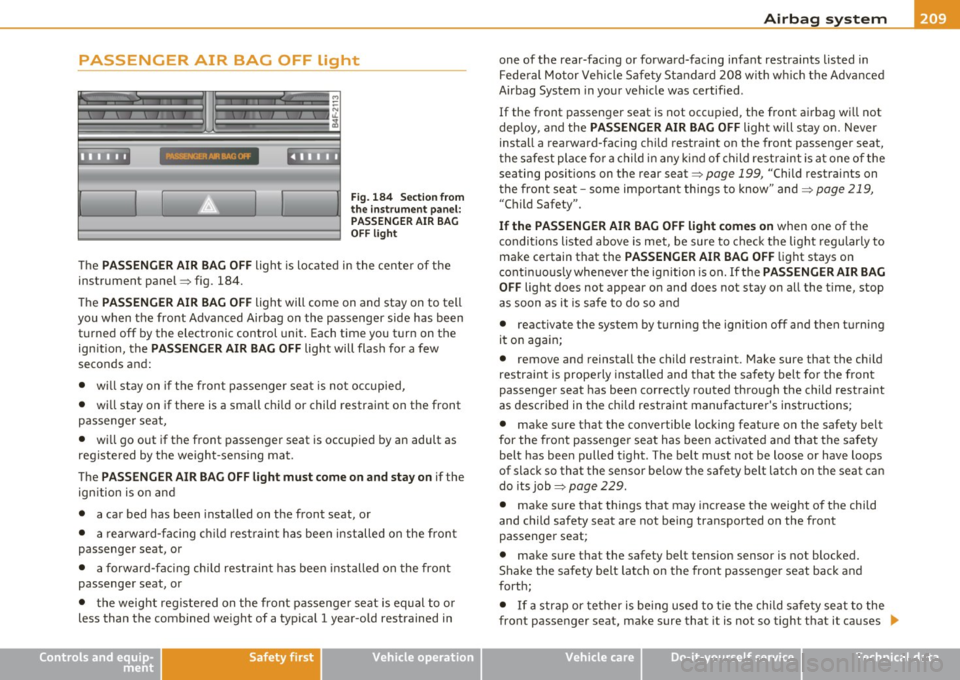
Fig. 184 Section from
the instrument panel:
PASSENGER AIR BAG
OFF light
The PASSENGER AIR BAG OFF light is located in the center of the
instrument panel~ fig. 184.
Th e
PASSENGER AIR BAG OFF light will come on and stay on to tell
you when the front Advanced Airbag on the passenger side has been turned
off by the electronic control unit. Each time you turn on the
ign ition, the
PASSENGER AIR BAG OFF light will flash fo r a few
seconds and:
• will stay on if the front passenger seat is not occupied,
• will stay on if there is a small child or child restraint on the front
passenge r seat,
• will go out if the front passenger seat is occupied by an adult as
registe red by the weight-sens ing mat.
The
PASSENGER AIR BAG OFF light must come on and stay on if the
ign ition is on and
• a car bed has been installed on the front seat, or
• a rearward-facing child restraint has been installed on the front
passengerseat,or
• a forward-facing child restraint has been insta lled on the front
passenger seat, or
• the weight registe red on the front passenger seat is equal to or
less than the combined weight of a typical 1 year-o ld restrained in
Controls and equip
ment Safety first
Vehicle operation
one of the rear-facing or forward-facing infa nt restraints listed in
Federal Motor Vehicle Safety Standard 208 with w hich the Adva nced
Airbag System in your vehicle was certified .
If the front passenger seat is not occupied, the front airbag wi ll not
dep loy, and the
PASSENGER AIR BAG OFF light will stay on. Never
install a rearward-facing child restraint on the front passenger seat,
the safest pla ce fo r a child in any kind of chi ld restraint is at one of the
seating positions on the rear seat~
page 199, "Child restraints on
t he front seat-some impo rtant things to know" and~
page 219,
"Child Safety" .
If the PASSENGER AIR BAG OFF light comes on when one of the
conditions listed above is met, be sure to check the light regu larly to
make certain that the
PASSENGER AIR BAG OFF lig ht stays on
continuously whenever the ignition is on.
If the PASSENGER AIR BAG
OFF
light does not appear on and does not stay on all the t ime, stop
as soon as it is safe to do so and
• reactivate the system by turning the ignition
off and then turning
it on again;
• remove and reinstall the ch ild restraint. Make sure that the child
restraint is properly installed and that the safety belt fo r the front
passenger seat has been correctly routed through the child restraint
as described in the child restraint manufacturer's instructions;
• make sure that the convertible locking feature on the safety belt
for the front passenge r seat has been activated and that the safety
belt has been pulled t ight. The belt must not be loose or have loops
of slack so that the senso r be low the safety belt latch on the seat can
do its job~
page 229.
• make sure that things that may increase the weight o f the chi ld
and child safety seat are not being transported on the front
passenger seat;
• make sure that the safety belt tension sensor is not blocked.
Shake the safety belt latch on the front passenge r seat back and
forth;
• If a strap or tether is be ing used to tie the child safety seat to the
front passenger seat, make sure that it is not so tight that it causes .,
Vehicle care Do-it-yourself service Technical data