2011 AUDI A6 suspension
[x] Cancel search: suspensionPage 214 of 370

____ A_ ir_b_ a_ g=- s-= y~ s_ t_ e_ m ____________________________________________ _
& WARNING (conti nued)
• Always make sure that the side a irbag can inflate without
interference :
- Never in stall seat covers or replacement uphol stery over the
front seatbacks that have not been specifically approved by
Audi .
- Never use addit ional se at cushions that cover the areas
where the side ai rbags inflate.
- Damage to the or iginal seat covers or to the seam in the area
of the side airbag module must always be repaired immedi
ately by an author ized Audi dealer.
• The airbag system can be activated only on ce. After an airbag
has inflated, it must be replaced by an authorized Audi dealer or
qualified technician who has the techni cal information, t raining
and special equipment necessary.
• The airbag sy stem can be deploy ed only once. After an airbag
has been dep loyed , it must be replaced with new replacement
parts designed and approved e specially for your Audi model
version. Replacement of complete airbag systems or a irbag
components must be performed by qualified workshops onl y.
Make sure that any airbag service action is entered in your Audi
Warranty
& Maintenance booklet under AIRBAG REPLACEMENT
RECORD .
• For s afety reason s in s evere accidents, the alternator and
starter are separated from the vehicle battery with a pyrotechnic
circuit interrupter.
-Work on the pyrotechnic circuit interrupter must only be
performed by a qualified dealer -risk of an accident!
- If the vehicle or the circuit interrupter is sc rapped , all appli
cable safety precautions must be followed.
W For the sake of the environment
Un deployed ai rbag modu les and p retensione rs might be class ified as
Perch lorate Mate rial -special handling may apply, see
www.dts c.ca.gov/ha za rdouswas te/pe rchlorate. When the vehicle or
parts of the restraint system includ ing airbag modules and saf ety
be lts wi th p retens ioners are sc rappe d, all applicable laws an d regu la
tions must be observed. Yo ur authorized Aud i dealer is familiar w ith
t hese requi reme nts and we recommend tha t yo u have yo ur dealer
perform th is service for you. •
Other things that can affect Advanced
Airbag performance
Chang ing the vehicle's suspension system can change the way that
t h e Advan ced Airbag System pe rforms in a cr ash . For e xamp le, usi ng
tire-rim combinations not app roved by Audi, lowering the vehicle,
c hang ing the stiffness o f th e suspension, incl uding the sp rings,
suspension struts, shock absorbers etc. can change the forces that
are meas ured by the a irbag sensors and sent to the ele ct ronic contro l
unit . Some suspension changes can, fo r exam ple, increase the force
levels measured by the senso rs and make the airbag system deploy in
crashes in which i t would not deploy if the changes had no t been
ma de . Other kinds of changes may reduce the force levels meas ured
by the sensors and p revent the airbag from dep loying when it should.
T he sensors in the safety belt b uckle for the drive r and front
p as senge r se at tell the e lectroni c cont rol mo dule if the sa fe ty belt is
latched or not . If the safety belt is being used, t he front a irbag w ill
dep loy a t a s lightly h igher r ate o f vehicle decele ration t han if t he
safety belt is not be ing used . Therefo re, in a par ticular collis io n, it is
possible that an a irba g w ill not dep loy at a seating position where the
safety belt is being used but w ill inflate at the posit ion where the
safety belt is not be ing use d. It is im portant that nothing interfere
w it h t he safety belt bu ckles so that t he sensors can se nd the co rrect
info rmation about safety be lt use to the electronic contro l unit.
~
Page 215 of 370
& WARNING
Changing the vehicle's susp ension including use of unapproved
tire -rim combination s can change Advan ced Airbag performance
and increase the risk of serious personal injury in a crash .
• Never install suspension component s that do not have the
same performance characteristics as the components originally
installed on your vehicle.
• Ne ver use tire-rim combinations that have not been approved
by Audi.
& WARNING
Items stored between the safety belt buckle and the center
console can cause the sensors in the buckle to send the wrong
information to the electronic control module and prevent the
Advanced Airbag System from working properly.
• Always make sure that nothing can interfere with the safety
belt buckles and that they a re not obstructed .
<£> For the sake of the environment
Undeployed airbag modu les and pretensioners might be class ified as
P erch lorate Materi al - sp eci al ha ndl ing m ay a pply, see
www.dtsc.ca.gov/hazardouswaste/perchlorate. When the vehicle or
parts of t he re st ra int s ystem includ in g air bag modu les and safe ty
belts with pretensioners are scrapped, all applicable laws and regula
tions m ust be o bserve d. Your authorized Audi dea le r is familiar with
t hese requirements and we recommend that you have yo ur dealer
per form th is service for you. •
Safety first Vehicle OP-eration
Airbag system
Side airbags
Description of side airbags
The airb ag sys tem can pro vide su pplemen ta l pro tection
t o pr operly restr ained occ upants .
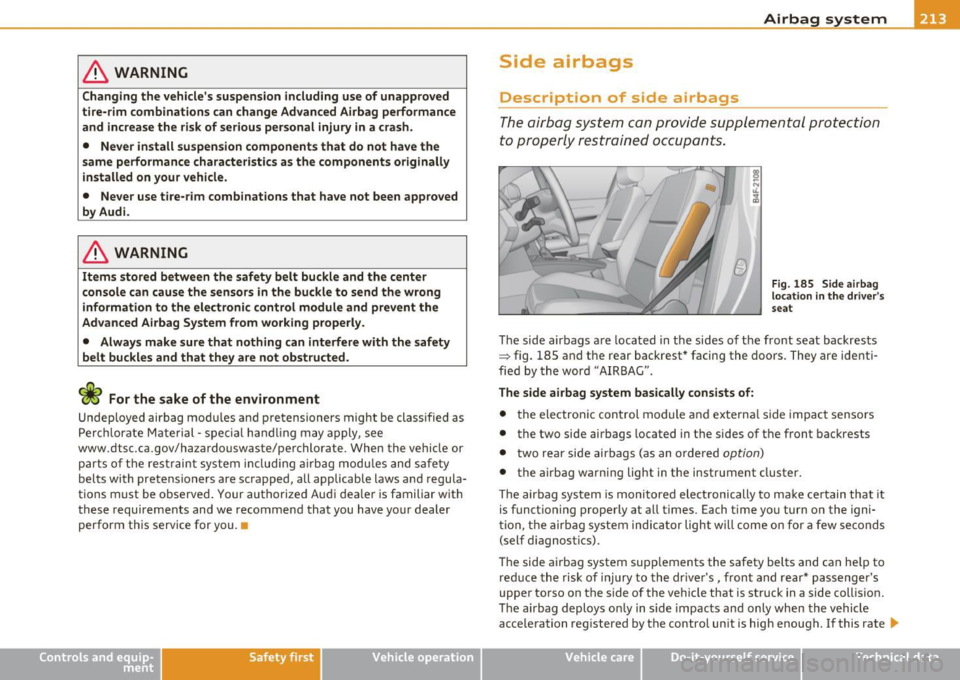
Fig. 18 5 S ide air bag
loca tion in the d river's
seat
T he side airbags are located in t he sides of t he front seat backrests
~ fig. 185 and the rear backrest * facing the doors. They are ide nti
fie d by th e word "AIRBAG" .
The side airbag system basically consists of :
• the ele ctron ic cont rol mod ule and extern al side imp act se nsors
• the two side airbags located in t he sides of the front backrests
• two rear side airbags (as an o rde red
o p tion)
• the airbag wa rni ng light in the instr ument cluster .
Th e air bag sys tem is monitore d ele ct ronically to m ake ce rtain that it
is funct io ning properly at all times. Each t ime you turn on the igni
tion , the airb ag system indica tor light w ill come on fo r a few seconds
(self d iagnostics).
Th e side airbag sy stem sup plements the safety belts and can he lp to
re du ce the risk of inju ry to the dr ive r's, fron t and rear* passenger 's
upper torso on the side of the ve hicle that is struck in a side coll is ion.
The airbag d eploys o nly in s ide impac ts an d only when the ve hicl e
acce leration reg istered by the contro l un it is high enough. If this rate
~
Vehicle care Do-it-yourselt service iTechnical data
Page 254 of 370

Driving and environment
New brake pads
Remember that new brake pads do not have a f ull braki ng
e ff e ct during the first 250 miles (400 kilometers) after they
are i nsta lle d.
New bra ke pads have to be "b ur nished in " before they have opt ima l
grab=> &.
Dur ing the break -in period, you sho uld avoid putting severe loads on
the brakes . Severe loads incl ude, for example, sudden hard braki ng,
in particu lar at very high s peeds or, for examp le, on mountai n passes.
& WARNING
New brake pads don 't have the be st stopping power and must be
" broken -in " during the initial 100 to 150 miles (150 to 200 kilo
meters ) of normal cit y driving. You can compensate for thi s by
pressing th e brak e pedal more firmly. This also applies lat er wh en
new pad s are installed. n
Avoid damaging the vehicle
W hen yo u are d riving on poor roads, or over c urbs, steep ram ps, etc.,
ma ke c ert ain that low-lying pa rts such as spoilers and exhaust system
parts do not bottom out and get damage d.
Thi s is espe cially t rue for veh icle s wi th low-slung chass is (spor ts
chassis)* and fully loaded vehicles.
Driving through water on roads
Note the following to avoid vehicle damage when driving throug h
water, fo r example on flooded roads: •
The water must not be any higher than the bottom of the vehicle
body .
• Do not dr ive faster than wa lking speed.
& WARNING
After driving through water , mud, slush , etc. , the brake s may be
slow to take effect because of wet brake rotors and pads.
Dry the
brakes first by braking carefully to restore the full b rak ing effect.
0 Note
Vehicle components such as the engine, transmission, suspension o r
elect rical sys tem can be seve rely damaged by dr iv ing t hrough w ater.
[ i ] Tips
• Check t he de pth of the wa ter bef ore dr iv ing thro ugh it.
• Do not stop the vehicle, drive in reverse or switch the engine off
when drivi ng throug h wate r.
• Keep in mind that oncoming vehicles may create waves t hat raise
t he wate r level a nd make i t too deep fo r yo ur veh icle to drive th ro ugh
safe ly.
• Avoid dr iv ing through sa lt water because i t can cause corros ion. •
Catalytic converter
--
It is very impor tant that your emission control system
(catalyti c converter) is functioning properly t o ensure
that y our vehicle i s run ning i n an en viro nme ntally sou nd
man ner.
- A lways us e lead-fr ee gasoline=> page 273, "F uel supp ly".
- N ever run the tan k down all the way to empty. .._
Page 308 of 370

___ T_ i_ r _e _s_ a_n_ d_ w_ h_ e_e_ l_ s _______________________________________________ _
Tire service Life
The servi ce life of tires depends on a lot of different
things including proper installation and balancing,
correct tir e pressure and driving style.
l 1.. ______ Jj
Tread Wear Indicator (TWI)
Fig. 2 18 Tire tread:
t rea d w ear in di cato rs
(TW I)
Fig . 21 9 R otati ng
tires f or m ore e ven
w ea r
The original t ires o n your veh icle have 1/16 inch ( 1.6 mm) h igh "wear
ind icators"~ fig. 218 running across the tread . Depending on the
ma ke, there w ill be six to eight of them even Ly placed around the ti re.
Marks on the t ire sidewall (for examp le "TWI " or other symbols) indi
cate the positions of the tread wea r indicators . Worn t ires must be
replaced. Differe nt figu res may apply in other countries ~ & .
Tire pressure
Incorrect tire pressure causes premature wea r and can cause sudden
tire blow-o ut. Fo r th is reason, tire pressu re must be checked at least
once a mont h
~ page 302.
Driving style
Driving fast aro und curves, heavy acceleration and hard b raking
increase tire wear .
Rotating tires for more even wear
For all four tires o n your ve hicle to have the same se rvice life, we
recommend that the fron t and rear t ires are rot ated according to the
tire manufact urer's suggested tire rotat ion intervals . Please
remember the fo llow ing :
• Tir e ro tat ion inte rvals may d iffe r from the vehicle serv ice intervals
out lined in your Maintenance and Warranty Booklet .
• The longer one tire is used in one locat ion on the vehicle, the more
it wears at certain points; therefore, we recommend that you follow
the t ire manufacture r's sugges ted tire rotation interva ls .
• Vehicles with front-whee l drive experience more tread wea r on the
front wheels compa red to a ll-wheel dr ive (quattro ®).
• Please ro ta te tires as shown~ fig. 219 .
• Extra care must be taken when rotating direction -specific t ires
~ page 325 .
Wheel balancing
The wheels on new vehicles are balanced. However, var ious si tuatio ns
dur ing everyday driving can cause them to become unbalanced,
resu lting in v ibr ations yo u can us ua lly fee l throug h the stee rin g
w heel.
Unbalanced whee ls mus t be rebalanced to avoid excessive wea r on
steeri ng, suspension and tires . A wheel must also be rebalanced
when a new tire is installed.
~
Page 315 of 370

Tires and wheels -________________ Effll
& WARNING (co ntinued )
• Snow chain s are available in different sizes. Always make sure
to follow the instructions provi ded by the snow chain manufac
turer.
• Wh en driving with snow cha in s never drive fa ster than the
speed permitted for your specific snow chains .
• Always observe local regulations.
0 Note
• Remove snow chains before d riving on roads not cove red w it h
snow to avoid damaging t ires and wearing t he snow chains down
unnecessar ily.
• Snow chains, which come into direct contact wi th the wheel rim,
can scratch or damage it. The refore, make s ure that the snow chai ns
are sui tably covered. Chec k the pos it ion o f the snow cha ins afte r
driving a few yards and correct if necessary . Follow the instructions
from t he snow chain man ufacturer when doing so .
• If the Adaptive A ir Suspension* sho uld ma lfunct ion, do no t mount
or use snow cha ins because t he ve hicle will be ex tremely low . If you
do drive w ith snow chains o n while the veh icle is at t his level, the
snow c hains m ight severe ly damage the whee lhouse and other parts
o f the ve hicl e.
[I) Tips
W he re snow c ha ins a re mandato ry on certain ro ads, this no rm ally
also applies to ve hicles with A ll W hee l Dr ive. •
Safety first
Wheel bolts
Wheel bol ts mus t alwa ys be tigh tened to the co rrect
torque .
The design of wheel bolts is matched to the factory installed rims. If
differe nt rims a re fitte d, the correc t wheel bolt s wi th the r ig ht length
and co rrectly s haped bolt heads must be used. Th is ensures that
w heels are fitte d se cu rely and that the br ake system fun ctions
correctly .
In certain circumstances, yo u may not use wheel bolts from a
different veh icle -even if it is the same model~
page 348.
& WARNING
Improperly tightened or ma intained wheel bolts can become
loose causing los s of control, a collision and seriou s per sonal
injury .
• Always keep the wheel bolts and the thread s in the wheel hub s
clean so the wheel bolts can turn easily and be properly tightened .
• Never grease or oil the wheel bolts and the threads in the wheel
hubs. They can become loose while driving if greased or oiled , even
if tightened to the specified torque.
• Only use wheel bolts that belong to the rim being installed.
• Never use different wheels bolts on your vehicle .
• Always maintain the correct tightening torque for the wheel
bolts to reduce the risk of a wheel loss . If the tightening torque of
the wheel bolts is too low , they can loosen and come out when the
vehicle is moving . If the tightening torque i s too h igh, the wheel
bolts and threads can be damaged and the wheel can become
loose .
0 Note
The specified tor que fo r th e wheel bolt s i s 90 ft lb (120 Nm) wi th a
tolerance of ± 7,4 ft lb( ± 10 Nm). Torque wheel bo lts diagonally. .,_
Vehicle care Technical data
Page 323 of 370

What do I do now? Ill
----------------
& WARNING (con tinued)
Trans missio n in "P " (Pa rk) w ill not pre ve nt the vehicle from
mo ving .
• Befo re you ch an ge a wheel , be s ure the ground i s le ve l an d
firm . If ne cess ary, us e a sturdy b oard und er the jack.
• Aft er in st a llin g the sp are wheel , make sure that you repl ace
the flat tire /wheel in it s storage area prop erly and tight en the
knurled ret ain ing s crew se cu rel y.•
Changing a wheel
When you change a wheel, follow the sequence described
below step-by-step and in exactly that order .
1. Activate the vehicle jack mode (only vehicles with Adaptive
Air Suspension) =>
page 170.
2. Remove the decorative wheel cover *. For more details see
also =>
page 322, "Decorative wheel covers" .
3 . Loosen the
wheel bolts => page 322.
4. Locate the proper mo unti ng point for the jack and align
the jack below that point=>
page 323.
5. Lift the car with the jack=> page 323.
6. Remove the wheel with the flat tire and then install the
spare =>
page 324.
7. Tighten all wheel bolts lightly.
8 .
Lower the vehicle with the jack.
9. Use the wheel bolt wrench and
firmly t ighten all wheel
bolts =>
page 322.
10. Replace the decorative wheel cover *.
Safety first
1 1. Deactivate the vehicle jack mode (only vehicles with
Adaptive Air Suspens ion) =>
page 170 .
& WARNING
Alwa ys re ad and f ollow all WARNINGS and information ~ & in
" Ra ising the vehicl e" on pag e
32 3 and ~ pag e 325. •
After changing a wheel
A wheel change is not complete without the doing the
following .
-Store and secure the wheel you replaced in the spare
wheel well .
- Replace the tools and the jack in the ir proper location.
- Check the tir e pr essur e on the spare wheel immediately
after mounting it .
- As soon as possib le, have the
tighten ing torques on a ll
wheel bolts checked with a torque wrench . The correct
tightening torque is 90 ft lb (120 Nm) .
- Have the flat tire
replaced as soon as possible.
[ i ] Tips
• If you not ic e that the wheel bolts are corroded and difficu lt to turn
wh ile chang ing a tire, they should be replaced before you check the
tightening torque .
• Drive at reduced speed until you have the tighten ing torques
checked. •
Vehicle care Do-it-yourself service Technical data
Page 325 of 370

What do I do now? -_______________ __.PfWII
& WARNING (continued)
• Do not loosen the wheel bolts more than one turn before you
raise the vehicle with the jack. -You risk an injury.
(I) Tips
• Never use the hexagonal socket in the handle of the screwdriver to
loosen o r tighten the wheel bolts .
• If a wheel bolt is very tight, you may find it easier to loosen by
carefully pushing down on the end of th e wheel bolt wrench with
one
foot only .
As you do so, hold on to the car to keep your balance and
take ca re not to slip .•
Raising the vehicle
The vehicle must be li~ed with the jack first before the
wheel can be removed.
Fig. 229 Changing a
wheel: mounting
points for the jack
Vehicle OP-eration
Fig. 230 Close-up:
proper positioning of
jack
- Activate the vehicle jack mode* (only vehicles with Adap
tive Air Suspension)=>
page 170.
-Engage the parking brake to prevent your vehicle from
rolling unintentionally.
- Move the
selector lever to position P.
-Position the jack below the door sill under the mounting
point
that is closest to the wheel to be changed
=> fig . 229.
- Extend the
jack under the lifting point on the door sill until
its arm is positioned directly under the lifting point=>& .
- Align the jack so that its arm©=> fig. 230 engages in the
designated lifting point in the door sill and the movable
base ® lies flat on the ground. The base® must be
vertical under the lifting point@.
- Wind the jack up further until the flat tire comes off the
ground =>& .
The jack must be installed only at the places indicated=> fig . 229.
There is exactly
one location for each wheel. The jack must not be
positioned at any other location
~ & .
Vehicle care Do-it-yourself service iTechnical data
Page 331 of 370

______________________________________________ F _u_s _e_ s_ a_ n_ d _ b _u_l_b _ s_---J _
Fuse assignment, cockpit passenger's side
No . Consumer
Fu se pa nel (bl ack )
1 Control module Convenience key
2 Cigarette lighter front
3 Tire pressure monitoring system
4 Electrical outlet front (center console)
5 Intelligent power module passenger
(glove box lock)
6 Door control module right-s ide
7 Sunroof
8 A/C cont rols
9 Heated seats, front
10 MMI
11 Seat adjustment (passenger)
12 Communication
Fu se pan el (brown )
1 Electr ic fuel pump
Fig . 235 Cockp it
passenger 's side : fuse
pa nel layo ut
Amps
15
20
5
20
15
15
-
20 1 0
30
7 ,5
10
5
20/30
Vehicle OP-eration
No. Consume r .,
2 Adaptive Air Suspension
3 Lane assist
4 Audi side assist
S Adaptive Air Suspens ion
6 Shift gate automatic transmission/clutch switch Parking System
9
10 Control module Gateway
Automatic headlight range control (a
uxiliary
driving lights) , headl ight electronics, right -side
Airbag
11 Heated rear seats
12 Telephone
Amps
15
10
5
5
5
5
5
5
5
5
5
Fuse assignment , luggage compartment
right
F ig. 236 R ight
luggage compartment:
fuse pane l layo ut
Re ad nu mber s of the fuses in the l ug ga ge comp art men t sta rti ng
from below ~ fig . 236.
•
Vehicle care Do-it-yourself service Technical data