2011 AUDI A6 center console
[x] Cancel search: center consolePage 152 of 370

ffl..__A_ u_ t_ o_ m_ a_ t _ ic_ t_r_a _ n_ s_m _ i_ s _s_ i_ o _ n _____________________________________________ _
The selection of the most suitable shift program is a continuous,
automatic process. The driver can also make the transmission switch
to a sporty program by
quickly pressing down the gas pedal.
This causes the transmission to shift down to a lower gear to achieve
rap id acceleration, e.g . for quic kly passing another vehicle. You do
not need to press the gas peda l into the kick-down range. After the
transmission has upshifted, the original program is selected
according to your driving style.
An additional shift program allows the automatic transmission to
select the proper gear for uph ill and downh ill gradients .
This keeps the transmission from shifting up and down unnecessarily
on hills . T he transmission will shift down to a lower gea r when the
driver presses the brake pedal on a downhill gradient. This makes use
of the braking effect of the engine without the need to shift down
manually. •
App lies to ve hicles : with 6-s p eed automatic t ransm iss ion
Manual shift program
Using the manual shift program you con manually select
gears.
Fig . 141 Center
console: shifting the
tiptronic ® manually Fig
. 142 Display :
manual shift program,
selected gear
Switching to manual shift program
- Push the selector lever to the right from D. As soon as the
transmission has switched over, the selected gear appears
in the display => fig. 142.
To upshift
-Push the selector lever forward to the plus position 0
=> fig. 141.
To downshift
- Push the lever to the minus position Q.
When accelerating, the transmission will automatically shift into
gears 1, 2, 3, 4 or 5 before the engine reaches its maximum RPM.
If you apply a light throttle when acce lerating, tiptronic ® wi ll auto
matically shift from 1st to 2nd gear to save fuel. If you apply a heavy
throttle , the transmission will stay in 1st gear until near maximum
RPM is reached, or until the driver shifts into 2nd gear.
If you take your foot off the accelerator pedal when driving down a
steep incline , tiptronic ® will downshift from the selected gear into
the next lower gear until it reaches 1st gear, based on road speed and
engine RPM. Automatic downshift ing is interrupted as soon as you
apply the throttle again . _.
Page 159 of 370

______________________________________________ A_ u_ t_ o_ m_ a_ t_ ic_ t_r _a _n_ s_m _ i_s _s_ i_o _n _ ___.ftlll
when the driver presses the brake pedal on a downhill gradient . This
makes use of the braking effect of the engine w ithout the need to
shift down manually .
If you are driving in hills and mounta ins, the transmission will contin
uously adjust the gear ratio to the road grade. If you press the brake
pedal when driving downhill, the transmission will downshift auto
matically. This increases the brak ing effect of the engine.
If the cruise control is on when you are traveling downhill, the trans
mission will automatica lly select a lower gear ratio in order to main
tain the set vehicle speed. Th is will cause the engine speed to
increase. •
Applies to vehi cles : wit h mul tit ro nic ® Co nt in uous ly Variabl e Tra ns missi on (CVT )
tiptronic ® manual shift program
Using the manual shi~ program (tiptronic®) you can
manually shift between seven pre-programmed gear
ratios (transmission positions) .
Contro ls a nd e quip
m en t
Fig . 149 Center
console : shifting
manually
Vehicle OP-eration
I I
I
1
Dl
1 Radio 95.4 .
FM.
*•41°F
300mi
M4
Fig. 150 Display:
man ual shift program,
selected gear
Switching to manual shift program
- Push the selector lever to the right from D. As soon as the
transmission has switched over, the selected gear appears
in the display ~ fig . 150.
To upshift
- Push the selector lever forward to the plus position
~ fig . 149
0 -
To downshift
- Push the lev er to the minus position Q.
When accelerating, the transmission will automatically shift into the
next higher gear before the engine reaches the maximum RPM .
When accelerating, if you apply a light throttle, the tiptronic ® will
automatically shift into the next higher gear to save fuel. If you apply
a heavy throttle, the transmiss ion wi ll stay in gear engaged until near
maximum RPM are reached, or until the driver manually shifts into a
higher gear.
If you take your foot off the accelerator pedal when driv ing down a
steep incline, the tiptronic ® will downshift from the selected gear
into the next lower gear based on road speed and engine RPM. The
automatic downshifting is interrupted as soon as you apply throttle
again.
Vehicle care Do-it-yourselt service iTechnical data
Page 160 of 370

llffl..__A_ u_ t_ o_ m_ a_ t _ ic_ t_r_a _ n_ s_m _ i_ s _s_ i_ o _ n _____________________________________________ _
(I) Tips
• When you sh ift into t he next lower gea r, the engine will downshift
only when there is no possibility of over-revving.
• When the kick-down comes on, the transm ission will shift down to
a lower gear depending on vehicle and engine speeds.
• The tiptron ic ® is inoperative when the transm ission is in the fail
safe mode .•
Applies to vehic les : w ith multitronic ® Continuously Variable Transm ission (CVT)
Steering wheel with tiptronic ®
The shift buttons on the steering wheel allow the driver to
shift gears manually.
F ig. 15 1 Ste eri ng
whe el: Shift butt ons
- To downshift, touc h the bu tton on t he l eft Q .
- To upshift, touch the button on t he right G).
The shift buttons a re activated when the selector lever is in D, Sor in
the manua l shift program (tiptronic).
Of co urse, yo u can cont in ue to use t he manual sh ift p rogr am with t he
selector lever on the center console .•
Applies to veh icles: w ith multitron ic® Conti nuously Variable Transmission (CVT)
Automatic transmission malfunction :)
In the event of a system malfunction, the automat ic tra nsm iss ion
switches to emergency operation mode.
Ge arbox malfunction: you can continue driving
You ca n con tinue to dr ive the vehicle. See an autho rized Audi dealer
or other qualified workshop at the next opportunity.
Gearbox malfunction : you can c ontinue dr iving (limited
functionality)
There is a serious system malfunction:
• T he program sh if ts only into certa in ge ars.
• T he engine may sta ll.
• It is not poss ible to restart the engine if it has been switched off.
• Con tinuing to d rive cou ld res ult in subseq uen t damage.
0 Note
If the transmission switches to fail-safe mode, you sho uld take t he
vehicle to an authorized Aud i dealership as soon as poss ible to have
the cond ition corrected .•
Page 215 of 370
& WARNING
Changing the vehicle's susp ension including use of unapproved
tire -rim combination s can change Advan ced Airbag performance
and increase the risk of serious personal injury in a crash .
• Never install suspension component s that do not have the
same performance characteristics as the components originally
installed on your vehicle.
• Ne ver use tire-rim combinations that have not been approved
by Audi.
& WARNING
Items stored between the safety belt buckle and the center
console can cause the sensors in the buckle to send the wrong
information to the electronic control module and prevent the
Advanced Airbag System from working properly.
• Always make sure that nothing can interfere with the safety
belt buckles and that they a re not obstructed .
<£> For the sake of the environment
Undeployed airbag modu les and pretensioners might be class ified as
P erch lorate Materi al - sp eci al ha ndl ing m ay a pply, see
www.dtsc.ca.gov/hazardouswaste/perchlorate. When the vehicle or
parts of t he re st ra int s ystem includ in g air bag modu les and safe ty
belts with pretensioners are scrapped, all applicable laws and regula
tions m ust be o bserve d. Your authorized Audi dea le r is familiar with
t hese requirements and we recommend that you have yo ur dealer
per form th is service for you. •
Safety first Vehicle OP-eration
Airbag system
Side airbags
Description of side airbags
The airb ag sys tem can pro vide su pplemen ta l pro tection
t o pr operly restr ained occ upants .
Fig. 18 5 S ide air bag
loca tion in the d river's
seat
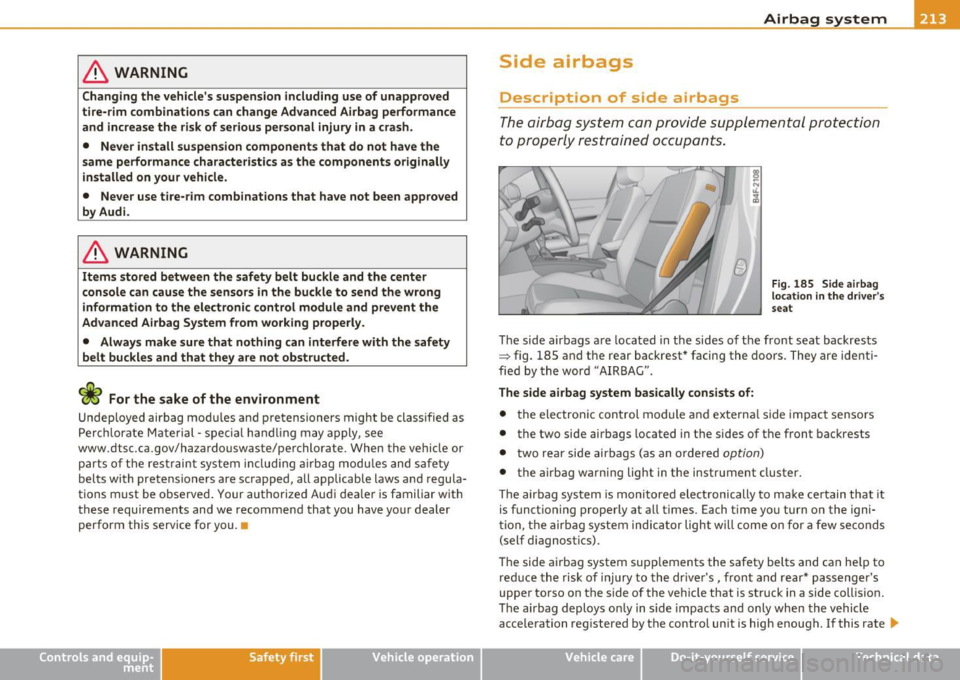
T he side airbags are located in t he sides of t he front seat backrests
~ fig. 185 and the rear backrest * facing the doors. They are ide nti
fie d by th e word "AIRBAG" .
The side airbag system basically consists of :
• the ele ctron ic cont rol mod ule and extern al side imp act se nsors
• the two side airbags located in t he sides of the front backrests
• two rear side airbags (as an o rde red
o p tion)
• the airbag wa rni ng light in the instr ument cluster .
Th e air bag sys tem is monitore d ele ct ronically to m ake ce rtain that it
is funct io ning properly at all times. Each t ime you turn on the igni
tion , the airb ag system indica tor light w ill come on fo r a few seconds
(self d iagnostics).
Th e side airbag sy stem sup plements the safety belts and can he lp to
re du ce the risk of inju ry to the dr ive r's, fron t and rear* passenger 's
upper torso on the side of the ve hicle that is struck in a side coll is ion.
The airbag d eploys o nly in s ide impac ts an d only when the ve hicl e
acce leration reg istered by the contro l un it is high enough. If this rate
~
Vehicle care Do-it-yourselt service iTechnical data
Page 244 of 370

Intelligent technology
'-----------------------------------------------
Intelligent technology
Notice about data recorded by
vehicle control modules
Your vehicle is not equipped with an Event Data Recorder (EDR),
installed by some manufacturers for the express purpose of
capturing data for retrieva l after an accident or crash event. ED R's are
sometimes called "crash recorders".
Some state laws restrict the retrieval or downloading of data stored
by ED R's that were installed in a vehicle for the express purpose of
retrieving data after an accident or crash event without the owner's
consent.
Although your vehicle is not equipped with an EDR, it is equipped w ith
a number of electronic control modu les for various vehicle systems
such as, for example, engine function, emission control, as well as for
the airbags and safety belts.
T hese electronic contro l modules also record vehicle-re lated data
during normal vehicle operation for diagnostic and repair purposes .
Th e recording capacity of the e lectronic control modu les is limited to
data (no sound is recorded) and only a sma ll amount of data is actu
ally recorded over a very limited period of time and stored when a
system fault or other condition is sensed by a control unit. Some of
the data then stored may relate to vehicle speed, direction, braking
as well as restraint system use and performance in the event of a
crash or other condition. Stored data can only be read and down
loaded with special equipment.
Electronic Stabilization Program
(ESP)
General information
The ESP improves the vehicle stability.
l, I
Fig. 201 Center
console with ESP
switch
ESP is des igned to help you maintain vehicle control in s ituations
where the car approaches the limits of "grip", especia lly when accel
erat ing and cornering. ESP reduces the risk of skidd ing and imp roves
stability under all road conditions.
Th e system operates across the entire speed range in combination
with the ABS system. If the Anti-Lock Brake System (ABS) malfunc
tions, the ESP will also shut down.
How the system works
The Anti-Lock Brake System (ABS), Electronic Differential Lock (EDL)
and the Anti-Slip Regulation System (ASR) are integrated in the elec
tronic stabilizatio n pro gram. In addition to the data provided by
these funct ions, the ESP control unit requires additional measure
ment data provided by high performance sensors. The rotational
speed of the vehicle about its vertical axis, veh icle acceleration in the ...
Page 331 of 370

______________________________________________ F _u_s _e_ s_ a_ n_ d _ b _u_l_b _ s_---J _
Fuse assignment, cockpit passenger's side
No . Consumer
Fu se pa nel (bl ack )
1 Control module Convenience key
2 Cigarette lighter front
3 Tire pressure monitoring system
4 Electrical outlet front (center console)
5 Intelligent power module passenger
(glove box lock)
6 Door control module right-s ide
7 Sunroof
8 A/C cont rols
9 Heated seats, front
10 MMI
11 Seat adjustment (passenger)
12 Communication
Fu se pan el (brown )
1 Electr ic fuel pump
Fig . 235 Cockp it
passenger 's side : fuse
pa nel layo ut
Amps
15
20
5
20
15
15
-
20 1 0
30
7 ,5
10
5
20/30
Vehicle OP-eration
No. Consume r .,
2 Adaptive Air Suspension
3 Lane assist
4 Audi side assist
S Adaptive Air Suspens ion
6 Shift gate automatic transmission/clutch switch Parking System
9
10 Control module Gateway
Automatic headlight range control (a
uxiliary
driving lights) , headl ight electronics, right -side
Airbag
11 Heated rear seats
12 Telephone
Amps
15
10
5
5
5
5
5
5
5
5
5
Fuse assignment , luggage compartment
right
F ig. 236 R ight
luggage compartment:
fuse pane l layo ut
Re ad nu mber s of the fuses in the l ug ga ge comp art men t sta rti ng
from below ~ fig . 236.
•
Vehicle care Do-it-yourself service Technical data
Page 356 of 370

___ A_ l_. p_ h _ a_b_ e_ t_ic _a_ l_ in_ d_e _ x ____________________________________________ _
Capacities .... ..................... 343
Car -Systems
Ambience lighting ... .............. 64
Lighting profiles . ................. 64
Car care .. .. .. ..................... 260
Interior ..... ............. .... .. 267
Plastic and vinyl .. .. .. .. ......... 264
Weatherstrips ................ ... 26S
Care of exterior .. .... .. .. ..... ... ... 260
Cargo area
See Loading the luggage compartment ..
183
Cargo net .. .. ...... .... .. .. .. ..... . 85
Catalytic converter .................. 252
CD changer ............ .... .. .... ... 94
Center armrest adjusting .. .... .. .. .... .......... 82
Storage compartment ... .......... 82
Centra l locking
Emergency locking ............ .... 45
Cert ification .... ...... .... ......... 349
Changing a flat tire .. .. .. .. ......... 320
Changing a wheel ........... ...... .. 320
Changing engine oil .. .. ... ....... .. . 285
Chassis Undercoating . ................. .. 266
See also Adaptive Air Suspension . .. 168
CHECK button . .. .. ........ .......... 11
Checking Engine coolant level . ........... .. 286
Checking tire pressure ............ ... 302
Child restra int system anchors . ... .... 232 Child restraints
Danger of us ing child restraints in the front
seat . ... ............... .. ... .. 199
Where can I get additional information
about child restraints and their use? .. .
239
Child safety ....... ...... ... . .. .. .. . 219
Convert ible locking retractor .... .. . 229
Guidance fixtures for lower anchorages
235
Important safety instructions for using
child safety seats ......... ... .. . 222
Important things to know when driving with children ............ .. .. .. . 219
Installing a child restraint using the LATCH
system .................. ..... 236
Mounting and releasing the anchorage hook .............. .... ....... 236
T ether anchors ...... ... .. .. .... . 237
Tether straps .............. ... .. . 23 7
Child safety lock rear doors (power) ........ .. .. .. .. 47
Child safety seats ............ .. ..... 224
Booster seats .... .. .. .. .. .. .. .. . 22 7
Convertible child seats .......... .. 225
Convertible lock ing retractor ....... 229
Danger of us ing child restraints in the front
seat .. .... .. ........... .. .. .. . 199
How do I properly install a child safety seat in my vehicle? ........... .. .. .. . 222
In fant seats .............. .. .... . 224
Insta lling ...... .... .. .. .. ....... 229
LATCH system ....... ..... ....... 236
Safety instructions . ... .... ....... 222 Child seats
Lower anchorages . ...... ........ . 234
Cigarette lighter ................... .. 92
Cleaning Alcantara (synthetic suede) .. .. .. .. 270
Engine compartment .......... ... 271
Exhaust tail pipes . .. .. .. ......... 266
Fabrics and fabric coverings . ....... 267
Instrument pane l ... ............. 268
Interior ............. .... ..... .. 267
Leather ....... ... ... ... ..... ... 269
MMI control console .............. 267
MMI display .. .... .. ......... .... 267
Plastic and vinyl .. .. ............. 264
Plastic parts ... .. .. .......... ... 268
Safety belts .............. ... .. .. 2 71
Trim strips ..................... . 263
tr im strips . .. ................. .. 264
Cleaning and protection ....... .. .. .. 260
Climate control . . . . . . . . . . . . . . . . . . . . . 96
Synchronizing . ................. .. 98
Warm and cold ....... ... .. .. .. ... 96
Climate controls Air distr ibut ion ...... ...... ...... 100
Air outlets . .. ....... ...... .. .. .. 101
Air outlets (rear) ................. 102
Air recirculation . ... ............. 100
AUTO (standard setting) ............ 99 Basic settings ............ ... .. .. 104
Center vents . ............... .... 105
Controls . . . . . . . . . . . . . . . . . . . . . . . . . 98
Defrosting/defogging ............ 100
Description .. .. ... ...... ..... .. .. 96