2011 AUDI A6 ESP
[x] Cancel search: ESPPage 312 of 370

-~_T_ i_ re _ s_ a_n _ d_ w_ h _e_ e_ ls _________________________________________________ _
& WARNING (conti nu ed )
• Alway s use tire s, rim s and wheel bolts that meet the specifica
tions of original factory-installed tires or other combinat ions that
have been specifically approved by the vehicle manufacturer .
• Tires age even if they are not being used and can fail suddenly,
especially at high speed s. Tires that are more than 6 years old can
only be used in an emergency and then with special care and at
lower speeds.
• Never mount used tir es on your vehicle if you are not sure of
their "previous history. " Old used t ires m ay have been damaged
even though the damage cannot be seen that can lead to sudden
tire failure and loss of vehicle control.
• All four wheels must be fitted with radial tires of the same
type , size (rolling circumference) and the same tread pattern .
Driving with different tire s reduces vehicle handling and can lead
to a loss of control.
• If the spare tire is not the same as the tires that are mounted
on the vehicle - for example w ith winter tires - only use the spare
tire for a short period of time and drive with extra care. Refit the
normal road wheel as soon as safely possible.
• Never drive fa ster than the maximum speed for which the tires
on your vehicle are rated because ti re s that are driven faster than
their rated speed can fail suddenly.
• Overloading tire s cause heat build-up, sudden tire failure,
including a blowout and sudden deflation and loss of control.
• Temperature grades apply to tires that are properl y inflated
and not over or underinflated.
• For technical reasons it is not always possible to u se wheels
from other veh icles- in some cases not even wheels from the same
vehicle model.
• If you install wheel tr im discs on the vehicle wheels , make sure
that the air flow to the brakes i s not blocked . Reduced airflow to
the brakes can them to overheat, increasing stopping distances
and cau sing a collision.
& W ARNING (continued )
• Run flat ti res may only be used on vehicles that were equipped
with them at the factory. The vehicle must have a chassi s designed
fo r run flat tires. Inco rrect use of run flat tires can lead to vehicle
damage or accidents. Che ck with an author ized Audi dealer or tire
specialist to see if your vehicle can be equipped with run flat tires .
If run flat tire s are u sed, they must be installed on all four wheels.
M ixing t ire types is not permitted.
0 Note
• For tech nica l reasons, it is not generally poss ible to use the wheel
r ims from o ther veh icles . T his ca n hold t rue for w heels of the same
veh icle type.
• If the sp are tire is different fr om the tires t hat yo u have mo unted
on your vehicle (for example w inter t ires or wide profile tires), then
use the s pare tire for a shor t perio d of tim e on ly and drive wi th ext ra
care. Replace t he flat tire w ith the tire matching the others on your
vehicle as soon as possible.
• Never dr ive witho ut the valve stem cap . The valves could get
damage d.
~ For the sake of the environment
Dispose of old t ires in accor dance with the loca l req uiremen ts .•
Uniform tire quality grading
• Tr ead we ar
• Tract ion AA A B C
• T emperat ure A B C
Quality g rades can be fo und where applicable on the tire s ide wall
between t re ad sho ulder and m aximum se ct io n w idth =>
page 30 7,
fig.220 . ~
Page 313 of 370

Tires and wheels Ill
----------------
For example: Tread wear 200, Traction AA, Temperature A.
All passenger car tires must conform to Federal Safety Requirements
in addition to these grades.
Tread wear
The tread wear grade is a comparative rating based on the wear rate
of the tire when tested under controlled conditions on a specified
government test course .
For example, a tire graded 150 would wear one and one half (1 1/2)
times as well on the government course as a tire graded 100.
The relative performance of tires depends upon the actual conditions
of their use, however, and may depart significantly from the norm
due to variations in driving habits, service practices and differences in
road characteristics and climate.
Traction
The traction grades, from highest to lowest, are AA, A, Band C. Those
grades represent the tire's ability to stop on wet pavement as
measured under controlled conditions on specified government test
surfaces of asphalt and concrete . A tire marked C may have poor trac
tion performance ~& .
Temperature
The temperature grades are A (the highest), B, and C, representing
the tire's resistance to the generation of heat and its ability to dissi
pate heat when tested under controlled conditions on a specified
indoor laboratory test wheel.
Sustained high temperature can cause the material of the tire to
degenerate and reduce tire life, and excessive temperature can lead
to sudden tire failure~&.
The grade C corresponds to a level of performance which all
passenger car tires must meet under the Federal Motor Vehicle
Safety Standard No. 109 . Grades Band A represent higher levels of
performance on the laboratory test wheel than the minimum
required by law .
Safety first
& WARNING
The traction grade assigned to this tire is based on straight-ahead
braking traction tests, and does not include acceleration,
cornering, hydroplaning or peak traction characteristics.
& WARNING
The temperature grade for this tire is established for a tire that is
properly inflated and not overloaded. Excessive speed, underinfla
tion, or excessive loading, either separately or in combination, can
cause heat buildup and possible tire failure. •
Winter tires
Winter tires can improve vehicle handling on snow and
ice . At temperatures below 45 °F (7 °C) we recommend
changing to winter tires.
In some heavy snow areas, local governments may require true
winter or "snow" tires, those with very deeply cut tread. These tires
should only be used in pairs and be installed on all four wheels. Make
sure you purchase snow tires that are the same size and construction
type as the other tires on your vehicle.
If your vehicle is equipped with all-wheel drive*, this will improve
traction during winter driving,
even with the standard tires. However,
we strongly recommend that you always equip all four wheels on your
vehicle with correctly fitted winter tires or all-season tires, when
winter road conditions are expected. This also improves the vehicle's
braking performance and reduces stopping distances.
Summer tires provide less grip on ice and snow .
Winter tires (snow tires) must always be fitted on all four wheels .
Ask your authorized Audi dealer or qualified workshop for permitted
winter tire sizes. Use only radial winter tires. ..,_
Vehicle care Technical data
Page 316 of 370

___ T_ ir_e_ s _ a_ n _ d_ w_ h_e_ e_ ls _______________________________________________ _
After changing a wheel, the torque must be checked as soon as
possible with a torque wrench -preferably by an authorized Audi
dealer or qualified workshop. •
Low aspect ratio tires
Your Audi is factory-equipped with low aspect ratio tires. These tires
have been thoroughly tested and been selected specifically for your
model for their superb performance, road feel and handling under a
variety of driving conditions. Ask your authorized Audi dealer for
more details.
The low aspect ratio of these tires is indicated by a numeral of
55 or
less
in the tire's size designation. The numeral represents the ratio of
the tire's sidewall height in relation to its tread width expressed in
percentage. Conventional tires have a height/width ratio of 60 or
more.
The performance of low-aspect-ratio tires is particularly sensitive to
improper inflation pressure. It is therefore important that low
aspect ratio tires are inflated to the specified pressure and that the
inflation pressure is regularly checked and maintained. Tire pres
sures should be checked at least once a month and always before a
long trip=>
page 302, "Checking tire pressure" .
What you can do to avoid tire and rim damage
Low aspect ratio tires can be damaged more easily by impact with
potholes, curbs, gullies or ridges on the road, particularly if the tire is
underinflated.
In order to minimize the occurrence of impact damage to the tires of
your vehicle, we recommend that you observe the following precau
tions:
• Always maintain recommended inflation pressures. Check your
tire pressure every 2,000 miles (3,000 km) and add air if necessary.
• Drive carefully on roads with potholes, deep gullies or ridges. The
impact from driving through or over such obstacles can damage your
tires. Impact with a curb may also cause damage to your tires. •
After any impact, immediately inspect your tires or have them
inspected by the nearest authorized Audi dealer. Replace a damaged
tire as soon as possible.
• Inspect your tires every 2,000 miles (3,000 km) for damage and
wear . Damage is not always easy to see. Damage can lead to loss of
air and underinflation, which could eventually cause tire failure. If
you believe that a tire may have been damaged, replace the tire as
soon as possible.
• These tires may wear more quickly than others.
• Please also remember that, while these tires deliver responsive
handling, they may ride less comfortably and make more noise than
other choices.
Reduced performance in winter/cold season
conditions
All tires are designed for certain purposes. The low aspect ratio, ultra
high performance tires originally installed on your vehicle are
intended for maximum dry and wet road performance and handling.
They are not suitable for cold, snowy or icy weather conditions. If you
drive under those circumstances, you should equip your vehicle with
all-season or winter tires, which offer better traction under those
conditions. We suggest you use the recommended snow or all-season
tires specified for your vehicle, or their equivalent.
Refer to=>
page 311 for more detailed information regarding winter
tires. •
Tire pressure monitoring system
Applies to veh icles: w ith tire pressure monitoring system
General notes '
Each tire, including the spare (if provided), should be checked
monthly when cold and inflated to the inflation pressure recom
mended by the vehicle manufacturer on the vehicle placard or tire
inflation pressure label. (If your vehicle has tires of a different size .,
Page 317 of 370

Tires and wheels Ill _______________ _____.
than the size indicated on the vehicle placard or tire inflation pressure
label , you sho uld determine the proper tire infla tion pressure fo r
those tires.)
As an added safety feature, your vehicle has been equipped with a tire pressu re monitoring sys tem (TPMS) that illuminates a low tire pres
sure telltale when one o r more of your t ires is s ignificantly under
inflated. Accord ingly, when the low tire pressure tellta le illumi nates,
you should stop and check your tires as soon as possib le, and inflate
them to the proper p ress ure. D riving on a sign ificantly under-inflated
tire causes the tire to overheat and can lead to tire fa ilure . Under
inflation also reduces f uel efficiency and tire tread life, and may
affect the vehicle's handling and stopping ability .
Please note that the TPMS is not a substitute for proper tire mainte
nance, and it is the d river's responsibility to mainta in correct tire
pressure, even if under-inflation has not reached the level to trigger
ill umination of the TPMS low tire press ure te lltale.
Your vehicle has also been equipped w ith a TPMS malfunction indi
cato r to indica te when the system is not operating properly . The
TP MS ma lf u nction indicator is combined with the low tire p ress ure
telltale. When the system detects a malfunct ion, the telltale will
fl ash for approximate ly one minute and then rema in continuously
illuminated. This sequence will continue upon subsequent vehicle
sta rt-ups as long as the malfunction exists.
When the ma lfunction indicator is illum inated, the system may not
be able to de tect or signa l low ti re pressure as intended . TPMS
ma lfunctions may occur fo r a var iety of reaso ns, includ ing the instal
lation of replacement o r alternate tires or wheels on the vehi cle that
prevent the T PMS from functioning properly . Always check the TPMS
ma lfunction tellta le after replacing one or more tires or whee ls on
yo ur vehicle to ensure that the replacement o r alte rnate t ires and
wheels allow the TPMS to continue to funct ion proper ly .•
Vehicle OP-eration
App lies to vehicles : wi th t ire p ressu re mon it ori ng system
Tire pressure indicator appears
The tire pressure indicator in the instrument cluster
informs you if the tire pressure is too low or if there is a
system malfunction.
Fi g. 221 D is pl ay:
un der infl ation
wa rning
Fi g. 2 22 Display :
Sys tem malfun ction
Us ing the ABS sensors, the tire pressure monitor ing system compares
the t ire tread c ircumference and vibration characteristics of the ind i
vidual tires .
If the pressure decreases in one or more tires, this is indi -
cated in the instrument cl uster with a warning symbol and a
message ~ fig. 221. The d river message in the display goes o ut after
5 seconds . The driver message can be displayed again by p ressing the
!C HECK ] button. If on ly one t ire is affected, the display will ind icate
its position. ._
Vehicle care Do-it-yourselt service iTechnical data
Page 318 of 370

IIIIL_T.:...:..: i r~ e:.: s~ a:::. n:..:..:: d:.....: w..:...:. h::e:.: e::.:: ls::::._ ______________________________________________ _
The tire pressure monitoring must be reset via MMI each t ime the
pressures are adjus ted (e.g. w hen swi tching between p art ial an d full
load pressure) or after chang ing o r replacing a tire o n your veh icle
~ page 31 6. Yo u can fi nd the recommended tire press ures for yo ur
veh icle on the label on the driver 's door pillar~ page
299 .
Tire tread circ umference and vibrat ion characteristics can change and
c a u se a tir e pressure war ning if:
• the t ire pressure in one o r more tires is too low,
• t he tire ha s structur al dam age,
• the tire press ure was changed, wheels rotated or rep laced but the
TPM S was no t reset~ page
316.
Warning symbols
1..1' Loss of press ure in at least one tire~ &. Check the tire or tires
and replace or repair if necessary. The indicator light (• in the instru
me nt clust er also illuminates~ page
12. Check/correct th e p res
sures o f all four tires and reset TPMS via MMI.
rr :; (T ire Pressu re M on itor ing System) Tire pres sure! System
malfunction.
If T ,.;> appears a fter switching the ignition on or w hile
dr iv ing ~ page
315, fig . 2 22 a nd t he indica to r lig ht 'in th e instr u
me nt clus ter b links for approx ima tely one m inute and the n stays on,
there is a system ma lf u nct io n. See your authorized Audi dealer as
soon as poss ible.
& WARNING
• If the tir e pres sure indicator appears in the instrument cluster
display, one or more of your tires i s significantly under-inflated.
Reduce your speed immediately and avoid any hard steering or
braking maneuvers. Stop as soon a s possible and check the tires
and their pressures . Inflate the tire pressure to the proper pres
sure as indicated on the vehicle 's tire pressure label~
page 299.
Driving on a significantly under -inflated tire causes the tire to
overheat and can lead to tire failure. Under -inflation also is likely
to impair the vehicle's handling and stopping ability.
& WARNING (co ntinued )
• The driver is re sponsible for maintaining the correct tire pres
sures . You must check the tire pres sures regularly .
• Under certain conditions (such as a sporty driving style , winter
conditions or unpaved roads) , the pressure monitor indicator may
be delayed.
• Ask your authorized Audi dealer if run-flat tires may be used on
your vehicle . Your vehicle registration becomes invalid if you u se
the se tires when not permitted. Damage to your vehicle or acci
dents could also result.
[ i ] Tips
• T he tire pressure monito ring system stops wor king when there is
an ES P/ABS malf u nctio n.
• Using snow cha ins may res ult in a system ma lf u n ct ion .
• The tire pressure mon itor ing system on your Au di was calibrated
using t ires with the "AO" or "RO " id ent ificat ion . We re comme nd
using these tires. •
Applies to vehicles: with tire p ressure monito ring system
Reset tire pressure monitoring system
I f the tire pressure is adjus ted, wheels are rotated or
changed, th e TPfvf S must b e re set via
fv1fv1 I.
-Turn on the ign it ion .
- Sele ct : Fu nct ion butt on
[C AR ]> Systems* > Tire pressure
monitoring
> Store now.
[ i ] Tips
Before resett ing the TPMS, the current pressures of all four t ires
mus t co rrespo nd to the specifie d val ues. A djust the tire pre ssure and
~
Page 330 of 370
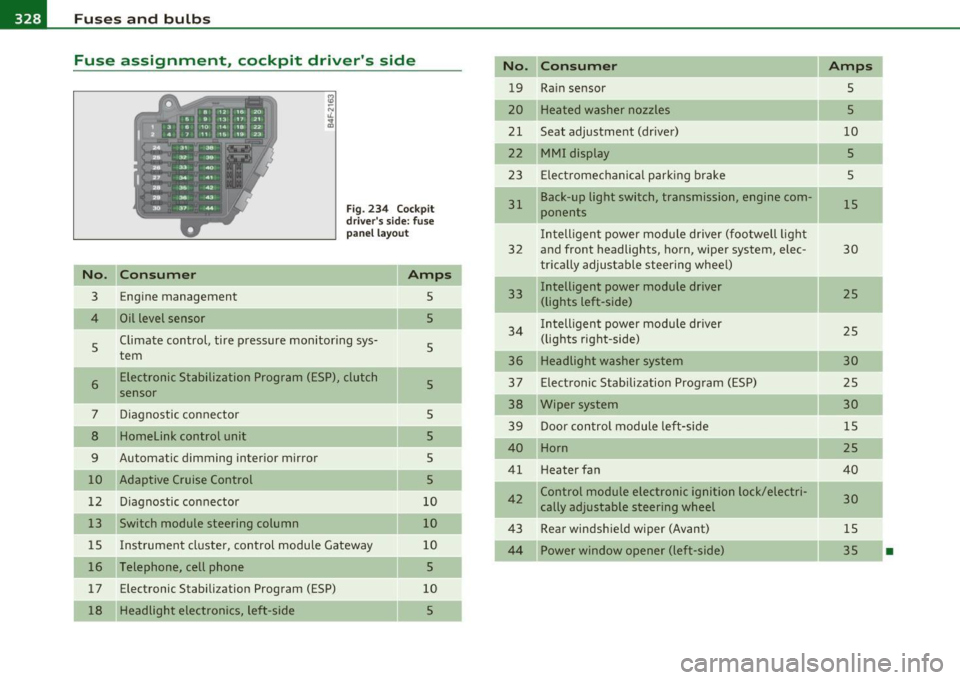
-L_!F~U:!_:S~ e~ s ~ a~ n~ d~b~ u~l~b ~s ~-------------------------------------------
Fuse assignment, cockpit driver's side
Fig. 234 Cockpit
driver's side: fuse
panel layout
No. Consume r
3 Engine management
4
5
6
7
8
9
10
12
13
Oil level sensor
Climate control, tire pressure monitoring sys
tem Electronic Stabilization Program (ESP), clutch
sensor
Diagnostic connector
Homelink control unit
Automatic dimming interior mirror
Adaptive Cruise Control Diagnostic connector
Switch module steering column
15 Instrument cluster, control module Gateway
16 Telephone, cell phone
17 Electronic Stabili zation Program (ESP)
18 Headlight electronics, left-side
Amps
5
5
5
5
5
5
s
5
10
10
10
5
10
5
No. Con sum er
19 Rain sensor
20 Heated washer nozzles
21 Seat adjustment (driver)
22 MMI display
23 Electromechanical park ing brake
31
32
33
34
36
37
38
39
40
41
42
43
Back-up light switch, transmission, engine com
ponents
I ntelligent power module driver (footwell light
and front headlights , horn, wiper system, elec
trically adjustable steering wheel)
Intelligent power module driver (lights left-side)
I ntelligent power module driver
(lights right-side)
Headlight washer system
Electronic Stabilization Program (ESP)
Wiper system Door control module left-side
Horn
Heater fan
Control module electronic ignition lock/elec tri
cally adjustable steering wheel
Rear windshield wiper (Avant)
44 Power window opener (left-side)
Amps
5
5
10
5
5
15
30
25
25
30
25
30
15
25
40
30
15
35
-
•
Page 332 of 370

lffl!I.___F_ u_ s_e _s_ a_n_ d_ b_u _ l_ b_ s _______________________________________________ _
No. Consumer
Fuse panel (black)
-
1 Digital Signal Processing (DSP)/
BOSE amplifier
2 Communication , Antenna amplifier
3 Electromechanical parking brake, left
4 Electromechanical parking brake, right
5 Luggage compartment power outlet
6 Battery energy management
7 Intelligent power module rear
(lights right-side)
8 Intelligent power module (comfort)
9 Intelligent power module rear
(lights left-side)
10 Power window opener (right-side)
11 Parking System
12 Cigarette lighter rear
Fuse panel (brown)
1 Rear view
2 Electric rear lid (Avant)
3 Electric rear lid (Avant)
Electric rear lid (Avant)
5 Communication , Antenna amplifier
7 MMI
9 Digital Tuner
Amps
-
30
5
30
30
20 5
20
-
5
30
-
35
5
20
5
30
30
20
5
5
5
•
Bulbs
Replacing light bulbs
For your safety, we recommend that you have your autho
rized Audi dealer replace burned out bulbs for you.
It is becoming increasingly more and more difficult to replace vehicle
light bulbs since in many cases, other parts of the car must first be
removed before you are able to get to the bulb . This applies especially
to the light bulbs in the front of your car which you can only reach
through the engine compartment .
Sheet metal and bulb holde rs can have sharp edges that can cause
serious cuts, and parts must be correctly taken apart and then prop
erly put back together to help p revent breakage of parts and long
term damage from water that can enter housings that have not been
properly resealed .
For your safety, we recommend that you have your authorized Audi
dealer replace any bulbs for you , since your dealer has the proper
tools, the correct bulbs and the expertise.
Gas discharge lamps (Xenon lights)*:
Due to the high electrical voltage, have the bulbs replaced by a qual
ified technician. Headlights with Xenon light can be identified by the
high voltage sticker .
& WARNING
Contact with high-voltage components of the electrical system
and improper replacement of gas discharge (Xenon) headlight
bulbs can cause serious personal injury and death.
• Xenon bulbs are pressurized and can explode when being
changed.
• Changing Xenon lamps requires the special training, instruc-
tions and equipment. .,_
Page 340 of 370

lffll.___E_ m_ e_ r-' g=- e_n_ c=-y _ s_it _ u _ a_t_ i_ o _ n_ s ______________________________________________ _
in. WARNING
• To reduce the risk of serious injury and vehicle damage.
-Always lift the vehicle only at the special workshop hoist and
floor jack lift points illustrated=>
page 337, fig. 243 and
=>
page 337, fig. 244.
- Failure to lift the vehicle at these points could cause the
vehicle to tilt or fall from a lift if there is a change in vehicle
weight distribution and balance. This might happen, for
example, when heavy components such as the engine block or
transmission are removed.
• When removing heavy components like these, anchor vehicle
to hoist or add corresponding weights to maintain the center of
gravity. Otherwise, the vehicle might tilt or slip off the hoist,
causing serious personal injury.
0 Note
• Be aware of the following points before lifting the vehicle :
-The vehicle should never be lifted or jacked up from under
neath the engine oil pan, the transmission housing, the front or
rear axle or the body side members. This could lead to serious
damage.
- To avoid damage to the underbody or chassis frame, a rubber
pad must be inserted between the floor jack and the lift points.
- Before driving over a workshop hoist, check that the vehicle
weight does not exceed the permissible lifting capacity of the hoist.
- Before driving over a workshop hoist, ensure that there is sufficient clearance between the hoist and low parts of the
vehicle. •