2011 AUDI A5 COUPE battery
[x] Cancel search: batteryPage 290 of 362

___ C_h_ e_c _k _i_n -=g :a,__ a_n_ d_ f_ i_ l _li _n _,g;._ __________________________________________ _
& WARNING
California Proposition 65 Warning:
• Battery post s, terminal s and related ac cess orie s co ntain lead
and lead compounds, chemicals known to the State of California
to caus e cancer and reprodu ctive pr oblem s. Wa sh hand s after
handling .
0 Note
• Do not disconnect the vehicle battery when the ignition is
switched on or when the engine is running, otherwise, you wi ll
damage electro nic components in t he e lectr ical system .
• If your ve hicle is go ing to st and for a long per iod of time witho ut
being d riven, protect the battery from "freezing", ot herw ise it will be
damaged and will then have to be replaced. •
Battery charging
Starting the engine requires a well charged battery .
Fig. 21 0 En gine
c om partme nt: C on nec
t or s fo r ch arge r and
jump er ca bles
Always read and heed all WARNINGS below ~ & and ~ &
i n "Work ing o n the batte ry" on
page 286 .
-Turn o ff t he ign it ion and all electrica l cons umers. -
Make sure the area is well vent ilate d wh en you c harge the
ba ttery .
- Open t he e ngi ne hood =?
page 274.
- O pen the red cover on the positive pole =? fig. 21 0.
- Con nect the charger con nectors accordi ng to the instruc-
tions to the
jump start bolts . (B olts un der the red cover =
"positive" , Bo lts w it h hex head = "negative") .
- Only now p lug t he ma ins lead for t he c har ging equipme nt
i n to t he wall outlet and tu rn it on ~ & .
-Make sure the charging rate is not over 30 amps /14 .8
Volt.
- When t he batte ry is fu lly c harged: Tu rn the cha rg ing
eq uipment o ff an d
remov e the main s le ad from the wa ll
out let.
- Now remove the clamps for the charging equipment.
- Close the re d cover on the positive pole .
Cl ose the hood ~
page 2 75.
A d ischa rged b atte ry can freeze at t empe ra tures of only 3 2 °F (0 °( ).
Allow a fro zen ba ttery to thaw comp letely before attempt ing to
c harge it =:, & . H owever, we recomme nd not using a thawed b attery
again because the battery casing ca n be cracked due to ice formation
and can leak b attery a cid.
Battery charging (Ma ximum charging rate of 30
amp s/14.8 Volt)
When charging at low vol tages (e.g. w ith a trickle charger ), the
b attery cables do not have to be disconnected first. The batte ry caps
should
not be opened when charging a batte ry .
It is not necessary to remove the battery from the luggage compart-
ment.
~
Page 291 of 362

___________________________________________ C_ h_e _c _k_ i_n ~g_ a_n_ d_ f_ i_ll _i_n _g __ _
Fast charging the battery (charging rate above 14 .8
Volts)
For technical reasons do not use a battery charge r that uses voltage
greater than 14.8 Volts to charge yo ur vehicle's battery.
& WARNING
Charging a battery can be dangerous.
• Always follow the ope rat ing instructions provided by the
battery charger manufacturer when charging your battery .
• Never charge a frozen battery. It ma y explode because of gas
trapped in the i ce . Allow a frozen battery to thaw out first .
• Do not reuse batteries which were frozen . The battery housing
may hav e cra cked and weakened when th e batter y froze.
• Charge the battery in a well ventilated area . Keep away from
open flame or electr ical spark . Do not smoke . Hydrogen gas gen er
ated by the battery i s explosive.
• To reduce the danger of explo sion, n ever conne ct or dis connect
c harger cables while the charger is operating.
• Fast charging a battery is dangerous and should only be
attempted by a competent te chnician with the proper equipment.
• Battery acid that may spill during charging should be washed
off with a solution of warm water and baking soda to neutralize
the acid.
0 Note
Never use a fast charger as a booster to start the eng ine. This w ill seri
ous ly damage sens itive elect ronic components, such as control units,
re lays, rad io, etc., as well as the battery charger. •
Safety first
Battery replacement
The ne w ba ttery must have the same spe cific ations and
dimensions as the original equi pment battery.
Inte lligent energy management in your veh icle is responsible for
dist ributing the ele ct ric a l ene rgy t hroughout yo ur veh icle
~ page 243. The intelligent energy management system will keep
t he eng ine ba ttery c ha rged better then vehicles wi thou t this system.
To make sure the additional e lectrical energy is available once again
after you h ave changed the ba tte ry, we re commend t hat yo u inst all
batter ies of the same type and ma nufacture only (the same as t hose
installe d at the time your ve hicle was delivere d). Specifications a re
listed on the battery housing . Your authorized Aud i dealer must code
the batte ry in the energy management system to enable you to use
the energy management f unctions co rrectly after rep laci ng the
battery.
If it is no t poss ibl e to use a batte ry of thi s ty pe, the new ba tte ry mus t
have the same capac ity , voltage (12 volts) , amperage , construction
and plug sea ling .
Whe n ins tal ling the ba ttery, make sure the ign it io n and a ll electr ica l
cons umers are turned off.
0 Note
Make s ure t he venti lation hose on the s ide of the battery is
co nnected, o the rwise fumes or battery acid can lea k out.
W For the sake of the environment
B ecau se of the p roblem of proper di sposal of a ba tte ry, we recom
mend your authorized Audi dealer change the battery for you.
B atteries con tain sulfuri c acid and lead and m ust always be dispose d
of properly in comp liance w it h all environmental regulations.
Dis pos ing o f vehi cle b atter ies im proper ly is ve ry dange ro u s to the
environment .•
Vehicle care Technical data
Page 295 of 362

________________________________________________ T_i_re _ s_ a _ n_d_ w_ h_ e_ e_l_s __ _
Groove
means the spa ce between two ad jacen t tread ribs .
Load rating (code)
mea ns the max imu m load th at a tir e is ra te d to c arry fo r a give n infla
tion pressure. You may not find this information on all t ires beca use
i t is no t required by law .
Maximum load rat ing
me ans the load r ati ng for a t ire at th e maxi mum p ermis sib le in flation
pressure for that tire.
Maximum loaded vehicle weight
means the sum of:
(a) Curb weight
(b) Accessory weig ht
(c) Vehicle ca pacity we ight, and
(d) Pro duct ion op tions weigh t
Maximum (permissible) inflation pressure
means the m aximu m cold infla tio n pr essur e to whi ch a t ire may be
inflated . Also called "maximum inflat ion press ure."
Normal occupant weight
means 150 lbs. (68 k ilog rams) times t he num ber of occupants seate d
in t he vehi cle up to the total sea ting cap aci ty of yo ur vehicl e.
Occupant distribution
means d is tribut ion of occ upan ts i n a vehicle.
Outer diameter
means the ove rall d iameter of an inflated new tire.
Overall width
means the linear distance betwee n the exter iors of the s idewalls of
a n in flated tire, in cludi ng eleva tions due to la beling, dec ora tions, o r
protective bands or ribs.
Safety first
Ply
means a layer o f rubbe r-coate d para llel co rds.
Production options we ight
me ans the co m bine d we ight of tho se in stalled regu lar pr oduction
options weighi ng over 5 lbs. (2.3 kg) in excess of t hose standard
i t ems w hic h they replace, not previously considere d in c urb we igh t o r
accessory weight, includ ing heavy duty brakes , ride levelers, roof
rack, heavy duty battery, and s pecial tr im.
Radial ply tire
me ans a pneuma tic tir e in wh ich the pl y cords that extend to t he
beads are laid at substantially 90 degrees to the centerline of the
t rea d.
Recommended inflation pressure
see => page 292, "C old tire in fla tion pr essu re".
Reinforced tire
mea ns a t ire desig n to operate at h ig her loads and at h igher i nflat io n
pressures tha n the corresponding standard tire . Re inforced tires may
be iden tifi ed as " XL", "x l", "E X TR A LOA D", or "RF " on t he sidew all.
Rim
means a metal suppo rt fo r a tire or a tire and tube assemb ly up on
wh ic h the t ire beads are seated.
Rim diameter
means nom inal d iameter of the bead seat . If you change yo ur whee l
si ze, yo u w ill have to purchase new tires to ma tc h the new r im diam
eter .
Rim size designation
means r im diamete r and width.
Rim width
mea ns nom inal dis tance be twee n rim flanges.
Vehicle care Technical data
Page 330 of 362

lffll.___E_ m_ e_ r-' g=- e_n_ c=-y _ s_it _ u _ a_t_ i_ o _ n_ s ______________________________________________ _
Emergency situations
General
This chapter is intended for trained emergency crew s and working
pe rsonnel who have the necessary tool s and equipment to perform
the se operation s. •
Starting by pushing or towing
0 Note
Veh icles with an automatic transmission cannot be started by
pushing or towing .•
Starting with jumper cables
If necess ary, the engine can be started b y connectin g it to
t he bat tery of another vehicle.
If the e ng ine shou ld fa il to start because of a discharged or weak
battery, the batte ry can be connected to t he battery of
another
veh icle, us ing a pair of jump er cables to start t he eng ine .
Jumper cables
Use only jumper cables of suffic iently large cross section to carry the
sta rter cur rent s afely . Refer to the m an ufa ct ur er's specificat ions.
Use only j umpe r cab les with
insulated te rmi nal clamps wh ich are
distinct ly marked :
plu s(+) cable i n most cases colored red
minus (-) cable i n most cases colored black .
& WARNING
Batterie s contain el ectricity, acid, and gas . Any of the se can cause
very serious or fatal injury. Follow the inst ructions below for safe
handling of your vehicle 's battery.
• Always shield your eyes and avoid leaning over the battery
whenev er po ssible .
• A discharged battery can freeze at temperatures just below
32 °F (0 °C ). Before connecting a jumper cable, you must thaw the
frozen battery completely, otherwise it could explode.
• Do not allow battery acid to contact eyes or sk in . Flush any
contacted area with water immedi ately .
• Improper use of a booste r battery to start a vehicle may cause
an explosion .
• Vehicle batteries generate e xplosive gases. Keep sparks, flame
and lighted cigarettes away from batterie s.
• Do not try to jump start any vehicle with a low acid level in the
battery.
• The voltage of the booster battery must also have a 12-Volt
rating. The capacity (Ah) of the booster battery should not be
lower than that of the discharged battery . Use of batteries of
different voltage or substantially different "Ah " rating may cau se
an e xplosion and personal injury.
• Never charge a frozen battery . Gas trapped in the ice may cause
an explosion.
• Never charge or use a battery that has been frozen. The battery
case may have be weakened .
• Use of batteries of different voltage or substantially different
capacity (Ah) rating may cause an explosion and injury . The
capacity (Ah) of the booster battery should not be lower than that
of the discharged battery. .,_
Page 331 of 362
_____________________________________________ E_ m___;, e_r-=g ~ e_ n_c,_:!y:.__: s_i:..:t ..:..u :..:a;;,. t.:.; i...: o :..: n...:..:. s _ __,J_
& WA RNING (co ntinued )
• Before you che ck anything in the engine compartment , always
read and heed all WARNINGS~
page 267, "Engine compart
ment ".
0 Note
• App lying a higher vo ltage booster battery will cause expensive
damage to sens itive e lec tron ic components, such as contro l units,
re lays, rad io, etc.
• Th ere must be no electrical contac t between the vehicles as othe r
wise current could a lready start to flow as soon as the posit ive(+)
t erm inals are con nected.
[I] Tips
• Th e discharged ba tte ry mus t be properly co nnecte d to the
vehicle's electrical system . When jump starting or charging the
bat tery, never connec t the negat ive ground cable to the batte ry nega
tive post because the battery manager system must be able to detect
t he battery's state of charge . Always connect the negative ground
cable to the negative ground post of the battery manage r contro l
unit. •
Vehicle OP-eration
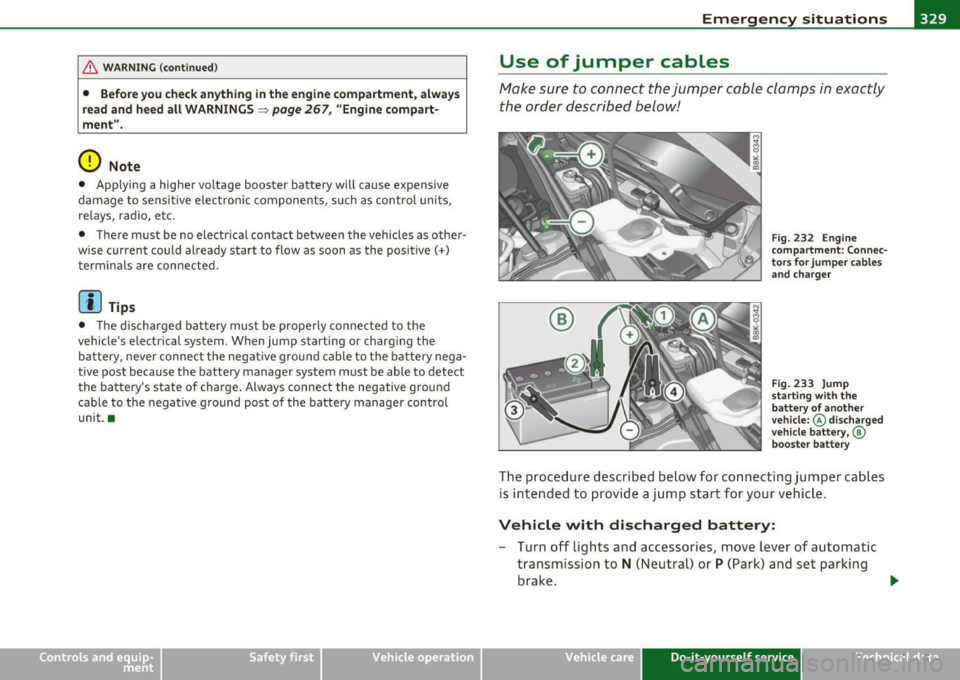
Use of jumper cables
Make sure to conne ct the jumper c able clamps in e xactly
the order described bel ow!
Fig. 232 Engine
c omp artment : C on nec
t o rs for jum per cable s
a nd ch arger
Fi g. 233 J ump
st arti ng with th e
battery of anot her
ve hicl e:@ disc harged
v ehi cle batt ery ,©
bo oste r batte ry
T he p roced ure descr ib ed below for co nnecting jumper cables
is intended to provide a j ump start for yo ur veh icle.
Vehicle with discharged battery:
- Turn o ff ligh ts an d accessories, move lever o f au tomatic
t ra nsmission to
N (Ne utral) o r P (P ark) and s et parking
brake .
~
Vehicle care Do-it-yourself service iTechnical data
Page 332 of 362

lffl!I.___E_ m_ e_r -=g =- e_ n_c -=y ;..._ s_i_t _u _a _ t_ i_ o _ n_ s ____________________________________________ _
Connect POSITIVE(+) to POSITIVE(+) (red)
- Remove the cover above the jump start connection .
- Open t he red cover on the positive pole~
page 329,
fig. 232.
1. Connect one end of the positive cable (red) on the
jump
start bolt~
page 329, fig. 233 (D (Bolts under red cover
= "positive") of the vehicle to be started @.
2. Connect the other end to the positive terminal @of the
booster battery ®·
Connect NEGATIVE(-) to NEGATIVE(-)
(black)
3. Connect one end to the negative terminal ® of the
booster battery @.
4. Connect the other end of the negative cable (black) to the
jump start bolt© (Bolts with hex head = "negative") of
the vehicle to be started @.
Starting the engine
- Start the engine of the vehicle with the booster battery.
Run the engine at a moderate speed.
- Start engine with discharged vehicle battery in the usual
manner.
- If the engine fails to start: do not keep the starter cranking for longer than 10 seconds. Wait for about
30 seconds and then try again.
- With engine running, remove jumper cables from both
vehicles in the exact
reverse order .
- Close the red cover on the positive pole.
The battery is vented to the outside to prevent gases from entering
the vehicle interior . Make sure that the jumper clamps are well
connected with their
metal parts in full contact with the battery
terminals.
& WARNING
To avoid serious personal injury and damage to the vehicle, heed
all warnings and instructions of the jumper cable manufacturer. If
in doubt, call for road service.
• Jumper cables must be long enough so that the vehicles do not
touch.
• When connecting jumper cables, make sure that they cannot
get caught in any moving parts in the engine compartment.
• Do not bend over the batteries· danger of chemical burns!
• The battery cell locking screws must be tightened securely.
• Before you check anything in the engine compartment, always
read and heed all WARNINGS~
page 267, ''Engine compart
ment".
0 Note
Improper hook-up of jumper cables can ruin the generator.
• Always connect POSITIVE(+) to POSITIVE(+), and NEGATIVE( -)
to NEGATIVE(-) ground post of the battery manager control unit.
• Check that all screw plugs on the battery cells are screwed in
firmly . If not, tighten plugs prior to connecting clamp on negative
battery terminal.
• Please note that the procedure for connecting a jumper cable as
described
above app lies specifically to the case of your vehicle be ing
jump started. When you are giving a jump start to another vehicle, do
not connect the negative (-) cab le to the negative(-) terminal on the
discharged battery©~
page 329, fig. 233. Instead, securely
connect the negative(-) cable to either a solid metal component that
is firmly bolted to the engine block or to the engine block itself.
If the _,,,
Page 333 of 362

Emergency situations Ill -------------=---:.-----J
battery that is being charged does not vent to the outside, escaping
battery gas could ignite and explode!•
Emergency towing with
commercial tow truck
General hints
Your Audi requires special handling for towing.
The following information is to be used by commercial tow truck
operators who know how to operate their equipment safely .
• Never tow your Audi, towing will cause damage to the engine
and transmission.
• Never wrap the safety chains or winch cables around the brake
lines.
• To prevent unnecessary damage, your Audi must be transported
with a flat bed truck.
• To load the vehicle on to the flat bed, use the towing loop found
in the vehicle tools and attach to the front or rear anchorage
~ page 331 and ~ page 332.
& WARNING
A vehicle being towed is not safe for passengers. Never allow
anyone to ride in a vehicle being towed, for any reason. •
Vehicle OP-eration
Front towing Loop
Do not install the front towing loop until it is needed.
Fig. 234 Front
bumper: removing the
cover cap
Fig. 235 Front
bumper: screwing in
the towing loop
The towing loop fits into the threaded hole located on the
right side of the front bumper and covered by a small cover
when not in use.
- Remove the towing loop from the vehicle toolkit
=> page 314.
- Press the cover in by applying short strong pressure to the
bottom part to release it from the bumper=> fig. 234.
- Screw the towing loop tightly into the threaded hole as far
asitwillgo=,,fig.235.
~
Vehicle care Do-it-yourself service iTechnical data
Page 338 of 362

___ G_ e_n_ e_r _a _ l_ in_ f_o _r_ m_ a_ t_io _ n _______________________________________________ _
General information
Explanation of technical data
Some of the technical data listed in this manual requires
further explanation.
The technical data for your vehicle is listed in the charts starting on
~ page 339 . This sect ion prov ides genera l information, notes and
restrictions which app ly to this data .•
Veh icle identification
The key data is given on the vehicle identification number
(VIN) plate and the vehicle data sticker.
F ig. 2 40 V ehicle I den
t ifi ca tion Nu mbe r
(V IN ) plate: locat io n
o n d river's s id e d ash
p an el Fi
g. 2 41 Th e vehicle
i d enti ficati on l abel -
in side the l ugga ge
co mpa rtme nt
The Vehicle Id ent ifi cat ion Number (VlN )
is located on the driver's s ide so that it is visible from the outside
through the windshield ~ fig . 240 . You can also d isp lay the Vehicle
Identification Number of your vehicle in the radio or in the MMI*.
Select :
I CARI function button> Veh icle ID numb er (VIN ).
The vehicle identifica tion lab el
is located in the luggage compartment near the battery .
The label~ fig . 241 shows the following vehicle data:
© Production control No.
@ Vehicle identification No.
® Type code n umber
@ Type designat io n/eng ine output in Kilow atts
© Engine and transmission code letter
© Paint No./Interior
(j) Optional equipment No.'s
Vehicle data 2 to 7 are also found in your Warranty
& Maintenance
booklet . .,,