2011 AUDI A5 CABRIOLET oil
[x] Cancel search: oilPage 38 of 364

Driver information display
Fuel supply too low I
When the symbol illuminates, this means there are about 2.1
gallons (8 liters) of fuel left in the fuel tank. Time to refuel!
=;, page 275.
If the symbol lights up, even when there is ample fue l in the tank, and
the text
TANK SYSTEM MALFUNCTION! CONTACT WORKSHOP
appears in the display, there is a fault in the system. Contact a quali
fied workshop to have the fault rectified. •
Applies to veh icles: w ith batte ry vol tage warning
Battery voltage L:
If battery power drops into the range where it can limit the ability of
the engine to start, this the symbol appears in the instrument
cluster display with the following driver message battery charge low:
Indicates charging by being driven.
While this driver notification is displayed, you have to be prepared for
limited starting capability.
Driver message appears and goes out again
If this driver message appears after the ignition is turned on or while
driving and it goes out again after a while, the battery has been
adequately recharged.
Driver message appears and does not go out again
If this driver notification appears after the ignition is turned on or
wh ile driving and does not go out again, the battery's state of charge
is not in the optimal range. Starting capability is restricted. Have the
battery checked at an authorized Audi dealer or other qualified work
shop as soon as possible. •
Check engine oil ~
, Add oil, max x qt (l). You may continue driving
If the . symbol lights up displaying this driver message, then add a
maximum of 1 liter at your earliest opportunity~
page 284. •
Engine oil level ~i.
c,,-Please check oil level
When the symbol illuminates, check the engine oi l level as soon as
possible~
page 284. Top off the oil at your earliest opportunity
~page284. •
Engine oil sensor defective
Oil level! Sensor defective
,., _,..
If the symbol illuminates, contact your authorized Audi dealer and
have the oi l sensor inspected. Until you have this done, check the oil
level each time you refuel just to be on the safe side~
page 284. •
Applies to vehicles: with engine speed limitation
Engine speed limitation -~
Do not exceed max. engine speed of XXXX rpm
Th e ·, symbol illuminates when there is an engine control malfunc
tion . The ind icator light 'in the instrument cluster also illuminates.
Th e engine speed is limited to the speed displayed in the driver infor
mation system. Keep in mind that the engine speed will not exceed
the va lue displayed in the driver information system, for example
when downshifti ng.
Please go to an author ized Audi dealer or other qualified workshop to
have the malfunction repaired. •
Page 88 of 364

Seats and storage Removing ashtray insert
- Release the ashtray inse rt by sliding the switch @
~ page 85, fig. 92 to the right.
- Remove the as htray insert @~
page 85, fig. 92.
Reinstalling ashtray insert
- Press th e asht ray ins ert i nto its ho ld er.
& WARNING
Never put wa ste paper in the a shtray . Hot as hes or other hot
objects in the ashtray could set waste paper on fire. •
Cigarette lighter
Using the cigarette lighter
-Ope n the lid o f the fro nt ash tray .
Fig. 93 Open fro nt
ashtray
- Push t he knob on the cigarette lighter i n.
- Wait u ntil the knob pops ou t sli ghtly.
- Remove the cigaret te lig hter immed iate ly. -
Light your c igarette from the red-hot heating coil of th e
cigare tte l ighter .
- Return the ciga rette lighte r to its socket.
Using the socket
- Remove the cigarette lighter.
- Insert the plug of the el ectrical device into the cigarette
lighter socke t.
The so cket of the ciga re tte lighter may be used for 12-volt app liances
w ith maximum consumption of up to 100 watts, such as a flash light ,
sm all vacuum cleane r, etc.
Before you purchase any accessor ies, always read and follow the
information in =>
page 345, "Additional accessor ies and parts
replacement" .
& WARNING
• Use care when using the cigarette lighter . Inattentive or unsu
per vis ed u se of the cig arette lighter can cause bu rn s - risk of
injury!
• The cigarette lighter work s when the ignition is switched off or
with the ignition key remo ved . Child ren shou ld never be left unsu
pervised in the vehicle, or there could be ri sk of fire!
• The power outlets and therefore the electrical acce ssories
connected to them operate only with the ignition on . Improper
use of th e outlets or of electri cal accessories can lead to seriou s
i njuries or cause a fire. Fo r thi s reason , children should neve r be
left unattended in th e vehicle -they could be injur ed!
0 Note
• T o avoid damag ing the socket, only use plugs that fit properly . _.,
Page 108 of 364
ffl..__O_ n_ t_h _e_ r_o _ a_ d _________________________________________________ _
Ignition Lock and ignition switch
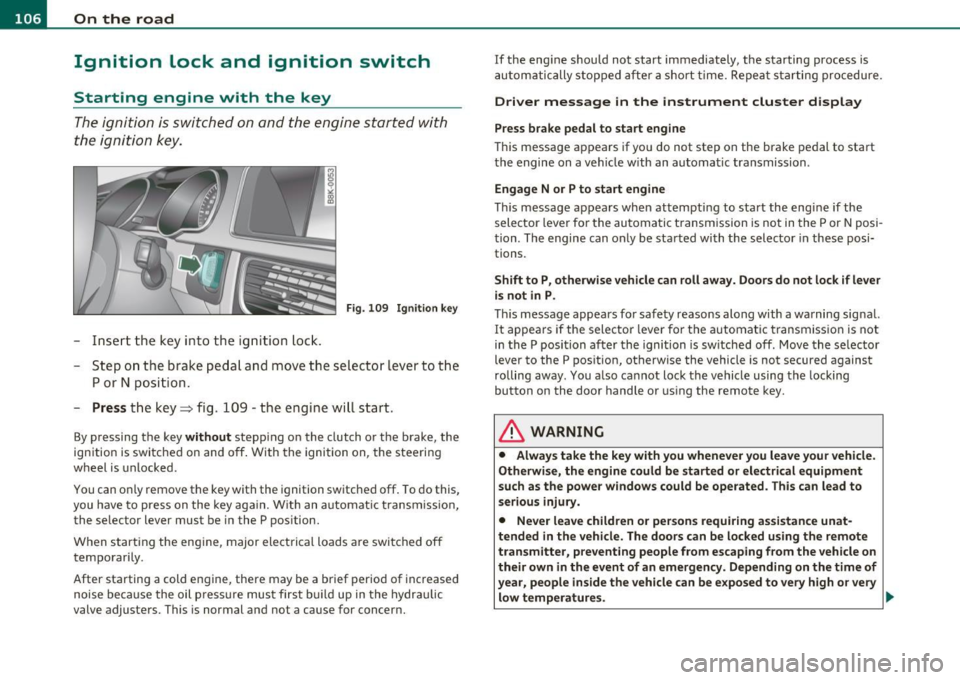
Starting engine with the key
The ignition is switched on and the engine started with
the ignition key.
F ig. 10 9 Igniti on k ey
-Inse rt the key in to the ig n ition lock.
- Step on th e brake pedal and mov e th e selec tor lev er to th e
P or N posi tion.
- Press the key => fig. 109 -the engine wi ll start .
By pressing the key without stepp ing on the clutch or the b rake, the
i gn itio n is switc hed on and o ff . With the ignition on, the steeri ng
w heel is unlocked.
You can o nly remove the key with the i gnition switc hed off . To do this,
you have to press on the key ag ain. Wi th an a utomat ic transm iss io n,
the se lector lever must be in the P pos ition.
W hen s tarting the eng ine, major electrica l loads a re swi tched off
temporarily .
After startin g a cold eng ine, there may be a brief period of increased
noise be cause the oil p ress ure mu st firs t b uild up in t he hydr auli c
valve adjuste rs. This is normal and not a cause for concern. If the eng
ine s hould not start immediately, the starting process is
a u tom atically st op ped aft er a sh ort t ime. Re peat sta rtin g p ro cedu re.
Driver message in the instrument cluster display
Press brake pedal to start engine
T h is message ap pears i f yo u do not step on the brake pedal to start
t he engine on a vehicle w ith an au toma tic transmission .
Engage N or P to start engine
This message appea rs when at tempti ng to start the eng ine if the
sele ctor lever fo r the au tomatic t ransm ission is no t in the P or N po si·
t ion . The engine can on ly be sta rted wi th the selecto r in these posi
tions.
Shift to P , otherwise vehicle can roll away. Doors do not lock if lever
is not in P .
This message app ears fo r sa fe ty reasons along with a wa rning sig nal.
It appea rs if the selector lever for t he automat ic transm iss io n is not
in the P posi tion af ter the ignition is sw itched off . M ov e t he se lector
lever to the P pos itio n, ot herw ise the vehicle is not secured against
rolling away . You a lso ca nnot lo ck th e ve hi cle u sing the locking
button on the door hand le or us ing the remote key.
& WARNING
• Always take the key with you whenever you leave your vehicle.
Otherwise, the engine could be started or electrical equipment
such a s the power windows could be operated . This can lead to
serious in jury.
• Never leave children or per sons requiring assistan ce unat
tended in the vehicle. The doors can be locked u sing the remote
transmitter, p reventing people from escaping from the vehicle on
their own in the event of an emergency. Depending on the time of
year, people inside the vehicle can be exposed to very high or very low temperatures. ..,
Page 110 of 364

ffl..__O_ n_ t_h _ e_ r_ o_ a_ d _________________________________________________ _
Starting and stopping the engine
with convenience key
A pplies to veh ic le s: with conven ience ke y
Starting the engine with the
[START ENGINE S TOP] button
This button switches on the ignition and starts the
engine.
Fig. 110 Convenience
key: START ENGINE
STOP
button
- Step on the brake pedal and move the selector lever to P
orN =>& .
- Pressonthe[START ENGINE STOP)button::::>fig. 110-
the engine will start.
By pressing the [STAR T ENGINE STOP] button without depressing
the clutch or the brake peal, the ignition is switched on and switched
off by pressing it again.
If the engine does not start immediately, stop trying after 10 seconds
and then try to restart the engine about 30 seconds later.
After a cold engine is started, there may be a brief period of increased
noise because oil pressure must first build up in the hydraulic valve
adjusters. This is normal and not a cause for concern.
Driver message in the instrument cluster display
No key identified
This message appears when the !START ENGINE STOP] button is
pressed if there is no master key inside the vehicle or if the system
does not recognize it. For example, the master key cannot be recog
nized if it is covered by an object (e.g. aluminum brief case) which
screens the radio signal. Electronic devices such as cell phones can
also interfere with the radio signal.
Press brake pedal to start engine
This message appears if you press the !START ENGINE STOP)
button to start the engine and do not depress the brake pedal. The
engine can only be started if the brake pedal is depressed.
Engage N or P to start engine
This message appears when attempting to start the engine if the
selector lever for the automatic transmission is not in the P or N posi
tion. The engine can only be started with the selector in these posi
tions.
Key not in vehicle
This message appears along with the.:! symbol if the master key is
removed from the vehicle with the engine running. It is intended to
remind you (e.g. when changing drivers) not to continue the journey
without the master key.
If the master key is no longer in the vehicle, you cannot switch on the
ignition after stopping the engine and you also cannot start the
engine again. Moreover, you cannot lock the vehicle from the outside
with the key.
Shift to P, otherwise vehicle can roll away. Doors do not lock if lever
is not in P.
This message appears for safety reasons along with a warning signal.
It appears if the selector lever for the automatic transmission is not
in the P position when switching off the ignition with the
!START ENGINE STOP] button. Move the selector lever to the P _..
Page 139 of 364

_________________________________________________ A_ u_d _ i_ s_id _ e_ a_s _s_ i_s _t __ ffl'II
Deactivating
- Pre ss th e b utton again . Th e ind icator light on the button
goes o ut.
The system works at speeds faster than 19 mph (30 km/h) .
& WARNING
• Improper reliance on the side assist system can cause collisions
and seriou s per sonal injury:
- Never rely only on side assist when changing lanes.
- Alway s check rear view mirrors to make sure that it is safe to
change lanes.
• Side assist cannot detect all vehicles under all condition s
danger of accident!
• Side a ssist cannot detect vehicle s
in time to alert you when
they approach from behind at very high speed , or fall drop bac;k
very quickly .
• The radar sensor's
vision can be reduced o r entirely blocked by
rain, snow, and heavy spray . Thi s can result in side a ssist not
adequately detecting vehicles o r, in some cases , not detecting
them at all. Always keep an eye on the direction you are traveling
and the relevant area around the vehicle.
• Plea se note that side assi st indi cates there are approaching
veh icles, or vehicles in your blind spot, only after your vehicle has
reached a driving speed of at lea st 19 mph (30 km/h).
• Side assist signal does not work around tight corners (turning
radius le ss than 328 feet or 100 m).
• Side assist is no replacement for the driver's full attention. The
driver alone is respon sible for lane changes and similar driving
maneuvers. Always keep an eye on the direction you are traveling
and the relevant area around the vehicle .
Controls and equip
ment Safety first
0 Note
• T
o ens ure t hat you do not adve rsely affec t side assist, do not blo ck
the area on the rear bumper where the radar sensors are located with
foreign obje cts (s uch as stickers or bicy cle ra cks).
• Make s ure that the s ignal light on the outside mirror is not
blo cked by st ickers or o ther ite ms.
W Tips
• Side assist a utoma tically deact iva tes if it de tects that the rada r
sensors are blocked =>
page 143. The indicator light on the button
goe s out.
• Th e area on the bumpe r w here the ra dar sensors are located must
c o nsistent ly remain free of snow, i ce, a nd heavy soiling so tha t side
assist can funct ion p roper ly. Follow the add itiona l notes on
=>
page 1 4 3.
• Additiona l tint ing on the front si de windows can make it ha rder to
see and co rrec tly un ders t and t he sig nal ligh t on the outs ide m irro r.
• F or Declaration of Compliance to United States FC C and Industry
Cana da regulat ions=>
pag e 346. •
Applies to veh icl es: w ith s ide ass ist
Sensor detection area
Vehicle care
Fig . 142 Schem atic
ill ustration: Se nsor
detectio n area
~
Technical data
Page 246 of 364

Intelligent technology
'-------------------------------------------------
Corrosion
T he re may be a te ndency fo r d irt to build u p on the bra ke pads and
co rrosion to form on the d iscs if the car is not dr iven reg ularly o r only
for short trips with litt le use of the bra kes .
If the brakes a re not used freq uen tly, or if co rrosion has formed o n
the discs, it is advisable to clean off the pads and discs by braking
fir mly a few times from a mode rat ely h igh spee d~ & .
Faults in the brake system
If yo u sh ou ld noti ce a sudden increase in b rake peda l trave l, then one
of the two brake circu its may have failed~& .
Low brake fluid level
Ma lfunctions can occ ur in t he brake system if the brake fluid level is
t oo low. The bra ke f lu id level is moni tore d elec tron ically.
Brake lin ing wear status
Brake lin ing wear may be checked by v isua l inspect ion of the condi
tion of the brake pads throu gh the open ings in the whee l.
If neces
sary, the whe el may be removed fo r thi s insp ection~
page 320,
"Changing a w hee l".
& WARNING
• You should perform braking maneuvers for the purpose of
cleaning the brake system only if road conditions permit. Other
road users must not be put at risk - you may cau se an accident!
• Before descending a steep grade, reduce speed and shift trans
mission into a lower gear or lower driving range. Do not ride the
brakes or hold the pedal down too long or too often . This could
cause the brakes to get hot and diminish braking efficiency.
• Do not "ride the brakes " by resting your foot on the pedal when
you do not intend to brake . This may cause the brakes to overheat ,
premature wear and increased stopping distance.
• Under certain climatic and operating condition s such as
passing through water , driving in heavy rain or after washing the
& WARNING (co ntinued )
vehicle, the effectiveness of the brakes can be reduced . In winter,
ice can ac cumulate on the brake pads, linings, dis cs and drums.
Carefully apply brakes for a test. Brakes will dry and ice coatings
will be cleaned off after a few careful brake appli cations.
• Driving for an extended period of time on salt-covered roads
without u sing your brakes can also affect braking efficiency . Clean
off accumulated salt coating from b rake discs and pads with a few
careful brake applic ations.
• If you damage the front spoiler, or if you install a different
spoiler, be sure the air flow to the front brakes i s not obstructed .
Otherwise the brake system could overheat reducing the effective
ness of the entire brake system.
• Failure of one brake circuit will impair the braking capability
resulting in an increased stopping di stance. Avoid driving the
vehicle and have it towed to the nearest authorized Audi dealer or
qualified workshop.
n
Brake booster
The b roke boost er odds extra broking po wer.
The bra ke boos ter wor ks wi th v acuum pressure whi ch is crea ted o nly
when the eng ine is ru nning~ &.
& WARNING
• Never let the vehicle roll to a stop with the engine shut off.
• If the brake booster is not working, for example when towing
your vehicle , or because the brake booster has somehow been
damaged, the brake pedal mu st be pressed considerably harder to
make up for the lack of booster assistance. •
Page 253 of 364

Driving and environment
----------------------------------------------'
New brake pads
- -
Remem ber th at new brake pads do not have a full braking
e ffe ct du ring the first 250 mi les (400 ki lo mete rs) afte r they
are in sta lle d .
N ew br ake pads have to be " burnishe d in" before they have op tim al
grab~ &-
Dur ing the break-in period, you sho uld avoid putting severe loads on
the brakes . Severe loads include, for example, sudden ha rd bra king,
in part icu lar at very high s peeds o r, for example, on mountain passes .
& WARNING
New brake pads don't have the best stopping power and must be
" broken-in " during the in itial 100 to 150 miles (150 to 200 kilo
meters) of normal city driving. You can compensate for this by
pressing the brake pedal mor e firmly . This also applies later when
new pads are installed. n
Avoid damaging the vehicle
When yo u are driving on poor roads, or over c urbs, steep ramps, etc.,
ma ke ce rtain that low-lying pa rts su ch as spoilers and exhaust system
parts do not bottom out and get damaged .
This is es peciall y tr ue for veh icle s wi th low-slung chass is (sports
chassis)" and fully loaded vehicles. •
Driving through water on roads
Note the following to avoid vehicle damage w hen drivi ng through
water, fo r examp le on floode d roa ds:
Controls and equip
ment Safety first Vehicle operation
•
The wate r must not be any higher than the bottom of the vehicle
body .
• Do not drive faster than wa lking speed.
& WARNING
After driving through water , mud , slush , etc ., the brakes may be
slow to take effect because of wet brake rotors and pads . Dry the
brakes first by braking carefully to resto re the full braking effect.
0 Note
Vehicle components such as the engine, transmiss ion, suspension or
ele ct ric al sy stem can be severe ly d amaged by driv ing thro ugh wa ter.
[ i ] Tips
• C heck the de pth o f th e wate r before driving thr oug h it.
• Do not stop the vehicle, drive in reverse or switch the engine off
w he n dr iving throug h wate r.
• Keep in m ind that oncoming vehicles may c reate waves t hat raise
t he water leve l and make it too deep fo r yo ur vehicle t o drive thr oug h
safely.
• Avoid drivi ng through sal t wa ter because it can cause corros io n.
Catalytic converter
It is very important th at your emission control s ystem
( c a ta lytic co n verter) is functionin g proper ly to e nsure
th at y our ve hicl e is ru nn in g in an en vir onm entally sound
m ann er.
- Alwa ys use lead- free g asoline=> p ag e 274, "Fuel sup ply".
- Never ru n the tan k down a ll the way to empty . .,
Vehicle care Do-it-yourself service Technical data
Page 254 of 364

Driving and environment
- Never put too much motor oil in your engine=> page 284,
"Adding engine oil~".
- Never try to pus h- or tow-sta rt your vehicle.
The catalytic converter is an efficient "clean-up" dev ice built into the
exhaust system of the vehicle. The catalytic converter burns many of
the pollutants in the exhaust gas before they are released into the
atmosphere.
T he exclusive use of unleaded fuel is c riti cal ly import ant for the life of
the catalytic converter and proper funct io ni ng of the eng ine.
& WARNING
• Do not park or operate the vehicle in areas where the hot
exhaust sy stem may come in conta ct with dry gras s, brush, fuel
spill or other material which can cause a fire.
• Do not apply addit ional undercoat ing or rustproofing on or
near the exhaust manifold , exhau st pipes , catalytic converte r or
heat shield s. During driving, the sub stan ce u sed f or under coating
c ould o ve rheat and cause a fire.
0 Note
• Be aware that just one tank filling with leaded fuel w ill already
ser iously degr ade the performance of the ca talytic co nve rter.
• Do not exceed the correct engine oil level =>
page 284.
• Do not dr ive until the f uel tank becomes com plete ly empty . T he
engine could misfire . Unburned fuel cou ld also get into the ex ha ust
system and t his co ul d cause t he ca talyt ic converter to ove rheat .
• Do not turn off the ignition while the vehicle is moving.
• Do not continue to operate your vehicle u nder these conditions, as
otherwise f uel can reac h the c ata ly tic conve rter. This co uld res ult in
over heat ing of the converter, requir ing its replacement.
• T o ass ure eff icien t operat ion of the Emission Cont rol System: -
Have your vehicle maintained properly and in accordance with
th e se rvice reco mmend ations in your W arran ty
& M ain ten ance
booklet.
- Lack of prope r main ten anc e as well as imp roper use of the
veh icle w ill impair the fu nction of the emission control system and
c o uld l ead to d amage.
~ For the sake of the environment
Even when the Emission Contro l System is operat ing proper ly, the
exhaust gas can have a sulfur-like exhaust gas smell u nder some
operating states. This depends on t he sulfur content of the fue l being
used . Using a different brand of fuel may help , o r fil lin g the tank with
lead-free supe r grade gasoline. •
Operate your vehicle economically
and minimize pollution
General
Yo ur person al sty le of drivi ng will determine the e cono my
of your vehicle, as well as e xhaust and noise levels .
Fuel economy, environmenta l impact, and wear on your engine,
bra kes and tires large ly depe nd on three fa ctors:
• your perso nal driv ing style
• operat ing cond itions
• technical lim itations
If you an ticipa te wh at yo u nee d to do nex t and drive e co nom ically,
you can easily cut your fuel consumption by 10- 15 percent. This
se ct io n w ill give you so me tips on how you ca n he lp the env ironment
and your pocketbook .
9>