2011.5 PEUGEOT 3008 parking brake
[x] Cancel search: parking brakePage 164 of 328
162
DRIVING
Going into engine START mode
The "ECO"
warning lamp goes
off and the engine starts with the
electronic gearbox
system
:
- gear lever in position A
or M
, release
the brake pedal,
- or gear lever in position N
and the
brake pedal released, move the
gear lever to position A
or M
,
- or engage reverse gear.
In this case the "ECO"
warning
lamp fl ashes for a few seconds,
then goes off.
Special cases: START invoked
automatically
START mode is invoked automatically when:
- the driver's door is open,
- the driver's seat belt is not fas-
tened,
- the speed of the vehicle exceeds
7 mph (11 km/h) with the electronic
gearbox system,
- the electric parking brake is being
applied,
- some special conditions (battery
charge, engine temperature, brak-
ing assistance, ambient tempera-
ture...) where the engine is needed
for control of a system.
This operation is perfectly normal.
Deactivation
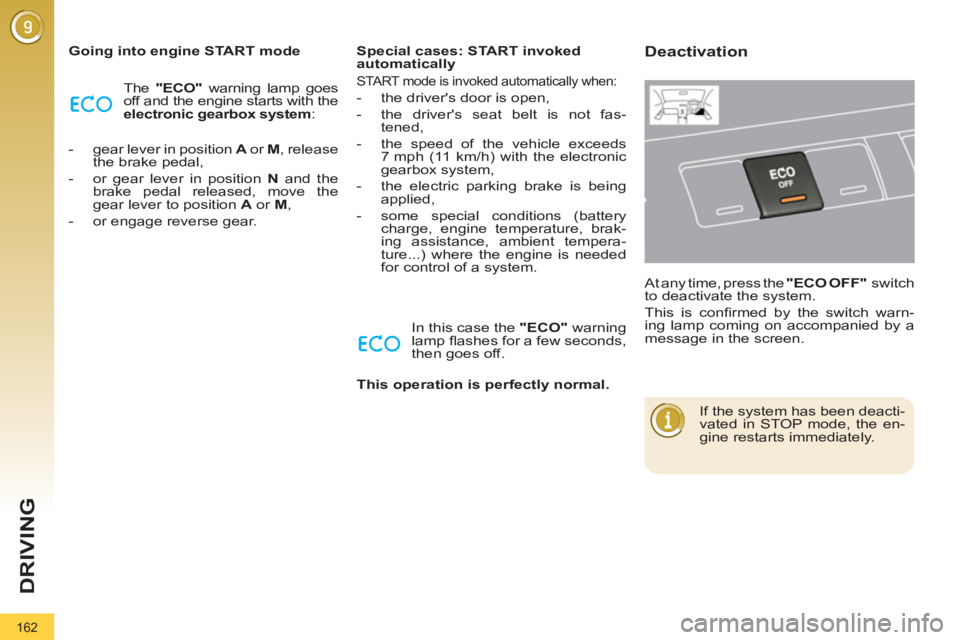
At any time, press the "ECO OFF"
switch
to deactivate the system.
This is confi rmed by the switch warn-
ing lamp coming on accompanied by a
message in the screen.
If the system has been deacti-
vated in STOP mode, the en-
gine restarts immediately.
Page 175 of 328
173
CHECKS
Brake disc wear
Brake pads
Brake wear depends on the
style of driving, particularly in
the case of vehicles used in
town, over short distances. It
may be necessary to have the
condition of the brakes checked, even
between vehicle services.
Unless there is a leak in the circuit, a
drop in the brake fl uid level indicates
that the brake pads are worn.
For information on checking
brake disc wear, contact a
PEUGEOT dealer or a quali-
fi ed workshop.
Manual gearbox
The gearbox does not re-
quire any maintenance (no oil
change).
Refer to the servicing booklet for
the details of the level checking
interval for this component.
6-speed electronic
gearbox system
The gearbox does not re-
quire any maintenance (no oil
change).
Refer to the servicing booklet
for details of the checking in-
terval for this component.
Automatic gearbox
The gearbox does not re-
quire any maintenance (no oil
change).
Refer to the servicing booklet
for details of the level checking
interval for this component. This system does not require any
routine servicing. However, in
the event of a problem, have the
system checked by a PEUGEOT
dealer or a qualifi ed workshop.
For more information, see "Driving -
Electric parking brake - § Operating
faults".
Electric parking brake
Particle emission filter (Diesel)
Maintenance of the particle emission fi l-
ter must be carried out by a PEUGEOT
dealer or a qualifi ed workshop.
On a new vehicle, the fi rst few
particle emissions fi lter regen-
erations may be accompanied
by a "burning" smell, which is perfect-
ly normal. Following prolonged oper-
ation of the vehicle at very low speed
or at idle, you may, in exceptional
circumstances, notice water vapour
from the exhaust on acceleration.
This does not affect the performance
of the vehicle or the environment.
Dust filter/Anti-odour filter
(activated carbon)
Your vehicle is fi tted with a fi lter which
traps certain dust and limits odours in
the ventilation and air conditioning.
Refer to the servicing booklet for its re-
placement interval.
Do not hesitate to change it if you notice
unpleasant odours, contact a PEUGEOT
dealer or a qualifi ed workshop.
A clogged passenger compartment fi lter
may reduce the performance of the air
conditioning system and produce un-
pleasant odours.
Page 176 of 328
174
PRACTICAL INFORMATION
TEMPORARY PUNCTURE
REPAIR KIT
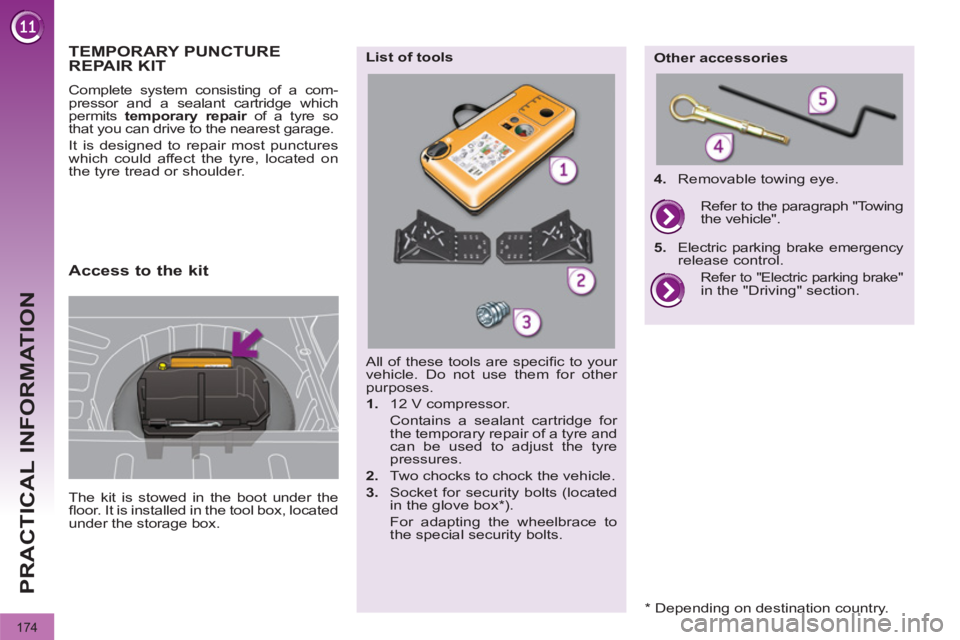
The kit is stowed in the boot under the
fl oor. It is installed in the tool box, located
under the storage box. Complete system consisting of a com-
pressor and a sealant cartridge which
permits temporary repair
of a tyre so
that you can drive to the nearest garage.
It is designed to repair most punctures
which could affect the tyre, located on
the tyre tread or shoulder.
All of these tools are specifi c to your
vehicle. Do not use them for other
purposes.
1.
12 V compressor.
Contains a sealant cartridge for
the temporary repair of a tyre and
can be used to adjust the tyre
pressures.
2.
Two chocks to chock the vehicle.
3.
Socket for security bolts (located
in the glove box * ).
For adapting the wheelbrace to
the special security bolts.
List of tools
Other accessories
4.
Removable towing eye.
Refer to "Electric parking brake" in the "Driving" section.
Refer to the paragraph "Towing
the vehicle".
5.
Electric parking brake emergency
release control.
Access to the kit
*
Depending on destination country.
Page 183 of 328
181
PRACTICAL INFORMATION
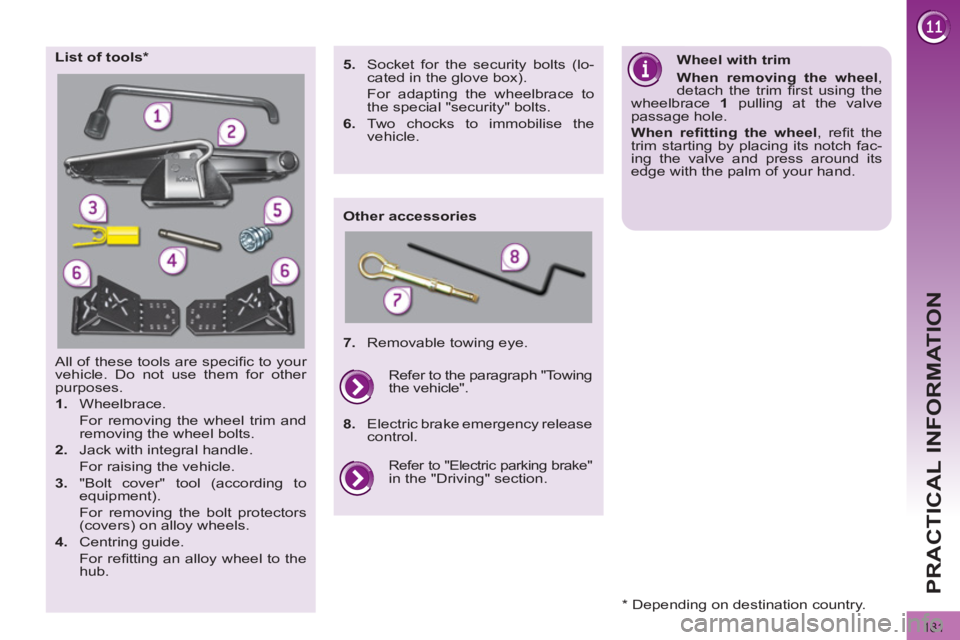
All of these tools are specifi c to your
vehicle. Do not use them for other
purposes.
1.
Wheelbrace.
For removing the wheel trim and
removing the wheel bolts.
2.
Jack with integral handle.
For raising the vehicle.
3.
"Bolt cover" tool (according to
equipment).
For removing the bolt protectors
(covers) on alloy wheels.
4.
Centring guide.
For refi tting an alloy wheel to the
hub.
List of tools *
Other accessories
Wheel with trim
When removing the wheel
,
detach the trim fi rst using the
wheelbrace 1
pulling at the valve
passage hole.
When refi tting the wheel
, refi t the
trim starting by placing its notch fac-
ing the valve and press around its
edge with the palm of your hand.
5.
Socket for the security bolts (lo-
cated in the glove box).
For adapting the wheelbrace to
the special "security" bolts.
6.
Two chocks to immobilise the
vehicle.
7.
Removable towing eye.
Refer to "Electric parking brake" in the "Driving" section. Refer to the paragraph "Towing
the vehicle".
8.
Electric brake emergency release
control.
* Depending on destination country.
Page 185 of 328
183
PRACTICAL INFORMATION
Parking the vehicle
Immobilise the vehicle where
it does not block traffi c: the
ground must be level, stable and
non-slippery ground.
Apply the parking brake unless it
has been programmed to automatic
mode, switch off the ignition and en-
gage fi rst gear * to lock the wheels.
Check that the braking warning lamp
and the P
warning lamp on the park-
ing brake control come on.
If necessary, place a chock under the
wheel diagonally opposite the wheel
to be changed.
The occupants must get out of the ve-
hicle and wait where they are safe.
Never go underneath a vehicle raised
using a jack; use an axle stand.
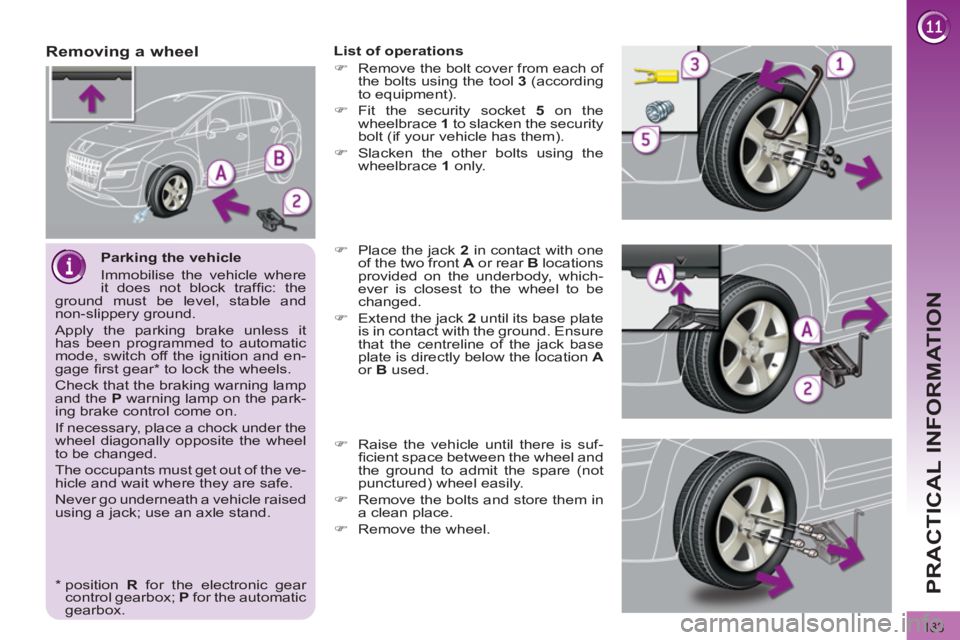
Removing a wheel
List of operations
)
Remove the bolt cover from each of
the bolts using the tool 3
(according
to equipment).
)
Fit the security socket 5
on the
wheelbrace 1
to slacken the security
bolt (if your vehicle has them).
)
Slacken the other bolts using the
wheelbrace 1
only.
)
Place the jack 2
in contact with one
of the two front A
or rear B
locations
provided on the underbody, which-
ever is closest to the wheel to be
changed.
)
Extend the jack 2
until its base plate
is in contact with the ground. Ensure
that the centreline of the jack base
plate is directly below the location A
or B
used.
)
Raise the vehicle until there is suf-
fi cient space between the wheel and
the ground to admit the spare (not
punctured) wheel easily.
)
Remove the bolts and store them in
a clean place.
)
Remove the wheel.
*
position R
for the electronic gear
control gearbox; P
for the automatic
gearbox.
Page 198 of 328
196
PRACTICAL INFORMATION
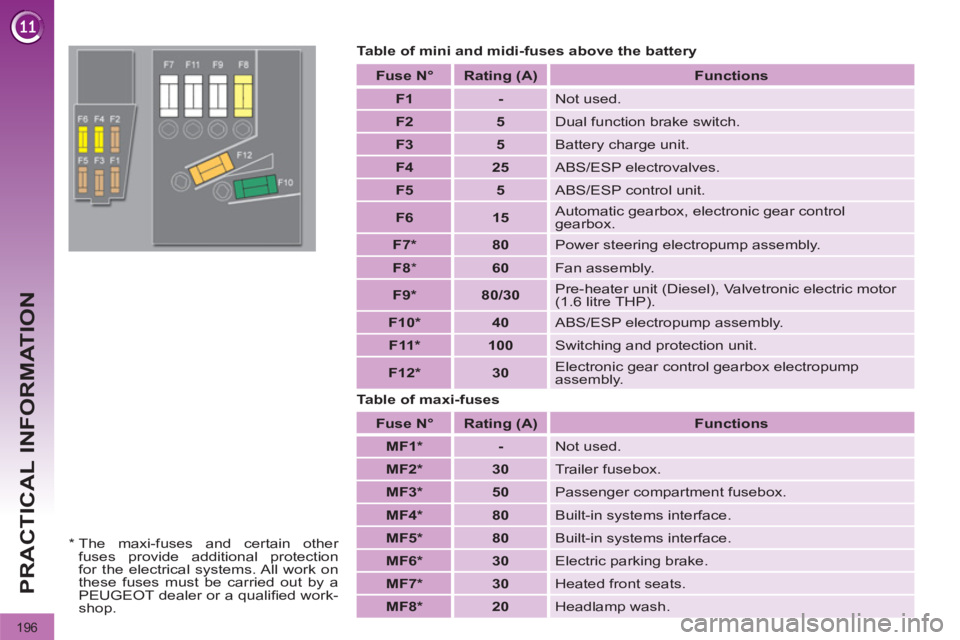
Table of mini and midi-fuses above the battery
Table of maxi-fuses
Fuse
N°
Rating
(A)
Functions
F1
-
Not used.
F2
5
Dual function brake switch.
F3
5
Battery charge unit.
F4
25
ABS/ESP electrovalves.
F5
5
ABS/ESP control unit.
F6
15
Automatic gearbox, electronic gear control
gearbox.
F7 *
80
Power steering electropump assembly.
F8
*
60
Fan assembly.
F9 *
80/30
Pre-heater unit (Diesel), Valvetronic electric motor
(1.6 litre THP).
F10 *
40
ABS/ESP electropump assembly.
F11 *
100
Switching and protection unit.
F12 *
30
Electronic gear control gearbox electropump
assembly.
Fuse
N°
Rating (A)
Functions
MF1 *
-
Not used.
MF2 *
30
Trailer fusebox.
MF3 *
50
Passenger compartment fusebox.
MF4 *
80
Built-in systems interface.
MF5 *
80
Built-in systems interface.
MF6 *
30
Electric parking brake.
MF7 *
30
Heated front seats.
MF8 *
20
Headlamp wash.
*
The maxi-fuses and certain other
fuses provide additional protection
for the electrical systems. All work on
these fuses must be carried out by a
PEUGEOT dealer or a qualifi ed work-
shop.
Page 203 of 328
201
PRACTICAL INFORMATION
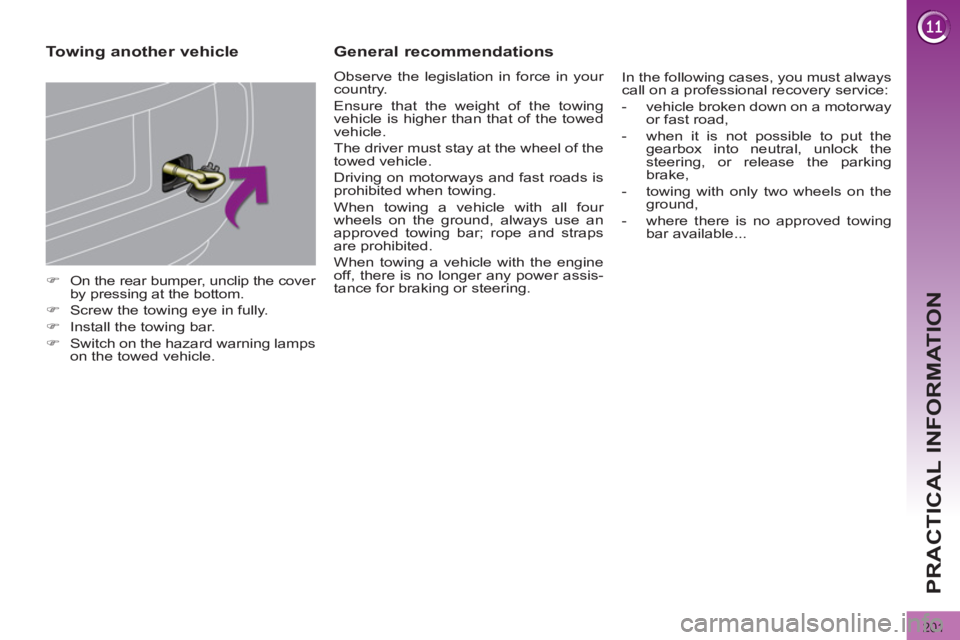
)
On the rear bumper, unclip the cover
by pressing at the bottom.
)
Screw the towing eye in fully.
)
Install the towing bar.
)
Switch on the hazard warning lamps
on the towed vehicle.
Towing another vehicle
General recommendations
Observe the legislation in force in your
country.
Ensure that the weight of the towing
vehicle is higher than that of the towed
vehicle.
The driver must stay at the wheel of the
towed vehicle.
Driving on motorways and fast roads is
prohibited when towing.
When towing a vehicle with all four
wheels on the ground, always use an
approved towing bar; rope and straps
are prohibited.
When towing a vehicle with the engine
off, there is no longer any power assis-
tance for braking or steering. In the following cases, you must always
call on a professional recovery service:
- vehicle broken down on a motorway
or fast road,
- when it is not possible to put the
gearbox into neutral, unlock the
steering, or release the parking
brake,
- towing with only two wheels on the
ground,
- where there is no approved towing
bar available...
Page 204 of 328

202
PRACTICAL INFORMATION
TOWING A TRAILER,
A CARAVAN, ETC.
Your vehicle is primarily designed for
transporting people and luggage, but it
may also be used for towing a trailer.
Driving advice
The maximum towed load on a long in-
cline depends on the gradient and the
ambient temperature.
In all cases, keep a check on the coolant
temperature.
Side wind
)
Take into account the increased
sensitivity to side wind.
Cooling
Towing a trailer on a slope increases
the temperature of the coolant.
As the fan is electrically controlled, its
cooling capacity is not dependent on
the engine speed.
)
To lower the engine speed, reduce
your speed.
Braking
Towing a trailer increases the braking
distance.
To avoid overheating of the brakes on a
long mountain type of descent, the use
of engine braking is recommended.
Tyres
)
Check the tyre pressures of the towing
vehicle and of the trailer, observing the
recommended pressures.
Lighting
)
Check the electrical lighting and sig-
nalling on the trailer.
The rear parking sensors will
be deactivated automatically if
a genuine PEUGEOT towbar
is used.
)
If the warning lamp and the
STOP
warning lamp come
on, stop the vehicle and
switch off the engine as
soon as possible.
Towbar suitable for the attachment of a
trailer or caravan with additional lighting
and signalling.
Distribution of loads
)
Distribute the load in the trailer so
that the heaviest items are as close
as possible to the axle and the nose
weight approaches the maximum
permitted without exceeding it.
Air density decreases with altitude, thus
reducing engine performance. Above
1 000 metres, the maximum towed load
must be reduced by 10 % for every
1 000 metres of altitude. Driving with a trailer places greater de-
mands on the towing vehicle and the
driver must take particular care.
We recommend the use of
genuine PEUGEOT towbars
and their harnesses that have
been tested and approved from the
design stage of your vehicle, and that
the fi tting of the towbar is entrusted
to a PEUGEOT dealer or a qualifi ed
workshop.
If the towbar is not fi tted by a
PEUGEOT dealer, it is imperative
that it is fi tted in accordance with the
vehicle manufacturer's instructions. Refer to the "Technical Data"
section for details of the weights
and towed loads which apply to
your vehicle.