Page 75 of 102
PERIODIC MAINTENANCE AND ADJUSTMENT
6-30
6
EAU23213
Checking and lubricating the
centerstand and sidestand The operation of the centerstand and
sidestand should be checked before
each ride, and the pivots and metal-to-
metal contact surfaces should be lubri-
cated if necessary.
WARNING
EWA10741
If the centerstand or sidestand does
not move up and down smoothly,
have a Yamaha dealer check or re-
pair it. Otherwise, the centerstand or
sidestand could contact the ground
and distract the operator, resulting
in a possible loss of control.
EAUM1651
Lubricating the swingarm piv-
ots The swingarm pivots must be lubricat-
ed by a Yamaha dealer at the intervals
specified in the periodic maintenance
and lubrication chart.
Recommended lubricant:
Lithium-soap-based grease
Recommended lubricant:
Lithium-soap-based grease
U1CWE0E0.book Page 30 Friday, September 11, 2009 9:05 AM
Page 76 of 102

PERIODIC MAINTENANCE AND ADJUSTMENT
6-31
6
EAU23272
Checking the front fork The condition and operation of the front
fork must be checked as follows at the
intervals specified in the periodic main-
tenance and lubrication chart.
To check the condition
Check the inner tubes for scratches,
damage and excessive oil leakage.
To check the operation
1. Place the vehicle on a level sur-
face and hold it in an upright posi-
tion. WARNING! To avoid injury,
securely support the vehicle so
there is no danger of it falling
over.
[EWA10751]
2. While applying the front brake,
push down hard on the handlebars
several times to check if the front
fork compresses and rebounds
smoothly.
NOTICE
ECA10590
If any damage is found or the front
fork does not operate smoothly,
have a Yamaha dealer check or re-
pair it.
EAU45511
Checking the steering Worn or loose steering bearings may
cause danger. Therefore, the operation
of the steering must be checked as fol-
lows at the intervals specified in the pe-
riodic maintenance and lubrication
chart.
1. Place the vehicle on the center-
stand. WARNING! To avoid inju-
ry, securely support the vehicle
so there is no danger of it falling
over.
[EWA10751]
2. Hold the lower ends of the front
fork legs and try to move them for-
ward and backward. If any free
play can be felt, have a Yamaha
dealer check or repair the steering.
U1CWE0E0.book Page 31 Friday, September 11, 2009 9:05 AM
Page 77 of 102

PERIODIC MAINTENANCE AND ADJUSTMENT
6-32
6
EAU23291
Checking the wheel bearings The front and rear wheel bearings must
be checked at the intervals specified in
the periodic maintenance and lubrica-
tion chart. If there is play in the wheel
hub or if the wheel does not turn
smoothly, have a Yamaha dealer check
the wheel bearings.
EAU33654
Battery This model is equipped with a VRLA
(Valve Regulated Lead Acid) battery.
There is no need to check the electro-
lyte or to add distilled water. However,
the battery lead connections need to be
checked and, if necessary, tightened.
WARNING
EWA10760
�
Electrolyte is poisonous and
dangerous since it contains sul-
furic acid, which causes severe
burns. Avoid any contact with
skin, eyes or clothing and al-ways shield your eyes when
working near batteries. In case
of contact, administer the fol-
lowing FIRST AID.
EXTERNAL: Flush with plenty
of water.
INTERNAL: Drink large quan-
tities of water or milk and im-
mediately call a physician.
EYES: Flush with water for 15
minutes and seek prompt
medical attention.
�
Batteries produce explosive hy-
drogen gas. Therefore, keep
sparks, flames, cigarettes, etc.,
away from the battery and pro-
vide sufficient ventilation when
charging it in an enclosed
space.
�
KEEP THIS AND ALL BATTER-
IES OUT OF THE REACH OF
CHILDREN.
To charge the battery
Have a Yamaha dealer charge the bat-
tery as soon as possible if it seems to
have discharged. Keep in mind that the
1. Battery band
2. Battery cover
3. Negative battery lead (black)
4. Positive battery lead (red)
2
13
4
U1CWE0E0.book Page 32 Friday, September 11, 2009 9:05 AM
Page 79 of 102
PERIODIC MAINTENANCE AND ADJUSTMENT
6-34
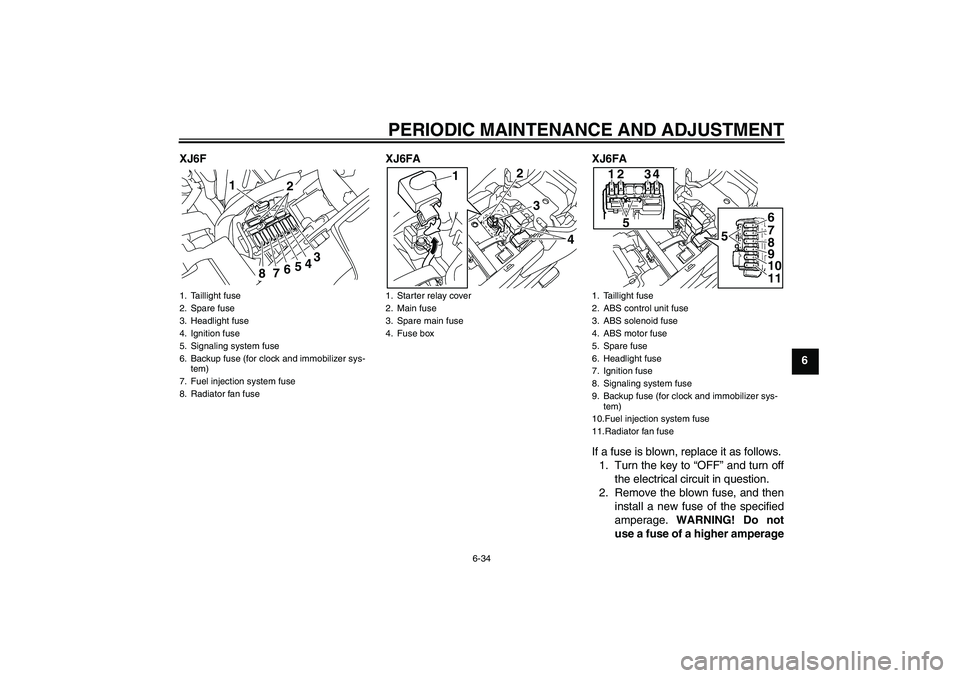
6 XJ6F XJ6FA XJ6FA
If a fuse is blown, replace it as follows.
1. Turn the key to “OFF” and turn off
the electrical circuit in question.
2. Remove the blown fuse, and then
install a new fuse of the specified
amperage. WARNING! Do not
use a fuse of a higher amperage
1. Taillight fuse
2. Spare fuse
3. Headlight fuse
4. Ignition fuse
5. Signaling system fuse
6. Backup fuse (for clock and immobilizer sys-
tem)
7. Fuel injection system fuse
8. Radiator fan fuse
1
2
3
4
5
6
7
8
1. Starter relay cover
2. Main fuse
3. Spare main fuse
4. Fuse box
2
4 3 1
1. Taillight fuse
2. ABS control unit fuse
3. ABS solenoid fuse
4. ABS motor fuse
5. Spare fuse
6. Headlight fuse
7. Ignition fuse
8. Signaling system fuse
9. Backup fuse (for clock and immobilizer sys-
tem)
10.Fuel injection system fuse
11.Radiator fan fuse
1
5
56
7
8
9
10
11 234
U1CWE0E0.book Page 34 Friday, September 11, 2009 9:05 AM
Page 83 of 102
PERIODIC MAINTENANCE AND ADJUSTMENT
6-38
6 3. Remove the burnt-out bulb by pull-
ing it out.
4. Insert a new bulb into the socket.
5. Install the socket (together with the
bulb) by pushing it in.
6. Install the license plate light unit by
installing the screws.
EAU39020
Auxiliary light bulb If the auxiliary light does not come on,
have a Yamaha dealer check the elec-
trical circuit or replace the bulb.
EAU44790
Front wheel (XJ6F)
WARNING
EWA14840
For the ABS model, have a Yamaha
dealer remove and install the wheel.
EAU42641
To remove the front wheel
WARNING
EWA10821
To avoid injury, securely support the
vehicle so there is no danger of it
falling over.1. Place the vehicle on the center-
stand.
2. Loosen the front wheel axle pinch
bolt, then the wheel axle and the
brake caliper bolts.
1. License plate light bulb socket
2. License plate light bulb
1
2
1. Auxiliary light bulb
1
U1CWE0E0.book Page 38 Friday, September 11, 2009 9:05 AM
Page 85 of 102

PERIODIC MAINTENANCE AND ADJUSTMENT
6-40
6
EAU44800
Rear wheel (XJ6F)
WARNING
EWA14840
For the ABS model, have a Yamaha
dealer remove and install the wheel.
EAU32874
To remove the rear wheel
WARNING
EWA10821
To avoid injury, securely support the
vehicle so there is no danger of it
falling over.1. Loosen the locknut and drive chain
slack adjusting nut on each side of
the swingarm.
2. Loosen the axle nut.3. Place the motorcycle on the cen-
terstand.
4. Remove the axle nut.
5. Push the wheel forward, and then
remove the drive chain from the
rear sprocket.
TIPThe drive chain does not need to be
disassembled in order to remove and
install the rear wheel.6. While supporting the brake caliper
and slightly lifting the wheel, pull
the wheel axle out.TIPA rubber mallet may be useful to tap the
wheel axle out.
1. Axle nut
2. Drive chain slack adjusting nut
3. Locknut
1
3
2
1. Locknut
2. Drive chain slack adjusting nut
3. Brake caliper bracket
4. Brake caliper
5. Wheel axle
1
4
3
2
5
U1CWE0E0.book Page 40 Friday, September 11, 2009 9:05 AM
Page 87 of 102

PERIODIC MAINTENANCE AND ADJUSTMENT
6-42
6
EAU25871
Troubleshooting Although Yamaha motorcycles receive
a thorough inspection before shipment
from the factory, trouble may occur dur-
ing operation. Any problem in the fuel,
compression, or ignition systems, for
example, can cause poor starting and
loss of power.
The following troubleshooting charts
represent quick and easy procedures
for checking these vital systems your-
self. However, should your motorcycle
require any repair, take it to a Yamaha
dealer, whose skilled technicians have
the necessary tools, experience, and
know-how to service the motorcycle
properly.
Use only genuine Yamaha replace-
ment parts. Imitation parts may look like
Yamaha parts, but they are often inferi-
or, have a shorter service life and can
lead to expensive repair bills.
WARNING
EWA15141
When checking the fuel system, do
not smoke, and make sure there are
no open flames or sparks in the ar-
ea, including pilot lights from waterheaters or furnaces. Gasoline or
gasoline vapors can ignite or ex-
plode, causing severe injury or
property damage.
U1CWE0E0.book Page 42 Friday, September 11, 2009 9:05 AM
Page 89 of 102

PERIODIC MAINTENANCE AND ADJUSTMENT
6-44
6 Engine overheating
WARNING
EWAT1040
�
Do not remove the radiator cap when the engine and radiator are hot. Scalding hot fluid and steam may be
blown out under pressure, which could cause serious injury. Be sure to wait until the engine has cooled.
�
Place a thick rag, like a towel, over the radiator cap, and then slowly rotate the cap counterclockwise to the de-
tent to allow any residual pressure to escape. When the hissing sound has stopped, press down on the cap
while turning it counterclockwise, and then remove the cap.
TIPIf coolant is not available, tap water can be temporarily used instead, provided that it is changed to the recommended coolant
as soon as possible.
Wait until the
engine has cooled.
Check the coolant level in the
reservoir and radiator.
The coolant level
is OK.The coolant level is low.
Check the cooling system
for leakage.
Have a Yamaha dealer checkand repair the cooling system.Add coolant. (See TIP.)
Start the engine. If the engine overheats again,
have a
Yamaha dealer check
and repair the cooling system.
There is
leakage.
There is
no leakage.
U1CWE0E0.book Page 44 Friday, September 11, 2009 9:05 AM