Page 47 of 110

Instrument operation
40
(See page 40 for information on switching the
digital speedometer display units.)
Analog tachometer
The analog tachometer shows the engine
speed.
The large inner numbers on the meter show
the engine speed × 100 rpm (r/min).
The “RPM” indicator light comes on when the
analog tachometer is selected.
To switch to the tachometer from the speed-
ometer:
Push the “Speed/RPM” button for at least 1
second after the multifunction information
center is activated. When the meter switches
to the analog tachometer function, the “RPM”
indicator light comes on.
EJU35024Information display
The information display shows watercraft op-
erating conditions.
EJU37084Digital speedometer
The digital speedometer shows the watercraft
speed against water.
By switching the display units, the speed can
be shown in kilometers per hour (km/h) or
miles per hour (mph).
TIP:
Kilometers are selected as the display units at
the Yamaha factory.
1“Speed/RPM” button
2“SPEED” indicator light
1“Speed/RPM” button
2“RPM” indicator light
2
1
1
2
1Fuel level meter
2Fuel indicator
3Hour meter/voltmeter
4Digital speedometer
5Engine overheat warning indicator
6Check engine warning indicator
7Oil pressure warning indicator
1Digital speedometer
1
UF2H71E0.book Page 40 Thursday, July 2, 2009 10:05 AM
Page 48 of 110

Instrument operation
41
Digital speedometer display (km/h)
The “SPEED” indicator light blinks once if kilo-
meters are selected as the display units when
the multifunction information center is activat-
ed.
TIP:
If the analog speedometer is selected, the
“SPEED” indicator light blinks once, then
comes on.
Digital speedometer display (mph)
The “SPEED” indicator light blinks three times
if miles are selected as the display units when
the multifunction information center is activat-
ed.
TIP:
If the analog speedometer is selected, the
“SPEED” indicator light blinks three times,
then comes on.
To switch the digital speedometer display
units:
Push the “Volt/Hour” button for at least 1 sec-
ond, within 10 seconds after the multifunction
information center is activated. The digital
speedometer display changes. When the dis-
play units are switched from kilometers to
miles only, the “SPEED” indicator light blinks
three times.
EJU35064Hour meter/voltmeter
The hour meter/voltmeter has both an hour
meter function and a voltmeter function. By
switching the meter, it can be used as either
an hour meter or a voltmeter.
TIP:
The hour meter is selected at the Yamaha
factory.
Hour meter
The hour meter shows the total number of
hours that the engine has been running since
the watercraft was new.
TIP:
The elapsed time will be kept even if the bat-
tery terminals have been disconnected.
To switch to the hour meter from the voltme-
ter:
Push the “Volt/Hour” button for at least 1 sec-
ond after the multifunction information center
is activated for more than 10 seconds. The
1“Volt/Hour” button
2“SPEED” indicator light
1
2
1Hour meter/voltmeter
1
UF2H71E0.book Page 41 Thursday, July 2, 2009 10:05 AM
Page 50 of 110

Instrument operation
43
After the fuel tank is refilled, the warning sig-
nals will be cleared when the engine is restart-
ed.
TIP:
Push any button on the multifunction informa-
tion center to stop the buzzer.
EJU35126Oil pressure warning
If the oil pressure drops significantly, the
“WARNING” indicator light and the oil pres-
sure warning indicator blink, and the buzzer
sounds intermittently. At the same time, the
engine speed is limited.
If the oil pressure warning is activated, imme-
diately reduce the engine speed, return to
shore, and then check the engine oil level.
(See page 54 for information on checking the
engine oil level.) If the oil level is sufficient,
have a Yamaha dealer check the watercraft.
TIP:
Push any button on the multifunction informa-
tion center to stop the buzzer.
EJU37601Engine overheat warning
If the engine temperature rises significantly,
the “WARNING” indicator light and the engine
overheat warning indicator blink, and the
buzzer sounds intermittently. Then, the
“WARNING” indicator light and the engine
overheat warning indicator stop blinking and
remain on, and the buzzer sounds continu-
ously. After the light and indicator start to blinkand the buzzer sounds, the engine speed is
limited.
If the engine overheat warning is activated,
immediately reduce the engine speed, return
to shore, and then make sure that water is be-
ing discharged from the port (left) cooling wa-
ter pilot outlet while the engine is running. If
there is no discharge of water, stop the en-
gine, and then check the jet intake for clog-
ging. (See page 96 for information on the jet
intake.) NOTICE: If you cannot locate and
correct the cause of the overheating, con-
sult a Yamaha dealer. Continuing to oper-
ate at higher speeds could result in severe
engine damage.
[ECJ00041]
TIP:
Push any button on the multifunction informa-
tion center to stop the buzzer.
UF2H71E0.book Page 43 Thursday, July 2, 2009 10:05 AM
Page 51 of 110
Instrument operation
44
EJU35133Check engine warning
If a sensor malfunction or a short circuit is de-
tected, the “WARNING” indicator light and the
check engine warning indicator blink, and the
buzzer sounds intermittently.
If the check engine warning is activated, im-
mediately reduce the engine speed, return to
shore, and have a Yamaha dealer check the
engine.
TIP:
Push any button on the multifunction informa-
tion center to stop the buzzer.
UF2H71E0.book Page 44 Thursday, July 2, 2009 10:05 AM
Page 52 of 110
Equipment operation
45
EJU40333
Equipment EJU31043Seats
The front and rear seats are removable.
Remove the seats to access the engine com-
partment and seat storage compartment.
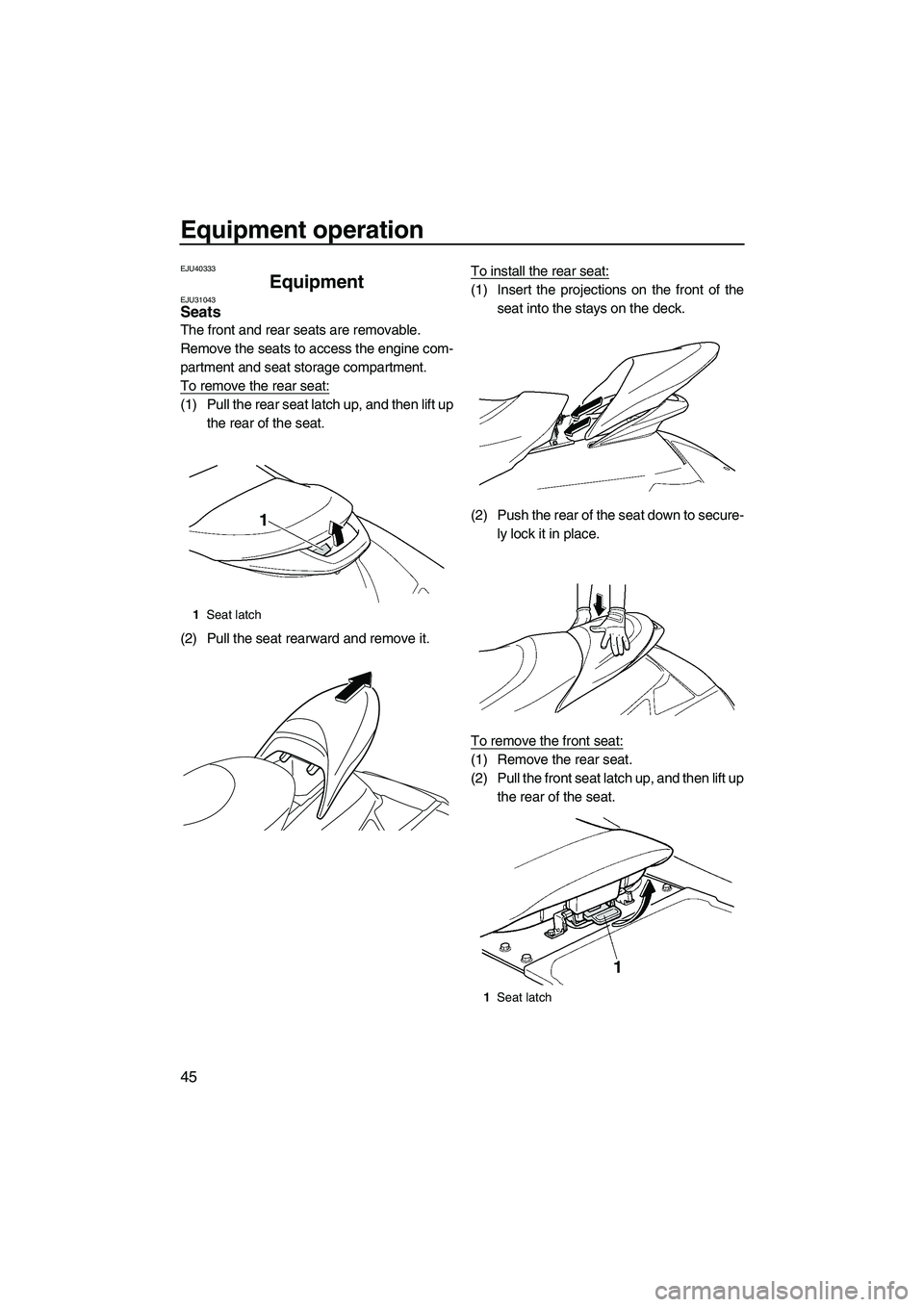
To remove the rear seat:
(1) Pull the rear seat latch up, and then lift up
the rear of the seat.
(2) Pull the seat rearward and remove it.To install the rear seat:
(1) Insert the projections on the front of the
seat into the stays on the deck.
(2) Push the rear of the seat down to secure-
ly lock it in place.
To remove the front seat:
(1) Remove the rear seat.
(2) Pull the front seat latch up, and then lift up
the rear of the seat.
1Seat latch
1Seat latch
UF2H71E0.book Page 45 Thursday, July 2, 2009 10:05 AM
Page 56 of 110
Equipment operation
49
To close the bow storage compartment:
Push the center of the hood down to securely
lock it in place.
To drain water from the bow storage compart-
ment:
(1) Remove the drain plug on the bottom of
the storage compartment to drain the wa-
ter into the engine compartment.
(2) Securely install the drain plug in its origi-
nal position.
EJU35163Glove compartment
The glove compartment is located in front of
the seat.To open the glove compartment:
Turn the glove compartment knob 90° to the
left or right, and then lift up the lid.
1Drain plug
1
1Glove compartment knob
1Glove compartment
Glove compartment:
Capacity:
5.9 L (1.6 US gal, 1.3 Imp.gal)
Load limit:
1.0 kg (2 lb)
1
1
UF2H71E0.book Page 49 Thursday, July 2, 2009 10:05 AM
Page 59 of 110

Operation and handling requirements
52
EJU31822
Fuel requirements EJU37225Fuel
WARNING
EWJ00282
�Gasoline and gasoline vapors are ex-
tremely flammable. To avoid fires and
explosions and to reduce the risk of in-
jury when refueling, follow these in-
structions.
�Gasoline is poisonous and can cause in-
jury or death. Handle gasoline with care.
Never siphon gasoline by mouth. If you
should swallow some gasoline, inhale a
lot of gasoline vapor, or get some gaso-
line in your eyes, see your doctor imme-
diately. If gasoline spills on your skin,
wash with soap and water. If gasoline
spills on your clothing, change your
clothes.
NOTICE
ECJ00321
�Do not use leaded gasoline. Leaded gas-
oline can seriously damage the engine.
�Avoid getting water and contaminants in
the fuel tank. Contaminated fuel can
cause poor performance and engine
damage. Use only fresh gasoline that
has been stored in clean containers.
Gasohol
There are two types of gasohol: gasohol con-
taining ethanol and that containing methanol.
Gasohol containing ethanol can be used if
ethanol content does not exceed 10% and thefuel meets the minimum octane ratings. E-85
is a fuel blend containing 85% ethanol and
therefore must not be used in this watercraft.
All ethanol blends containing more than 10%
ethanol can cause fuel system damage or en-
gine performance problems.
Yamaha does not recommend gasohol con-
taining methanol because it can cause fuel
system damage and engine performance
problems.
To fill the fuel tank:
(1) Before refueling, stop the engine. Do not
stand or sit on the watercraft. Never refu-
el while smoking, or while in the vicinity of
sparks, open flames, or other sources of
ignition.
(2) Place the watercraft in a well-ventilated
area and in a horizontal position.
(3) Remove the seats, and then check the
fuel level. (See page 45 for seat removal
and installation procedures.)
(4) Pull the visor up, and then lift up the rear
of the hood.
Recommended fuel:
Regular unleaded gasoline with a
minimum octane rating of
86
(Pump octane number) = (R + M)/2
90 (Research octane number)
1Visor
1
UF2H71E0.book Page 52 Thursday, July 2, 2009 10:05 AM
Page 60 of 110
Operation and handling requirements
53
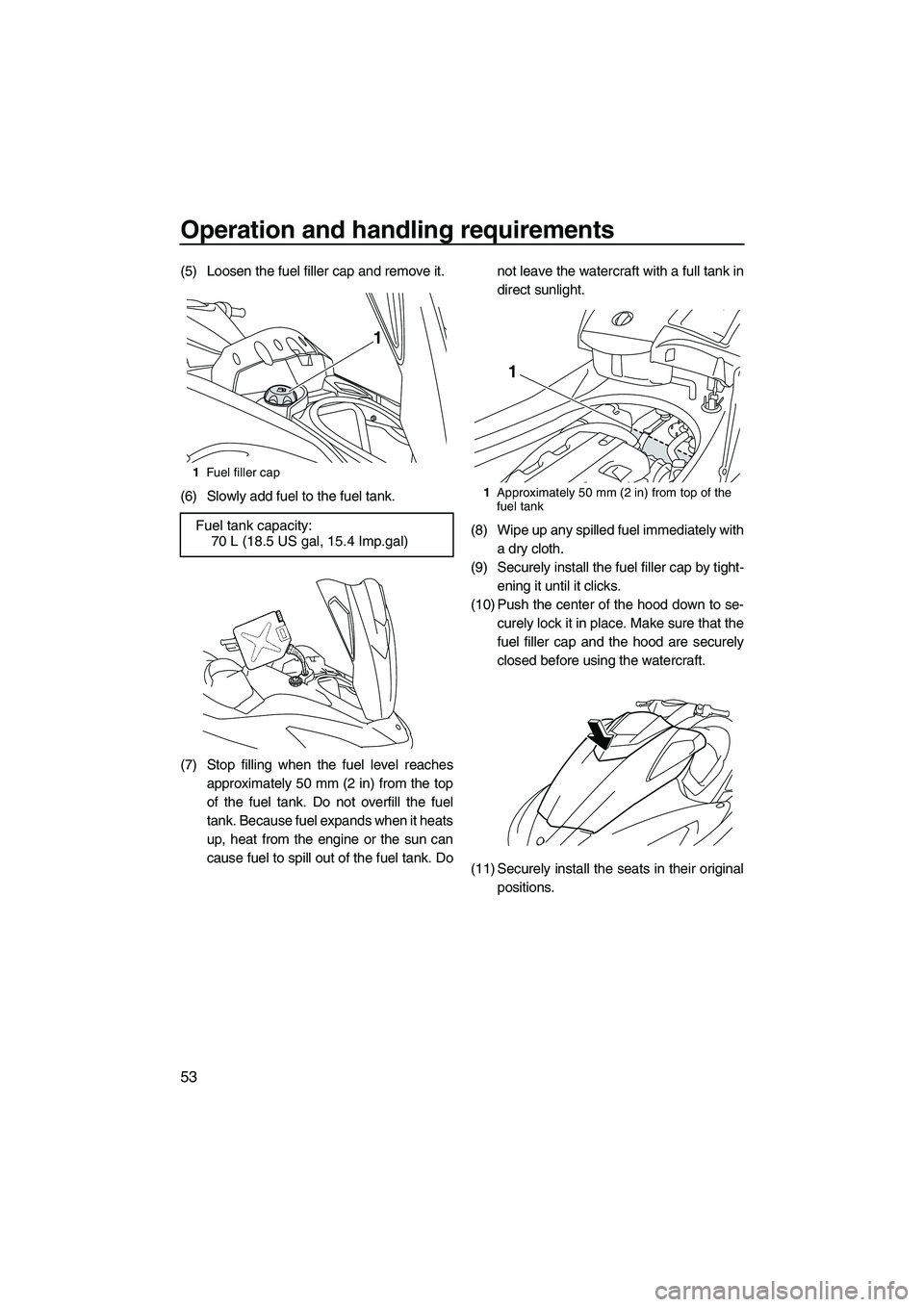
(5) Loosen the fuel filler cap and remove it.
(6) Slowly add fuel to the fuel tank.
(7) Stop filling when the fuel level reaches
approximately 50 mm (2 in) from the top
of the fuel tank. Do not overfill the fuel
tank. Because fuel expands when it heats
up, heat from the engine or the sun can
cause fuel to spill out of the fuel tank. Donot leave the watercraft with a full tank in
direct sunlight.
(8) Wipe up any spilled fuel immediately with
a dry cloth.
(9) Securely install the fuel filler cap by tight-
ening it until it clicks.
(10) Push the center of the hood down to se-
curely lock it in place. Make sure that the
fuel filler cap and the hood are securely
closed before using the watercraft.
(11) Securely install the seats in their original
positions.
1Fuel filler cap
Fuel tank capacity:
70 L (18.5 US gal, 15.4 Imp.gal)
1
1Approximately 50 mm (2 in) from top of the
fuel tank
1
UF2H71E0.book Page 53 Thursday, July 2, 2009 10:05 AM