Page 81 of 146
8-3
1
2
3
4
5
6
78
9
10
11
EBU21743
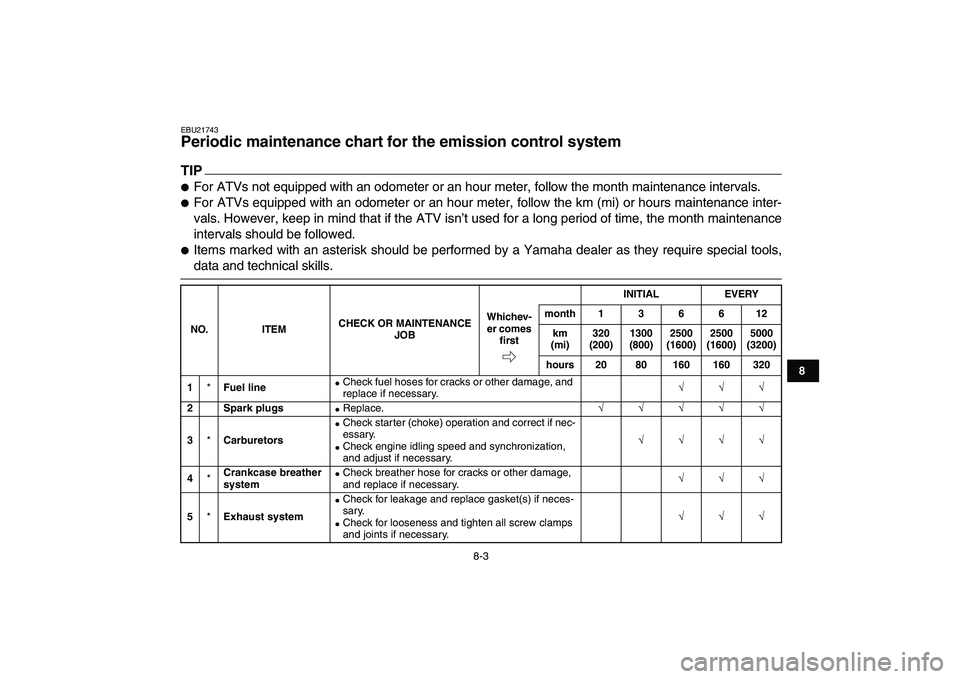
Periodic maintenance chart for the emission control system
TIP
�
For ATVs not equipped with an odometer or an hour meter, follow the month maintenance intervals.
�
For ATVs equipped with an odometer or an hour meter, follow the km (mi) or hours maintenance inter-
vals. However, keep in mind that if the ATV isn’t used for a long period of time, the month maintenance
intervals should be followed.
�
Items marked with an asterisk should be performed by a Yamaha dealer as they require special tools,
data and technical skills.
NO. ITEMCHECK OR MAINTENANCE
JOBINITIAL EVERY
Whichev-
er comes
firstmonth136612
km
(mi)320
(200)1300
(800)2500
(1600)2500
(1600)5000
(3200)
hours 20 80 160 160 3201
*
Fuel line
�
Check fuel hoses for cracks or other damage, and
replace if necessary.
√√√
2 Spark plugs
�
Replace.
√√√√√
3
*
Carburetors
�
Check starter (choke) operation and correct if nec-
essary.
�
Check engine idling speed and synchronization,
and adjust if necessary.
√√√√
4
*
Crankcase breather
system
�
Check breather hose for cracks or other damage,
and replace if necessary.
√√√
5
*
Exhaust system
�
Check for leakage and replace gasket(s) if neces-
sary.
�
Check for looseness and tighten all screw clamps
and joints if necessary.
√√√
✦✯��✬�✩✧�✤✲✣ ✦ ��
����������������������
Page 87 of 146

8-9
1
2
3
4
5
6
78
9
10
11
EBU28321
Checking the spark plugs
The spark plugs are important engine compo-
nents, which are easy to check. Since heat and de-
posits will cause any spark plug to slowly erode,
the spark plugs should be removed and checked in
accordance with the periodic maintenance and lu-
brication chart. In addition, the condition of the
spark plugs can reveal the condition of the engine.
To remove a spark plug
1. Remove the spark plug cap.
2. Remove the spark plug as shown, with thespark plug wrench included in the owner’s tool
kit.
To check the spark plugs
1. Check that the porcelain insulator around the
center electrode of each spark plug is a medi-
um-to-light tan (the ideal color when the ATV
is ridden normally).
2. Check that all spark plugs installed in the en-
gine have the same color.TIP
If any spark plug shows a distinctly different color,
the engine could be operating improperly. Do not
1. Spark plug cap
1
1. Spark plug wrench
1
✦✯��✬�✩✧�✤✲✣ ✬ ��
����������������������
Page 89 of 146
8-11
1
2
3
4
5
6
78
9
10
11
fore each ride. In addition, the transmission oil
must be changed at the intervals specified in the
periodic maintenance and lubrication chart.
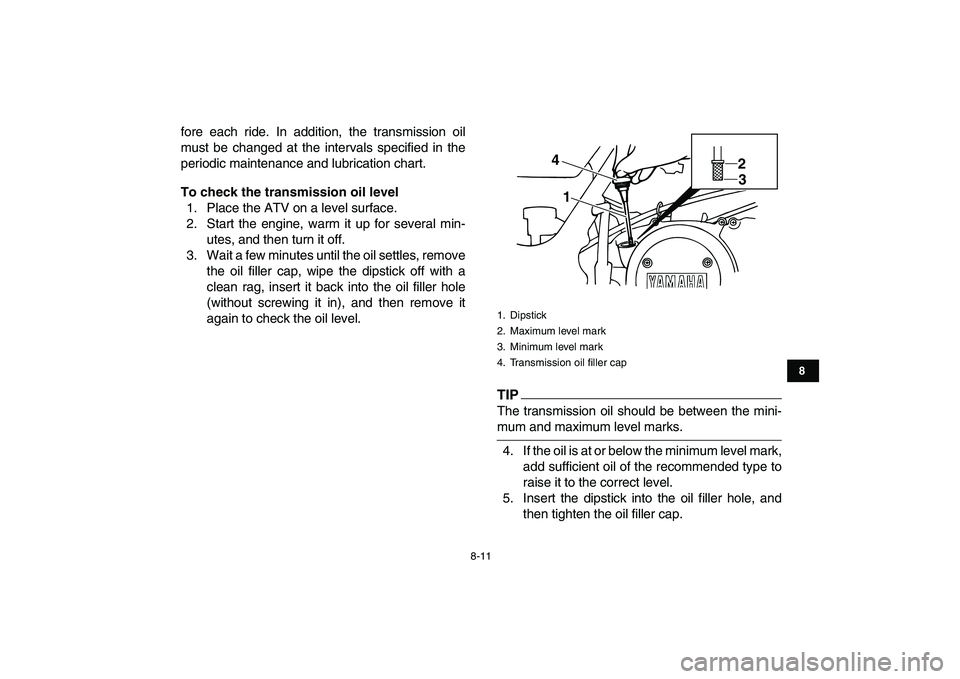
To check the transmission oil level
1. Place the ATV on a level surface.
2. Start the engine, warm it up for several min-
utes, and then turn it off.
3. Wait a few minutes until the oil settles, remove
the oil filler cap, wipe the dipstick off with a
clean rag, insert it back into the oil filler hole
(without screwing it in), and then remove it
again to check the oil level.TIP
The transmission oil should be between the mini-
mum and maximum level marks.
4. If the oil is at or below the minimum level mark,
add sufficient oil of the recommended type to
raise it to the correct level.
5. Insert the dipstick into the oil filler hole, and
then tighten the oil filler cap.
1. Dipstick
2. Maximum level mark
3. Minimum level mark
4. Transmission oil filler cap
12
34
✦✯��✬�✩✧�✤✲✣ ✤✤ ��
����������������������
Page 91 of 146
8-13
1
2
3
4
5
6
78
9
10
11
crankcase.
7. Start the engine, and then let it idle for several
minutes while checking it for oil leakage. If oil
is leaking, immediately turn the engine off and
check for the cause.
8. Turn the engine off, and then check the oil lev-
el and correct it if necessary.
EBU23470
Coolant
The coolant level should be checked before each
ride. In addition, the coolant must be changed at
the intervals specified in the periodic maintenance
and lubrication chart.
EBU23502
To check the coolant level
1. Place the ATV on a level surface.
TIP
The coolant level must be checked on a cold en-
gine since the level varies with engine tempera-
ture.
2. Check the coolant level in the coolant reser-
voir.
TIP
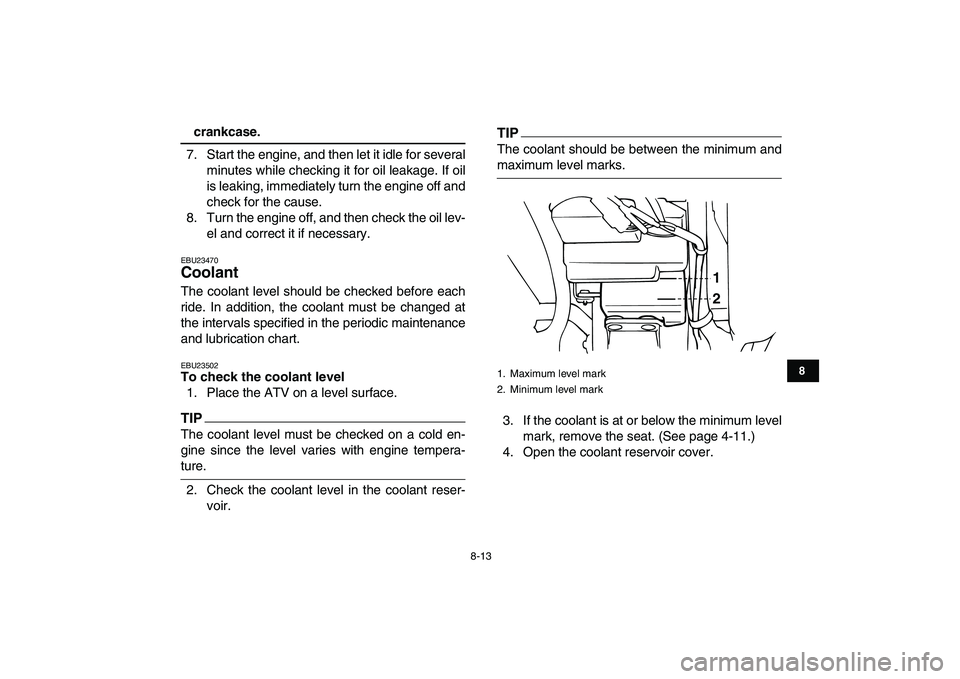
The coolant should be between the minimum and
maximum level marks.
3. If the coolant is at or below the minimum level
mark, remove the seat. (See page 4-11.)
4. Open the coolant reservoir cover.
1. Maximum level mark
2. Minimum level mark
1
2
✦✯��✬�✩✧�✤✲✣ ✤✦ ��
����������������������
Page 92 of 146
8-14
1
2
3
4
5
6
78
9
10
11
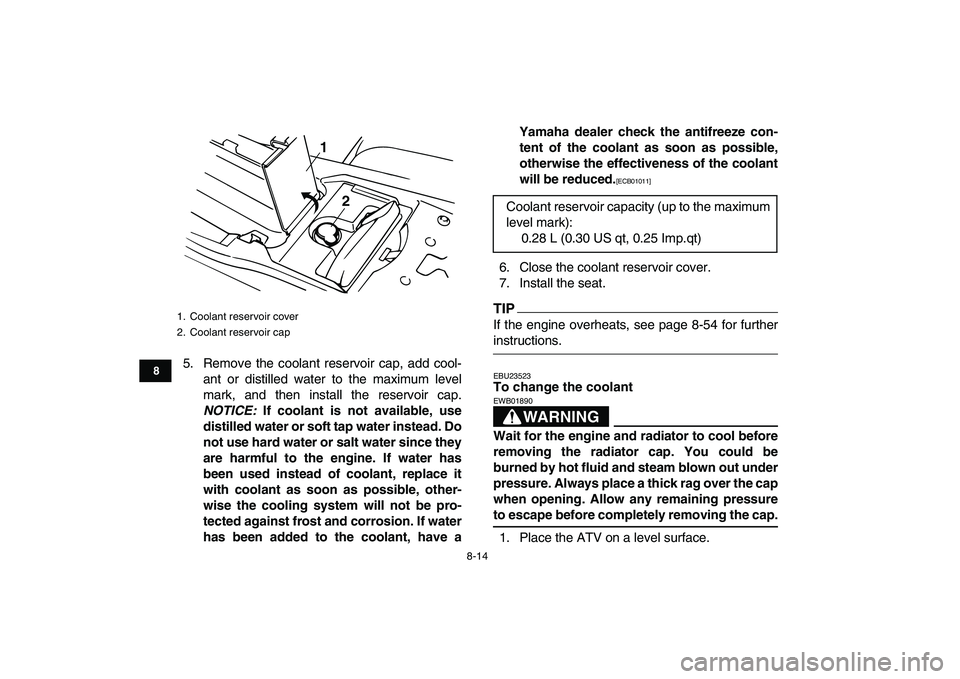
5. Remove the coolant reservoir cap, add cool-
ant or distilled water to the maximum level
mark, and then install the reservoir cap.
NOTICE:
If coolant is not available, use
distilled water or soft tap water instead. Do
not use hard water or salt water since they
are harmful to the engine. If water has
been used instead of coolant, replace it
with coolant as soon as possible, other-
wise the cooling system will not be pro-
tected against frost and corrosion. If water
has been added to the coolant, have aYamaha dealer check the antifreeze con-
tent of the coolant as soon as possible,
otherwise the effectiveness of the coolant
will be reduced.
[ECB01011]
6. Close the coolant reservoir cover.
7. Install the seat.
TIP
If the engine overheats, see page 8-54 for further
instructions.
EBU23523
To change the coolantWARNING
EWB01890
Wait for the engine and radiator to cool before
removing the radiator cap. You could be
burned by hot fluid and steam blown out under
pressure. Always place a thick rag over the cap
when opening. Allow any remaining pressure
to escape before completely removing the cap.
1. Place the ATV on a level surface.
1. Coolant reservoir cover
2. Coolant reservoir cap
1
2
Coolant reservoir capacity (up to the maximum
level mark):
0.28 L (0.30 US qt, 0.25 Imp.qt)
✦✯��✬�✩✧�✤✲✣ ✤✧ ��
����������������������
Page 95 of 146
8-17
1
2
3
4
5
6
78
9
10
11
7. After draining the coolant, thoroughly flush the
cooling system with clean tap water.
8. Replace the coolant drain bolt washers if they
are damaged, and then tighten the coolant
drain bolts to the specified torque.
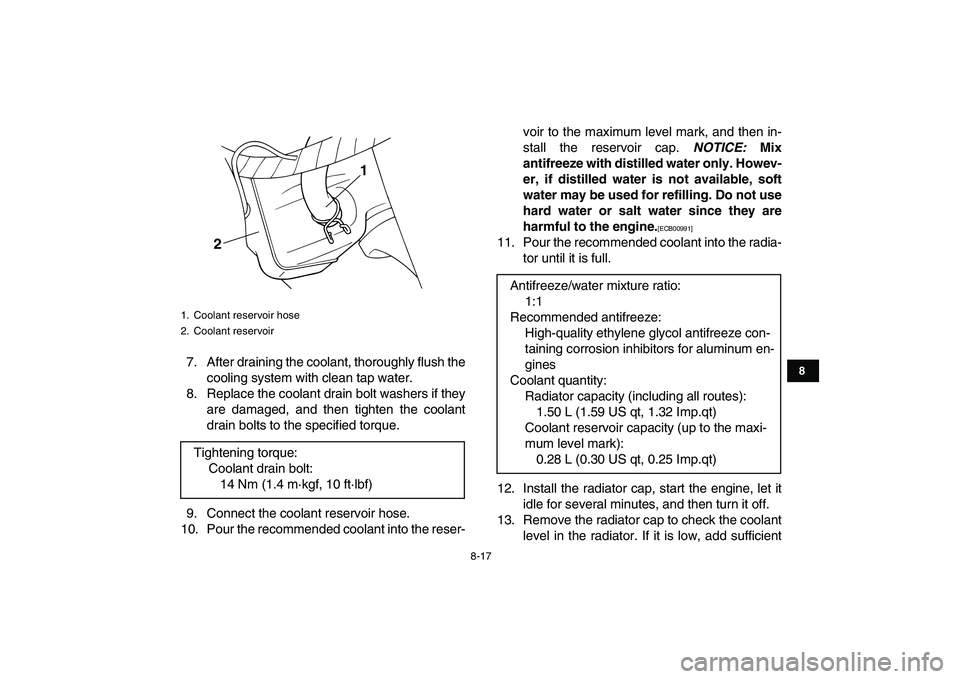
9. Connect the coolant reservoir hose.
10. Pour the recommended coolant into the reser-voir to the maximum level mark, and then in-
stall the reservoir cap.
NOTICE:
Mix
antifreeze with distilled water only. Howev-
er, if distilled water is not available, soft
water may be used for refilling. Do not use
hard water or salt water since they are
harmful to the engine.
[ECB00991]
11. Pour the recommended coolant into the radia-
tor until it is full.
12. Install the radiator cap, start the engine, let it
idle for several minutes, and then turn it off.
13. Remove the radiator cap to check the coolant
level in the radiator. If it is low, add sufficient
1. Coolant reservoir hose
2. Coolant reservoir
Tightening torque:
Coolant drain bolt:
14 Nm (1.4 m·kgf, 10 ft·lbf)
1
2
Antifreeze/water mixture ratio:
1:1
Recommended antifreeze:
High-quality ethylene glycol antifreeze con-
taining corrosion inhibitors for aluminum en-
gines
Coolant quantity:
Radiator capacity (including all routes):
1.50 L (1.59 US qt, 1.32 Imp.qt)
Coolant reservoir capacity (up to the maxi-
mum level mark):
0.28 L (0.30 US qt, 0.25 Imp.qt)
✦✯��✬�✩✧�✤✲✣ ✤✪ ��
����������������������
Page 96 of 146
8-18
1
2
3
4
5
6
78
9
10
11
coolant until it reaches the top of the radiator,
and then install the radiator cap.
14. Start the engine, and then check for coolant
leakage.
TIP
If any leakage is found, have a Yamaha dealer
check the cooling system.
15. Install the radiator cover by installing the
screws.
EBU23623
Cleaning the air filter element
The air filter element should be cleaned at the in-
tervals specified in the periodic maintenance and
lubrication chart. Clean or, if necessary, replace
the air filter element more frequently if you are
riding in unusually wet or dusty areas.
TIP
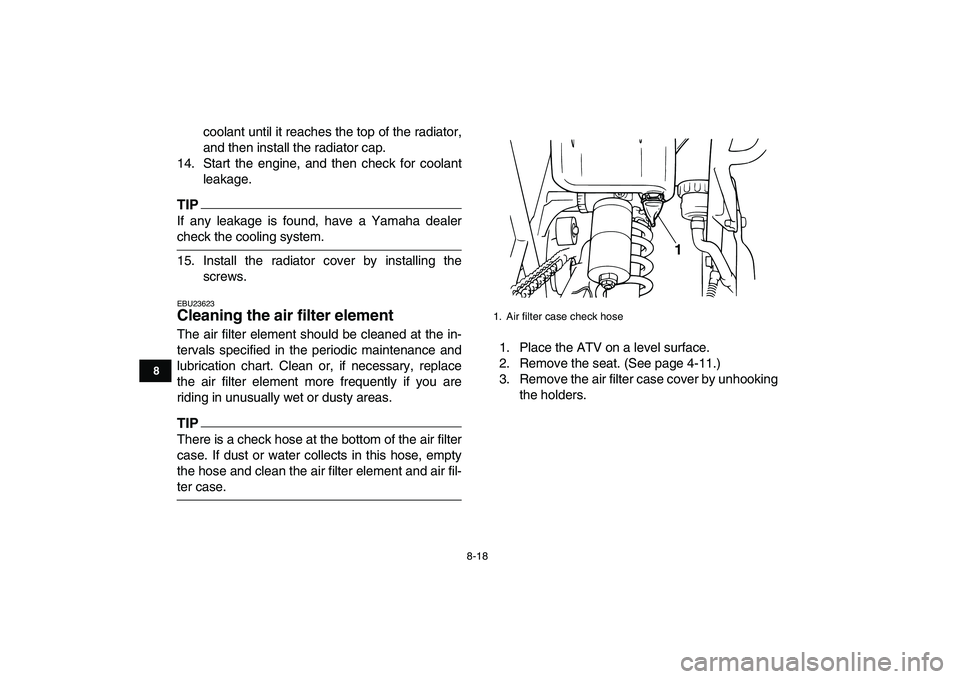
There is a check hose at the bottom of the air filter
case. If dust or water collects in this hose, empty
the hose and clean the air filter element and air fil-
ter case.1. Place the ATV on a level surface.
2. Remove the seat. (See page 4-11.)
3. Remove the air filter case cover by unhooking
the holders.
1. Air filter case check hose
1
✦✯��✬�✩✧�✤✲✣ ✤✫��
����������������������
Page 98 of 146
8-20
1
2
3
4
5
6
78
9
10
11
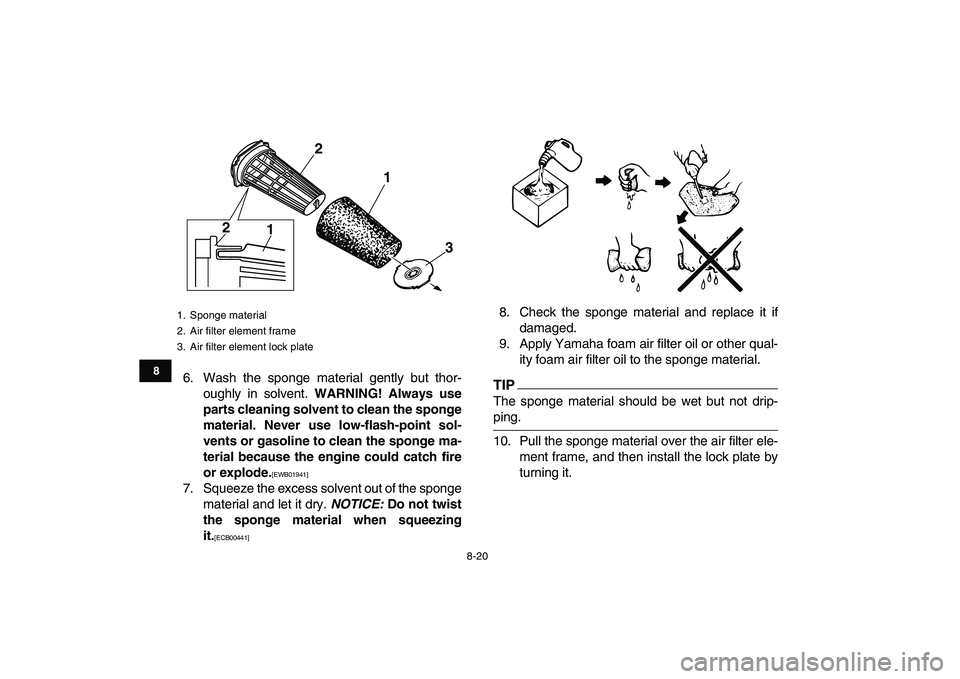
6. Wash the sponge material gently but thor-
oughly in solvent.
WARNING! Always use
parts cleaning solvent to clean the sponge
material. Never use low-flash-point sol-
vents or gasoline to clean the sponge ma-
terial because the engine could catch fire
or explode.
[EWB01941]
7. Squeeze the excess solvent out of the sponge
material and let it dry.
NOTICE:
Do not twist
the sponge material when squeezing
it.
[ECB00441]
8. Check the sponge material and replace it if
damaged.
9. Apply Yamaha foam air filter oil or other qual-
ity foam air filter oil to the sponge material.
TIP
The sponge material should be wet but not drip-
ping.
10. Pull the sponge material over the air filter ele-
ment frame, and then install the lock plate by
turning it.
1. Sponge material
2. Air filter element frame
3. Air filter element lock plate
1 22
1
3
✦✯��✬�✩✧�✤✲✣ ✥✣ ��
����������������������