2010 VOLKSWAGEN PASSAT engine run
[x] Cancel search: engine runPage 232 of 392
Brakes coated with road salt also react slower and need longer stopping distances. If there is salt on the roads and you are not braking regularly, brake carefully and gently from time to time to remove any
salt coating from the brake discs and pads ⇒ .
Brake disc corrosion (rust) and dirt build-up on the brake pads are more likely to occur if the vehicle is not driven much or is driven only for short distances with little braking. If the brakes have not been used and there is some rust on the discs, clean the brake discs and pads once in a while by carefully braking a couple of times while driving at relatively high speed to help clean the brake discs and pads.
Make sure nobody is behind you and that you do not endanger yourself or others ⇒ .
Brake system malfunction
If you brake and find that vehicle doesn't brake nearly as well as it used to (sudden increase in stopping distance), a brake circuit may have failed. The brake warning light h or BRAKE will come on and a message may appear in the instrument cluster display. If you believe the vehicle is safe to drive, immediately take it to the nearest authorized Volkswagen dealer or authorized Volkswagen Service Facility for repair. Drive slowly and very carefully, allow for the longer stopping distance, and be ready to push longer and harder on the brake pedal to slow the vehicle down.
Brake booster
The brake booster works only when the engine is running. It increases the force on the brakes above and beyond the pressure put on the brake pedal by the driver.
If the brake booster is not working, or if the vehicle has to be towed, you will have to push the brake pedal harder to make up for the lack of booster assistance and the resulting longer stopping distance
⇒ .
WARNING
New brake pads do not provide maximum braking performance.
x New brake pads do not have the best stopping power for the first 200 miles (320 km) and must be “broken in.” You can compensate for the slightly reduced braking force by putting more pressure on the brake pedal.
x Drive with extra care while the new brake pads are being broken in. This reduces the risk of collisions and serious personal injuries due to a loss of control over the vehicle.
x Never follow other vehicles too closely or put yourself into other situations that might require sudden, hard braking, especially when the brake pads have not been broken in.
WARNING
Overheated brakes will reduce the vehicle's stopping power and increase stopping distances considerably.
x When driving downhill, the brakes have to work especially hard and heat up quickly.
x Before driving downhill, especially on hills that are long or steep, always reduce speed and shift into lower gear (manual or automatic transmission). This will let the vehicle use engine braking and reduce the load on the brakes. Otherwise, the brake system could overheat and possibly fail. Only use the brakes when you need them to slow the vehicle down more or to stop.
x A damaged front spoiler or a non-standard spoiler can reduce airflow to the brakes and make them overheat.
Page 234 of 392

slush or snow, ESC cannot perform the same way it would on a dry surface. If the vehicle “hydroplanes” (rides on a cushion of water instead of the road surface), ESC will not be able to help you steer the vehicle because contact with the pavement has been interrupted and the vehicle cannot be braked or steered. During fast cornering, particularly on winding roads, ESC cannot always deal as effectively with difficult driving situations as it can at lower speeds. When towing a trailer, ESC is not able to help you regain control as it would if you were not towing a trailer.
Always adjust your speed and driving style to visibility, road, traffic, and weather conditions. ESC cannot override the vehicle's physical limits, increase the available traction, or keep a vehicle on the road if road departure is a result of driver inattention. Instead, ESC improves the possibility of keeping the vehicle under control and on the road during extreme maneuvers by using the driver's steering inputs to help keep the vehicle going in the intended direction. If you are traveling at a speed that causes you to run off the road before ESC can provide any assistance, you may not experience the benefits of ESC.
ESC includes and/or works together with the ABS, BAS, ASR, EDL, and XDL systems (see below). ESC is switched on all the time and cannot be switched off.
Anti-Lock Brake System (ABS)
ABS helps to keep the wheels from locking up and helps to maintain the driver's ability to steer and control the vehicle. This means the vehicle is less likely to skid, even during hard braking:
x Push the brake pedal down hard and hold it there. Don't take your foot off the pedal or reduce the force on the pedal!
x Do not “pump” the brake pedal or let up on it!
x Steer the vehicle while pushing down hard on the brake pedal.
x ABS stops working if you release or let up on the brake.
When ABS is doing its job, you will notice a slight vibration through the brake pedal and hear a noise. ABS cannot shorten the stopping distance under all conditions. The stopping distance may even be longer, for instance, when driving on gravel or on newly fallen snow covering an icy or slippery surface.
Brake Assist (BAS)
The Brake Assist System can help to reduce stopping distances. If you press the brake pedal very quickly, BAS detects an emergency situation. It then very quickly builds up full brake system pressure, maximizing braking power and reducing the stopping distance. This way, ABS can be activated more quickly and efficiently.
Do not reduce pressure on the brake pedal! BAS switches off automatically as soon as you release or let up on the brake.
Anti-Slip Regulation (ASR)
ASR reduces engine power directed to spinning wheels and adjusts power to the road conditions. Even under poor road conditions, ASR can make it easier to get moving, accelerate, and climb hills.
ESC and ASR can help when driving on loose surfaces (such as gravel) and in deep snow. If you get stuck in deep snow, you may be able to get going again by “rocking” the vehicle back and forth. ESC and ASR recognize this special driving situation and automatically increase the speed of the front wheels. Keep pressing the accelerator and let ESC increase the speed of the front wheels to help you keep moving or get moving again.
Electronic Differential Lock (EDL and XDL)
EDL is applied during regular straight-line acceleration. EDL gently brakes a drive wheel that has lost traction (spinning) and redirects the drive force to other drive wheels. In extreme cases, EDL automatically switches off to keep the brake from overheating. As soon as the brake has cooled down, EDL automatically switches on again.
XDL is an extension of the Electronic Differential Lock system. XDL does not react to drive wheel slippage when driving straight ahead. Instead, XDL detects slippage of the inside front wheel during
Page 239 of 392

speed fluctuations caused by taking your foot off the accelerator. Active braking and accelerating is then not necessarily required.
Calm and smooth driving
Consistency is more important than speed. The more smoothly you drive, the less fuel the vehicle consumes.
When driving on the highway or freeway, a constant, moderate speed is more efficient and economical than constantly accelerating and braking. Usually you can reach your destination just as quickly by driving at a moderate, but steady speed.
The cruise control system can assist in maintaining a uniform driving style.
Moderate use of extra electrical loads
Comfort inside the vehicle is nice and important, but it is important to use them in an environmentally conscious manner.
Some devices can increase fuel consumption when activated (examples):
x Climate control system (air conditioner): If the climate control system has to produce starkly contrasting temperatures, it requires a large amount of energy, which is generated by the engine. The temperature in the vehicle should therefore not be extremely different from that of the outside temperature. It may be helpful to ventilate the vehicle before driving and then to drive a short distance with the windows open. After that, switch on the air conditioner with the windows closed. Keep the windows closed when driving at high speeds. Open windows increase fuel consumption.
x Switch off seat heating once it has served its purpose.
x Switch off the rear window defroster as soon as the windows are free of fog and ice.
Additional factors that increase fuel consumption (examples):
x Malfunctioning engine control.
x Driving in the mountains.
x Towing a trailer.
NOTICE
Never let the vehicle coast or roll down a hill in Neutral (N), especially when the engine is not running. The transmission will not be lubricated and will be damaged.
Page 243 of 392

Reverse (manual transmission) or in Drive (D), Sport Drive (S), or Reverse (R) (automatic transmission) and you must use the foot brake to hold the vehicle before starting to move.
Hill Hold keeps the brake applied for not quite 2 seconds with the same force you used to prevent the vehicle from moving. This gives you time to take your foot off the brake, let the clutch out on a manual transmission vehicle, and gently depress the accelerator to get the vehicle moving again. If you do not depress the accelerator pedal and get the vehicle moving again within this time, the brakes will release and the vehicle will roll downhill. Furthermore, if any requirement for engaging Hill Hold is no longer met while the vehicle is stopped, Hill Hold disengages and the brakes are automatically released and will no longer hold the vehicle.
Hill Hold is activated automatically when points 1 to 3 are met at the same time:
Manual transmissionAutomatic transmission
1. Hold the stopped vehicle on an incline with the foot or parking brake.
2. The engine must be running “smoothly.”
3. A manual transmission vehicle must be in 1st gear (1) if headed up a hill or in Reverse (R) if backing up a hill; you must hold the clutch down and the foot brake must be depressed to keep the vehicle from moving.
An automatic transmission vehicle must be in Reverse (R), Drive (D), or Sport Drive (S) and the foot brake must be depressed to keep the vehicle from moving.
4. To drive off take your foot off the brake pedal as you let the clutch out and gently depress the accelerator within 2 seconds.
To drive off take your foot off the brake pedal and gently depress the accelerator within 2 seconds.
Hill Hold is immediately deactivated:
x If any requirement listed in the table above is no longer met (see ⇒ page 244, Hill Hold is activated automatically when points 1 to 3 are met at the same time:).
x If the engine is not running smoothly or the engine malfunctions.
x If the engine stalls or is switched off.
x Automatic transmission vehicles: If the transmission is in Neutral (N).
x Automatic transmission vehicles: If a tire does not have enough road contact (such as when the vehicle is tipped or at an angle).
WARNING
The intelligent technology of Hill Hold cannot overcome the laws of physics. Never let the increased convenience provided by Hill Hold tempt you into taking risks.
x The Hill Hold feature cannot hold the vehicle in all hill start situations (for example, if the surface is icy or slippery).
x Hill Hold can only help keep the vehicle from moving for less than 2 seconds. After that, the brakes will be released and the vehicle can roll down the hill.
Page 254 of 392
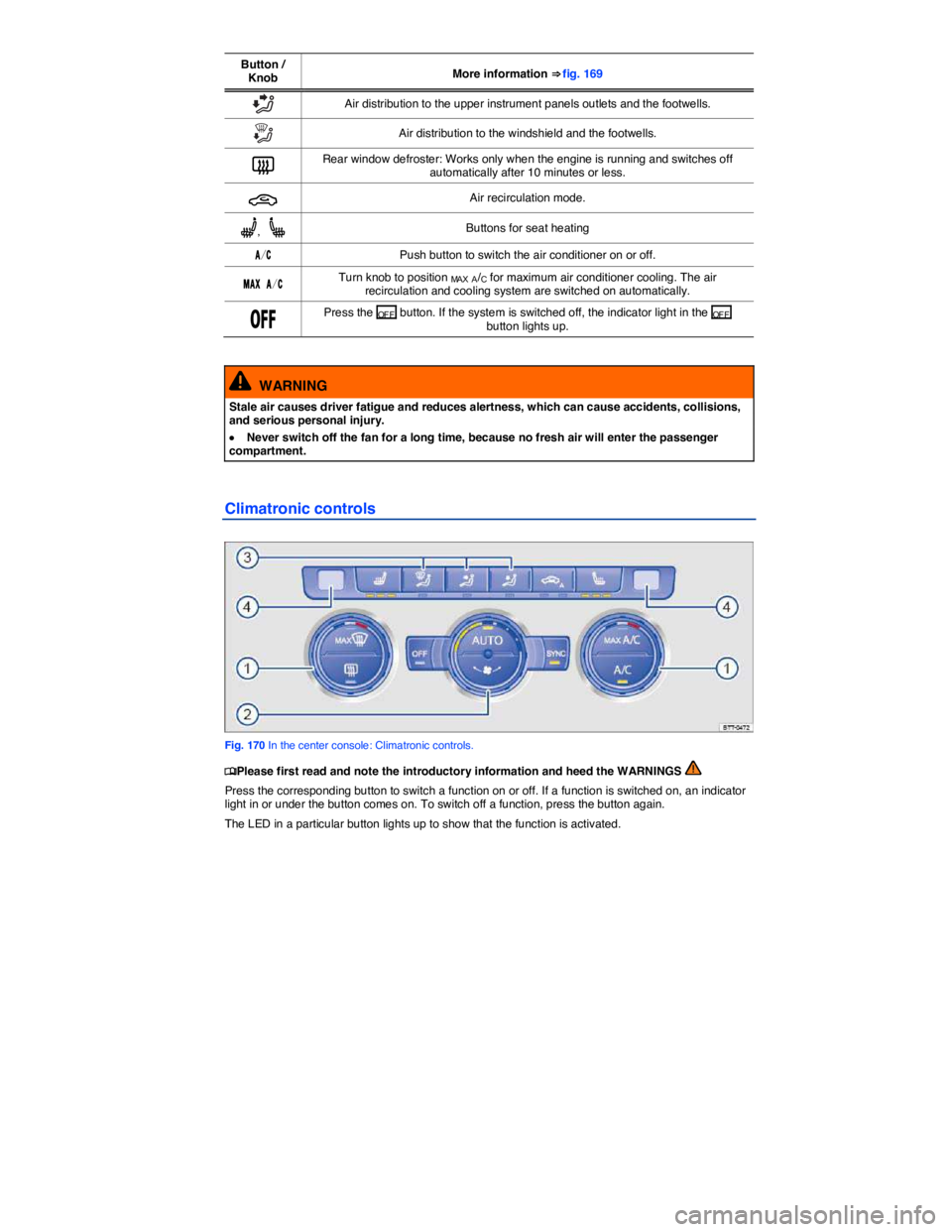
Button / Knob More information ⇒ fig. 169
O Air distribution to the upper instrument panels outlets and the footwells.
u Air distribution to the windshield and the footwells.
= Rear window defroster: Works only when the engine is running and switches off automatically after 10 minutes or less.
3 Air recirculation mode.
A, [ Buttons for seat heating
!/# Push button to switch the air conditioner on or off.
-!8 !/# Turn knob to position MA X A/C for maximum air conditioner cooling. The air recirculation and cooling system are switched on automatically.
/&& Press the OF F button. If the system is switched off, the indicator light in the OF F button lights up.
WARNING
Stale air causes driver fatigue and reduces alertness, which can cause accidents, collisions, and serious personal injury.
x Never switch off the fan for a long time, because no fresh air will enter the passenger compartment.
Climatronic controls
Fig. 170 In the center console: Climatronic controls.
Page 263 of 392
WARNING
Driving with a fuel tank that is almost empty can lead to stalling in traffic, a collision, and serious personal injuries.
x When the fuel tank is almost empty, fuel supply to the engine can be interrupted, especially when driving over bumps, across slopes, and up and down hills.
x Steering and braking assistance as well as ESC and related systems will not work if the engine “sputters” or stalls due to lack of fuel.
x Always refuel when the tank is 1/4 full to reduce the risk of running out of fuel and stalling in traffic.
NOTICE
x Failure to heed warning lights or text WARNINGS can result in vehicle damage.
x Never drive until the fuel tank is completely empty. The irregular fuel supply can cause the engine to misfire. This allows unburned fuel to get into the exhaust system and damage the catalytic converter or the diesel particulate filter.
The small arrow next to the gas pump symbol in the fuel gauge shows the side of the vehicle with the fuel filler flap.
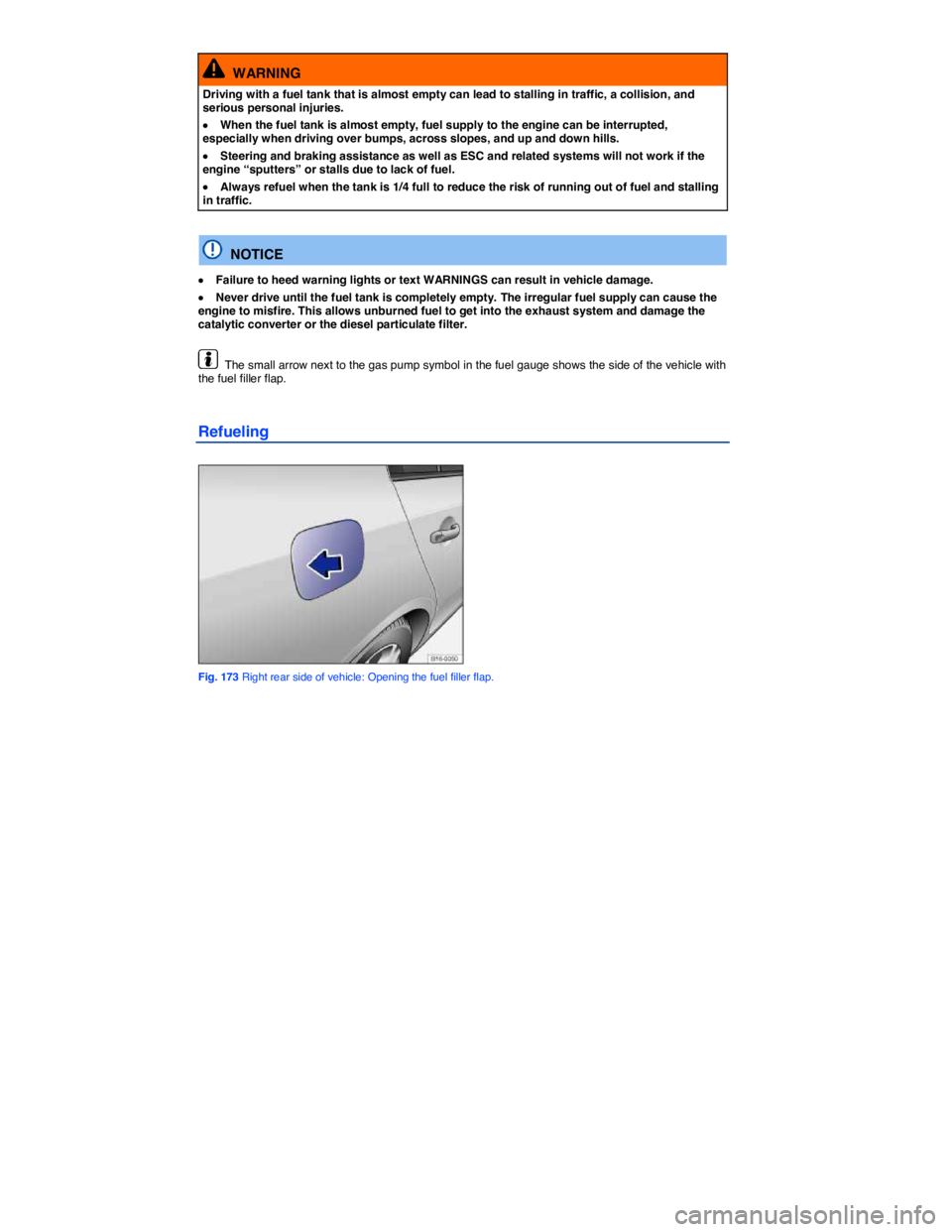
Refueling
Fig. 173 Right rear side of vehicle: Opening the fuel filler flap.
Page 269 of 392
Octane rating
Octane rating indicates a gasoline's ability to resist engine-damaging “knock” caused by pre-ignition. Using the correct grade of gasoline is very important to help prevent engine damage and loss of engine performance.
The recommended gasoline octane rating for your engine is listed on a label inside of the fuel filler flap. This rating may be specified according to AKI (CLC) or RON (ROZ) standards.
If unleaded Premium grade gasoline is specified for your vehicle, then Volkswagen recommends using TOP TIER Detergent Gasoline with a minimum octane rating of 91 AKI (95 RON). For more information on TOP TIER Detergent Gasoline, please go to the official Web site http://www.toptiergas.com.
The gasoline grades most commonly sold in the United States and Canada have the following octane ratings, which can usually be found on the filler pump:
x Premium grade: 91 to 96 AKI
x Regular grade: 87 to 90 AKI
Unleaded gasoline
Unleaded gasoline is available throughout the USA and Canada. Volkswagen recommends that you do not take your vehicle to places where unleaded gasoline may not be available.
Gasoline containing alcohol or MTBE
You may use unleaded gasoline blended with alcohol or MTBE (methyl tertiary butyl ether), commonly referred to as oxygenated fuels, if the blended mixture meets the following criteria:
Blends of gasoline and methanol (wood alcohol or methyl alcohol):
x Anti-Knock Index (AKI) must be 87 or higher.
x Blend must contain no more than 3% methanol.
x Blend must contain more than 2% co-solvents.
Blends of gasoline and ethanol (grain alcohol or ethyl alcohol):
x Anti-Knock Index (AKI) must be 87 or higher.
x Blend must contain no more than 10% ethanol.
Blends of gasoline and MTBE:
x Anti-Knock Index (AKI) must be 87 or higher.
x Blend must contain no more than 15% MTBE.
Seasonally adjusted gasoline
Many fuels are blended especially for winter or summer conditions. When seasons change, Volkswagen suggests that you buy fuel at busy stations where the seasonal adjustment is more likely to be made earlier.
WARNING
Starting fluids can explode and cause a run-away vehicle condition.
x Never use starting assist fluids.
NOTICE
x Never use fuel with an octane rating lower than 87 AKI / 91 RON. Using lower octane fuel may cause expensive engine damage.
x Never use leaded gasoline! Leaded gasoline will severely damage your vehicle's catalytic converter.
Page 272 of 392

and conditions of the Volkswagen Limited Warranties that came with your vehicle. Use only Biodiesel from high quality sources, certified by the BQ-9000 label at the fuel station and complying to ASTM D 7467 S15, B6 to B20.
Using diesel fuel with concentrations of methyl ester biodiesel higher than 20 % (B20), such as B100 is still contrary to the terms of your Emission warranties or any other Volkswagen Limited Warranty and remains strictly prohibited.
Biodiesel blends (up to B20) may be used in your Illinois registered TDI® Clean Diesel vehicle; however, please be aware that biodiesel has characteristics that are different from other kinds of fuel, especially petroleum-based fuels.
Biodiesel can attract water and also deteriorate with age. Small amounts of biodiesel can get into the engine oil, but unlike petroleum diesel, it does not evaporate over time. This can cause the oil level in the engine to rise and can affect the quality of the oil.
x Routinely check the engine oil level. A good time to do this is when you refuel, especially if you regularly do a lot of short distance or stop-and-go driving. This will help you see if the engine oil level is getting higher. (A rising oil level beyond the maximum indicator means an oil change is needed due
to the dilution of the oil in the system; a potential characteristic of biodiesel use) ⇒ page 285, Engine oil.
x If you ever notice that the engine oil level has risen or is above the maximum indicator, contact your authorized Volkswagen dealer, authorized Volkswagen Service Facility or Volkswagen Customer CARE to schedule an oil change – regardless of the time or mileage that has elapsed since you last had an oil change performed.
x Continue to follow the oil change intervals found in the Warranty and Maintenance booklet that came with your vehicle, and use only engine oil that expressly complies with Volkswagen quality standard VW 507 00.
x Refuel only at trusted, commercial fueling stations that are located near main highways. These stations are more likely to have “fresh” biodiesel fuels that have not aged significantly.
x If your vehicle will be in storage (or not driven) for several weeks or months, please completely fill the fuel tank. If possible, fill the tank with Ultra Low Sulfur Diesel fuel [ASTM D-975 standard Grade No. 2-D (S15)].
If you have additional questions about your Illinois registered TDI® Clean Diesel vehicle, please call or write to us at:
Volkswagen of America, Inc.
Attn: Customer CARE
3800 Hamlin Road, Auburn Hills, MI 48326
Tel.: 1-800-444-8982
WARNING
Starting fluids can explode and cause a run-away vehicle condition.
x Never use starting assist fluids.
NOTICE
x The vehicle's diesel engine was designed solely for use with ULSD fuel. For this reason, never use gasoline, heating oil, or other fuels that have not been expressly approved for use with the diesel engine. These fuels contain substances that will severely damage the fuel system and the engine. Such damage will not be covered by any Volkswagen Limited Warranty.
x If you put any amount of the incorrect fuel in the fuel tank, do not start the engine under any circumstances. Immediately contact the nearest authorized Volkswagen dealer or authorized Volkswagen Service Facility for assistance.