Page 309 of 386
5
When trouble arises
299
5-2. Steps to take in an emergency
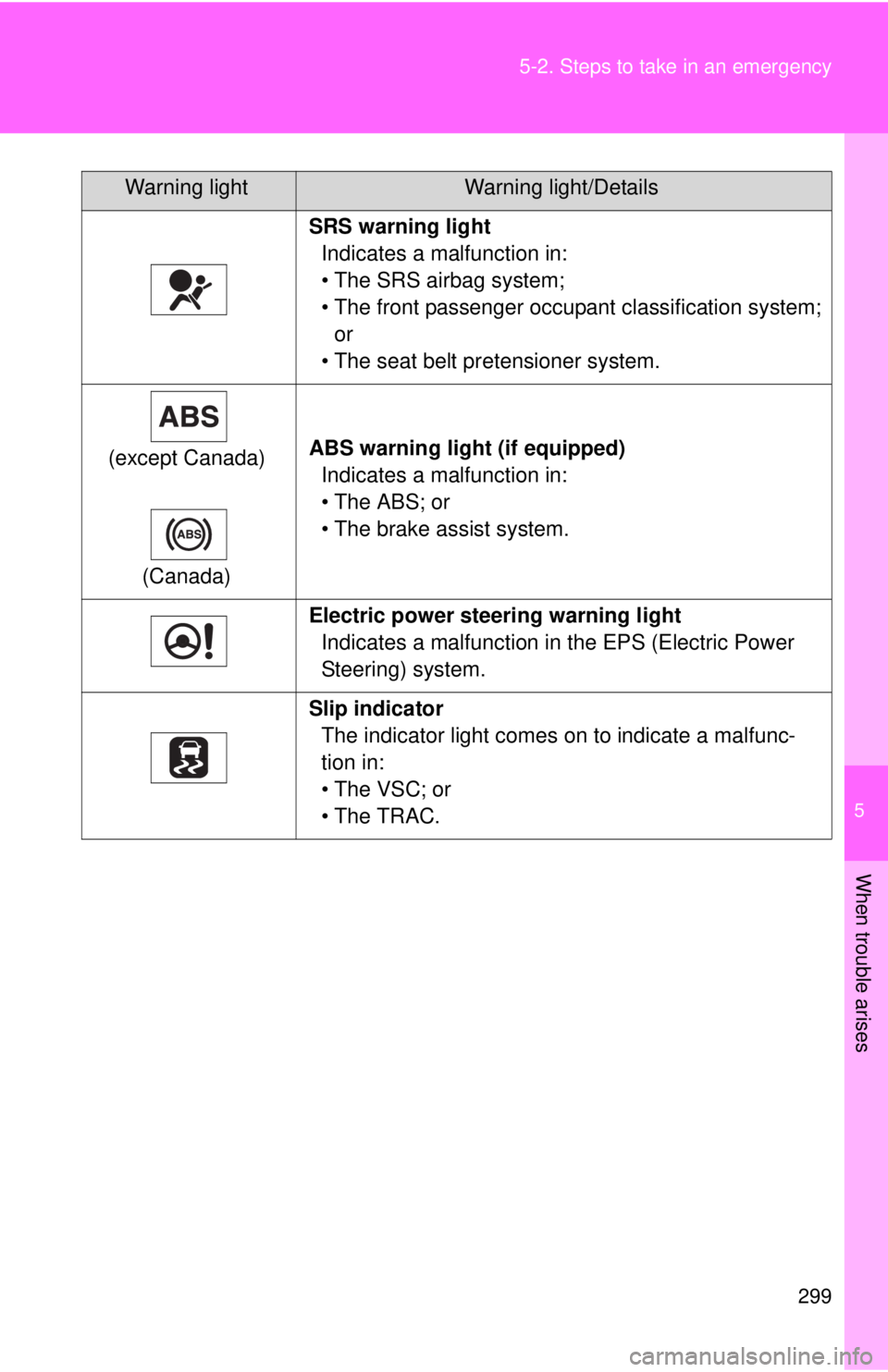
SRS warning light
Indicates a malfunction in:
• The SRS airbag system;
• The front passenger occupant classification system; or
• The seat belt pretensioner system.
(except Canada)
(Canada) ABS warning light (if equipped)
Indicates a malfunction in:
• The ABS; or
• The brake assist system.
Electric power steering warning light Indicates a malfunction in the EPS (Electric Power
Steering) system.
Slip indicator The indicator light comes on to indicate a malfunc-
tion in:
• The VSC; or
• The TRAC.
Warning lightWarning light/Details
Page 315 of 386

5
When trouble arises
305
5-2. Steps to take in an emergency
CAUTION
nIf the tire pressure warning light comes on
Be sure to observe the following precautions. Failure to do so could
cause loss of vehicle control and result in death or serious injury.
lStop your vehicle in a safe place as
soon as possible. Adjust the tire
inflation pressure immediately.
lIf the tire pressure warning light comes on even after tire inflation pres-
sure adjustment, it is pr obable that you have a flat tire. Check the tires.
If the tire is flat, change to the spare tire and have the flat tire repaired
by the nearest Toyota dealer.
lAvoid abrupt maneuvering and braking. If the vehicle tires deteriorate,
you could lose control of the steering wheel or the brakes.
nIf a blowout or sudden air leakage should occur
The tire pressure warning syste m may not activate immediately.
nMaintenance of the tire
Each tire, including the spare (if provided), should be checked monthly
when cold and inflated to the inflation pressure recommended by the
vehicle manufacturer on the vehicle placard or tire inflation pressure
label (tire and load information label). (If your vehicle has tires of a differ-
ent size than the size indicated on the vehicle placard or tire inflation
pressure label [tire and load information label], you should determine the
proper tire inflation pr essure for those tires.)
As an added safety feature, your vehicle has been equipped with a tire
pressure monitoring system (TPMS-ti re pressure warning system) that
illuminates a low tire pressure telltal e (tire pressure warning light) when
one or more of your tires is significantly under-inflated. Accordingly,
when the low tire pressure telltale (tire pre ssure warning light) illumi-
nates, you should stop and check your tires as soon as possible, and
inflate them to the proper pressure. Driving on a significantly under-
inflated tire causes the tire to overheat and can lead to tire failure.
Under-inflation also reduces fuel effi ciency and tire tread life, and may
affect the vehicle’s handling and stopping ability.
Page 317 of 386
5
When trouble arises
307
5-2. Steps to take in an emergency
If you have a flat tire
Remove the flat tire and replace it with the spare provided.
nBefore jacking up the vehicle
lStop the vehicle on a hard, flat surface.
l Set the parking brake.
l Shift the shift lever to P (automatic transmission) or R (manual
transmission).
l Stop the engine.
l Turn on the emergency flashers.
n Location of the spare tire, jack and tools
Tool bag
(including towing eyelet) Spare tire
Jack
Jack handle
Page 326 of 386
316 5-2. Steps to take in an emergency
CAUTION
nWhen using the compact spare tire
lRemember that your compact spare tire is specifically designed for
use with your vehicle. Do not use your compact spare tire on another
vehicle.
lDo not use two compact spare tires simultaneously.
lReplace the compact spare tire with a standard tire as soon as possi-
ble.
lAvoid sudden acceleration, deceleration and braking, as well as sharp
cornering.
nSpeed limit when using the compact spare tire
Do not drive at speeds in excess of 50 mph (80 km/h) when a compact
spare tire is installed on the vehicle.
The compact spare tire is not designed for driving at high speeds. Failing
to observe this precaution may lead to an accident causing death or seri-
ous injury.
n When the spare tire is attached
The vehicle speed may not be correctly detected, and the following systems
may not operate correctly:
lABS&Brake assist (if equipped)
l VSC (if equipped)
l TRAC (if equipped)
l Cruise control
Page 330 of 386
320
5-2. Steps to take in an emergency
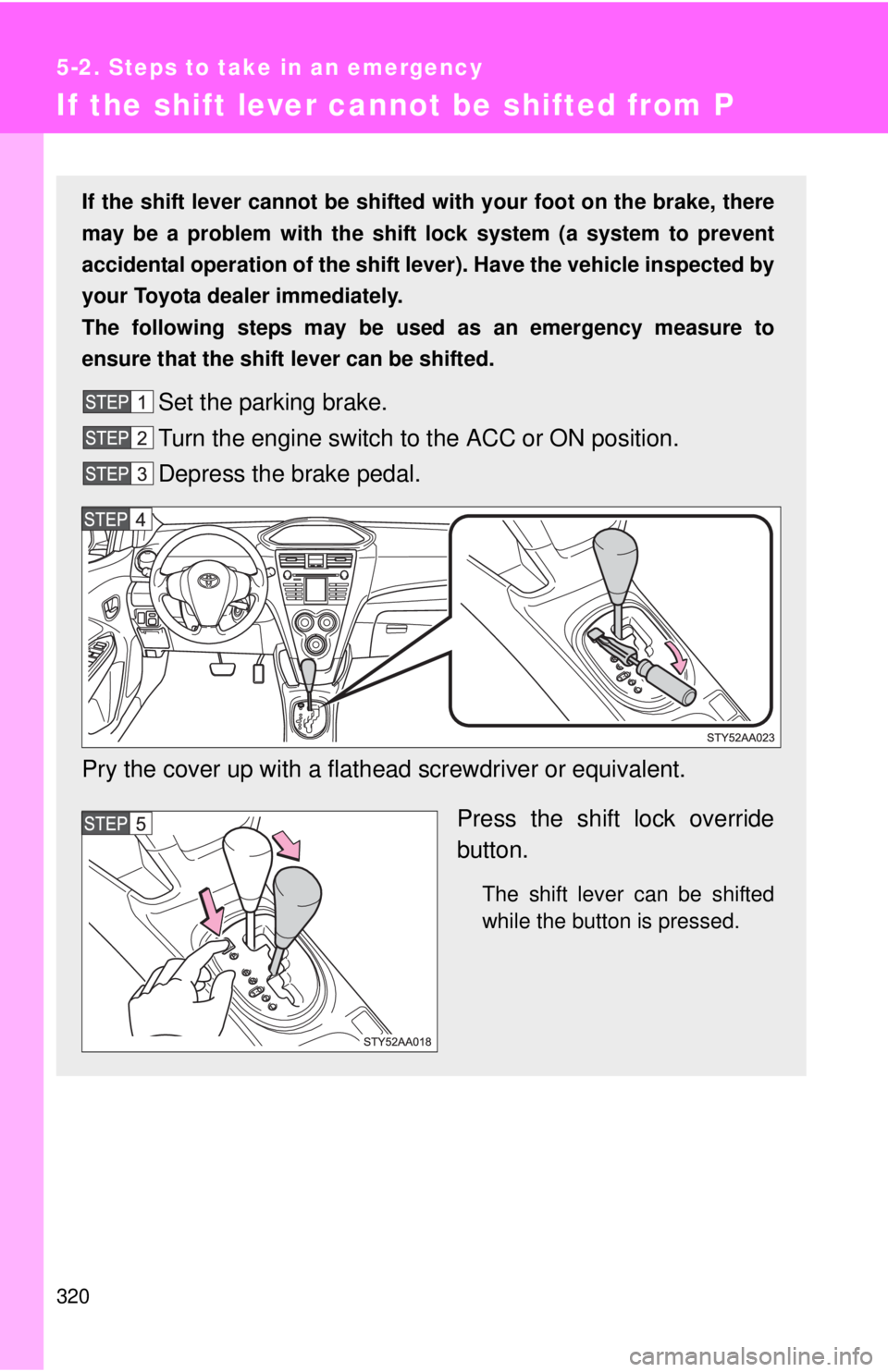
If the shift lever cannot be shifted from P
If the shift lever cannot be shifted with your foot on the brake, there
may be a problem with the shift lock system (a system to prevent
accidental operation of the shift lever). Have the vehicle inspected by
your Toyota dealer immediately.
The following steps may be used as an emergency measure to
ensure that the shift lever can be shifted.
Set the parking brake.
Turn the engine switch to the ACC or ON position.
Depress the brake pedal.
Pry the cover up with a flathead screwdriver or equivalent. Press the shift lock override
button.
The shift lever can be shifted
while the button is pressed.
Page 338 of 386
328
5-2. Steps to take in an emergency
If the vehicle becomes stuck
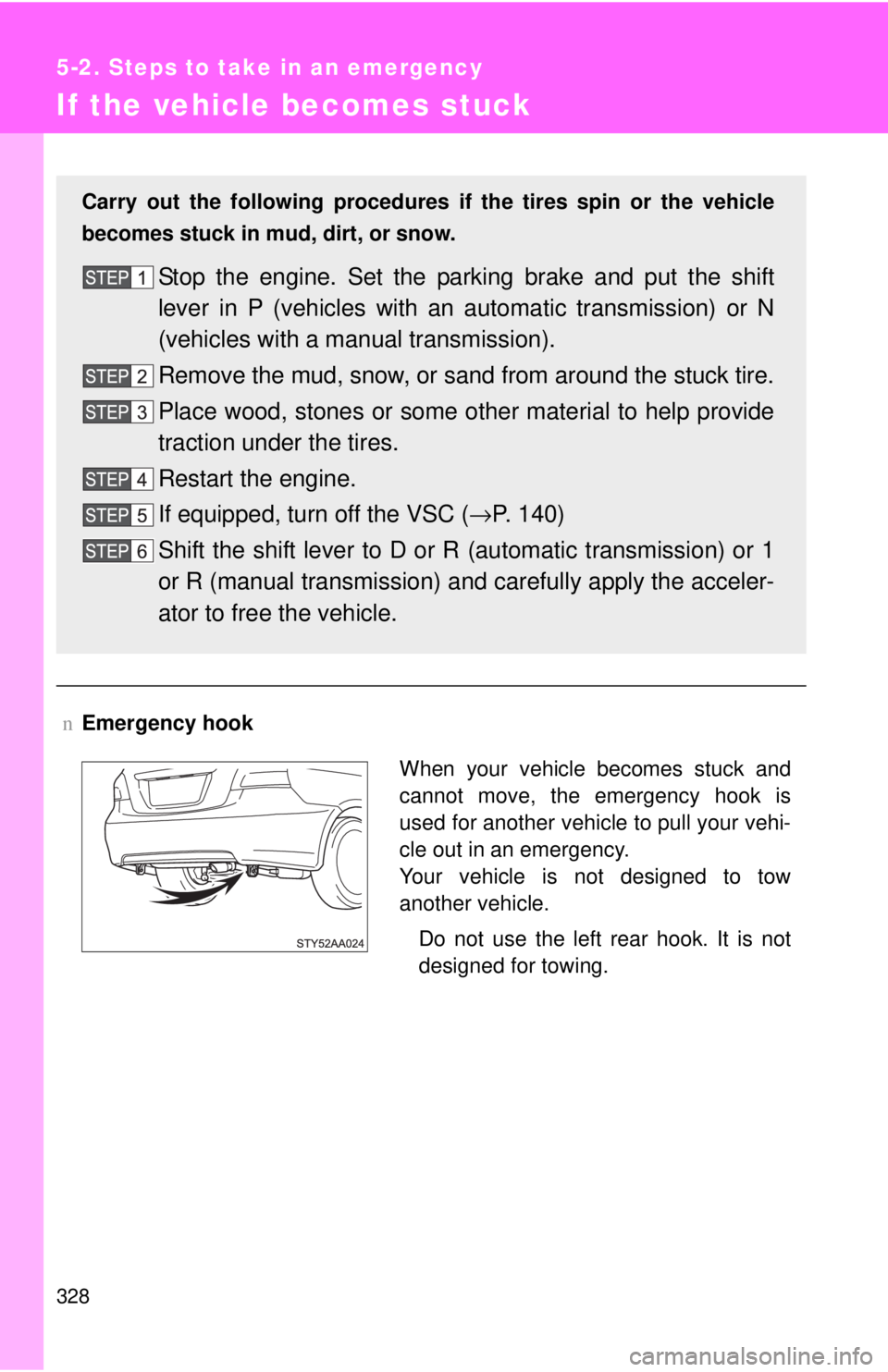
nEmergency hook
Carry out the following procedures if the tires spin or the vehicle
becomes stuck in mud, dirt, or snow.
Stop the engine. Set the parking brake and put the shift
lever in P (vehicles with an automatic transmission) or N
(vehicles with a manual transmission).
Remove the mud, snow, or sand from around the stuck tire.
Place wood, stones or some other material to help provide
traction under the tires.
Restart the engine.
If equipped, turn off the VSC ( →P. 140)
Shift the shift lever to D or R (automatic transmission) or 1
or R (manual transmission) and carefully apply the acceler-
ator to free the vehicle.
When your vehicle becomes stuck and
cannot move, the emergency hook is
used for another vehicle to pull your vehi-
cle out in an emergency.
Your vehicle is not designed to tow
another vehicle.
Do not use the left rear hook. It is not
designed for towing.
Page 340 of 386
330
5-2. Steps to take in an emergency
If your vehicle has to be stopped in an emergency
CAUTION
nIf the engine has to be turned off while driving
lPower assist for the brakes and steering wheel will be lost, making the
brake pedal harder to depress and the steering wheel heavier to turn.
Decelerate as much as possible before turning off the engine.
l Never attempt to remove the key, as doing so will lock the steering wheel.
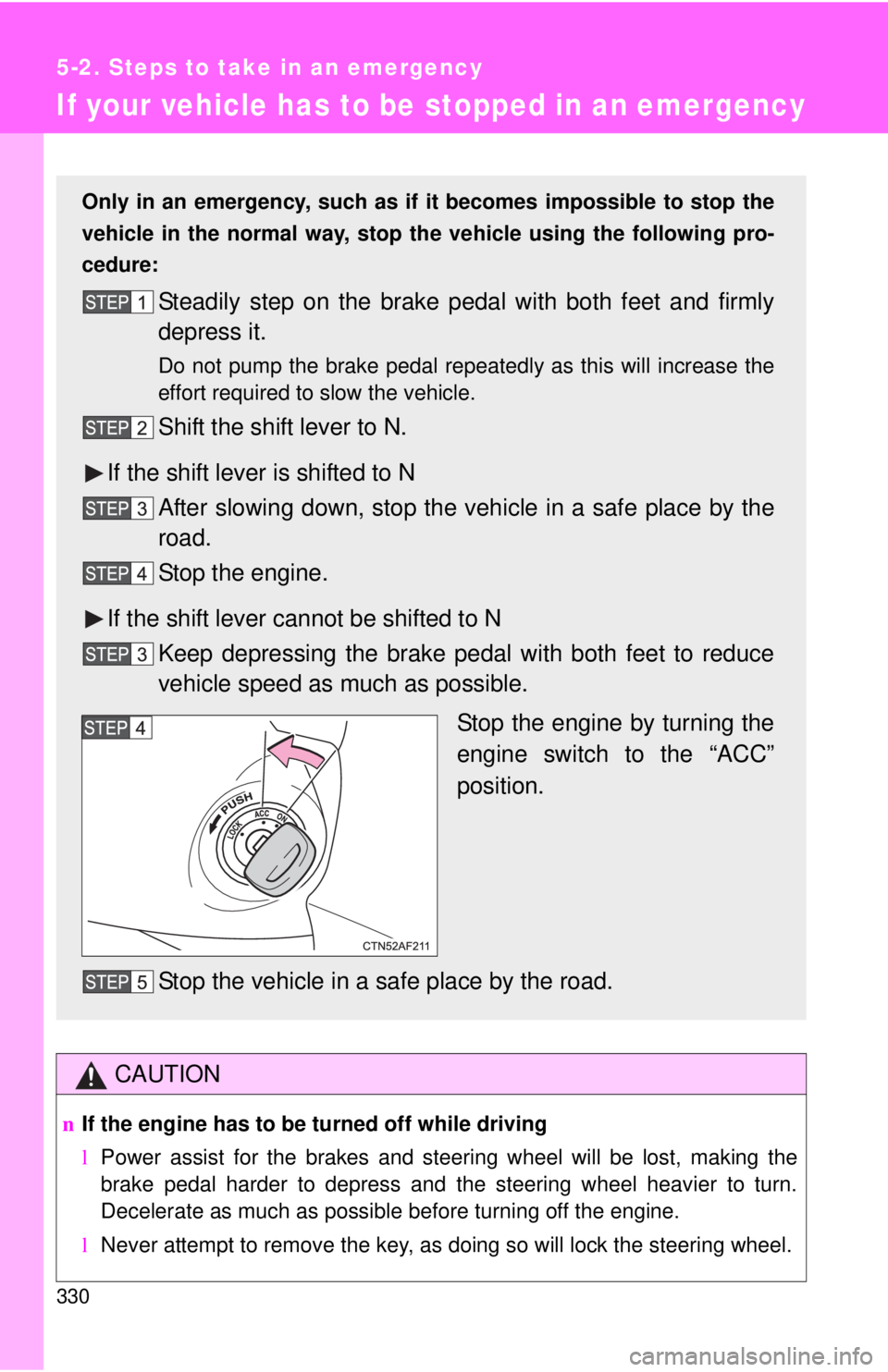
Only in an emergency, such as if it becomes impossible to stop the
vehicle in the normal way, stop the vehicle using the following pro-
cedure:
Steadily step on the brake pedal with both feet and firmly
depress it.
Do not pump the brake pedal repeatedly as this will increase the
effort required to slow the vehicle.
Shift the shift lever to N.
If the shift lever is shifted to N After slowing down, stop the vehi cle in a safe place by the
road.
Stop the engine.
If the shift lever cannot be shifted to N Keep depressing the brake pedal with both feet to reduce
vehicle speed as much as possible.
Stop the engine by turning the
engine switch to the “ACC”
position.
Stop the vehicle in a safe place by the road.
Page 349 of 386
340 6-1. Specifications
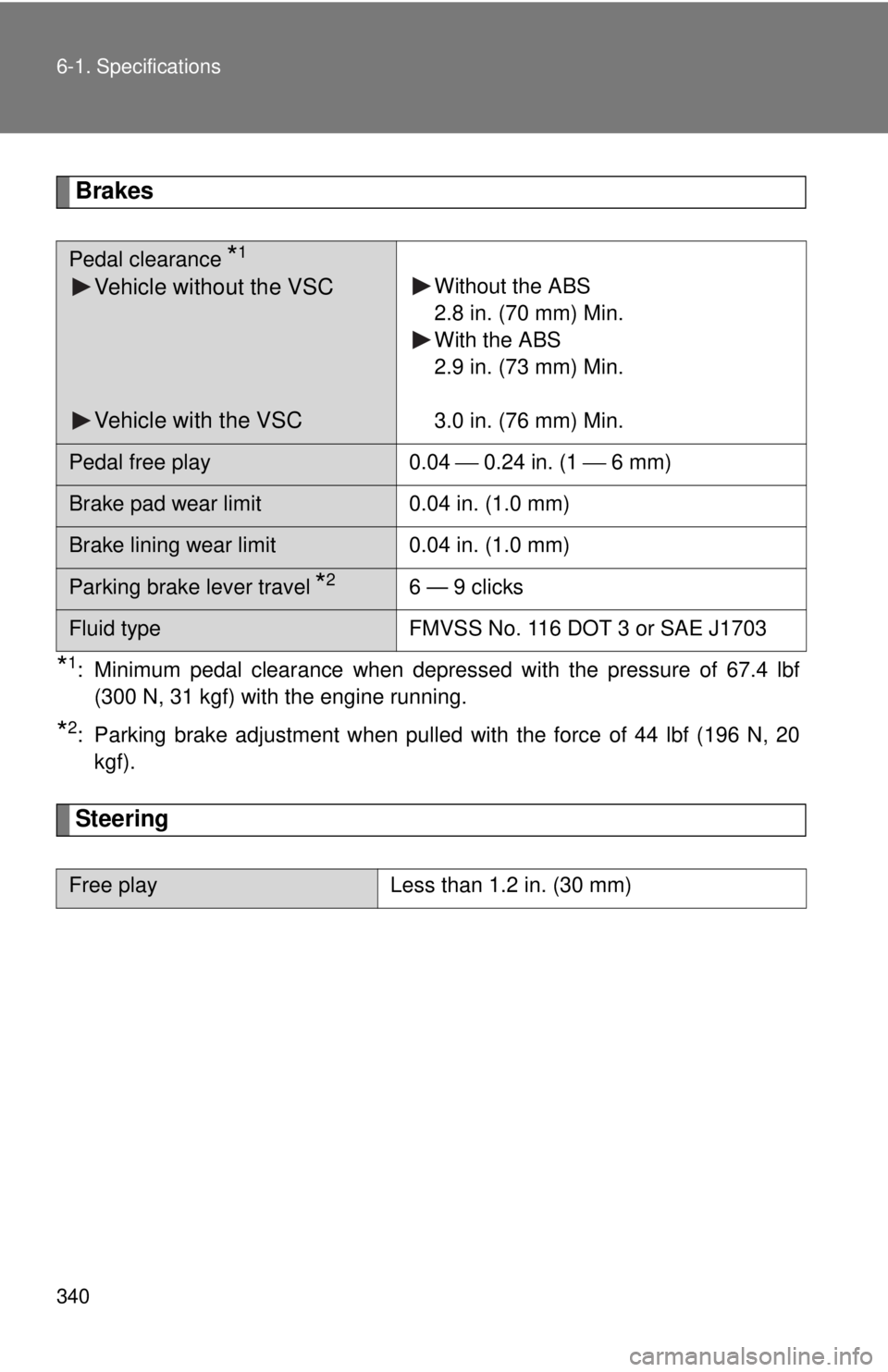
Brakes
*1: Minimum pedal clearance when depressed with the pressure of 67.4 lbf(300 N, 31 kgf) with the engine running.
*2: Parking brake adjustment when pulled with the force of 44 lbf (196 N, 20kgf).
Steering
Pedal clearance *1
Vehicle without the VSC
Vehicle with the VSCWithout the ABS
2.8 in. (70 mm) Min.
With the ABS
2.9 in. (73 mm) Min.
3.0 in. (76 mm) Min.
Pedal free play 0.04 ⎯ 0.24 in. (1 ⎯ 6 mm)
Brake pad wear limit 0.04 in. (1.0 mm)
Brake lining wear limit 0.04 in. (1.0 mm)
Parking brake lever travel *26 — 9 clicks
Fluid typeFMVSS No. 116 DOT 3 or SAE J1703
Free playLess than 1.2 in. (30 mm)