Page 247 of 724
247
2-4. Using other
driving systems
2
When driving
To disable A-TRAC (4L mode on 4WD models)
If the vehicle gets stuck in fresh snow or mud, A-TRAC may reduce
power from the engine to the wheels. You may need to turn the sys-
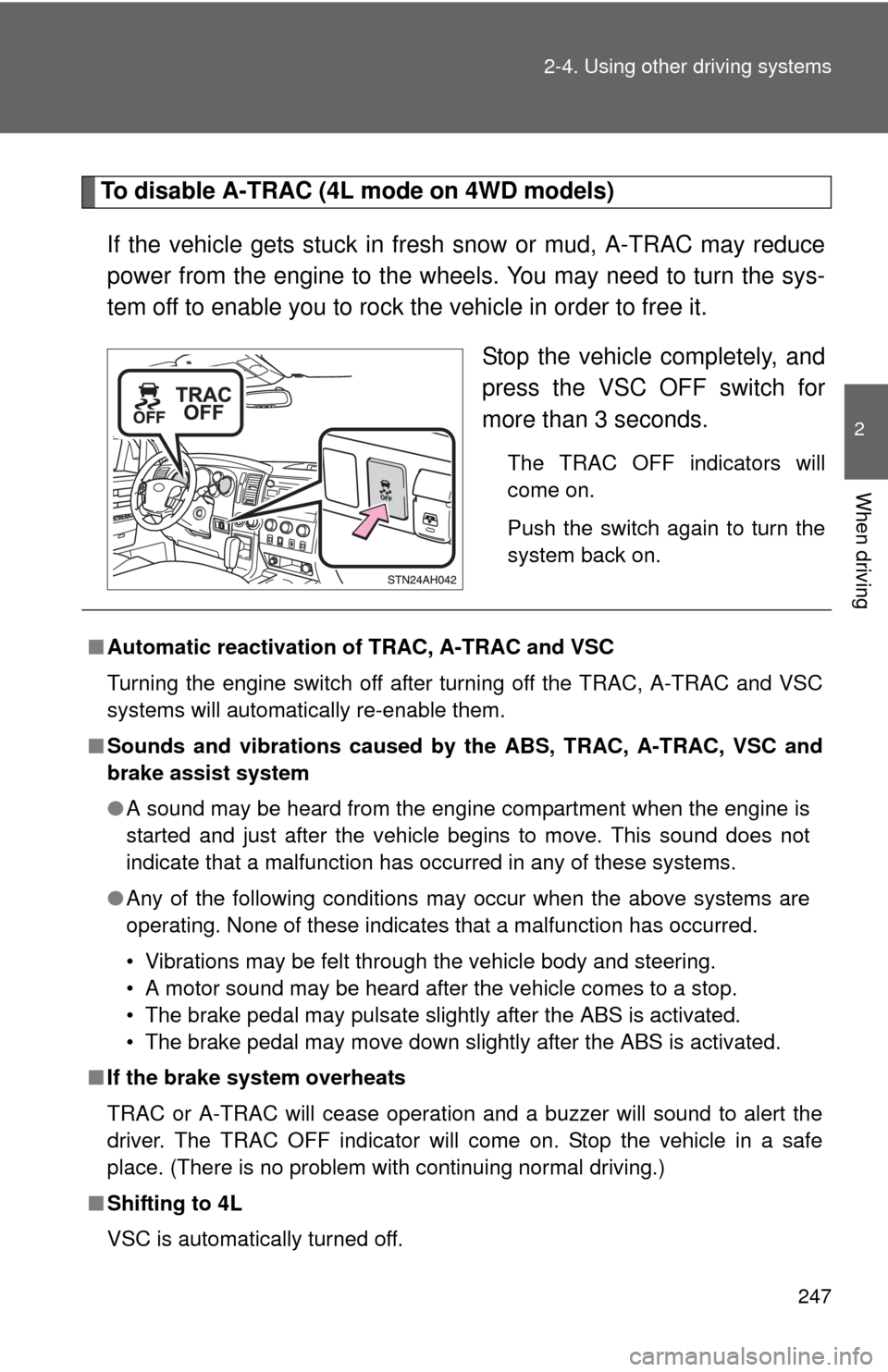
tem off to enable you to rock the vehicle in order to free it. Stop the vehicle completely, and
press the VSC OFF switch for
more than 3 seconds.
The TRAC OFF indicators will
come on.
Push the switch again to turn the
system back on.
■Automatic reactivation of TRAC, A-TRAC and VSC
Turning the engine switch off after turning off the TRAC, A-TRAC and VSC
systems will automatically re-enable them.
■ Sounds and vibrations caused by the ABS, TRAC, A-TRAC, VSC and
brake assist system
●A sound may be heard from the engine compartment when the engine is
started and just after the vehicle begins to move. This sound does not
indicate that a malfunction has occurred in any of these systems.
● Any of the following conditions may occur when the above systems are
operating. None of these indicates that a malfunction has occurred.
• Vibrations may be felt through the vehicle body and steering.
• A motor sound may be heard after the vehicle comes to a stop.
• The brake pedal may pulsate slightly after the ABS is activated.
• The brake pedal may move down slightly after the ABS is activated.
■ If the brake system overheats
TRAC or A-TRAC will cease operation and a buzzer will sound to alert the
driver. The TRAC OFF indicator will come on. Stop the vehicle in a safe
place. (There is no problem with continuing normal driving.)
■ Shifting to 4L
VSC is automatically turned off.
Page 254 of 724
254 2-5. Driving information
NOTICE
■To prevent the water damage
●Take all necessary safety measures to ensure that water damage to the
engine or other components does not occur.
● Water entering the engine air intake will cause severe engine damage.
● Water entering the automatic transmission will cause deterioration in shift
quality, locking up of your transmission accompanied by vibration, and ulti-
mately damage.
● Water can wash the grease from wheel bearings, causing rusting and pre-
mature failure, and may also enter the differentials, transmission and
transfer case, reducing the gear oil’s lubricating qualities.
■ When you drive through water
If driving through water, such as when crossing shallow streams, first check
the depth of the water and the bottom of the river bed for firmness. Drive
slowly and avoid deep water.
■ Inspection after off-road driving
●Sand and mud that has accumulate d in brake drums and around brake
discs may affect braking efficiency and may damage brake system compo-
nents.
● Always perform a maintenance inspection after each day of off-road driv-
ing that has taken you through rough terrain, sand, mud, or water. For
scheduled maintenance information, refer to the “Scheduled Maintenance
Guide” or “Owner’s Manual Supplement”.
Page 260 of 724
260
2-5. Driving information
Winter driving tips
Carry out the necessary preparations and inspections before driving
the vehicle in winter. Always drive the vehicle in a manner appropri-
ate to the prevailing weather conditions.
■ Pre-winter preparations
●Use fluids that are appropriate to the prevailing outside tem-
peratures.
• Engine oil
• Engine coolant
• Washer fluid
● Have a service technician inspect the level and specific grav-
ity of battery electrolyte.
● Have the vehicle fitted with four snow tires or purchase a set
of tire chains for the rear tires.
Ensure that all tires are the same size and brand, and that chains
match the size of the tires.
■Before driving the vehicle
Perform the following according to the driving conditions.
●Do not try to forcibly open a window, scrape an outside rear
view mirror surface or move a wiper or outside rear view mir-
ror that is frozen. Pour warm water over the frozen area to
melt the ice. Wipe away the water immediately to prevent it
from freezing.
● To ensure proper operation of th e climate control system fan,
remove any snow that has accumulated on the air inlet vents
in front of the windshield.
● Remove any ice that has accumu lated on the vehicle chassis.
● Periodically check for and remove any excess ice or snow
that may have accumulated in the wheel well or on the
brakes.
Page 261 of 724
261
2-5. Driving information
2
When driving
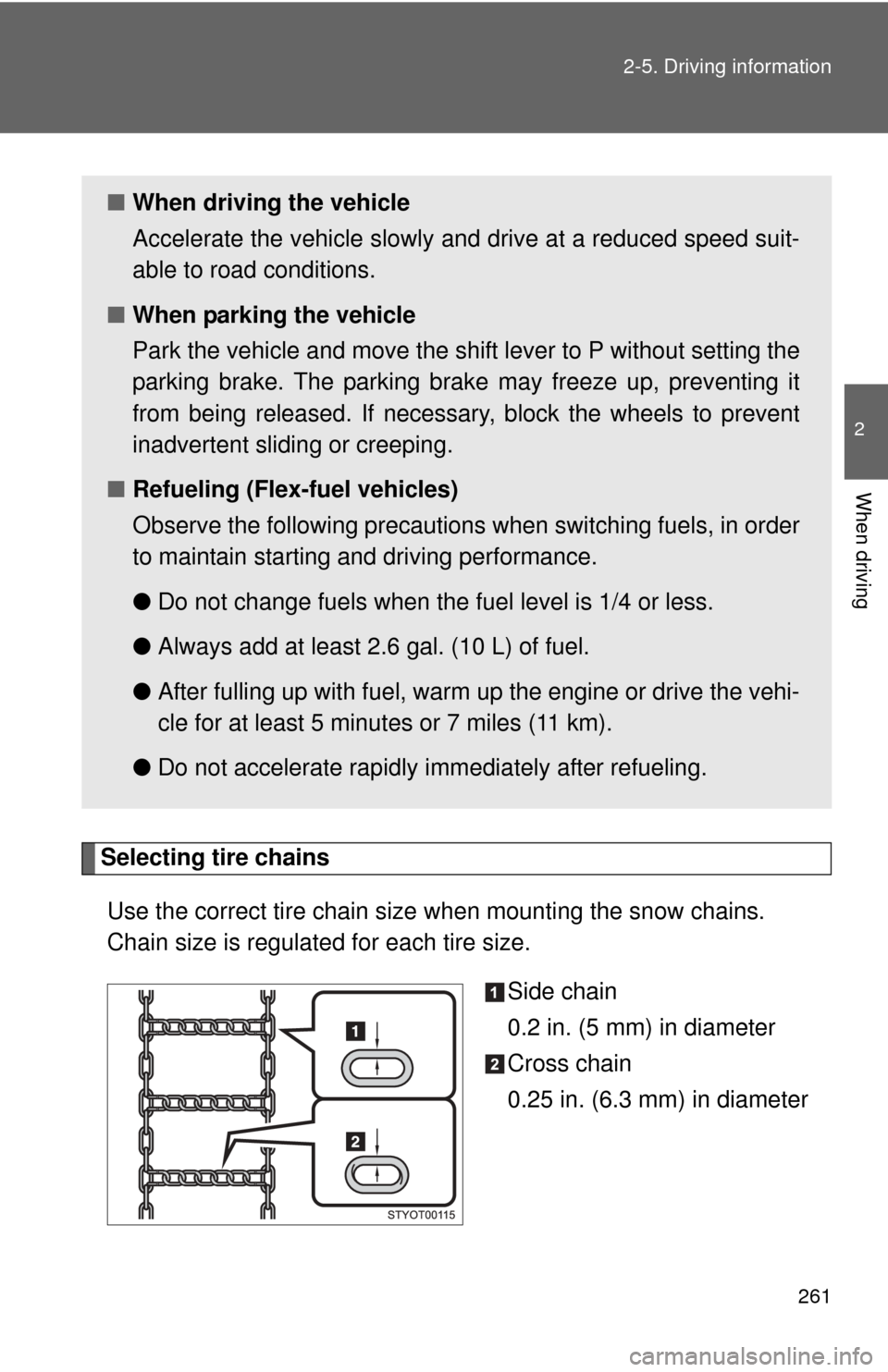
Selecting tire chains
Use the correct tire chain size when mounting the snow chains.
Chain size is regulated for each tire size. Side chain
0.2 in. (5 mm) in diameter
Cross chain
0.25 in. (6.3 mm) in diameter
■When driving the vehicle
Accelerate the vehicle slowly and drive at a reduced speed suit-
able to road conditions.
■ When parking the vehicle
Park the vehicle and move the shift lever to P without setting the
parking brake. The parking brak e may freeze up, preventing it
from being released. If necessary , block the wheels to prevent
inadvertent sliding or creeping.
■ Refueling (Flex-fuel vehicles)
Observe the following precautions when switching fuels, in order
to maintain starting and driving performance.
●Do not change fuels when the fuel level is 1/4 or less.
● Always add at least 2.6 gal. (10 L) of fuel.
● After fulling up with fuel, warm up the engine or drive the vehi-
cle for at least 5 minutes or 7 miles (11 km).
● Do not accelerate rapidly immediately after refueling.
Page 265 of 724
265
2-5. Driving information
2
When driving
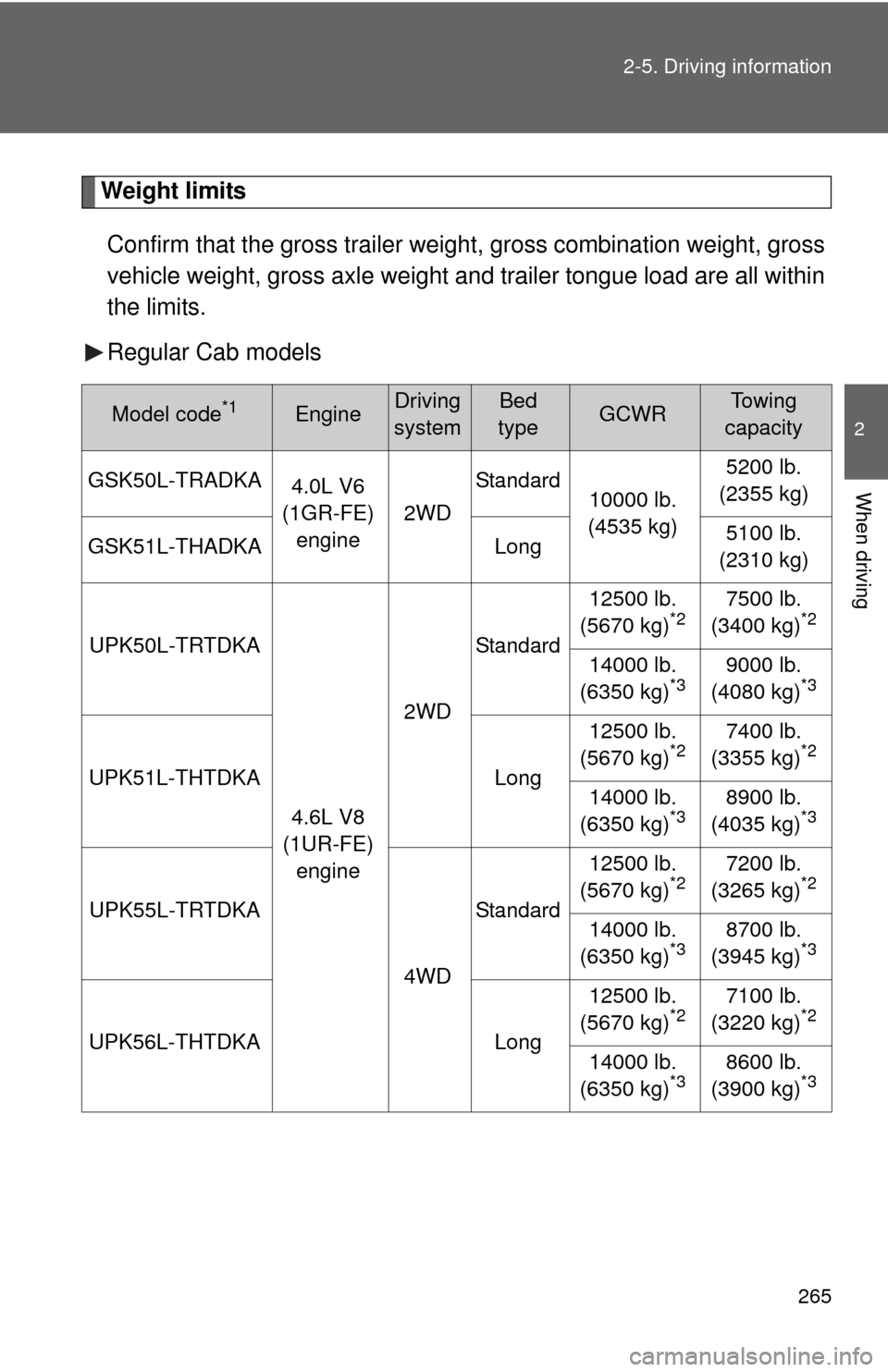
Weight limits
Confirm that the gross trailer weight, gross combination weight, gross
vehicle weight, gross axle weight and trailer tongue load are all within
the limits.
Regular Cab models
Model code*1EngineDriving
systemBed
typeGCWRTowing
capacity
GSK50L-TRADKA 4.0L V6
(1GR-FE) engine 2WDStandard
10000 lb.
(4535 kg) 5200 lb.
(2355 kg)
GSK51L-THADKA Long 5100 lb.
(2310 kg)
UPK50L-TRTDKA
4.6L V8
(1UR-FE) engine 2WD
Standard
12500 lb.
(5670 kg)
*27500 lb.
(3400 kg)*2
14000 lb.
(6350 kg)*39000 lb.
(4080 kg)*3
UPK51L-THTDKA Long12500 lb.
(5670 kg)
*27400 lb.
(3355 kg)*2
14000 lb.
(6350 kg)*38900 lb.
(4035 kg)*3
UPK55L-TRTDKA
4WDStandard
12500 lb.
(5670 kg)
*27200 lb.
(3265 kg)*2
14000 lb.
(6350 kg)*38700 lb.
(3945 kg)*3
UPK56L-THTDKA Long12500 lb.
(5670 kg)
*27100 lb.
(3220 kg)*2
14000 lb.
(6350 kg)*38600 lb.
(3900 kg)*3
Page 266 of 724
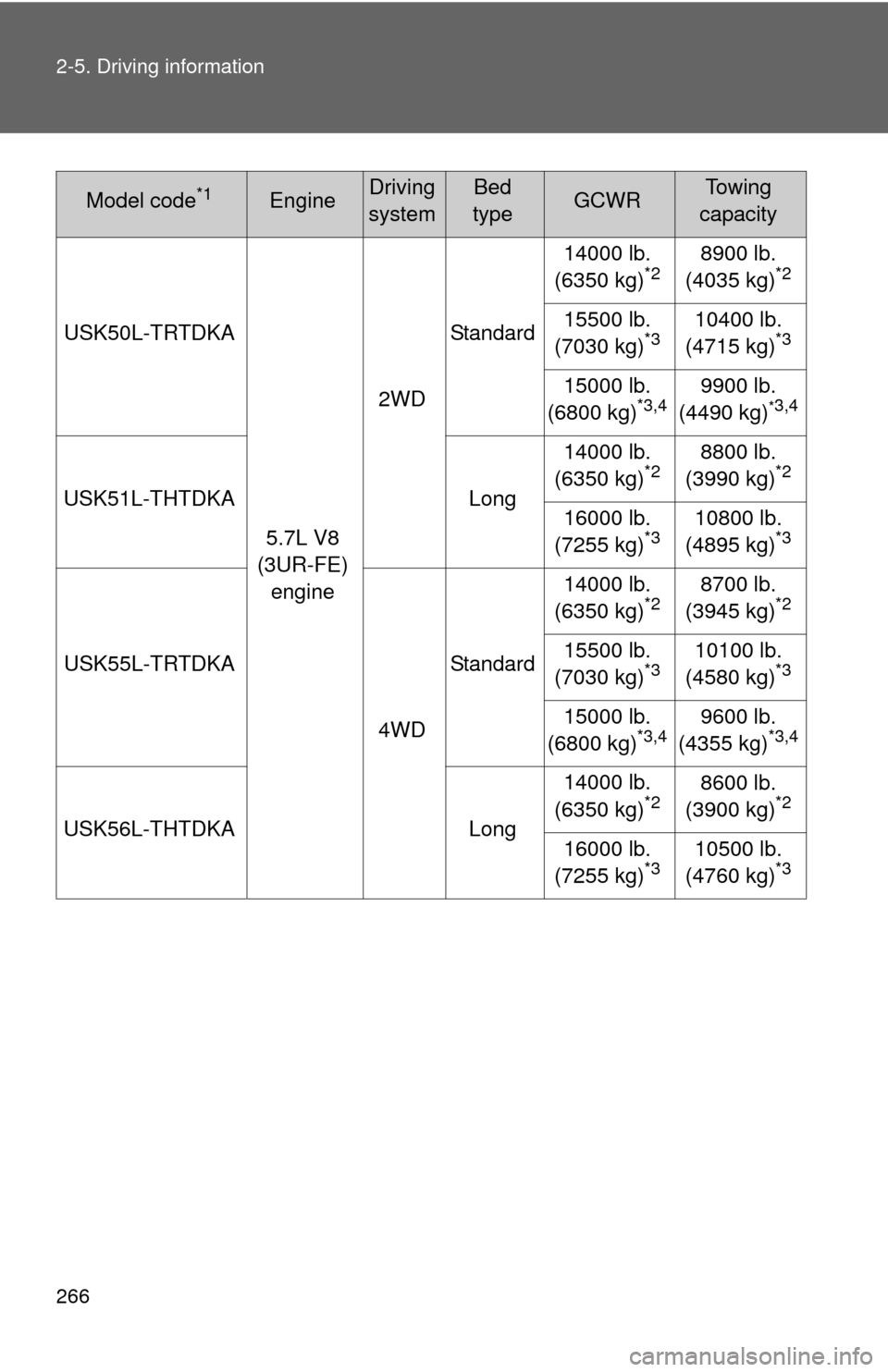
266 2-5. Driving information
USK50L-TRTDKA5.7L V8
(3UR-FE) engine 2WD
Standard 14000 lb.
(6350 kg)
*28900 lb.
(4035 kg)*2
15500 lb.
(7030 kg)*310400 lb.
(4715 kg)*3
15000 lb.
(6800 kg)*3,49900 lb.
(4490 kg)*3,4
USK51L-THTDKA Long14000 lb.
(6350 kg)
*28800 lb.
(3990 kg)*2
16000 lb.
(7255 kg)*310800 lb.
(4895 kg)*3
USK55L-TRTDKA
4WDStandard 14000 lb.
(6350 kg)
*28700 lb.
(3945 kg)*2
15500 lb.
(7030 kg)*310100 lb.
(4580 kg)*3
15000 lb.
(6800 kg)*3,49600 lb.
(4355 kg)*3,4
USK56L-THTDKA Long14000 lb.
(6350 kg)
*28600 lb.
(3900 kg)*2
16000 lb.
(7255 kg)*310500 lb.
(4760 kg)*3
Model code*1EngineDriving
systemBed
typeGCWRTowing
capacity
Page 267 of 724
267
2-5. Driving information
2
When driving
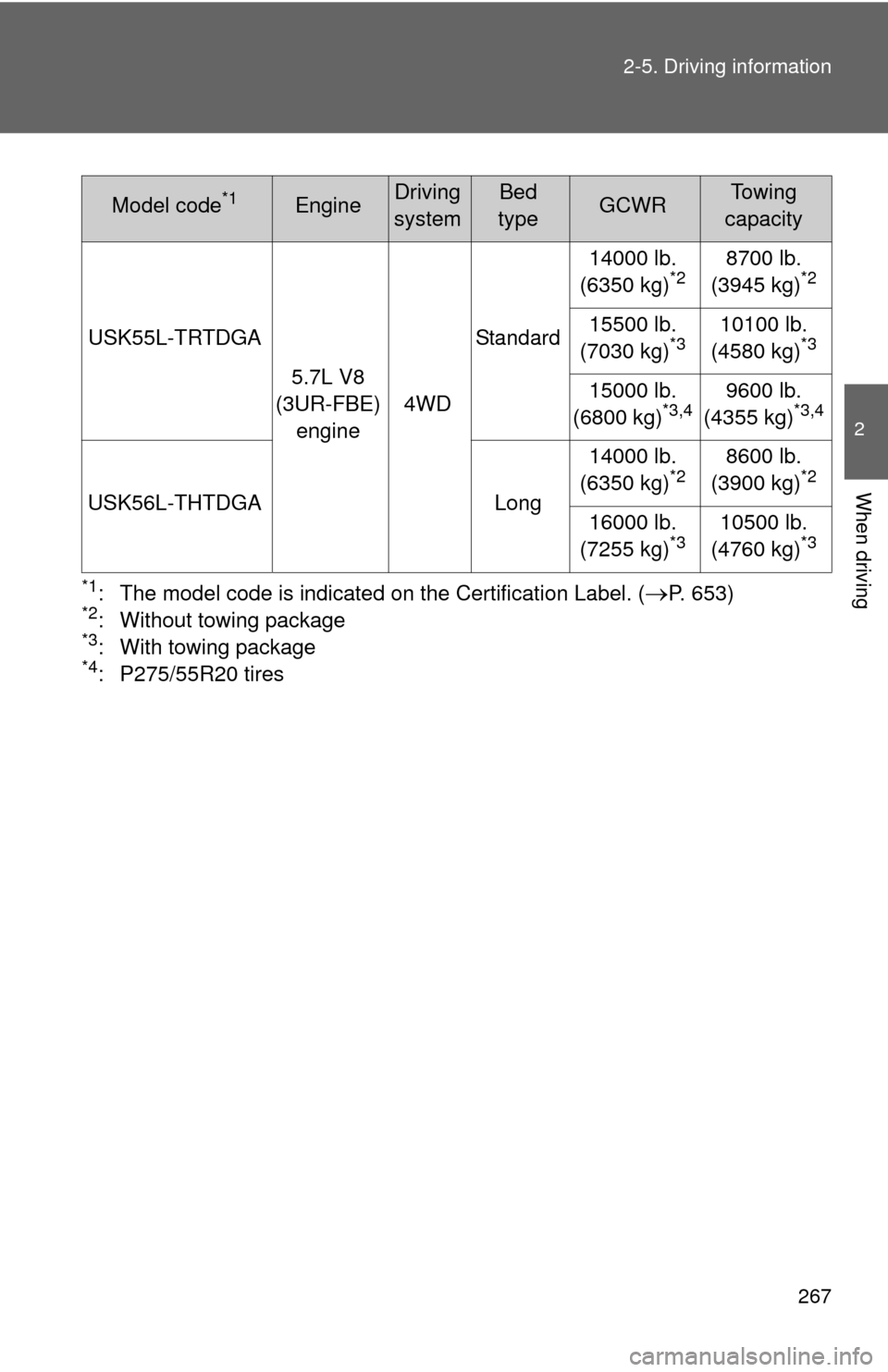
*1: The model code is indicated on the Certification Label. (P. 653)*2: Without towing package*3: With towing package*4: P275/55R20 tires
Model code*1EngineDriving
systemBed
typeGCWRTowing
capacity
USK55L-TRTDGA 5.7L V8
(3UR-FBE) engine 4WDStandard 14000 lb.
(6350 kg)
*28700 lb.
(3945 kg)*2
15500 lb.
(7030 kg)*310100 lb.
(4580 kg)*3
15000 lb.
(6800 kg)*3,49600 lb.
(4355 kg)*3,4
USK56L-THTDGA Long14000 lb.
(6350 kg)
*28600 lb.
(3900 kg)*2
16000 lb.
(7255 kg)*310500 lb.
(4760 kg)*3
Page 268 of 724
268 2-5. Driving information
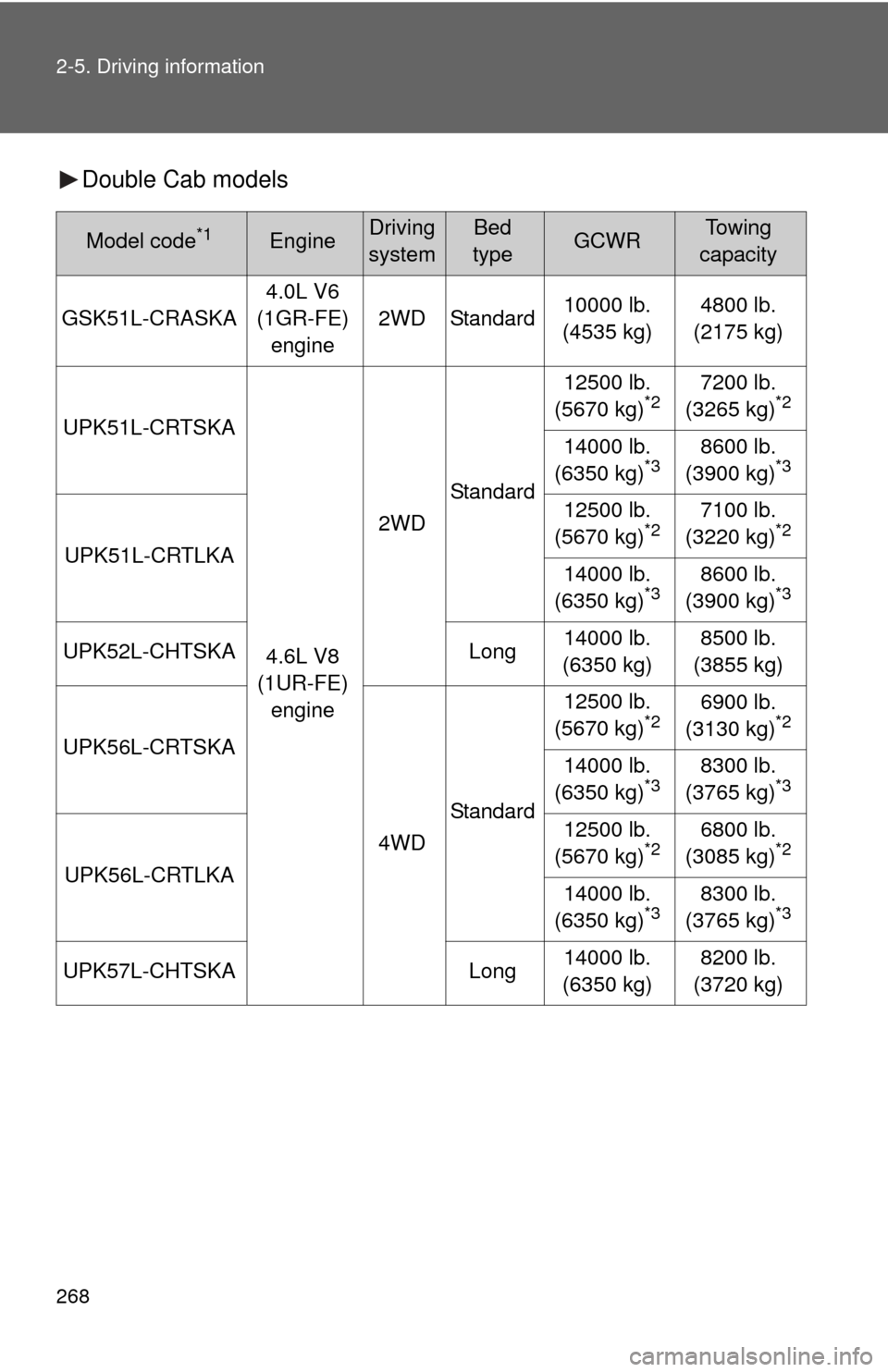
Double Cab models
Model code*1EngineDriving
systemBed
typeGCWRTowing
capacity
GSK51L-CRASKA 4.0L V6
(1GR-FE) engine 2WD Standard
10000 lb.
(4535 kg) 4800 lb.
(2175 kg)
UPK51L-CRTSKA
4.6L V8
(1UR-FE) engine 2WD
Standard 12500 lb.
(5670 kg)
*27200 lb.
(3265 kg)*2
14000 lb.
(6350 kg)*38600 lb.
(3900 kg)*3
UPK51L-CRTLKA 12500 lb.
(5670 kg)
*27100 lb.
(3220 kg)*2
14000 lb.
(6350 kg)*38600 lb.
(3900 kg)*3
UPK52L-CHTSKA Long14000 lb.
(6350 kg) 8500 lb.
(3855 kg)
UPK56L-CRTSKA
4WDStandard 12500 lb.
(5670 kg)
*26900 lb.
(3130 kg)*2
14000 lb.
(6350 kg)*38300 lb.
(3765 kg)*3
UPK56L-CRTLKA 12500 lb.
(5670 kg)
*26800 lb.
(3085 kg)*2
14000 lb.
(6350 kg)*38300 lb.
(3765 kg)*3
UPK57L-CHTSKA Long14000 lb.
(6350 kg) 8200 lb.
(3720 kg)