Page 426 of 513

5
When trouble arises
425
5-2. Steps to take in an emergency
■
If the malfunction indicator lamp comes on while driving
First check the following:
● Is the fuel tank empty?
If it is, fill the fuel tank immediately.
● Is the fuel tank cap loose?
If it is, tighten it securely.
The malfunction indicator lamp will go off after taking several driving trips.
If the malfunction indicator lamp does not go off even after several trips, con-
tact your Toyota dealer as soon as possible.
■ Front passenger detection sensor and passenger seat belt reminder
● If luggage is placed on the front passenger seat, the front passenger
detection sensor may cause the warning light to flash, even if a passen-
ger is not sitting in the seat.
● If a cushion is placed on the seat, the sensor may not detect a passen-
ger, and the warning light may not operate properly.
■ Changing the engine oil (U.S.A. only)
Make sure to reset the oil change system. ( P. 355)
■
The tire pressure warning light may turn on due to natural causes
The tire pressure warning light may turn on due to natural causes such
as natural air leaks or tire inflation pressure changes caused by temper-
ature. In this case, adjusting the ti re inflation pressure will turn off the
warning light (after a few minutes).
■When a tire is replaced with a spare tire (vehicles with a tire pres-
sure warning system)
The spare tire is also equipped with the tire pressure warning valve and
transmitter. The tire pressure warning li ght will turn on if the tire inflation
pressure of the spare tire is low. If a tire goes flat, even though the flat
tire is replaced with the spare tire, the tire pressure warning light does
not turn off. Replace the spare tire with the repaired tire and adjust the
proper tire inflation pressure. The ti re pressure warning light will turn off
after a few minutes.
Page 467 of 513
466 6-1. Specifications
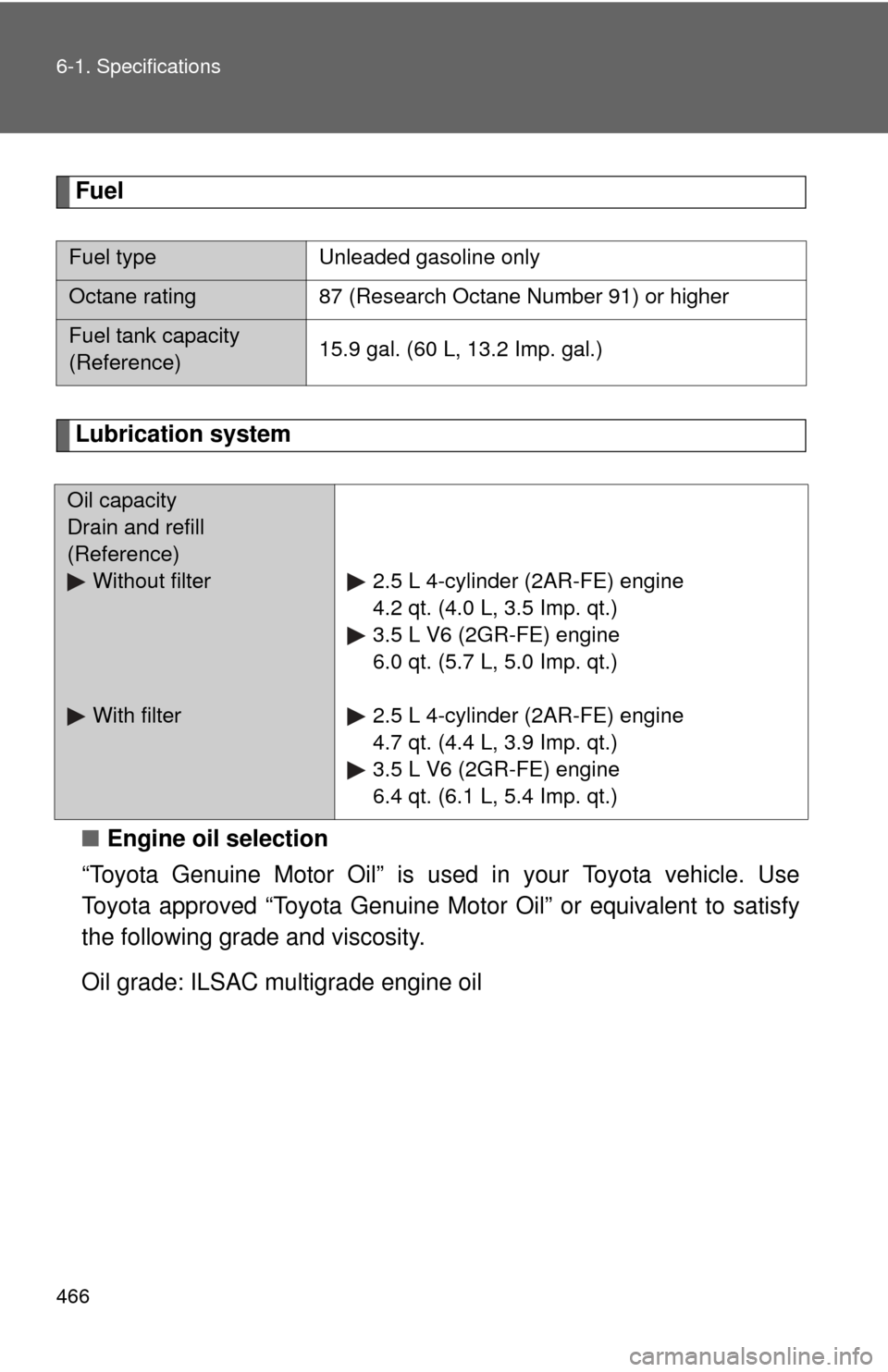
Fuel
Lubrication system■ Engine oil selection
“Toyota Genuine Motor Oil” is used in your Toyota vehicle. Use
Toyota approved “Toyota Genuine Motor Oil” or equivalent to satisfy
the following grade and viscosity.
Oil grade: ILSAC multigrade engine oil
Fuel type Unleaded gasoline only
Octane rating 87 (Research Octane Number 91) or higher
Fuel tank capacity
(Reference) 15.9 gal. (60 L, 13.2 Imp. gal.)
Oil capacity
Drain and refill
(Reference)
Without filter
With filter 2.5 L 4-cylinder (2AR-FE) engine
4.2 qt. (4.0 L, 3.5 Imp. qt.)
3.5 L V6 (2GR-FE) engine
6.0 qt. (5.7 L, 5.0 Imp. qt.)
2.5 L 4-cylinder (2AR-FE) engine
4.7 qt. (4.4 L, 3.9 Imp. qt.)
3.5 L V6 (2GR-FE) engine
6.4 qt. (6.1 L, 5.4 Imp. qt.)
Page 468 of 513

467
6-1. Specifications
6
Vehicle specifications
Recommended viscosity:
2.5 L 4-cylinder (2AR-FE) engine
SAE 5W-20 or 0W-20
SAE 5W-20 or 0W-20 engine oil
may be used. However, SAE
0W-20 is the best choice for
good fuel economy and good
starting in cold weather.
The 0W portion of the oil viscosity rating indicates the characteristic of the
oil which allows cold startability. Oils with a lower value before the W allow
for easier starting of the engine in cold weather.
The 20 in 0W-20 indicates the oil viscosity when the oil is at its operating
temperature. An oil with a higher viscosity may be better suited if the vehi-
cle is operated at high speeds, or under extreme load conditions.
3.5 L V6 (2GR-FE) engine
SAE 5W-30SAE 5W-30 is the best choice for
good fuel economy and good
starting in cold weather.
If SAE 5W-30 is not available,
SAE 10W-30 oil may be used.
However, it should be replaced
with SAE 5W-30 at the next oil
change.
The 5W portion of the oil viscosity rating indicates the characteristic of the
oil which allows cold startability. Oils with a lower value before the W allow
for easier starting of the engine in cold weather.
The 30 in 5W-30 indicates the oil viscosity when the oil is at its operating
temperature. An oil with a higher viscosity may be better suited if the vehi-
cle is operated at high speeds, or under extreme load conditions.
Outside temperature
Outside temperature
Page 469 of 513
468 6-1. Specifications
How to read oil container label:
The ILSAC (International Lubricant Standardization and Approval
Committee) Certification Mark is added to some oil containers to help
you select the oil you should use.
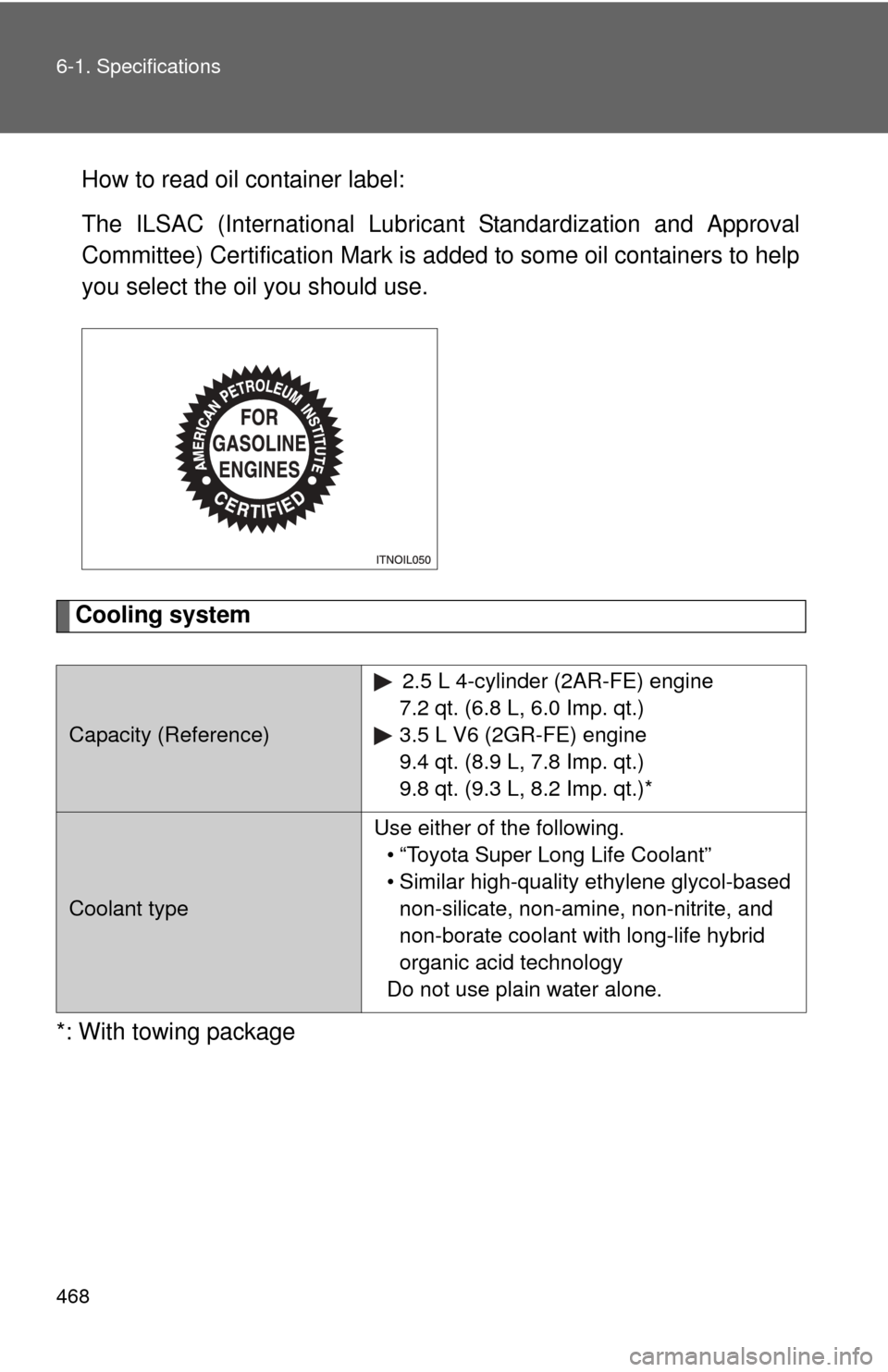
Cooling system
*: With towing package
Capacity (Reference) 2.5 L 4-cylinder (2AR-FE) engine
7.2 qt. (6.8 L, 6.0 Imp. qt.)
3.5 L V6 (2GR-FE) engine
9.4 qt. (8.9 L, 7.8 Imp. qt.)
9.8 qt. (9.3 L, 8.2 Imp. qt.)*
Coolant type Use either of the following.
• “Toyota Super Long Life Coolant”
• Similar high-quality ethylene glycol-based non-silicate, non-amine, non-nitrite, and
non-borate coolant with long-life hybrid
organic acid technology
Do not use plain water alone.
Page 470 of 513
469
6-1. Specifications
6
Vehicle specifications
Ignition system
Electrical system
Rear differential (4WD models)
Spark plug
Make
Gap
2.5 L 4-cylinder (2AR-FE) engine
DENSO, SK16HR11
3.5 L V6 (2GR-FE) engine
DENSO FK20HR11
0.043 in. (1.1 mm)
NOTICE
■ Iridium-tipped spark plugs
Use only iridium-tipped spark plugs. Do not adjust gap when tuning the
engine.
Battery
Open voltage* at
68 F (20 C): 12.6 12.8 V Fully charged
12.2 12.4 V Half charged
11 . 8
12.0 V Discharged
(*: Voltage is checked 20 minutes
after the engine and all the lights are
turned off)
Charging rates 5 A max.
Oil capacity0.5 qt. (0.5 L, 0.4 Imp. qt.)
Oil typeHypoid gear oil API GL-5
Recommended oil viscosityAbove 0
F (-18 C): SAE 90
Below 0 F (-18 C): SAE 80W or SAE
80W-90
Page 483 of 513
482 6-1. Specifications
Warning: The temperature grades for this tire are established for a
tire that is properly inflated and not overloaded.
Excessive speed, underinflation, or excessive loading, either sepa-
rately or in combination, can cause heat buildup and possible tire fail-
ure.
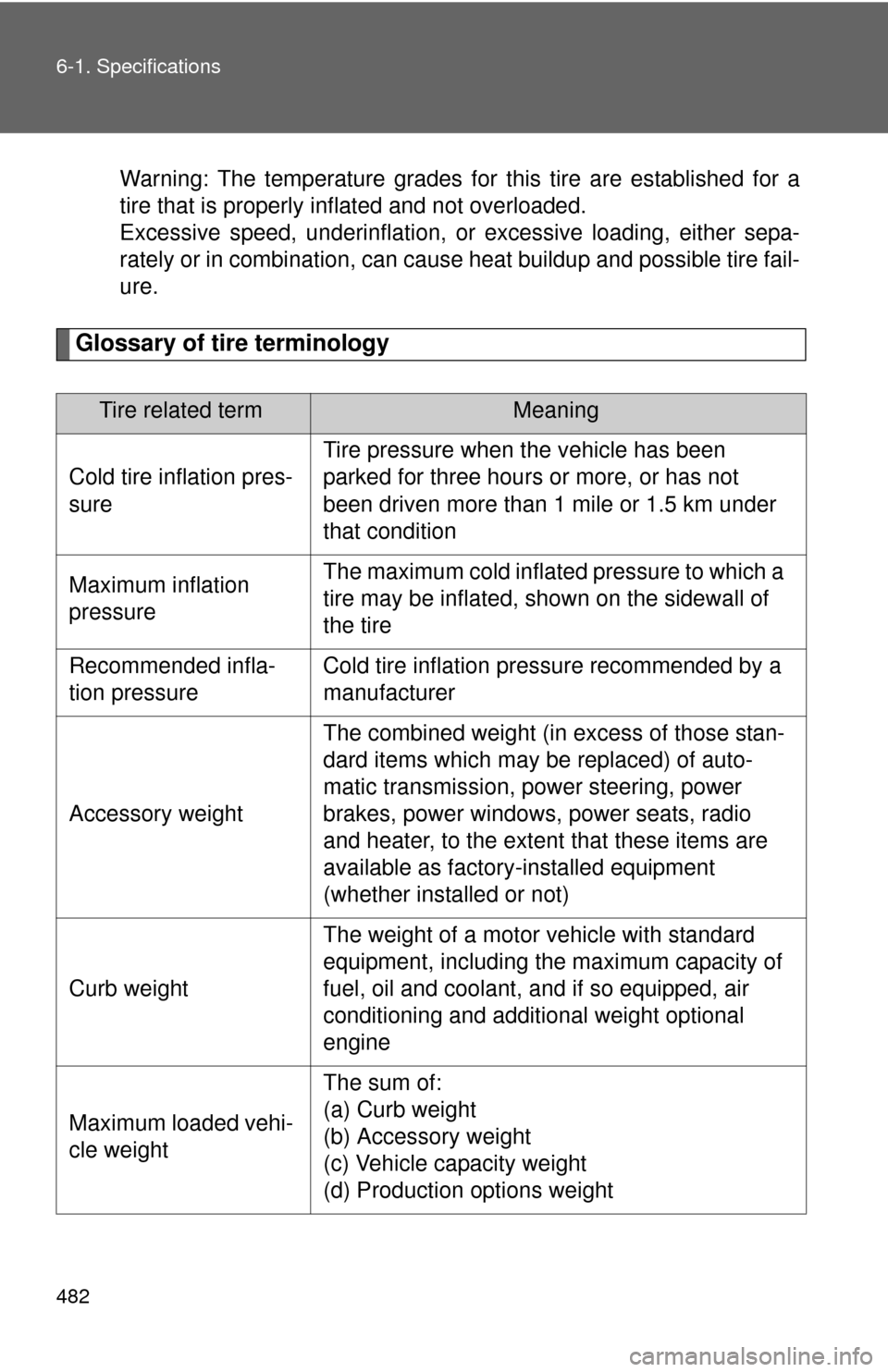
Glossary of tire terminology
Tire related termMeaning
Cold tire inflation pres-
sure Tire pressure when the vehicle has been
parked for three hours or more, or has not
been driven more than 1 mile or 1.5 km under
that condition
Maximum inflation
pressure The maximum cold inflated
pressure to which a
tire may be inflated, s hown on the sidewall of
the tire
Recommended infla-
tion pressure Cold tire inflation pressure recommended by a
manufacturer
Accessory weight The combined weight (in excess of those stan-
dard items which may be replaced) of auto-
matic transmission, power steering, power
brakes, power windows, power seats, radio
and heater, to the extent that these items are
available as factory-installed equipment
(whether installed or not)
Curb weight The weight of a motor vehicle with standard
equipment, including the maximum capacity of
fuel, oil and coolant, and if so equipped, air
conditioning and additional weight optional
engine
Maximum loaded vehi-
cle weight The sum of:
(a) Curb weight
(b) Accessory weight
(c) Vehicle capacity weight
(d) Production options weight
Page 492 of 513
491
6
Vehicle specifications
6-3. Initialization
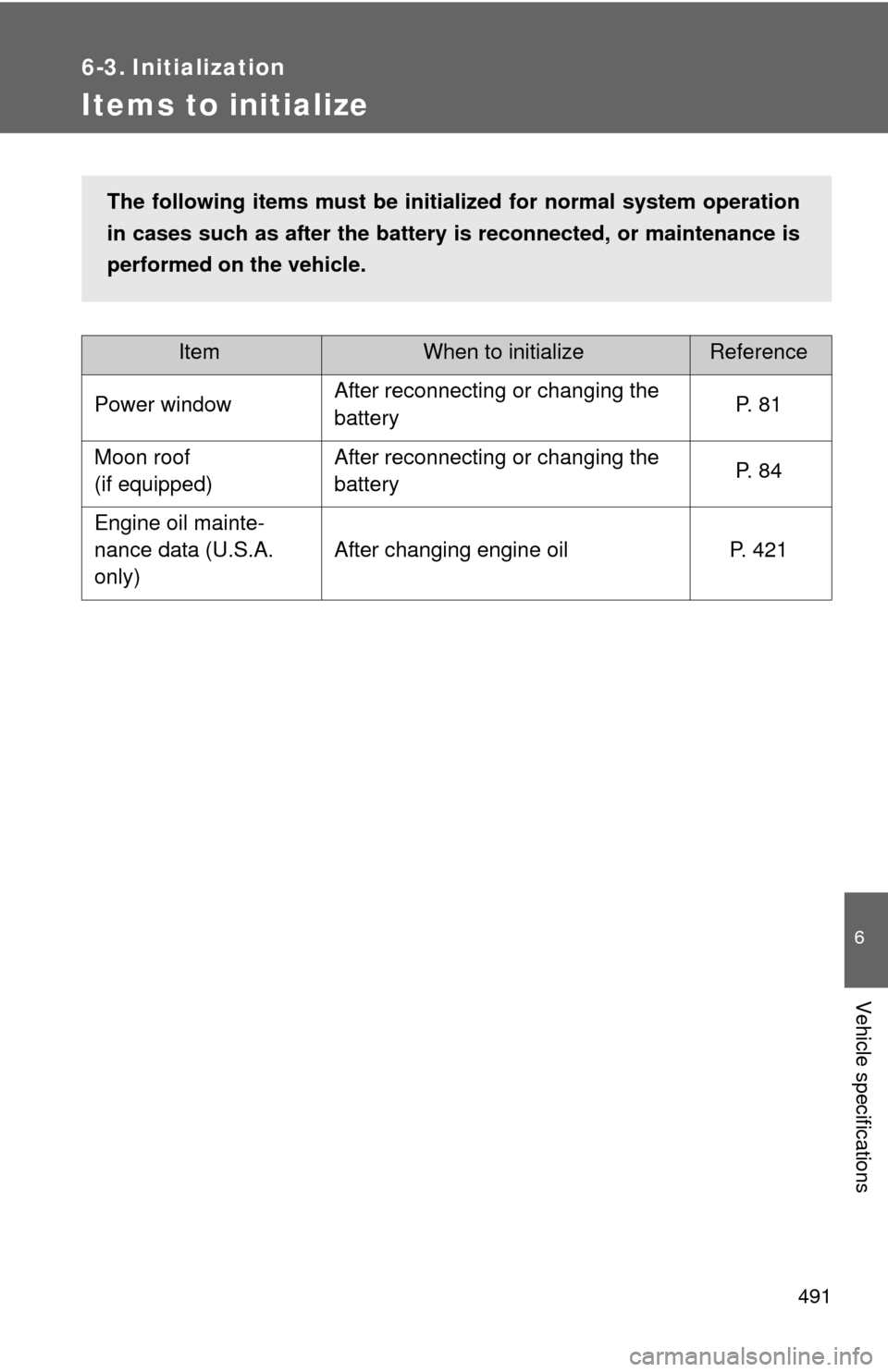
Items to initialize
ItemWhen to initializeReference
Power window After reconnecting or changing the
battery P. 8 1
Moon roof
(if equipped) After reconnecting or changing the
battery
P. 8 4
Engine oil mainte-
nance data (U.S.A.
only) After changing engine oil P. 421
The following items must be initia
lized for normal system operation
in cases such as after the battery is reconnected, or maintenance is
performed on the vehicle.
Page 503 of 513

502 Alphabetical index
DoorsDoor glasses ...........................81
Door lock ..................... 26, 38, 42
Side mirrors .............................79
Downhill assist control
system .................................... 189
Driver's seat belt reminder light ......................................... 421
Driving Break-in tips .......................... 135
Correct posture .......................96
Procedures ............................ 134
Winter driving tips.................. 206
Electric power steering ........... 180
Electronic key If your electronic key battery is discharged........... 451
Emergency flasher
Switch.................................... 406
Emergency, in case of If a warning buzzer
sounds... ............................ 418
If a warning light turns on ........................................ 418
If the electronic key does not operate properly............ 451
If the engine will not start ...... 448
If the shift lever cannot be
shifted ................................. 449
If the vehicle has a
discharged battery .............. 453
If you have a flat tire ............. 430
If you lose your keys ............. 450
If you think something is wrong .................................. 414
If your vehicle becomes
stuck ................................... 458
If your vehicle has to be stopped in an emergency ................. 459
If your vehicle needs to be towed .................................. 407
If your vehicle overheats ....... 456 Engine
Compartment ........................ 350
Engine switch ................ 143, 147
Hood ..................................... 346
How to start the
engine ......................... 143, 147
Identification number............. 464
If the engine will not start ...... 448
Ignition switch ............... 143, 147
Overheating .......................... 456
Engine compartment cover .... 352
Engine coolant
Capacity ................................ 468
Checking ............................... 357
Preparing and checking before winter ....................... 206
Engine coolan t temperature
gauge ...................................... 156
Engine immobilizer system ...... 92
Engine oil Capacity ................................ 466
Checking ............................... 353
Preparing and checking before winter ....................... 206
Engine oil maintenance data ......................................... 355
Enhanced vehicle stability control .................................... 180
Enhanced VSC ......................... 180
EPS............................................ 180
Event data recorder ................. 416
Floor mat .................................. 322
Fluid
Brake..................................... 358
Washer.................................. 364
E
F