Page 456 of 513
5
When trouble arises
455
5-2. Steps to take in an emergency
CAUTION
■
Avoiding battery fires or explosions
Observe the following precautions to prevent accidentally igniting the flam-
mable gas that may be emitted from the battery.
●Make sure the jumper cable is connected to the correct terminal and that it
is not unintentionally in contact with any part other than the intended termi-
nal.
● Do not allow the jumper cables to come into contact with the “+” and “-” ter-
minals.
● Do not smoke, use matches, cigarette lighters or allow open flame near
the battery.
■ Battery precautions
The battery contains poisonous and corrosive acidic electrolyte, while
related parts contain lead and lead compounds. Observe the following pre-
cautions when handling the battery.
●When working with the battery, always wear safety glasses and take care
not to allow any battery fluids (acid) to come into contact with skin, clothing
or the vehicle body.
● Do not lean over the battery.
● In the event that battery fluid comes into contact with the skin or eyes,
immediately wash the affected area with water and seek medical attention.
Place a wet sponge or cloth over the affected area until medical attention
can be received.
● Always wash your hands after handling the battery support, terminals, and
other battery-related parts.
● Do not allow children near the battery.
NOTICE
■When handling jumper cables
Be careful that the jumper cables do not become tangled in the cooling fans
or any of the belts when connecting or disconnecting them.
Page 457 of 513
456
5-2. Steps to take in an emergency
If your vehicle overheats
If your engine overheats:
Stop the vehicle in a safe place and turn off the air condi-
tioning system.
Check to see if steam is coming out from under the hood.
If you see steam: Stop the engine. Carefully lift the hood after the steam
subsides and then restart the engine.
If you do not see steam: Leave the engine running and carefully lift the hood.
Check to see if the cooling fans are operating.
If the fans are operating: Wait until the temperature of the engine (shown on the
instrument cluster) begins to fall and then stop the
engine.
If the fans are not operating: Stop the engine and call your Toyota dealer.
After the engine has cooled
down sufficiently, check the
engine coolant level and
inspect the radiator core (radi-
ator) for any leaks.
Add engine coolant if neces-
sary.
Water can be used in an emer-
gency if engine coolant is
unavailable.
( P. 468)
STEP 1
STEP 2
STEP 3
STEP 5 STEP 4
STEP 5
Page 469 of 513
468 6-1. Specifications
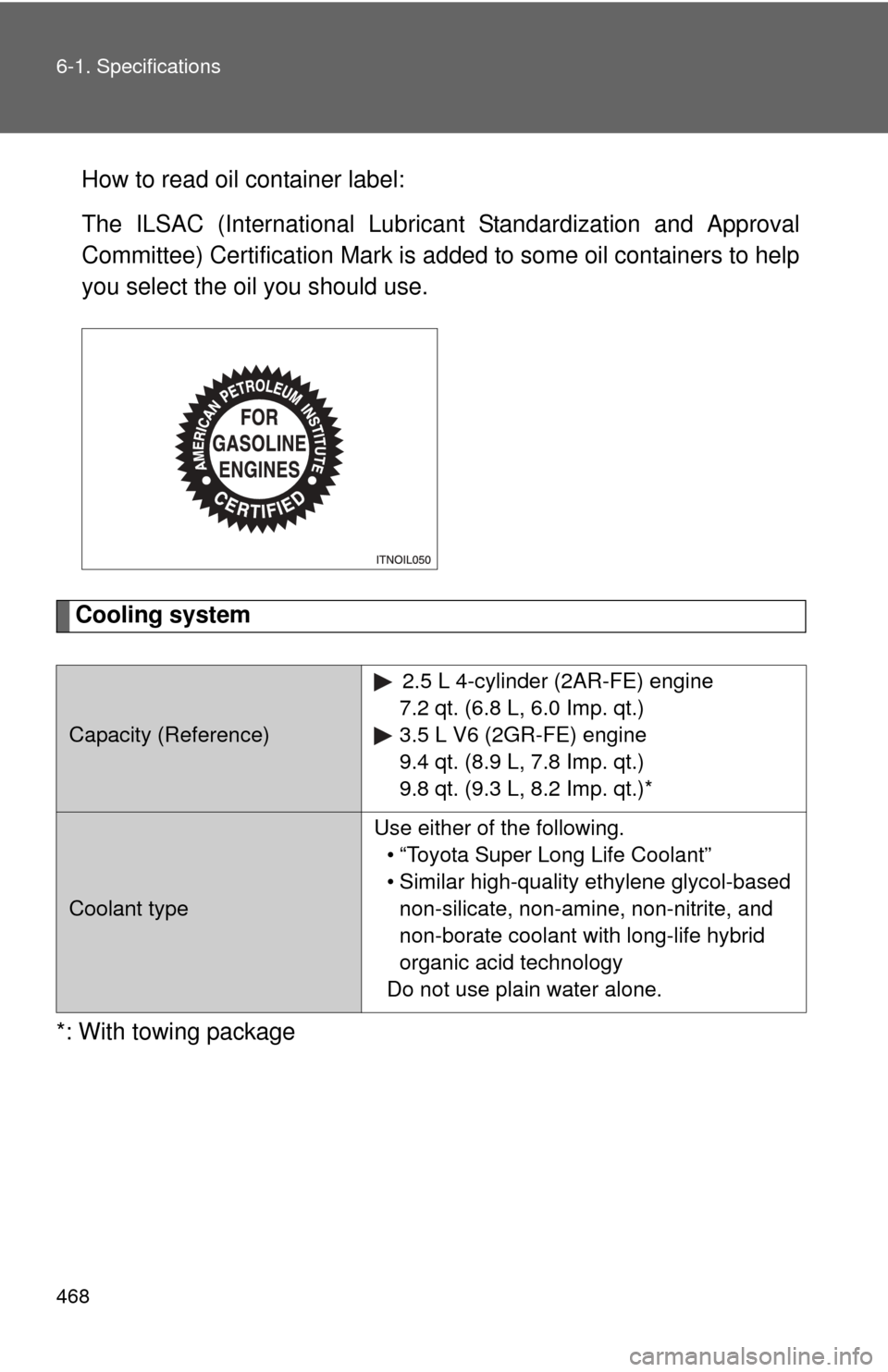
How to read oil container label:
The ILSAC (International Lubricant Standardization and Approval
Committee) Certification Mark is added to some oil containers to help
you select the oil you should use.
Cooling system
*: With towing package
Capacity (Reference) 2.5 L 4-cylinder (2AR-FE) engine
7.2 qt. (6.8 L, 6.0 Imp. qt.)
3.5 L V6 (2GR-FE) engine
9.4 qt. (8.9 L, 7.8 Imp. qt.)
9.8 qt. (9.3 L, 8.2 Imp. qt.)*
Coolant type Use either of the following.
• “Toyota Super Long Life Coolant”
• Similar high-quality ethylene glycol-based non-silicate, non-amine, non-nitrite, and
non-borate coolant with long-life hybrid
organic acid technology
Do not use plain water alone.
Page 502 of 513

501
Alphabetical index
Care
Exterior ................................. 330
Interior .................................. 333
Seat belts ............................. 334
Cargo capacity ........................ 204
Cargo hooks ............................ 323
CD changer .............................. 245
CD player ................................. 245
Chains ...................................... 206
Child restraint system Booster seats, definition ....... 117
Booster seats, installation .... 121
Convertible seats, definition............................. 117
Convertible seats, installation .......................... 121
Front passenger occupant
classification system .......... 111
Infant seats, definition .......... 117
Infant seats, installation ........ 121
Installing CRS with LATCH anchors ................. 123
Installing CRS with seat
belts ................................... 125
Installing CRS with a top tether strap ......................... 128
Child safety Airbag precautions ............... 105
Battery precautions ...... 362, 455
Child restraint system ........... 117
Child-protectors ...................... 44
How your child should wear the seat belt ......................... 72
Installing child restraints ....... 121
Moon roof precautions............ 87 Power window lock switch.......81
Power window precautions .....83
Removed key battery
precautions .........................382
Seat belt extender
precautions ...........................75
Seat belt precautions ..............73
Seat heater precautions ........318
Child-protectors .........................44
Cleaning Exterior ..................................330
Interior ...................................333
Seat belts ..............................334
Clock .........................................314
Condenser ................................358
Console box .............................306
Cooling system
Engine overheating ...............456
Cruise control...........................172
Cup holders ..............................308
Curtain shield airbags ...............98
Customizable features.............488
Daytime running light system ....................................166
Defogger Rear window .........................233
Side mirrors ...........................233
Dimensions...............................462
Dinghy towing ..........................218
Display Trip information .....................162
Do-it-yourself main tenance.....342
Door courtesy lights
Door courtesy lights ..............300
Wattage .................................473C
D