Page 423 of 592

423
4-2. Maintenance
4
Maintenance and care
L/C200_U
Emission inspection and maintenance (I/M) programs
Some states have vehicle emission inspection programs which
include OBD (On Board Diagnostics) checks. The OBD system moni-
tors the operation of the emission control system.
■If the malfunction indicator lamp comes on
The OBD system determines that a problem exists somewhere
in the emission control system. Your vehicle may not pass the I/
M test and may need to be repaired. Contact your Toyota dealer
to service the vehicle.
■ Your vehicle may not pass the I/M test:
●When the battery is disconnected or discharged
Readiness codes that are se t during ordinary driving are
erased.
Also, depending on your driving habits, the readiness codes
may not be completely set.
● When the fuel tank cap is loose
The malfunction indicator lamp comes on as a temporary mal-
function and your vehicle may not pass the I/M test.
■ When the malfunction indicator lamp goes off after several
driving trips
The error code in the OBD system will not be cleared unless the
vehicle is driven 40 or more times.
■ If your vehicle does not pass the I/M test
Contact your Toyota dealer to prepare the vehicle for re-testing.
Page 424 of 592

424
L/C200_U
4-3. Do-it-yourself maintenance
Do-it-yourself ser vice precautions
If you perform maintenance yourself, be sure to follow the correct
procedure given in these sections.
ItemsParts and tools
Battery condition ( P. 4 3 9)
•Warm water
• Baking soda
• Grease
• Conventional wrench
(for terminal clamp bolts)
Brake fluid level ( P. 436)
• FMVSS No.116 DOT 3 or SAE
J1703 brake fluid
• Rag or paper towel
• Funnel (used only for adding brake fluid)
Engine coolant level ( P. 434)
• “Toyota Super Long Life Coolant”
or similar high quality ethylene
glycol based non-silicate, non-
amine, non-nitrite and non-borate
coolant with long-life hybrid
organic acid technology.
“Toyota Super Long Life Cool-
ant” is pre-mixed with 50% cool-
ant and 50% deionized water.
• Funnel (used only for adding cool- ant)
Engine oil level ( P. 430)
• “Toyota Genuine Motor Oil” or
equivalent
• Rag or paper towel
• Funnel (used only for adding engine oil)
Fuses ( P. 464)• Fuse with same amperage rating
as original
Page 426 of 592

426 4-3. Do-it-yourself maintenance
L/C200_U
CAUTION
The engine compartment contains many mechanisms and fluids that may
move suddenly, become hot, or become electrically energized. To avoid death
or serious injury.
■When working on the engine compartment
● Keep hands, clothing, and tools away from the moving fan and engine
drive belt.
● Be careful not to touch the engine, inverter, radiator, exhaust manifold, etc.
right after driving as they may be hot. Oil and other fluids may also be hot.
● Do not leave anything that may burn easily, such as paper or rags, in the
engine compartment.
● Do not smoke, cause sparks or expose an open flame to fuel or the bat-
tery. Fuel and battery fumes are flammable.
● Be extremely cautious when working on the battery. It contains poisonous
and corrosive sulfuric acid.
■ When working near the electric cooling fan or radiator grille
Be sure the “ENGINE START STOP” switch is OFF.
With the “ENGINE START STOP” switch in IGNITION ON mode, the electric
cooling fan may automatically start to run if the air conditioning is on and/or if
the coolant temperature is high. ( P. 435)
■ When working on or under the vehicle
● Do not get under the vehicle with just the jack supporting it.
Always use automotive jack stands or other solid supports.
● Use eye protection to prevent flying or falling material, fluid spray, etc. from
getting in your eyes.
NOTICE
■If you remove the air cleaner filter
Driving with the air cleaner filter removed may cause excessive engine wear
due to dirt in the air. Also a backfire could cause a fire in the engine compart-
ment.
Page 428 of 592
428
4-3. Do-it-yourself maintenance
L/C200_U
Engine compar tment
Power steering fluid reser-
voir (P. 438)
Engine oil level dipstick ( P. 430)
Engine coolant reservoir ( P. 434)
Cooling fans
Engine oil filler cap ( P. 431)Brake fluid reservoir
( P. 436)
Fuse box ( P. 464)
Washer fluid tank ( P. 442)
Battery ( P. 439)
Condenser ( P. 435)
Radiator ( P. 435)
Page 439 of 592
439
4-3. Do-it-yourself maintenance
4
Maintenance and care
L/C200_U
Battery
■ Exterior
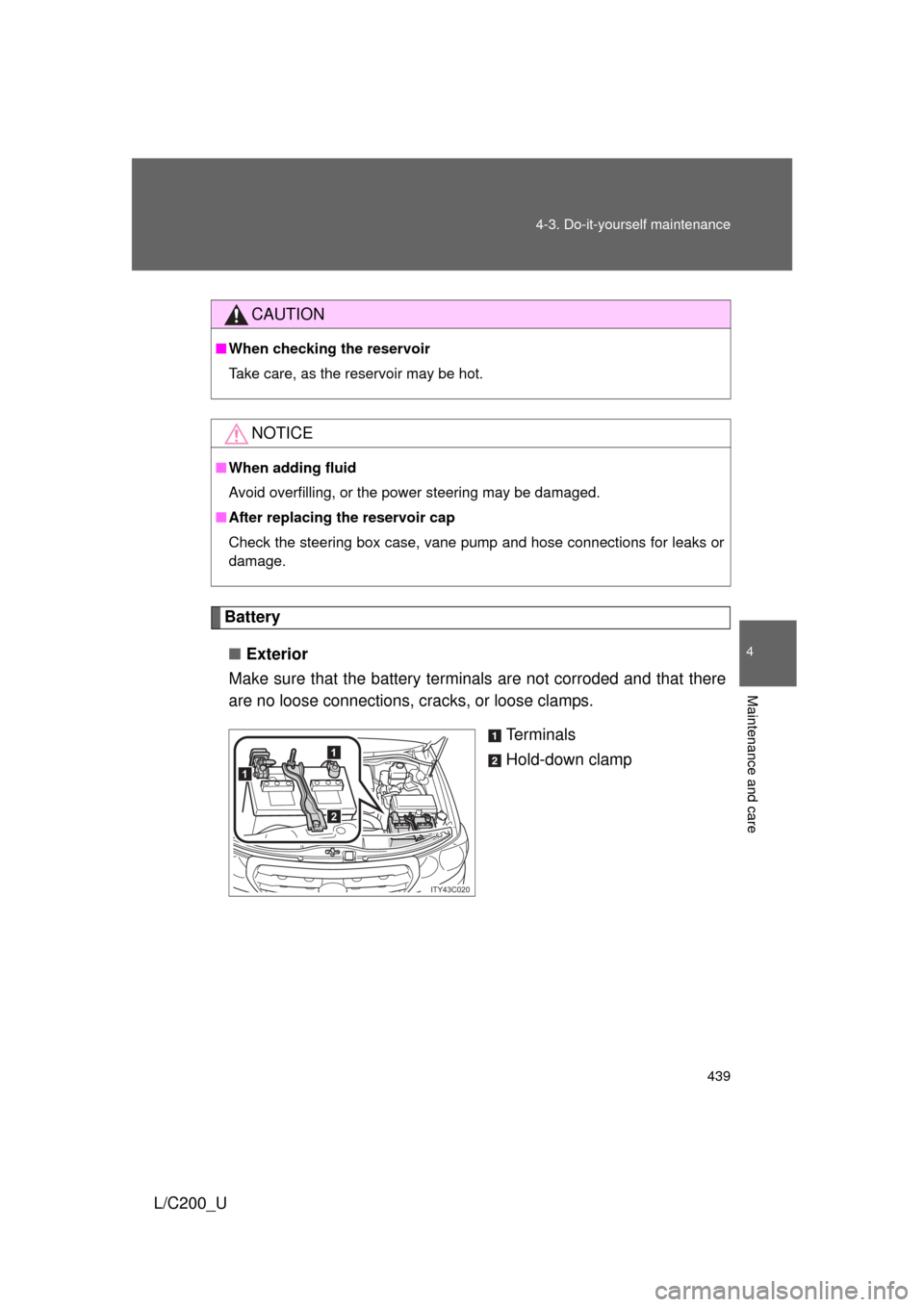
Make sure that the battery terminals are not corroded and that there
are no loose connections, cracks, or loose clamps.
Te r m i n a l s
Hold-down clamp
CAUTION
■When checking the reservoir
Take care, as the reservoir may be hot.
NOTICE
■When adding fluid
Avoid overfilling, or the power steering may be damaged.
■ After replacing the reservoir cap
Check the steering box case, vane pump and hose connections for leaks or
damage.
1
1
2
ITY43C020
Page 440 of 592
440 4-3. Do-it-yourself maintenance
L/C200_U■
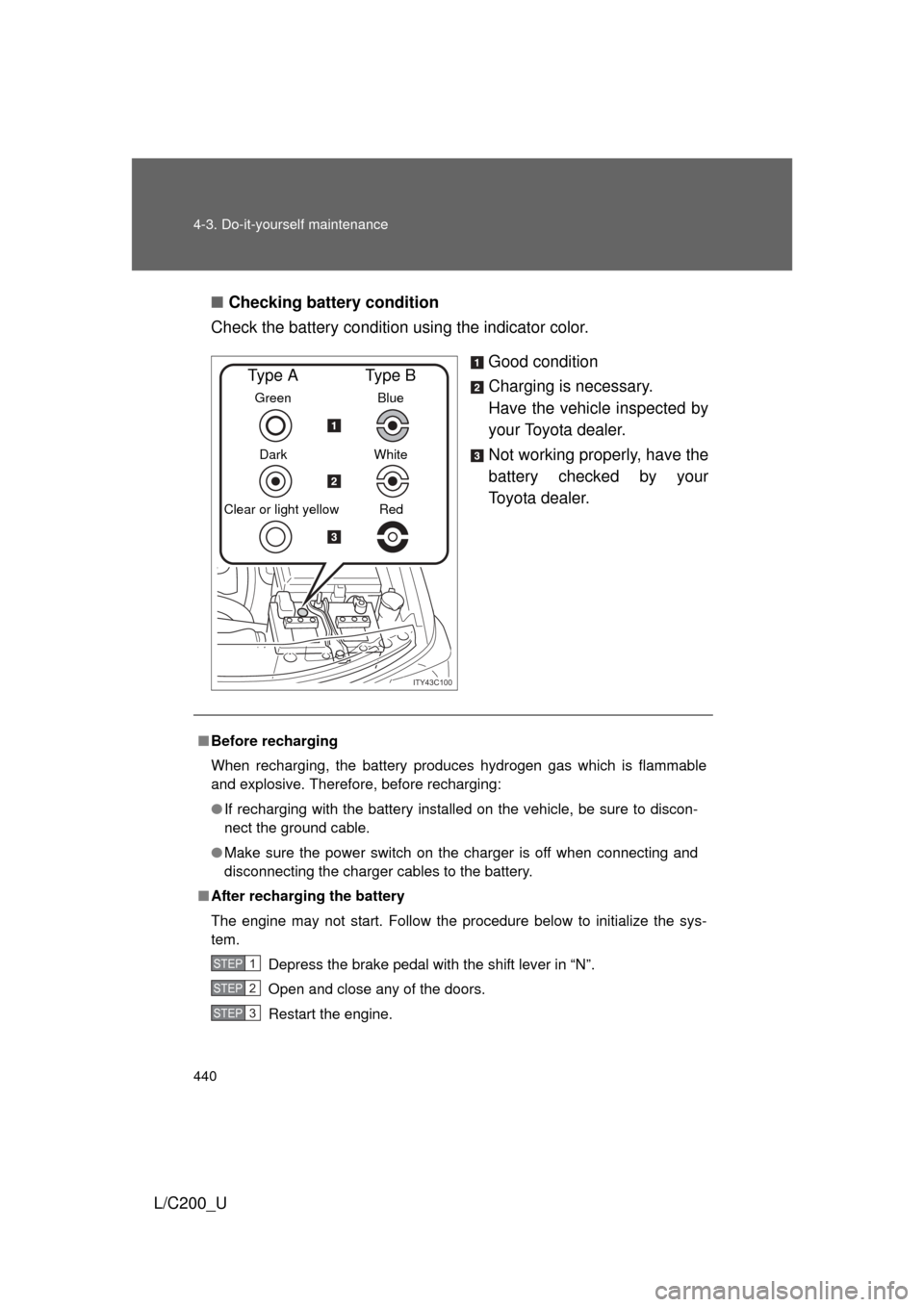
Checking battery condition
Check the battery condition using the indicator color.
Good condition
Charging is necessary.
Have the vehicle inspected by
your Toyota dealer.
Not working properly, have the
battery checked by your
Toyota dealer.
ITY43C100
Green
Dark
Clear or light yellow
Type A
Blue
White Red
Type B
■ Before recharging
When recharging, the battery produces hydrogen gas which is flammable
and explosive. Therefore, before recharging:
● If recharging with the battery installed on the vehicle, be sure to discon-
nect the ground cable.
● Make sure the power switch on the charger is off when connecting and
disconnecting the charger cables to the battery.
■ After recharging the battery
The engine may not start. Follow the procedure below to initialize the sys-
tem.
Depress the brake pedal with the shift lever in “N”.
Open and close any of the doors.
Restart the engine.
STEP1
STEP2
STEP3
Page 441 of 592

441
4-3. Do-it-yourself maintenance
4
Maintenance and care
L/C200_U
CAUTION
■
Chemicals in the battery
A battery contains poisonous and corrosive sulfuric acid and may produce
hydrogen gas which is flammable and explosive. To reduce the risk of death
or serious injury, take the following precautions while working on or near bat-
tery:
● Do not cause sparks by touching the battery terminals with tools.
● Do not smoke or light a match near the battery.
● Avoid contact with eyes, skin and clothes.
● Never inhale or swallow electrolyte.
● Wear protective safety glasses when working near the battery.
● Keep children away from the battery.
■ Where to safely charge the battery
Always charge the battery in an open area. Do not charge the battery in a
garage or closed room where there is not sufficient ventilation.
■ How to recharge the battery
Only perform a slow charge (5A or less). The battery may explode if charged
at a quicker rate.
■ Emergency measures regarding electrolyte
● If electrolyte gets in your eyes
Flush your eyes with clean water for at least 15 minutes and get immedi-
ate medical attention. If possible, continue to apply water with a sponge or
cloth while traveling to the nearest medical facility.
● If electrolyte gets on your skin
Wash the affected area thoroughly. If you feel pain or a burning sensation,
seek medical attention immediately.
● If electrolyte gets on your clothes
It can soak through clothing on to your skin. Immediately take off the cloth-
ing and follow the procedure above if necessary.
● If you accidentally swallow electrolyte
Drink a large quantity of water or milk. Get emergency medical attention
immediately.
Page 442 of 592
442 4-3. Do-it-yourself maintenance
L/C200_U
Washer fluidIf any washer does not work or
the warning message appears
on the multi-information display,
the washer tank may be empty.
Add washer fluid.
NOTICE
■When recharging the battery
Never recharge the battery while the engine is running. Also, be sure all
accessories are turned off.
CAUTION
■When refilling the washer fluid
Do not refill the washer fluid when the engine is hot or running, as the
washer fluid contains alcohol and may catch fire if spilled on the engine etc.
NOTICE
■Do not use any fluid other than washer fluid
Do not use soapy water or engine antifreeze instead of washer fluid.
Doing so may cause streaking on the vehicle’s painted surfaces.
■ Diluting washer fluid
Dilute washer fluid with water as necessary.
Refer to the freezing temperatures listed on the washer fluid tank.