Page 4 of 439

TABLE OF CONTENTSIndex
4
3-5. Other interior features
Sun visors .......................... 254
Vanity mirrors ..................... 255
Clock .................................. 256
Outside temperature
display .............................. 257
Power outlet (12V DC) ....... 258
Power outlet (115V AC) ..... 259
Armrest............................... 265
Floor mat ............................ 266
Luggage storage box
(vehicles without sub
woofer) ............................. 267
Luggage compartment
features ............................ 268
Compass ............................ 271
4-1. Maintenance and care
Cleaning and protecting
the vehicle exterior ........... 278
Cleaning and protecting
the vehicle interior ............ 280
4-2. Maintenance
Maintenance
requirements .................... 283
General maintenance ......... 285
Emission inspection and
maintenance (I/M)
programs .......................... 2884-3. Do-it-yourself maintenance
Do-it-yourself service
precautions ....................... 289
Hood ................................... 293
Engine compartment .......... 294
Tires.................................... 308
Tire inflation pressure ......... 313
Wheels................................ 317
Air conditioning filter ........... 319
Key battery ......................... 322
Checking and replacing
fuses ................................. 324
Light bulbs .......................... 335
5-1. Essential information
Emergency flashers ............ 344
If your vehicle needs to be
towed ................................ 345
If you think something is
wrong ................................ 350
Fuel pump shut off
system .............................. 351
Event data recorder ............ 352
4Maintenance and care
5When trouble arises
Page 258 of 439
258
3-5. Other interior features
Power outlet (12V DC)
■The power outlet can be used when
The engine switch is in the ACC or ON position.
NOTICE
■To avoid damaging the power outlet
Close the power outlet lid when not in use.
Foreign objects or liquids that enter the power outlet may cause a short cir-
cuit.
■To prevent the fuse from being blown
Do not use an accessory that uses more than 12V/10A.
■To prevent the battery discharge
Do not use the power outlet longer than necessary when the engine is not
running.
The power outlet can be used for 12 V accessories that run on less
than 10A.
Page 263 of 439

263 3-5. Other interior features
3
Interior features
CAUTION
■To prevent injuries and accidents, securely fix all electric appliances
before use and do not use any appliances that may do any of the fol-
lowing:
●Distract the driver while driving, or hamper safe driving.
●Result in a fire or burn injuries due to the appliance rolling, falling or over-
heating while driving.
●Emit steam, while the windows of the cabin are closed.
■To prevent unexpected accidents, such as electric shocks, do not per-
form any of the following.
●Using the power outlet for electric heaters while sleeping.
●Contaminating the power outlet with liquid substances or mud.
●Handling electrical appliance plugs at the power outlet with wet hands or
feet.
●Inserting foreign objects into the power outlet.
●Using malfunctioning electric appliances.
●Inserting inappropriate or badly fitting plugs into the power outlet.
NOTICE
■To avoid damaging the power outlet and the plug
●Close the power outlet lid when not in use.
●Foreign objects or liquids that enter the power outlet may cause a short
circuit.
●Do not use plug adaptors to connect too many plugs to the power outlet.
●After inserting a plug, gently close the power outlet lid.
■To prevent the fuse from being blown
Do not use a 115V AC appliance that requires more than maximum capacity.
If a 115V AC appliance that consumes more than maximum capacity is
used, the protection circuit will cut the power supply.
Page 277 of 439
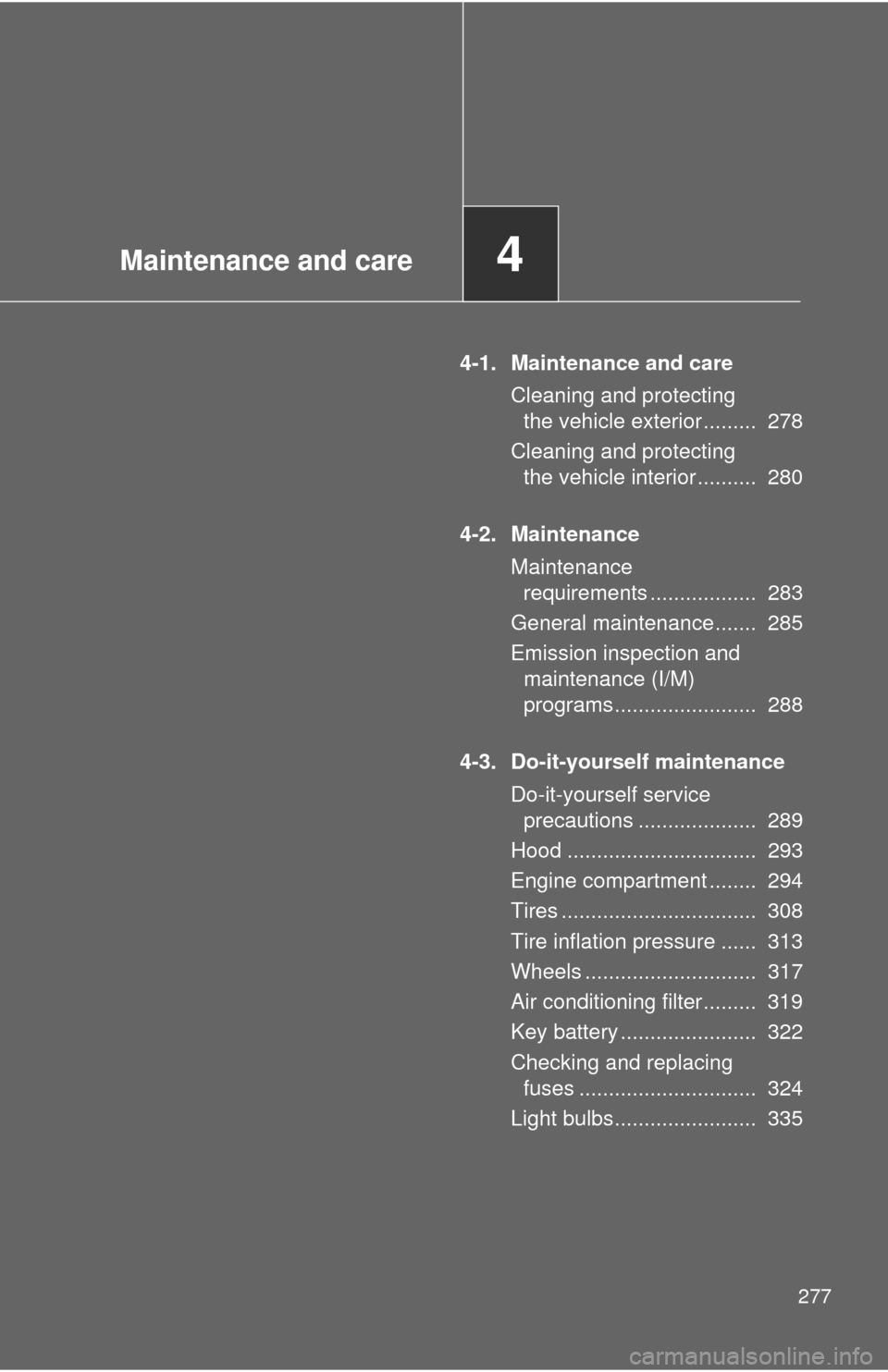
Maintenance and care4
277
4-1. Maintenance and care
Cleaning and protecting
the vehicle exterior ......... 278
Cleaning and protecting
the vehicle interior .......... 280
4-2. Maintenance
Maintenance
requirements .................. 283
General maintenance....... 285
Emission inspection and
maintenance (I/M)
programs........................ 288
4-3. Do-it-yourself maintenance
Do-it-yourself service
precautions .................... 289
Hood ................................ 293
Engine compartment ........ 294
Tires ................................. 308
Tire inflation pressure ...... 313
Wheels ............................. 317
Air conditioning filter......... 319
Key battery ....................... 322
Checking and replacing
fuses .............................. 324
Light bulbs........................ 335
Page 290 of 439

289
4
Maintenance and care
4-3. Do-it-yourself maintenance
Do-it-yourself ser vice precautions
If you perform maintenance yourself, be sure to follow the correct
procedures as given in these sections.
ItemsParts and tools
Battery condition (P. 303)•Warm water
• Baking soda
• Grease
• Conventional wrench
(for terminal clamp bolts)
Brake fluid level (P. 300)• FMVSS No.116 DOT 3 or SAE
J1703 brake fluid
• Rag or paper towel
Engine coolant level (P. 299)• “Toyota Super Long Life Coolant”
or similar high quality ethylene
glycol based non-silicate, non-
amine, non-nitrite and non-borate
coolant with long-life hybrid
organic acid technology.
U.S.A.:
“Toyota Super Long Life Coolant”
is pre-mixed with 50% coolant
and 50% deionized water.
Canada:
“Toyota Super Long Life Coolant”
is pre-mixed with 55% coolant
and 45% deionized water.
Engine oil levelP. 295)• Toyota Genuine Motor Oil or
equivalent
• Rag or paper towel
• Funnel (used only for adding oil)
Fuses (P. 324)• Fuse with same amperage rating
as original
Page 295 of 439
294
4-3. Do-it-yourself maintenance
Engine compar tment
Washer fluid tank (P. 306)
Power steering fluid reservoir
(P. 302)
Radiator cap
Engine oil level dipstick
(P. 295)
Engine coolant reservoir
(P. 299)Engine oil filler cap
(P. 295)
Brake fluid reservoir
(P. 300)
Fuse box (P. 324)
Battery (P. 303)
Condenser (P. 300)
Radiator (P. 300)
Page 325 of 439
324
4-3. Do-it-yourself maintenance
Checking and replacing fuses
If any of the electrical components do not operate, a fuse may have
blown. If this happens, check and replace the fuses as necessary.
Turn the engine switch off.
The fuses are located in the following places. To check the
fuses, follow the instructions below.
■Engine compartment
Ty p e A
Push the tab in and lift the lid
off.
Type B (if equipped)
Push the tab in and lift the lid
off.
Page 326 of 439
325 4-3. Do-it-yourself maintenance
4
Maintenance and care
■Under the instrument panel
Remove the lid.
After a system failure, see “Fuse layout and amperage rat-
ings” (P. 328) for details about which fuse to check.