Page 55 of 388

2-36
BEFORE DRIVING
57L20-03E
Lap-Shoulder BeltEmergency Locking Retractor (ELR)
The seat belt has an emergency locking
retractor (ELR), which is designed to lock
the seat belt only during a sudden stop or
impact. It also may lock if you pull the belt
across your body very quickly. If this hap-
pens, let the belt go back to unlock it, then
pull the belt across your body more slowly.
Automatic Locking Retractor (ALR)
The front passenger’s seat belt and the
rear seat belts have emergency locking
retractors (ELRs) that can be temporarily
converted to function as automatic locking
retractors (ALRs). The ALR mode should
be used if you need to secure a child
restraint system in the seat. Refer to the
“Child Restraint Systems” section for
details.Safety reminder
60A038
60A040
WARNING
(Continued)
Infants and small children should
never be transported unless they
are properly restrained. Restraint
systems for infants and small chil-
dren can be purchased commer-
cially and should be used. Make
sure that the system you purchase
meets Federal Motor Vehicle Safety
Standards. Read and follow all the
directions provided by the manu-
facturer.
Avoid contamination of seat belt
webbing by polishes, oils, chemi-
cals and particularly battery acid.
Cleaning may safely be carried out
using mild soap and water.
For children, if the shoulder belt
irritates the neck or face, move the
child closer to the center of the
vehicle.
All seatbacks should always be in
an upright position when driving,
or seat belt effectiveness may be
reduced. Seat belts are designed to
offer maximum protection when
seatbacks are in the upright posi-
tion.
Sit up straight and
fully back
Low on hips
Low on hips
Supplemental Restraint System (advanced air bags):
3, 9, 12
Page 63 of 388
2-44
BEFORE DRIVING
57L20-03E
Child Restraint Systems
60G332
Infant restraint - rear seat only
65D202
Infant restraint - rear seat only
80JC007
Booster seat
80JC008
WARNING
Be sure to inspect all seat belt
assemblies after any collision. Any
seat belt assembly which was in use
during a collision (other than a very
minor one) should be replaced, even
if damage to the assembly is not
obvious. Any seat belt assembly
which was not in use during a colli-
sion should be replaced if it does not
function properly, it is damaged in
any way or the seat belt pretension-
ers were activated.
EXAMPLE
EXAMPLEEXAMPLE
Page 64 of 388

2-45BEFORE DRIVING
57L20-03E
SUZUKI highly recommends that you use
a child restraint system to restrain infants
and small children. Many different types of
child restraint systems are available; make
sure that the restraint system you select
meets Federal Motor Vehicle Safety Stan-
dards.
All child restraint systems are designed to
be secured in vehicle seats by either seat
belts (lap belts or the lap portion of lap-
shoulder belts) or by special rigid lower
anchor bars built into the seats. Whenever
possible, SUZUKI recommends that child
restraint systems be installed on the rear
seat. According to accident statistics, chil-
dren are safer when properly restrained in
rear seating positions than in front seating
positions.
If you must use a front-facing child restraint
in the front passenger’s seat, be sure to
move the front passenger’s seat as far
back as possible.
65D607 65D608
65D609
WARNING
Do not install a rear-facing child
restraint in the front passenger’s
seat. If the passenger’s air bag
inflates, a child in a rear-facing child
restraint could be killed or seriously
injured. The back of a rear-facing
child restraint would be too close to
the inflating air bag.
Page 65 of 388
2-46
BEFORE DRIVING
57L20-03E
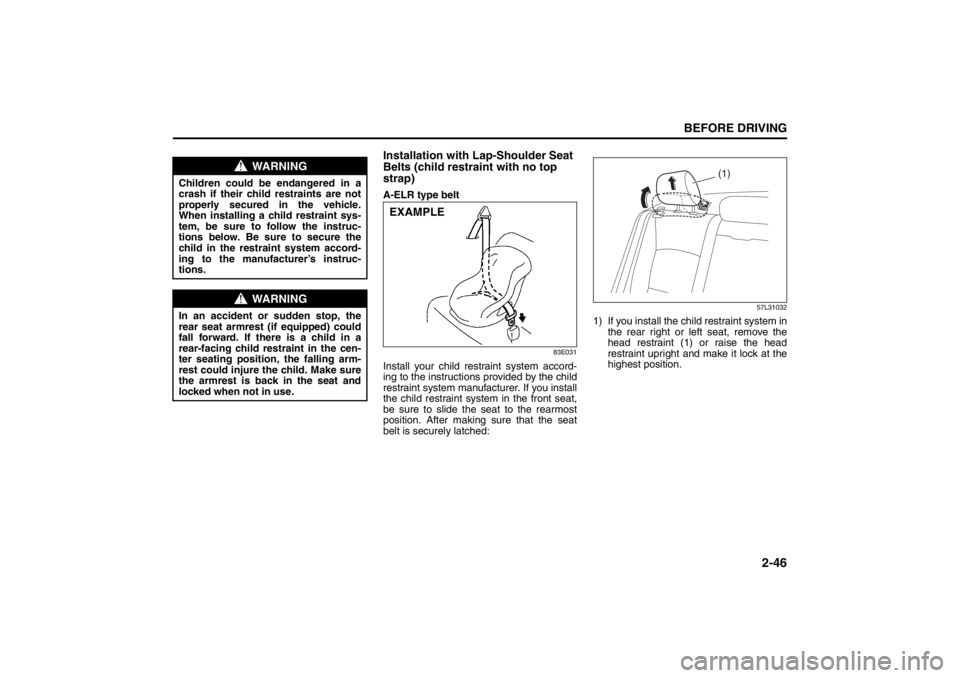
Installation with Lap-Shoulder Seat
Belts (child restraint with no top
strap)A-ELR type belt
83E031
Install your child restraint system accord-
ing to the instructions provided by the child
restraint system manufacturer. If you install
the child restraint system in the front seat,
be sure to slide the seat to the rearmost
position. After making sure that the seat
belt is securely latched:
57L31032
1) If you install the child restraint system in
the rear right or left seat, remove the
head restraint (1) or raise the head
restraint upright and make it lock at the
highest position.
WARNING
Children could be endangered in a
crash if their child restraints are not
properly secured in the vehicle.
When installing a child restraint sys-
tem, be sure to follow the instruc-
tions below. Be sure to secure the
child in the restraint system accord-
ing to the manufacturer’s instruc-
tions.
WARNING
In an accident or sudden stop, the
rear seat armrest (if equipped) could
fall forward. If there is a child in a
rear-facing child restraint in the cen-
ter seating position, the falling arm-
rest could injure the child. Make sure
the armrest is back in the seat and
locked when not in use.
EXAMPLE
(1)
Page 67 of 388
2-48
BEFORE DRIVING
57L20-03E
A-ELR type belt
65D234
A-ELR type belt
65D235
5) Try moving the child restraint system in
all directions, to make sure it is securely
installed. If you need to tighten the belt,
pull more webbing toward the retractor.To revert from ALR to ELR
65D267
When you unbuckle the seat belt and allow
it to retract to a certain length, the retractor
will automatically revert back to the normal
ELR mode.
WARNING
Before installing a child restraint in
the rear center seat, follow these
steps for secure installation:
Make sure the detachable connec-
tor is securely latched and the web-
bing is not twisted.
Make sure the seat belt is passed
through the seat belt guide.
EXAMPLE
Move to check
EXAMPLE
Pull to tighten
EXAMPLE
Page 68 of 388

2-49BEFORE DRIVING
57L20-03E
Installation with the LATCH System
65D33757L21046
Your vehicle is equipped with lower
anchors for securing up to one or two stan-
dard LATCH-type child restraint(s) in the
rear seats. (LATCH stands for Lower
Anchors and Tethers for Children.)
The anchors are located where the rear of
the seat cushion meets the bottom of the
seatback.
57L21047
The covers marked with the child restraint
symbol as shown in the illustration indicate
the presence of lower anchors. Remove
the covers before installing the child
restraint system. Cover the lower anchors
when not in use.
NOTE:
Stow the removed covers in the glove box
or other appropriate stowage so they will
not inconvenience the occupants.
Install the LATCH-type child restraint sys-
tem according to the instructions provided
by the child restraint system manufacturer.
After installing, try moving the child
restraint system in all directions, especially
forward to make sure the flexible straps or
rigid connecting bars are securely latched
to the anchors.
Rigid lower connecting
bar typeFlexible lower connecting
strap type
EXAMPLE
EXAMPLE
Page 69 of 388
2-50
BEFORE DRIVING
57L20-03E
NOTE:
Although there are three rear seating posi-
tions, you cannot install three LATCH type
child restraints in the rear seats. You can
install one or two LATCH restraint(s). Be
sure to install the LATCH type child
restraint(s) in the outboard seating posi-
tions.
If your LATCH restraint has flexible lower
connecting straps, these general instruc-
tions apply:
1) If possible, fold the seatback rearward
for easier installation.
73K017
2) Place the child restraint in the rear seat,
feeding the strap hooks through the
slots in the seat cushion or the slots in
the seatback bottom.
65D340
3) Snap the strap hooks to the anchors.
Take care not to pinch your fingers.
65D341
4) Return the seatback to the normal,
upright position. Tighten the lower
straps as described in the child restraint
owner’s manual. Attach the top tether
strap, if applicable.
EXAMPLE
EXAMPLE
EXAMPLE
Page 70 of 388
2-51BEFORE DRIVING
57L20-03E
65D342
5) Make sure the child restraint is securely
fastened by trying to move the child
restraint system in all directions, espe-
cially forward.If your LATCH restraint has rigid lower con-
necting bars, these general instructions
apply:
1) If possible, fold the seatback rearward
for easier installation.
78F114
2) Place the child restraint in the rear seat,
inserting the connecting bars through
the slots in the seat cushion or the slots
in the seatback bottom.
54G183
3) Use your hands to carefully align the
connecting bar tips with the anchors.
Take care not to pinch your fingers.
WARNING
The seatback should always be
securely latched in a fairly upright
position when any type of child seat
is installed. An unlatched or reclined
seatback will reduce the intended
effectiveness of the child restraint
system.EXAMPLE
EXAMPLE
EXAMPLE


