2010 SUBARU TRIBECA tire type
[x] Cancel search: tire typePage 394 of 422
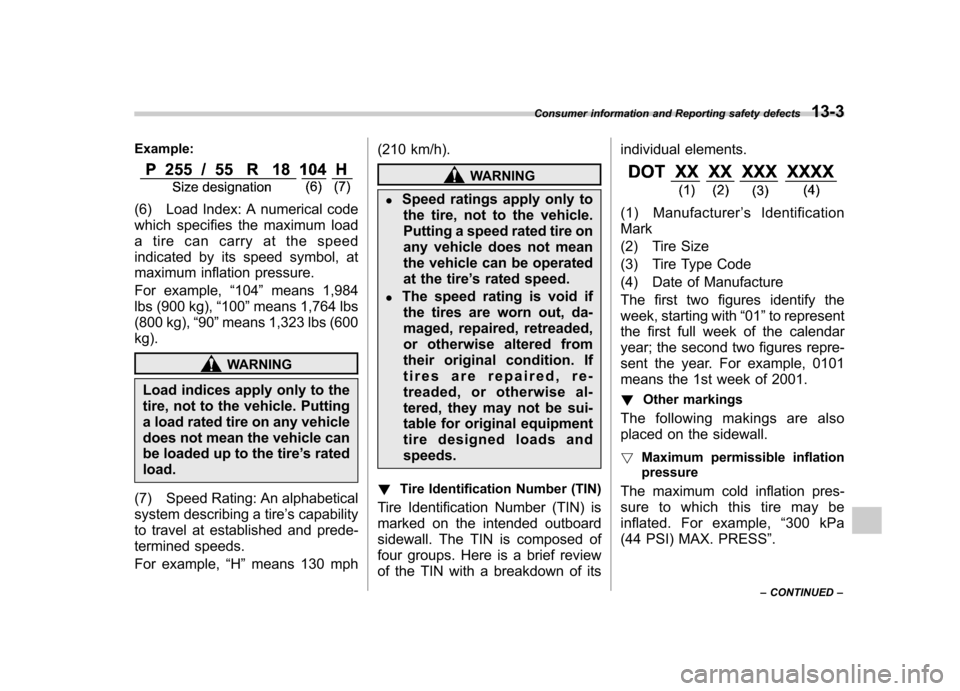
Example:
(6) Load Index: A numerical code
which specifies the maximum load
a tire can carry at the speed
indicated by its speed symbol, at
maximum inflation pressure.
For example,“104 ”means 1,984
lbs (900 kg), “100 ”means 1,764 lbs
(800 kg), “90 ”means 1,323 lbs (600
kg).
WARNING
Load indices apply only to the
tire, not to the vehicle. Putting
a load rated tire on any vehicle
does not mean the vehicle can
be loaded up to the tire ’s rated
load.
(7) Speed Rating: An alphabetical
system describing a tire ’s capability
to travel at established and prede-
termined speeds.
For example, “H ” means 130 mph (210 km/h).
WARNING
. Speed ratings apply only to
the tire, not to the vehicle.
Putting a speed rated tire on
any vehicle does not mean
the vehicle can be operated
at the tire ’s rated speed.
. The speed rating is void if
the tires are worn out, da-
maged, repaired, retreaded,
or otherwise altered from
their original condition. If
tires are repaired, re-
treaded, or otherwise al-
tered, they may not be sui-
table for original equipment
tire designed loads andspeeds.
! Tire Identification Number (TIN)
Tire Identification Number (TIN) is
marked on the intended outboard
sidewall. The TIN is composed of
four groups. Here is a brief review
of the TIN with a breakdown of its individual elements.
(1) Manufacturer
’s Identification
Mark
(2) Tire Size
(3) Tire Type Code
(4) Date of Manufacture
The first two figures identify the
week, starting with “01 ”to represent
the first full week of the calendar
year; the second two figures repre-
sent the year. For example, 0101
means the 1st week of 2001.
! Other markings
The following makings are also
placed on the sidewall. ! Maximum permissible inflation
pressure
The maximum cold inflation pres-
sure to which this tire may be
inflated. For example, “300 kPa
(44 PSI) MAX. PRESS ”.
Consumer information and Reporting safety defects
13-3
– CONTINUED –
Page 395 of 422
13-4Consumer information and Reporting safety defects
!Maximum load rating
The load rating at the maximum
permissible weight load for this tire.
For example, “MAX. LOAD 730 kg
(1609 LBS) @ 300 kPa (44 PSI)
MAX. PRESS. ”
WARNING
Maximum load rating applies
only to the tire, not to the
vehicle. Putting a load rated
tire on any vehicle does not
mean the vehicle can be
loaded up to the tire ’s rated
load.
! Construction type
Applicable construction of this tire.
For example, “TUBELESS STEEL
BELTED RADIAL ”
! Construction
The generic name of each cord
material used in the plies (both
sidewall and tread area) of this tire.
For example, “PLIES: TREAD 2 STEEL + 2 POLYESTER + 1
NYLON SIDEWALL 2 POLYE- STER
”
! Uniform Tire Quality Grading (UTQG)
For details, refer to “Uniform tire
quality grading standards ”F 13-15 .
Page 400 of 422

sory weight, including heavy duty
brakes, ride levelers, roof rack,
heavy duty battery, and special trim. .Radial ply tire
A pneumatic tire in which the ply
cords that extend to the beads are
laid at substantially 90 degrees to
the centerline of the tread. . Recommended inflation pres-
sure
The cold inflation pressure recom-
mended by a vehicle manufacturer. . Reinforced tire
A tire designed to operate at higher
loads and at higher inflation pres-
sures than the corresponding stan-
dard tire. . Rim
A metal support for a tire or a tire
and tube assembly upon which the
tire beads are seated. . Rim diameter
Nominal diameter of the bead seat. . Rim size designation
Rim diameter and width. .
Rim type designation
The industry of manufacturer ’s des-
ignation for a rim by style or code. . Rim width
Nominal distance between rim flanges. . Section width
The linear distance between the
exteriors of the sidewalls of an
inflated tire, excluding elevations
due to labeling, decoration, or
protective bands. . Sidewall
That portion of a tire between the
tread and bead.. Sidewall separation
The parting of the rubber com-
pound from the cord material in
the sidewall.. Test rim
The rim on which a tire is fitted for
testing, and it may be any rim listed
as appropriate for use with that tire.. Tread
That portion of a tire that comes
into contact with the road. .
Tread rib
A tread section running circumfer-
entially around a tire. . Tread separation
Pulling away of the tread from the
tire carcass. . Treadwear indicators (TWI)
The projections within the principal
grooves designed to give a visual
indication of the degrees of wear of
the tread. . Vehicle capacity weight
The rated cargo and luggage load
plus 150 lbs (68 kg) times thevehicle ’s designated seating capa-
city. . Vehicle maximum load on the
tire
Load on an individual tire that is
determined by distributing to each
axle its share of the maximum
loaded vehicle weight and dividing
by 2. . Vehicle normal load on the tire
Load on an individual tire that is
determined by distributing to each
axle its share of the curb weight,
Consumer information and Reporting safety defects
13-9
– CONTINUED –
Page 406 of 422

injury. .Vehicle stability will deteriorate.
. Heavy and/or high-mounted
loads could increase the risk of
rollover.. Stopping distance will increase.
. Brakes could overheat and fail.
. Suspension, bearings, axles and
other parts of the body could break
or experience accelerated wear
that will shorten vehicle life. . Tires could fail.
. Tread separation could occur.
. Tire could separate from its rim.
& Steps for Determining Cor-
rect Load Limit
1. Locate the statement “The com-
bined weight of occupants and
cargo should never exceed XXXpounds ”on your vehicle ’s placard.
2. Determine the combined weight
of the driver and passengers that
will be riding in your vehicle. 3. Subtract the combined weight of
the driver and passengers from
XXX kilograms or XXX pounds. 4.
The resulting figure equals the
available amount of cargo and
luggage load capacity. For exam-
ple, if the “XXX ”amount equals
1,400 lbs (635 kg) and there will be
five- 150 lbs (68 kg) passengers in
your vehicle, the amount of avail-
able cargo and luggage load capa-
city is 650 lbs. (1,400 750 (5 6
150) = 650 lbs).
5. Determine the combined weight
of luggage and cargo being loaded
on the vehicle. That weight may not
safely exceed the available cargo
and luggage load capacity calcu-
lated in Step 4. 6. If your vehicle will be towing a
trailer, load from your trailer will be
transferred to your vehicle. Consult
this manual to determine how this
reduces the available cargo and
luggage load capacity of your ve- hicle. Uniform tire quality grading
standards
This information indicates the rela-
tive performance of passenger car
tires in the area of treadwear,
traction, and temperature resis-
tance. This is to aid the consumer
in making an informed choice in the
purchase of tires.
Quality grades can be found where
applicable on the tire sidewall be-
tween tread shoulder and maxi-
mum section width. For example:
Treadwear 200 Traction AA Tem-
perature A
The quality grades apply to new
pneumatic tires for use on passen-
ger cars. However, they do not
apply to deep tread, winter type
snow tires, space-saver or tempor-
ary use spare tires, tires with
nominal rim diameters of 12 inches
or less, or to some limited produc-
tion tires.
All passenger car tires must con-
Consumer information and Reporting safety defects
13-15
– CONTINUED –
Page 418 of 422

SPORT mode............................................................ 7-18
SPORT mode indicator light ........................................ 3-20
SRS
Curtain airbag ........................................................ 1-60
Frontal airbag ........................................................ 1-49
Side airbag ........................................................... 1-60
SRS airbag (Supplemental Restraint System airbag) ... 4, 1-45
SRS airbag system Monitors. ............................................................... 1-71
Servicing ............................................................... 1-72
Warning light ......................................................... 3-11
Starting the engine ....................................................... 7-7
State emission testing (U.S. only) .................................. 7-5
Steering wheel Power ................................................................... 7-18
Tilt ....................................................................... 3-44
Stopping the engine ..................................................... 7-8
Storage compartment ................................................... 6-6
Sun shade ................................................................ 2-27
Sun visors ................................................................... 6-4
Supplemental Restraint System airbag (SRS) ... ............. 1-45
Synthetic leather upholstery ........................................ 10-5
T
Tachometer ................................................................. 3-7
Temperature gauge ...................................................... 3-9
Temperature warning light AT OIL TEMP ........................................................ 3-13
Rear differential oil ................................................. 3-14
Temporary spare tire .................................................... 9-5
Tether (child restraint system) .............................. 1-38, 1-41 Tie-down hooks
.......................................................... 9-15
Tilt steering wheel. ...................................................... 3-44
Tire................................................................. 11-24, 12-3
Chains .................................................................. 8-11
Inspection ............................................................ 11-25
Pressures and wear .............................................. 11-26
Replacement. ....................................................... 11-29
Rotation .............................................................. 11-29
Types .................................................................. 11-24
Tire pressure monitoring system (TPMS) ..... 7-28, 9-11, 11-24
Warning light .......................................................... 3-14
Tires and wheels ...................................................... 11-24
Tools ......................................................................... 9-19
Top tether anchorages ........................................ 1-38, 1-41
Towing ...................................................................... 9-14
All wheels on the ground ......................................... 9-17
Flat-bed truck ......................................................... 9-17
Hooks ................................................................... 9-15
Weight .................................................................. 8-20
Traction Control system OFF indicator light .......................................... 3-18, 7-25
OFF switch ............................................................ 7-27
Trailer Connecting ............................................................ 8-18
Hitch ............................................................. 8-18, 8-23
Towing .................................................................. 8-20
Towing tips ............................................................ 8-26
Trip meter ................................................................... 3-7
Turn signal
Indicator lights ........................................................ 3-20
Lever .................................................................... 3-28 Index
14-9