Page 375 of 448
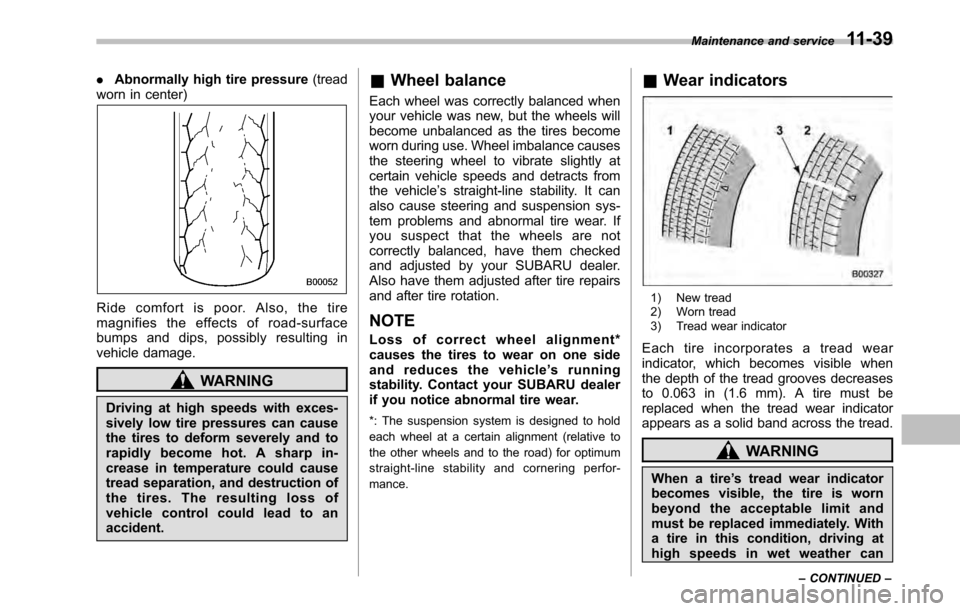
.Abnormally high tire pressure (tread
worn in center)
Ride comfort is poor. Also, the tire
magnifies the effects of road-surface
bumps and dips, possibly resulting in
vehicle damage.
WARNING
Driving at high speeds with exces-
sively low tire pressures can cause
the tires to deform severely and to
rapidly become hot. A sharp in-
crease in temperature could cause
tread separation, and destruction of
the tires. The resulting loss of
vehicle control could lead to anaccident. &
Wheel balance
Each wheel was correctly balanced when
your vehicle was new, but the wheels will
become unbalanced as the tires become
worn during use. Wheel imbalance causes
the steering wheel to vibrate slightly at
certain vehicle speeds and detracts from
the vehicle ’s straight-line stability. It can
also cause steering and suspension sys-
tem problems and abnormal tire wear. If
you suspect that the wheels are not
correctly balanced, have them checked
and adjusted by your SUBARU dealer.
Also have them adjusted after tire repairs
and after tire rotation. NOTE
Loss of correct wheel alignment*
causes the tires to wear on one side
and reduces the vehicle ’s running
stability. Contact your SUBARU dealer
if you notice abnormal tire wear.
*: The suspension system is designed to hold
each wheel at a certain alignment (relative to
the other wheels and to the road) for optimum
straight-line stability and cornering perfor- mance. &
Wear indicators
1) New tread
2) Worn tread
3) Tread wear indicator
Each tire incorporates a tread wear
indicator, which becomes visible when
the depth of the tread grooves decreases
to 0.063 in (1.6 mm). A tire must be
replaced when the tread wear indicator
appears as a solid band across the tread.
WARNING
When a tire ’s tread wear indicator
becomes visible, the tire is worn
beyond the acceptable limit and
must be replaced immediately. With
a tire in this condition, driving at
high speeds in wet weather can Maintenance and service
11-39
– CONTINUED –
Page 376 of 448
11-40Maintenance and service
cause the vehicle to hydroplane.
The resulting loss of vehicle control
can lead to an accident.
NOTE
For safety, inspect the tire tread reg-
ularly and replace the tires before their
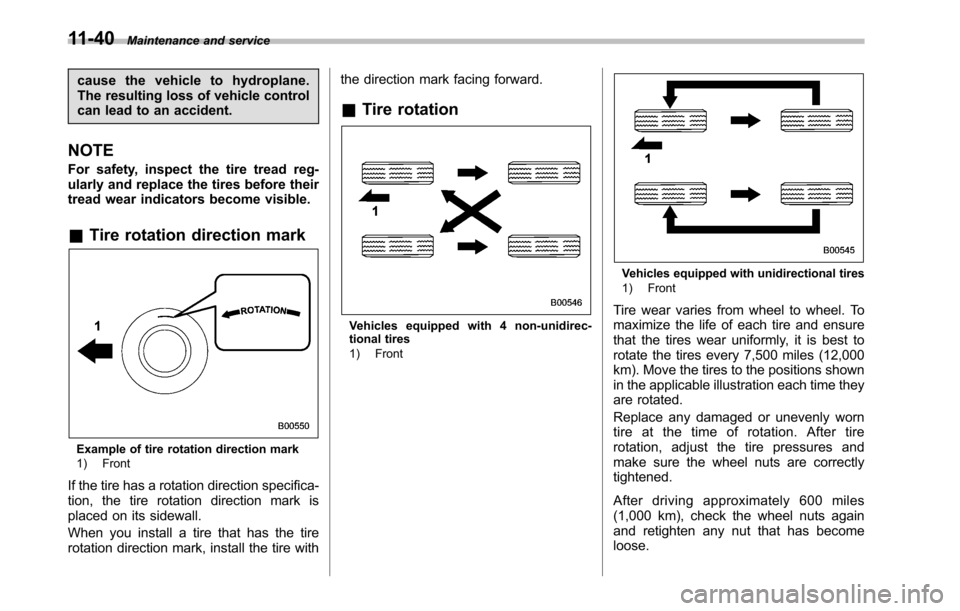
tread wear indicators become visible. & Tire rotation direction mark
Example of tire rotation direction mark
1) Front
If the tire has a rotation direction specifica-
tion, the tire rotation direction mark is
placed on its sidewall.
When you install a tire that has the tire
rotation direction mark, install the tire with the direction mark facing forward.
& Tire rotation
Vehicles equipped with 4 non-unidirec-
tional tires
1) Front
Vehicles equipped with unidirectional tires
1) Front
Tire wear varies from wheel to wheel. To
maximize the life of each tire and ensure
that the tires wear uniformly, it is best to
rotate the tires every 7,500 miles (12,000
km). Move the tires to the positions shown
in the applicable illustration each time they
are rotated.
Replace any damaged or unevenly worn
tire at the time of rotation. After tire
rotation, adjust the tire pressures and
make sure the wheel nuts are correctlytightened.
After driving approximately 600 miles
(1,000 km), check the wheel nuts again
and retighten any nut that has become loose.
Page 377 of 448
&Tire replacement
The wheels and tires are important and
integral parts of your vehicle ’s design;
they cannot be changed arbitrarily. The
tires fitted as standard equipment are
optimally matched to the characteristics
of the vehicle and were selected to give
the best possible combination of running
performance, ride comfort, and service
life. It is essential for every tire to have a
size and construction matching those
shown on the tire placard and to have a
speed symbol and load index matching
those shown on the tire placard.
Using tires of a non-specified size detracts
from controllability, ride comfort, braking
performance, speedometer accuracy and
odometer accuracy. It also creates incor-
rect body-to-tire clearances and inappro-
priately changes the vehicle ’sground
clearance.
All four tires must be the same in terms of
manufacturer, brand (tread pattern), con-
struction, and size. You are advised to
replace the tires with new ones that are
identical to those fitted as standard equip-ment.
For safe vehicle operation, SUBARU
recommends replacing all four tires at
the same time.WARNING
. All four tires must be the same in
terms of manufacturer, brand
(tread pattern), construction, de-
gree of wear, speed symbol, load
index and size. Mixing tires of
different types, sizes or degrees
of wear can result in damage to
the vehicle ’s power train. Use of
different types or sizes of tires
can also dangerously reduce
controllability and braking per-
formance and can lead to anaccident.
. Use only radial tires. Do not use
radial tires together with belted
bias tires and/or bias-ply tires.
Doing so can dangerously re-
duce controllability, resulting in
an accident. &
Wheel replacement
When replacing wheels due, for example,
to damage, make sure the replacement
wheels match the specifications of the
wheels that are fitted as standard equip-
ment. Replacement wheels are available
from SUBARU dealers.
WARNING
Use only those wheels that are
specified for your vehicle. Wheels
not meeting specifications could
interfere with brake caliper opera-
tion and may cause the tires to rub
against the wheel well housing dur-
ing turns. The resulting loss of
vehicle control could lead to anaccident. Maintenance and service
11-41
Page 378 of 448
11-42Maintenance and service
Aluminum wheels
Aluminum wheels can be scratched and
damaged easily. Handle them carefully to
maintain their appearance, performance,
and safety. .When any of the wheels is removed
and replaced for tire rotation or to change
a flat, always check the tightness of the
wheel nuts after driving approximately 600
miles (1,000 km). If any nut is loose,
tighten it to the specified torque. . Never apply oil to the threaded parts,
wheel nuts, or tapered surface of the wheel. . Never let the wheel rub against sharp
protrusions or curbs.. When wheel nuts, balance weights, or
the center cap is replaced, be sure to
replace them with genuine SUBARU parts
designed for aluminum wheels. Windshield washer fluid
CAUTION
Never use engine coolant as washer
fluid because it could cause paintdamage.
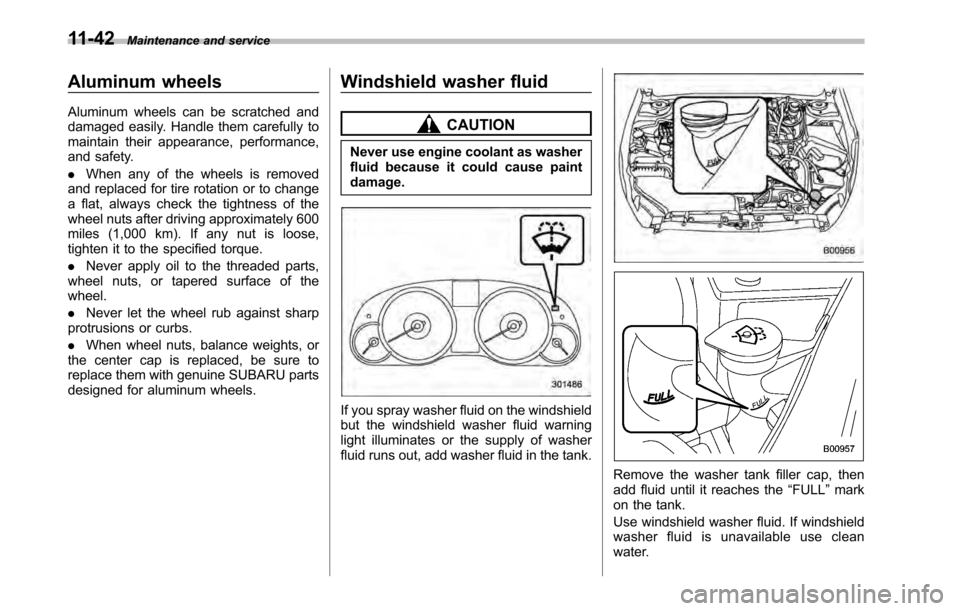
If you spray washer fluid on the windshield
but the windshield washer fluid warning
light illuminates or the supply of washer
fluid runs out, add washer fluid in the tank.
Remove the washer tank filler cap, then
add fluid until it reaches the “FULL ”mark
on the tank.
Use windshield washer fluid. If windshield
washer fluid is unavailable use clean
water.
Page 397 of 448
Specifications..................................................... 12-2
Dimensions ........................................................ 12-2
Engine ............................................................... 12-3
Electrical system ................................................ 12-3
Capacities .......................................................... 12-4
Tires .................................................................. 12-5
Wheel alignment ................................................ 12-5 Fuses and circuits
............................................. 12-6
Fuse panel located in the passenger compartment ................................................... 12-6
Fuse panel located in the engine compartment ................................................... 12-8
Bulb chart ......................................................... 12-10
Vehicle identification ....................................... 12-13Specifications
12
Page 401 of 448
&Tires
Tire size P205/60R16
91V P215/70R16
99S P225/60R17
98T P215/50R17
90V P225/50R17
93V 225/45R18
91W
Wheel size 1666 1/2JJ
16 66 1/2J 16
66 1/2JJ 17 67J 17 67 1/2J 18 67 1/2J
Pressure Front 33 psi (230 kPa) 32 psi (220 kPa) 33 psi (230 kPa)
Rear 32 psi (220 kPa) 30 psi (210 kPa) 32 psi (220 kPa)
Temporary spare tire Size T135/80R16 T145/80R17 T135/70R17 Pressure
60 psi (420 kPa)
& Wheel alignment
Item Legacy
Outback
2.5 L non-turbo models Except 2.5 L non-turbo models
Toe Front Toe in 0 in (0 mm)
Total toe 0 8 Toe in 0.1 in (2 mm)
Total toe 0 810 ’
Rear Toe in 0 in (0 mm)
Total toe 0 8 Toe in 0.1 in (2 mm)
Total toe 0 810 ’
Camber Front 0830 ’ 0815 ’ 0800 ’
Rear 1800 ’ 1810 ’
0800 ’
Specifications
12-5
Page 409 of 448
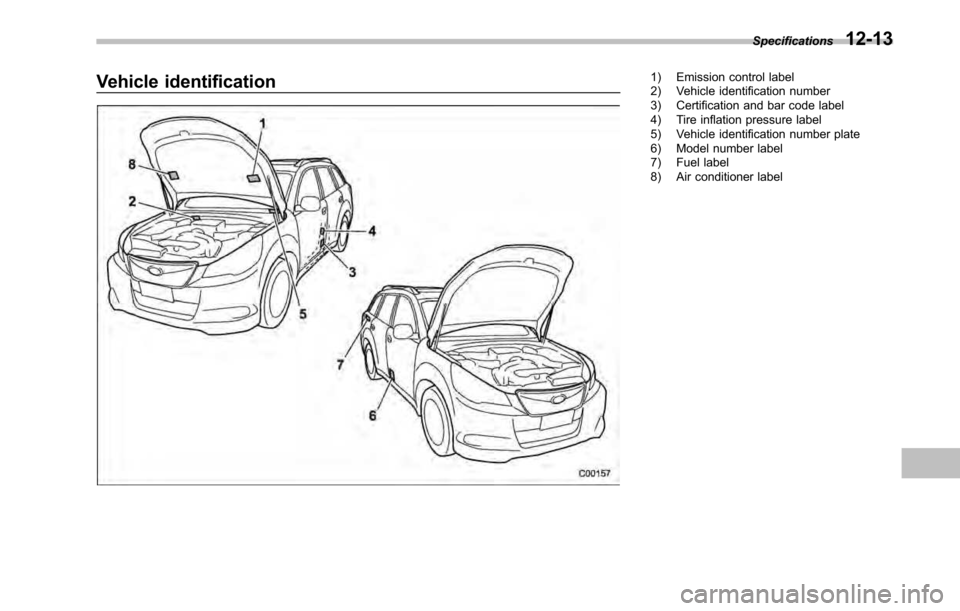
Vehicle identification1) Emission control label
2) Vehicle identification number
3) Certification and bar code label
4) Tire inflation pressure label
5) Vehicle identification number plate
6) Model number label
7) Fuel label
8) Air conditioner labelSpecifications
12-13
Page 411 of 448

For U.S.A............................................................ 13-2
Tire information .................................................. 13-2
Tire labeling ....................................................... 13-2
Recommended tire inflation pressure .................. 13-5
Glossary of tire terminology ............................... 13-7
Tire care –maintenance and safety
practices ........................................................ 13-11
Vehicle load limit –how to determine ................ 13-11 Determining compatibility of tire and vehicle load
capacities ...................................................... 13-14
Adverse safety consequences of overloading on handling and stopping and on tires ................ 13-14
Steps for Determining Correct Load Limit ......... 13-15
Uniform tire quality grading standards .......... 13-15
Treadwear ....................................................... 13-16
Traction AA, A, B, C ......................................... 13-16
Temperature A, B, C ......................................... 13-16
Reporting safety defects (USA) ...................... 13-17
Consumer information and Reporting safety defects
13