Page 343 of 448
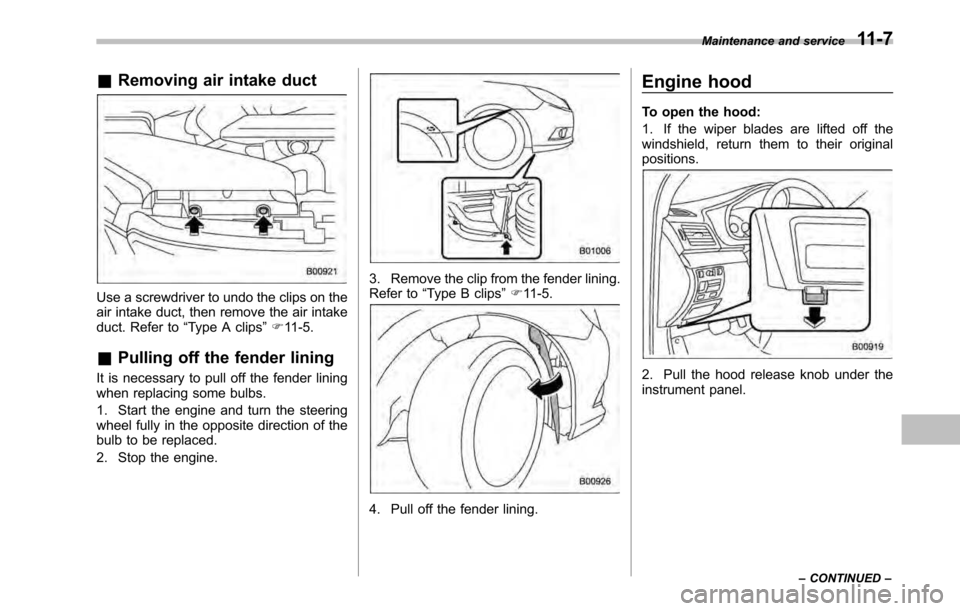
&Removing air intake duct
Use a screwdriver to undo the clips on the
air intake duct, then remove the air intake
duct. Refer to “Type A clips ”F 11-5.
& Pulling off the fender lining
It is necessary to pull off the fender lining
when replacing some bulbs.
1. Start the engine and turn the steering
wheel fully in the opposite direction of the
bulb to be replaced.
2. Stop the engine.
3. Remove the clip from the fender lining.
Refer to “Type B clips ”F 11-5.
4. Pull off the fender lining. Engine hood
To open the hood:
1. If the wiper blades are lifted off the
windshield, return them to their originalpositions.
2. Pull the hood release knob under the
instrument panel.
Maintenance and service
11-7
– CONTINUED –
Page 345 of 448
Engine compartment overview &2.5 L non-turbo models1) Power steering fluid reservoir
(page 11-29)
2) Manual transmission oil level gauge (MT) (page 11-23)
3) Clutch fluid reservoir (page 11-31)
4) Brake fluid reservoir (page 11-30)
5) Fuse box (page 11-48)
6) Battery (page 11-47)
7) Windshield washer tank (page 11-42)
8) Engine oil filler cap (page 11-12)
9) Engine coolant reservoir (page 11-18)
10) Radiator cap (page 11-18)
11) Engine oil level gauge (page 11-12)
12) Air cleaner case (page 11-20) Maintenance and service
11-9
– CONTINUED –
Page 346 of 448
11-10Maintenance and service
& 2.5 L turbo models
1) Power steering fluid reservoir
(page 11-29)
2) Manual transmission oil level gauge (MT) (page 11-23)
3) Clutch fluid reservoir (page 11-31)
4) Brake fluid reservoir (page 11-30)
5) Fuse box (page 11-48)
6) Battery (page 11-47)
7) Windshield washer tank (page 11-42)
8) Engine oil filler cap (page 11-12)
9) Engine coolant reservoir (page 11-18)
10) Radiator cap (page 11-18)
11) Engine oil level gauge (page 11-12)
12) Air cleaner case (page 11-20)
Page 347 of 448
&3.6 L models1) Power steering fluid reservoir
(page 11-29)
2) Differential gear oil level gauge (AT) (page 11-26)
3) Automatic transmission fluid level gauge (page 11-24)
4) Brake fluid reservoir (page 11-30)
5) Fuse box (page 11-48)
6) Battery (page 11-47)
7) Windshield washer tank (page 11-42)
8) Engine oil filler cap (page 11-12)
9) Engine coolant reservoir (page 11-18)
10) Radiator cap (page 11-18)
11) Engine oil level gauge (page 11-12)
12) Air cleaner case (page 11-20) Maintenance and service
11-11
Page 365 of 448
SAE viscosity No. and applicable tempera- turePower steering fluid &
Checking the fluid level
WARNING
Be careful not to burn yourself
because the fluid may be hot.
CAUTION
. When power steering fluid is
being added, use only clean fluid,
and be careful not to allow any
dirt into the tank. And never use
different brands together.
. Avoid spilling fluid when adding
it in the tank. .
Be careful not to spill power
steering fluid when adding it. If
power steering fluid touches the
exhaust pipe, it may cause a bad
smell, smoke, and/or a fire. If
power steering fluid gets on the
exhaust pipe, be sure to wipe itoff.
The power steering fluid expands greatly
as its temperature rises; the fluid level
differs according to fluid temperature.
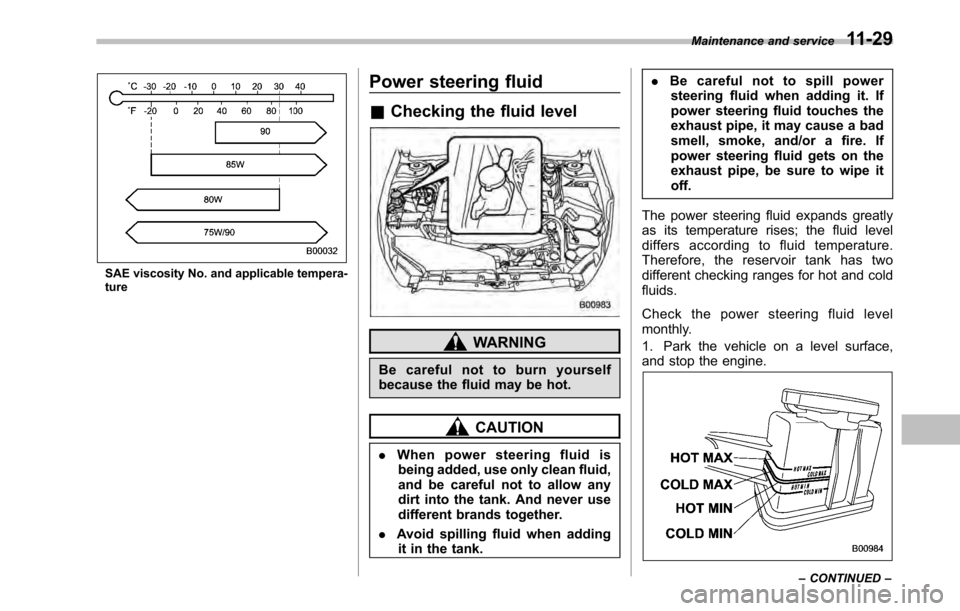
Therefore, the reservoir tank has two
different checking ranges for hot and coldfluids.
Check the power steering fluid level
monthly.
1. Park the vehicle on a level surface,
and stop the engine.
Maintenance and service 11-29
– CONTINUED –
Page 374 of 448
11-38Maintenance and service
NOTE .The air pressure in a tire increases
by approximately 4.3 psi (30 kPa, 0.3 kgf/cm
2) when the tire becomes warm.
. The tires are considered cold when
the vehicle has been parked for at least
3 hours or has been driven less than 1
mile (1.6 km).
WARNING
Do not let air out of warm tires to
adjust pressure. Doing so will result
in low tire pressure.
Incorrect tire pressures detract from con-
trollability and ride comfort, and they
cause the tires to wear abnormally. .
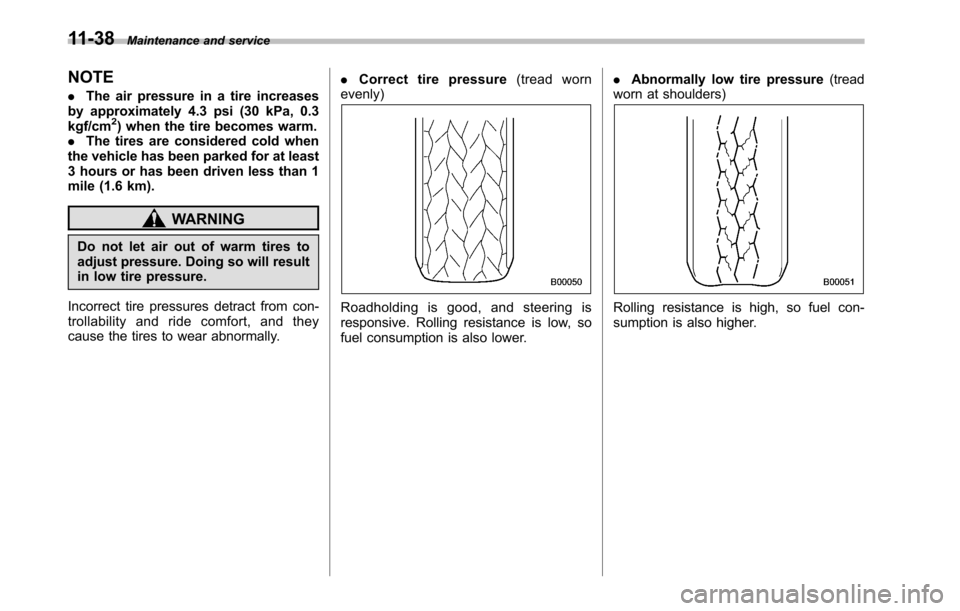
Correct tire pressure (tread worn
evenly)
Roadholding is good, and steering is
responsive. Rolling resistance is low, so
fuel consumption is also lower. .
Abnormally low tire pressure (tread
worn at shoulders)Rolling resistance is high, so fuel con-
sumption is also higher.
Page 375 of 448
.Abnormally high tire pressure (tread
worn in center)
Ride comfort is poor. Also, the tire
magnifies the effects of road-surface
bumps and dips, possibly resulting in
vehicle damage.
WARNING
Driving at high speeds with exces-
sively low tire pressures can cause
the tires to deform severely and to
rapidly become hot. A sharp in-
crease in temperature could cause
tread separation, and destruction of
the tires. The resulting loss of
vehicle control could lead to anaccident. &
Wheel balance
Each wheel was correctly balanced when
your vehicle was new, but the wheels will
become unbalanced as the tires become
worn during use. Wheel imbalance causes
the steering wheel to vibrate slightly at
certain vehicle speeds and detracts from
the vehicle ’s straight-line stability. It can
also cause steering and suspension sys-
tem problems and abnormal tire wear. If
you suspect that the wheels are not
correctly balanced, have them checked
and adjusted by your SUBARU dealer.
Also have them adjusted after tire repairs
and after tire rotation. NOTE
Loss of correct wheel alignment*
causes the tires to wear on one side
and reduces the vehicle ’s running
stability. Contact your SUBARU dealer
if you notice abnormal tire wear.
*: The suspension system is designed to hold
each wheel at a certain alignment (relative to
the other wheels and to the road) for optimum
straight-line stability and cornering perfor- mance. &
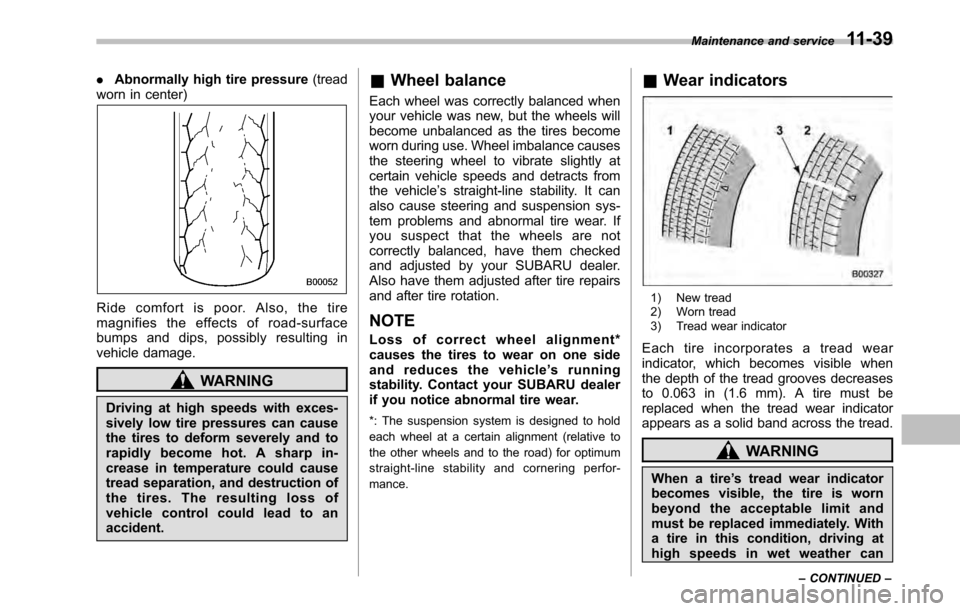
Wear indicators
1) New tread
2) Worn tread
3) Tread wear indicator
Each tire incorporates a tread wear
indicator, which becomes visible when
the depth of the tread grooves decreases
to 0.063 in (1.6 mm). A tire must be
replaced when the tread wear indicator
appears as a solid band across the tread.
WARNING
When a tire ’s tread wear indicator
becomes visible, the tire is worn
beyond the acceptable limit and
must be replaced immediately. With
a tire in this condition, driving at
high speeds in wet weather can Maintenance and service
11-39
– CONTINUED –
Page 400 of 448
12-4Specifications
&Capacities
Fuel tank 18.5 US gal (70 liters, 15.4 Imp gal)
Engine oil 2.5 L models 4.2 US qt (4.0 liters, 3.5 Imp qt)
3.6 L models 6.7 US qt (6.3 liters, 5.5 Imp qt)
Transmission oil (MT) 3.9 US qt (3.7 liters, 3.3 Imp qt)
Transmission fluid (CVT) 13.2 US qt (12.5 liters, 11.0 Imp qt)
Transmission fluid (AT) 10.4 US qt (9.8 liters, 8.6 Imp qt)
Front differential gear oil (AT and CVT models) 1.5 US qt (1.4 liters, 1.2 Imp qt)
Rear differential gear oil 0.8 US qt (0.8 liter, 0.7 Imp qt)
Power steering fluid 0.7 US qt (0.7 liter, 0.6 Imp qt)
Engine coolant 2.5 L non-turbo models MT6.9 US qt (6.5 liters, 5.7 Imp qt)
CVT 6.8 US qt (6.4 liters, 5.6 Imp qt)
2.5 L turbo models 6.9 US qt (6.5 liters, 5.7 Imp qt)
3.6 L models 6.9 US qt (6.5 liters, 5.7 Imp qt)