Page 378 of 448
11-42Maintenance and service
Aluminum wheels
Aluminum wheels can be scratched and
damaged easily. Handle them carefully to
maintain their appearance, performance,
and safety. .When any of the wheels is removed
and replaced for tire rotation or to change
a flat, always check the tightness of the
wheel nuts after driving approximately 600
miles (1,000 km). If any nut is loose,
tighten it to the specified torque. . Never apply oil to the threaded parts,
wheel nuts, or tapered surface of the wheel. . Never let the wheel rub against sharp
protrusions or curbs.. When wheel nuts, balance weights, or
the center cap is replaced, be sure to
replace them with genuine SUBARU parts
designed for aluminum wheels. Windshield washer fluid
CAUTION
Never use engine coolant as washer
fluid because it could cause paintdamage.
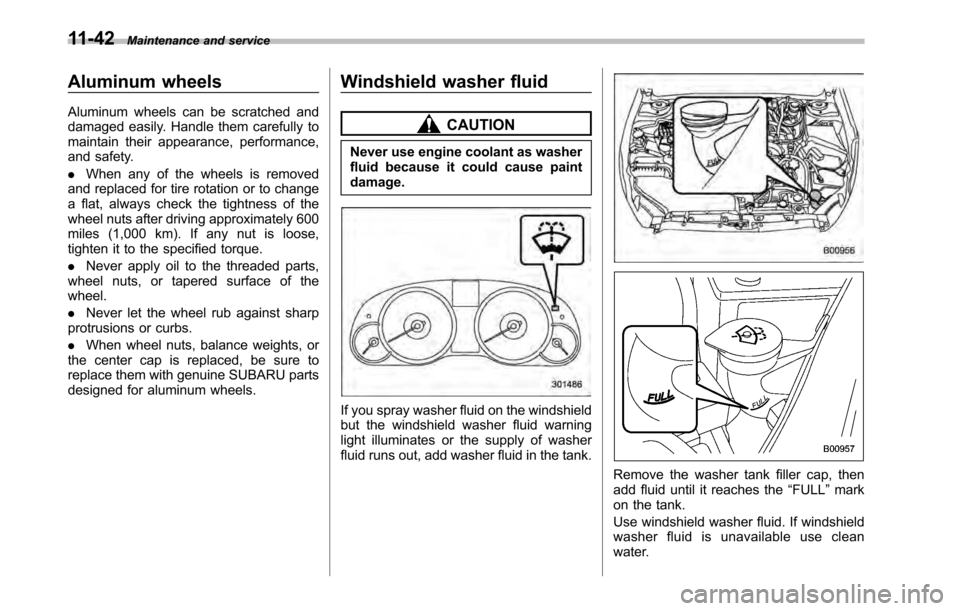
If you spray washer fluid on the windshield
but the windshield washer fluid warning
light illuminates or the supply of washer
fluid runs out, add washer fluid in the tank.
Remove the washer tank filler cap, then
add fluid until it reaches the “FULL ”mark
on the tank.
Use windshield washer fluid. If windshield
washer fluid is unavailable use clean
water.
Page 397 of 448
Specifications..................................................... 12-2
Dimensions ........................................................ 12-2
Engine ............................................................... 12-3
Electrical system ................................................ 12-3
Capacities .......................................................... 12-4
Tires .................................................................. 12-5
Wheel alignment ................................................ 12-5 Fuses and circuits
............................................. 12-6
Fuse panel located in the passenger compartment ................................................... 12-6
Fuse panel located in the engine compartment ................................................... 12-8
Bulb chart ......................................................... 12-10
Vehicle identification ....................................... 12-13Specifications
12
Page 398 of 448
12-2Specifications
Specifications
These specifications are subject to change without notice. &Dimensions
in (mm)
Item Legacy
Outback
2.5 L non-turbo 2.5 L turbo 3.6 L 2.5 L non-turbo
3.6 L
Drive system AWD
Transmission type MT CVT MT AT MT CVT AT
Overall length 186.4 (4,735) 188.2 (4,780)
Overall width 71.7 (1,820) 71.7 (1,820)
Overall height 59.3 (1,505) 66.1 (1,680)
*2
65.7 (1,670)*3
Wheelbase
108.3 (2,750) 107.9 (2,740)
Tread Front 61.6 (1,565) 61.0 (1,550) 61.6 (1,565) 61.0 (1,550)
Rear 61.8 (1,570) 61.2 (1,555) 61.8 (1,570) 61.0 (1,550)
Ground clearance
*15.9 (150) 8.7 (220)
*1: Measured with vehicle empty
*2: Measured when roof rails are used as crossbars
*3: Measured when roof rails are not used as crossbars
AT: Automatic transmission
MT: Manual transmission
CVT: Continuously variable transmission
AWD: All-Wheel Drive
Page 401 of 448
&Tires
Tire size P205/60R16
91V P215/70R16
99S P225/60R17
98T P215/50R17
90V P225/50R17
93V 225/45R18
91W
Wheel size 1666 1/2JJ
16 66 1/2J 16
66 1/2JJ 17 67J 17 67 1/2J 18 67 1/2J
Pressure Front 33 psi (230 kPa) 32 psi (220 kPa) 33 psi (230 kPa)
Rear 32 psi (220 kPa) 30 psi (210 kPa) 32 psi (220 kPa)
Temporary spare tire Size T135/80R16 T145/80R17 T135/70R17 Pressure
60 psi (420 kPa)
& Wheel alignment
Item Legacy
Outback
2.5 L non-turbo models Except 2.5 L non-turbo models
Toe Front Toe in 0 in (0 mm)
Total toe 0 8 Toe in 0.1 in (2 mm)
Total toe 0 810 ’
Rear Toe in 0 in (0 mm)
Total toe 0 8 Toe in 0.1 in (2 mm)
Total toe 0 810 ’
Camber Front 0830 ’ 0815 ’ 0800 ’
Rear 1800 ’ 1810 ’
0800 ’
Specifications
12-5
Page 415 of 448
&Recommended tire inflation pressure
! Recommended cold tire inflation pressure
Recommended cold tire inflation pressure for your vehicle ’s tires is as follows.
Tire size P205/60R16
91V P215/70R16
99S P225/60R17
98T P215/50R17
90V P225/50R17
93V 225/45R18
91W
Wheel size 16
66 1/2JJ
16 66 1/2J 16
66 1/2JJ 17 67J 17 67 1/2J 18 67 1/2J
Pressure Front 33 psi
(230 kPa) 32 psi (220 kPa) 33 psi (230 kPa)
Rear 32 psi
(220 kPa) 30 psi (210 kPa) 32 psi (220 kPa)
Tempor-
ary spare tire Size T135/80R16 T145/80R17 T135/70R17 Pressure
60 psi (420 kPa)Consumer information and Reporting safety defects
13-5
– CONTINUED –
Page 418 of 448

13-8Consumer information and Reporting safety defects
ing on a vehicle.
. Light truck (LT) tire
A tire designated by its manufac-
turer as primarily intended for use
on lightweight trucks or multipur-
pose passenger vehicles. . Load rating
The maximum load that a tire is
rated to carry for a given inflationpressure. . Maximum inflation pressure
The maximum cold inflation pres-
sure to which a tire may be inflated. . Maximum load rating
The load rating for a tire at the
maximum permissible inflation
pressure for that tire. . Maximum loaded vehicle weight
The sum of: (a) Curb weight
(b) Accessory weight
(c) Vehicle capacity weight
(d) Production options weight
. Maximum permissible inflation
pressure
The maximum cold inflation pres-
sure to which a tire may be inflated. .
Measuring rim
The rim on which a tire is fitted for
physical dimension requirements. . Normal occupant weight
150 lbs (68 kg) times the number of
occupants specified in the second
column of Table 1 that is appended
to the end of this section. . Occupant distribution
Distribution of occupants in a vehi-
cle as specified in the third column
of Table 1 that is appended to the
end of this section. . Open splice
Any parting at any junction of tread,
sidewall, or innerliner that extends
to cord material. . Outer diameter
The overall diameter of an inflated
new tire. . Overall width
The linear distance between the
exteriors of the sidewalls of an
inflated tire, including elevations
due to labeling, decorations, or
protective bands or ribs. .
Passenger car tire
A tire intended for use on passen-
ger cars, multipurpose passenger
vehicles, and trucks, that have a
gross vehicle weight rating (GVWR)
of 10,000 lbs (4,535 kg) or less. . Ply
A layer of rubber-coated parallel cords. . Ply separation
A parting of rubber compound
between adjacent plies. . Pneumatic tire
A mechanical device made of rub-
ber, chemicals, fabric and steel or
other materials, that, when
mounted on an automotive wheel,
provides the traction and contains
the gas or fluid that sustains theload. . Production options weight
The combined weight of those
installed regular production options
weighing over 5.1 lbs (2.3 kg) in
excess of those standard items
which they replace, not previously
considered in curb weight or acces-
Page 420 of 448
13-10Consumer information and Reporting safety defects
accessory weight, and normal oc-
cupant weight (distributed in accor-
dance with Table 1 that is ap-
pended to the end of this section)
and dividing by 2. .Wheel-holding fixture
The fixture used to hold the wheel
and tire assembly securely duringtesting. Table 1
—Occupant loading and distribution for vehicle normal load for
various designated seating capacities
Designated seating
capacity, number of
occupants Vehicle normal load,
number of occupants Occupant distribution in a
normally loaded vehicle
2 through 4 2 2 in front.
5 through 10 3 2 in front, 1 in second seat.
11 through 15 5 2 in front, 1 in second
seat, 1 in third seat, 1 in
fourth seat.
16 through 22 7 2 in front, 2 in second
seat, 2 in third seat, 1 in
fourth seat.
Page 421 of 448

&Tire care –maintenance and
safety practices
. Check on a daily basis that the
tires are free from serious damage,
nails, and stones. At the same time,
check the tires for abnormal wear.
. Inspect the tire tread regularly
and replace the tires before their
tread wear indicators become visi-
ble. When a tire ’streadwear
indicator becomes visible, the tire
is worn beyond the acceptable limit
and must be replaced immediately.
With a tire in this condition, driving
at even low speeds in wet weather
can cause the vehicle to hydro-
plane. Possible resulting loss of
vehiclecontrolcanleadtoanaccident.
. To maximize the life of each tire
and ensure that the tires wear
uniformly, it is best to rotate the
tires every 7,500 miles (12,000 km).
Rotating the tires involves switch-
ing the front and rear tires on the
right-hand side of the vehicle and
similarly switching the front and rear tires on the left-hand side of
the vehicle. (Each tire must be kept
on its original side of the vehicle.)
Replace any damaged or unevenly
worn tire at the time of rotation.
After tire rotation, adjust the tire
pressures and make sure the wheel
nuts are correctly tightened. For
information about the tightening
torque and tightening sequence
for the wheel nuts, refer to
“Flat
tires ”F 9-6 .
& Vehicle load limit –how to
determine
The load capacity of your vehicle is
determined by weight, not by avail-
able cargo space. The load limit of
your vehicle is shown on the
vehicle placard attached to the
driver ’s side B-pillar. Locate the
statement “The combined weight
of occupants and cargo should
never exceed XXX kg or XXX lbs ”
on your vehicle ’s placard.
Thevehicleplacardalsoshows
seating capacity of your vehicle. The total load capacity includes the
total weight of driver and all pas-
sengers and their belongings, any
cargo, any optional equipment such
as a trailer hitch, roof rack or bike
carrier, etc., and the tongue load of
a trailer. Therefore cargo capacity
can be calculated by the following method.
Cargo capacity = Load limit
(total
weight of occupants + total weight
of optional equipment + tongue
load of a trailer (if applicable))
For towing capacity information and
weight limits, refer to “Trailer tow-
ing ”F 8-19 .
Consumer information and Reporting safety defects
13-11
– CONTINUED –