2010 SUBARU FORESTER engine coolant
[x] Cancel search: engine coolantPage 318 of 402
the cooling system and connections be
checked for leaks, damage, or looseness. &Engine coolant
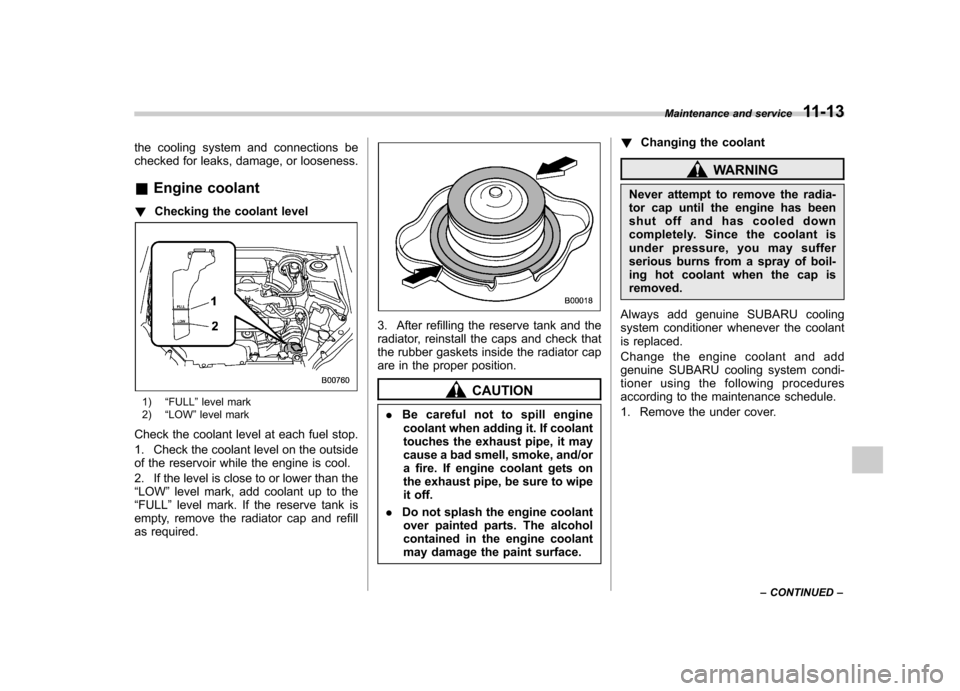
! Checking the coolant level
1) “FULL ”level mark
2) “LOW ”level mark
Check the coolant level at each fuel stop.
1. Check the coolant level on the outside
of the reservoir while the engine is cool.
2. If the level is close to or lower than the “ LOW ”level mark, add coolant up to the
“ FULL ”level mark. If the reserve tank is
empty, remove the radiator cap and refill
as required.
3. After refilling the reserve tank and the
radiator, reinstall the caps and check that
the rubber gaskets inside the radiator cap
are in the proper position.
CAUTION
. Be careful not to spill engine
coolant when adding it. If coolant
touches the exhaust pipe, it may
cause a bad smell, smoke, and/or
a fire. If engine coolant gets on
the exhaust pipe, be sure to wipe
it off.
. Do not splash the engine coolant
over painted parts. The alcohol
contained in the engine coolant
may damage the paint surface. !
Changing the coolant
WARNING
Never attempt to remove the radia-
tor cap until the engine has been
shut off and has cooled down
completely. Since the coolant is
under pressure, you may suffer
serious burns from a spray of boil-
ing hot coolant when the cap isremoved.
Always add genuine SUBARU cooling
system conditioner whenever the coolant
is replaced.
Change the engine coolant and add
genuine SUBARU cooling system condi-
tioner using the following procedures
according to the maintenance schedule.
1. Remove the under cover. Maintenance and service
11-13
– CONTINUED –
Page 319 of 402
11-14Maintenance and service
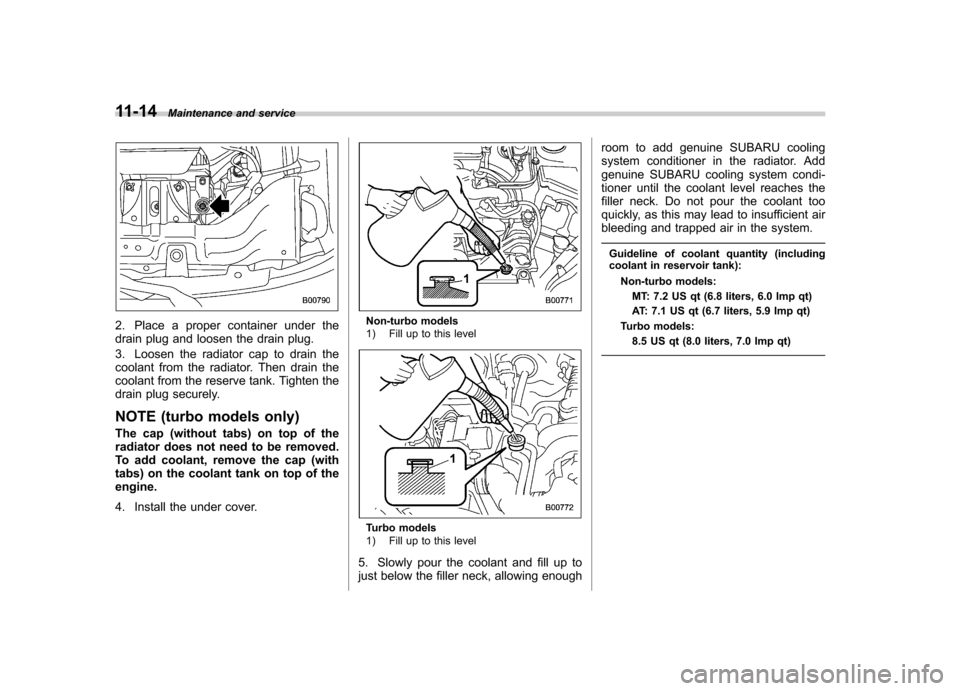
2. Place a proper container under the
drain plug and loosen the drain plug.
3. Loosen the radiator cap to drain the
coolant from the radiator. Then drain the
coolant from the reserve tank. Tighten the
drain plug securely.
NOTE (turbo models only)
The cap (without tabs) on top of the
radiator does not need to be removed.
To add coolant, remove the cap (with
tabs) on the coolant tank on top of theengine.
4. Install the under cover.Non-turbo models
1) Fill up to this level
Turbo models
1) Fill up to this level
5. Slowly pour the coolant and fill up to
just below the filler neck, allowing enough room to add genuine SUBARU cooling
system conditioner in the radiator. Add
genuine SUBARU cooling system condi-
tioner until the coolant level reaches the
filler neck. Do not pour the coolant too
quickly, as this may lead to insufficient air
bleeding and trapped air in the system.
Guideline of coolant quantity (including
coolant in reservoir tank): Non-turbo models:MT: 7.2 US qt (6.8 liters, 6.0 Imp qt)
AT: 7.1 US qt (6.7 liters, 5.9 Imp qt)
Turbo models: 8.5 US qt (8.0 liters, 7.0 Imp qt)
Page 320 of 402
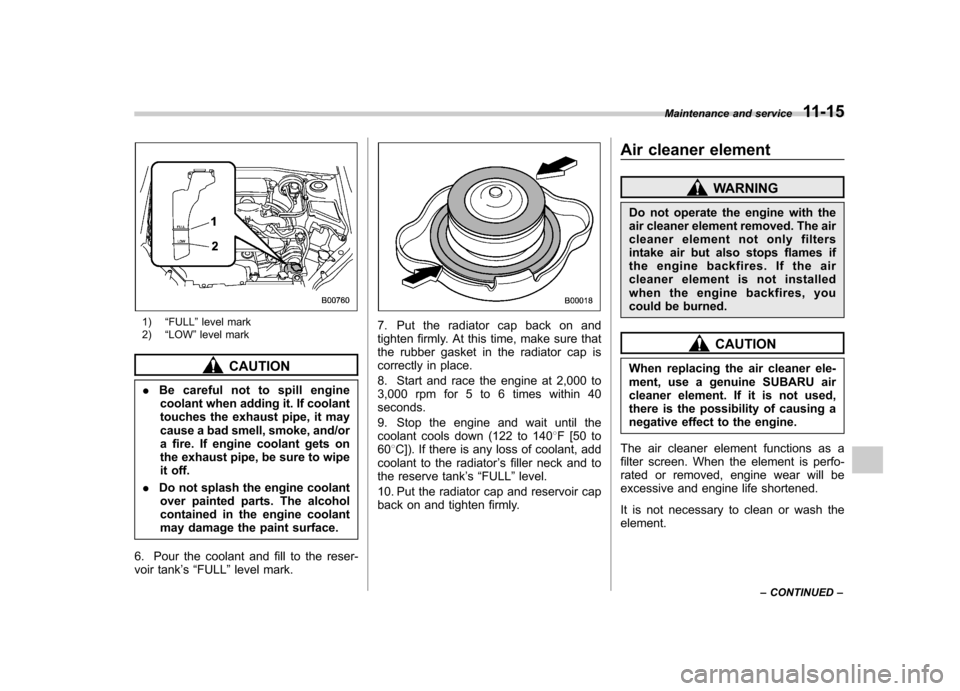
1)“FULL ”level mark
2) “LOW ”level mark
CAUTION
. Be careful not to spill engine
coolant when adding it. If coolant
touches the exhaust pipe, it may
cause a bad smell, smoke, and/or
a fire. If engine coolant gets on
the exhaust pipe, be sure to wipe
it off.
. Do not splash the engine coolant
over painted parts. The alcohol
contained in the engine coolant
may damage the paint surface.
6. Pour the coolant and fill to the reser-
voir tank ’s “FULL ”level mark.
7. Put the radiator cap back on and
tighten firmly. At this time, make sure that
the rubber gasket in the radiator cap is
correctly in place.
8. Start and race the engine at 2,000 to
3,000 rpm for 5 to 6 times within 40seconds.
9. Stop the engine and wait until the
coolant cools down (122 to 140 8F [50 to
60 8C]). If there is any loss of coolant, add
coolant to the radiator ’s filler neck and to
the reserve tank ’s “FULL ”level.
10. Put the radiator cap and reservoir cap
back on and tighten firmly. Air cleaner element
WARNING
Do not operate the engine with the
air cleaner element removed. The air
cleaner element not only filters
intake air but also stops flames if
the engine backfires. If the air
cleaner element is not installed
when the engine backfires, you
could be burned.
CAUTION
When replacing the air cleaner ele-
ment, use a genuine SUBARU air
cleaner element. If it is not used,
there is the possibility of causing a
negative effect to the engine.
The air cleaner element functions as a
filter screen. When the element is perfo-
rated or removed, engine wear will be
excessive and engine life shortened.
It is not necessary to clean or wash the element. Maintenance and service
11-15
– CONTINUED –
Page 343 of 402
11-38Maintenance and service
Windshield washer fluid
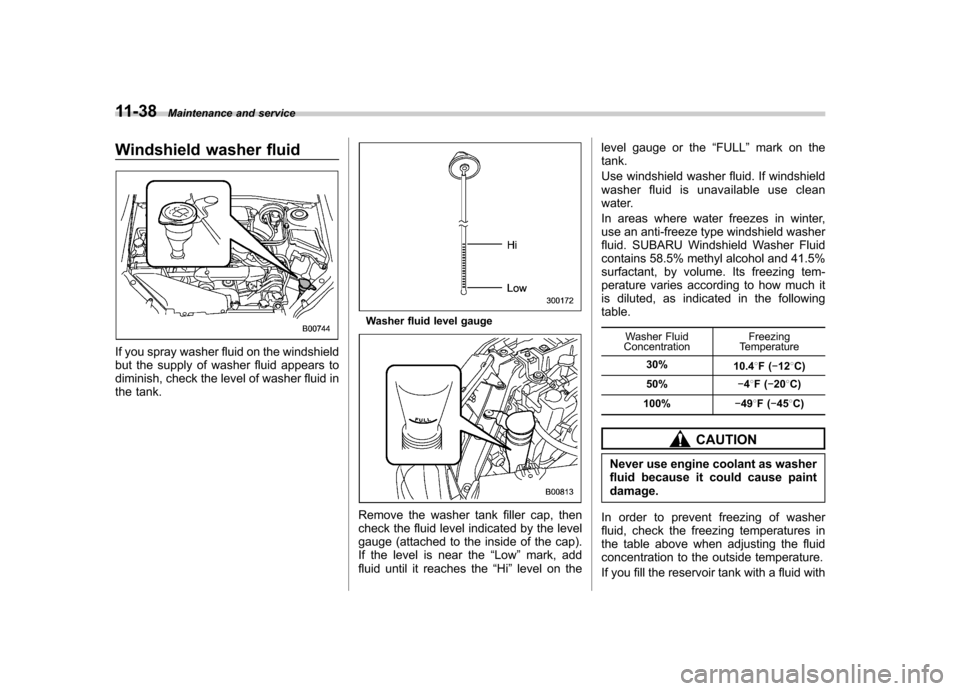
If you spray washer fluid on the windshield
but the supply of washer fluid appears to
diminish, check the level of washer fluid in
the tank.
Washer fluid level gauge
Remove the washer tank filler cap, then
check the fluid level indicated by the level
gauge (attached to the inside of the cap).
If the level is near the “Low ”mark, add
fluid until it reaches the “Hi ”level on the level gauge or the
“FULL ”mark on the
tank.
Use windshield washer fluid. If windshield
washer fluid is unavailable use clean
water.
In areas where water freezes in winter,
use an anti-freeze type windshield washer
fluid. SUBARU Windshield Washer Fluid
contains 58.5% methyl alcohol and 41.5%
surfactant, by volume. Its freezing tem-
perature varies according to how much it
is diluted, as indicated in the followingtable.
Washer Fluid
Concentration Freezing
Temperature
30% 10.48F( 12 8C)
50% 48F( 20 8C)
100% 49 8F( 45 8C)
CAUTION
Never use engine coolant as washer
fluid because it could cause paintdamage.
In order to prevent freezing of washer
fluid, check the freezing temperatures in
the table above when adjusting the fluid
concentration to the outside temperature.
If you fill the reservoir tank with a fluid with
Page 361 of 402

12-4Specifications
&Capacities
Fuel tank 16.9 US gal (64 liters, 14.1 Imp gal)
Engine oil 4.2 US qt (4.0 liters, 3.5 Imp qt)
Transmission oil (MT models) 3.7 US qt (3.5 liters, 3.1 Imp qt)
Transmission fluid (AT models) 9.8 US qt (9.3 liters, 8.2 Imp qt)
Front differential gear oil (AT models) 1.3 US qt (1.2 liters, 1.1 Imp qt)
Rear differential gear oil 0.8 US qt (0.8 liters, 0.7 Imp qt)
Power steering fluid 0.7 US qt (0.7 liter, 0.6 Imp qt)
Engine coolant Non-turbo models MT models 7.2 US qt (6.8 liters, 6.0 Imp qt)
AT models 7.1 US qt (6.7 liters, 5.9 Imp qt)
Turbo models 8.5 US qt (8.0 liters, 7.0 Imp qt)
AT: Automatic transmission
MT: Manual transmission
Each quantity indicated above is only a guideline. The necessary quantity for replacement may differ slightly depending on the temperature and other factors.
Page 378 of 402

&Glossary of tire terminology
. Accessory weight
The combined weight (in excess of
those standard items which may be
replaced) of automatic transmis-
sion, power steering, power brakes,
power windows, power seats, radio,
and heater, to the extent that these
items are available as factory-in-
stalled equipment (whether in-
stalled or not). . Bead
The part of the tire that is made of
steel wires, wrapped or reinforced
by ply cords and that is shaped to fit
the rim. . Bead separation
A breakdown of the bond between
components in the bead. . Bias ply tire
A pneumatic tire in which the ply
cords that extend to the beads are
laid at alternate angles substantially
less than 90 degrees to the center-
line of the tread. . Carcass
The tire structure, except tread and sidewall rubber which, when in-
flated, bears the load.
. Chunking
The breaking away of pieces of the
tread or sidewall.. Cold tire pressure
The pressure in a tire that has been
driven less than 1 mile or has been
standing for three hours or more.. Cord
The strands forming the plies in the tire. . Cord separation
The parting of cords from adjacent
rubber compounds.. Cracking
Any parting within the tread, side-
wall, or inner liner of the tire
extending to cord material. . Curb weight
The weight of a motor vehicle with
standard equipment including the
maximum capacity of fuel, oil and
coolant, and if so equipped, air
conditioning and additional weight
optional engine. .
Extra load tire
A tire designed to operate at higher
loads and higher inflation pressure
than the corresponding standardtire. . Groove
The space between two adjacent
tread ribs.. Innerliner
The layer(s) forming the inside sur-
face of a tubeless tire that contains
the inflating medium within the tire. . Innerliner separation
The parting of the innerliner from
cord material in the carcass.. Intended outboard sidewall
(1) The sidewall that contains a
whitewall, bears white lettering
or bears manufacturer, brand,
and/or model name molding that
is higher or deeper than the
same molding on the other side-
wall of the tire, or (2) The outward facing sidewall
of an asymmetrical tire that has
a particular side that must al-
ways face outward when mount-
Consumer information and Reporting safety defects
13-7
– CONTINUED –
Page 392 of 402

Pad and lining...................................................... 11-29
Parking ........................................................ 7-31, 11-29
Pedal .................................................................. 11-27
System ................................................................. 7-22
Brake pedal Free play ............................................................. 11-27
Reserve distance .................................................. 11-27
Brake system ............................................................ 7-22
Warning light ......................................................... 3-17
Braking ..................................................................... 7-21
Tips...................................................................... 7-21
Breaking-in of new brake pads and linings ................... 11-29
Bulb
Chart .................................................................. 12-10
Replacing ............................................................. 11-46
C Capacities ................................................................. 12-4
Cargo area
Cover ................................................................... 6-13
Light ............................................................. 6-3, 11-50
Tie-down hooks ..................................................... 6-15
Cargo tray ................................................................. 10-6
Catalytic converter ....................................................... 8-3
Center Console .................................................................. 6-5
Ventilators ............................................................... 4-3
Center and side ventilators ............................................ 4-3
Changing Coolant ................................................................ 11-13
Flat tire ................................................................... 9-6 Oil and oil filter
....................................................... 11-9
Charge warning light ................................................... 3-14
CHECK ENGINE warning light/Malfunction indicator lamp ...................................................................... 3-12
Checking Brake pedal free play ............................................ 11-27
Brake pedal reserve distance ................................. 11-27
Clutch function ..................................................... 11-27
Clutch pedal free play ........................................... 11-28
Coolant level ........................................................ 11-13
Fluid level (automatic transmission fluid) .................. 11-20
Fluid level (brake fluid) .......................................... 11-24
Fluid level (clutch fluid) .......................................... 11-25
Fluid level (power steering fluid) .. ........................... 11-23
Fluid level (washer fluid) ........................................ 11-38
Oil level (engine oil) ................................................ 11-8
Oil level (front differential gear oil) .......................... 11-21
Oil level (manual transmission oil) .......................... 11-19
Child restraint systems ................................................ 1-23
Installation of a booster seat .................................... 1-29
Installation with A/ELR seatbelt ... ............................. 1-26
Lower and tether anchorages ................................... 1-30
Top tether anchorages ............................................ 1-33
Child safety ................................................................... 5
Locks .................................................................... 2-19
Chime Key........................................................................ 3-5 Light ..................................................................... 3-25
Seatbelt. ........................................................ 1-13, 3-10
Cleaning Aluminum wheels ................................................... 10-3 Index
14-3
Page 393 of 402

14-4Index
Interior .................................................................. 10-5
Ventilation grille ..................................................... 4-12
Climate control system
Automatic ................................................................ 4-8
Manual ................................................................... 4-3
Clock ........................................................................ 3-22
Clutch Fluid .................................................................... 11-25
Pedal .................................................................. 11-27
Coat hook ................................................................. 6-13
Coin tray ..................................................................... 6-7
Compass .......................................................... 3-32, 3-34
Coolant .................................................................... 11-13
Temperature high warning light ................................ 3-13
Temperature low indicator light. ................................ 3-13
Cooling system ......................................................... 11-12
Corrosion protection ................................................... 10-4
Cruise control ............................................................ 7-34
Indicator light ................................................. 3-21, 7-37
Set indicator light ........................................... 3-21, 7-38
Cup holder .................................................................. 6-8
Front passenger ’s .................................................... 6-8
Rear passenger ’s..................................................... 6-8
D
Daytime running light system ....................................... 3-26
Defogger ................................................................... 3-40
Deicer ...................................................................... 3-40
Differential gear oil Front ................................................................... 11-21
Rear .................................................................... 11-22 Dimensions
................................................................ 12-2
Disarming the alarm system ......................................... 2-17
Disc brake pad wear warning indicators ........................ 7-22
Dome light ......................................................... 6-2, 11-50
Door Locks ..................................................................... 2-4
Open warning light. ................................................. 3-18
Step light ............................................................. 11-50
Drive belts ............................................................... 11-18
Driving All-Wheel Drive warning light ................................... 3-18
AWD models ........................................................... 8-5
Car phone/cell phone .................................................. 7
Drinking. .................................................................... 6
Drugs ........................................................................ 6
Foreign countries ..................................................... 8-4
Pets .......................................................................... 7
Snowy and icy roads ............................................... 8-9
Tips ......................................................... 7-15, 8-2, 8-5
Tired or sleepy ........................................................... 7
Winter .................................................................... 8-8
E
Electrical system ........................................................ 12-3
Electronic Brake Force Distribution (EBD) system... 3-17, 7-24
Emergency Locking Retractor (ELR) ............................. 1-12
Engine Compartment overview ............................................ 11-6
Coolant ............................................................... 11-13
Exhaust gas (carbon monoxide) ............................. 5, 8-2
Hood .................................................................... 11-5