2010 SKODA YETI ECU
[x] Cancel search: ECUPage 77 of 271

Seats and Stowage
76
Adjusting seats in crosswise directionMoving seats in crosswise direction– Remove the middle seat page 75.
– Fold the outer seat forwards page 74 and lock it page 75, fig. 63 .
– Move the folded forward and unlocked seat on the guide towards the middle of the vehicle up to the stop.
– Lock the seat at the end of the guide fig. 64 .Move seats into the initial positionLocking seats and folding back into position– If the seat is removed, first of all position it on the guide and lock the seat fig. 64 .
Check for yourself that the seat is correctly locked by pulling it up. – Fold the seat into the horizontal position until it is heard to lock. Check for yourself
that the seat can no longer be lifted by pulling it up.
– Push the lever fig. 65 and fold the backrest back in to position. Check for yourself
that the seat backrest is engaged.
– Take the belt tongue out of the safety holder.
– Close the guide loop of the seat belt on the side of the outer seats until it is heard to lock.
WARNING
The belt locks and the belts must be in their original position after folding
back the seat cushions and the seat backrests - they must be ready to use.
The seat backrests must be securely interlocked in position so that no
objects in the luggage compartment can slide into the passenger compartment
if there is sudden braking - risk of injury!
When folding the seat backrest always make sure that it has safely locked
into position, this is confirmed by the position and a visible marking on the
cover of the lever.Note
The seat belts of the outer seats must always be guided through the guide loops next
to the head restraints. Otherwise the seat belts can slip behind the seat.Folding table on the middle seat backrest*
Fig. 64 Locking the seatFig. 65 Folding the seat backrest back
into position
Fig. 66 Rear seats: Armrest
s2ug.6.book Page 76 Friday, April 9, 2010 2:24 PM
Page 78 of 271
Seats and Stowage77
Using the system
Safety
Driving Tips
General Maintenance
Breakdown assistance
Technical Data
– The middle seat backrest can be folded
page 74, “Folding rear seats forwards”
forwards and used as armres t or table with cup holder page 76, fig. 66 .
– You can place two cups or beverage cans into the recesses.
Note
If the middle rear seat backrest should be folded forward for lengthy periods, then
make sure that the belt locks are not located below it - this can result in permanent
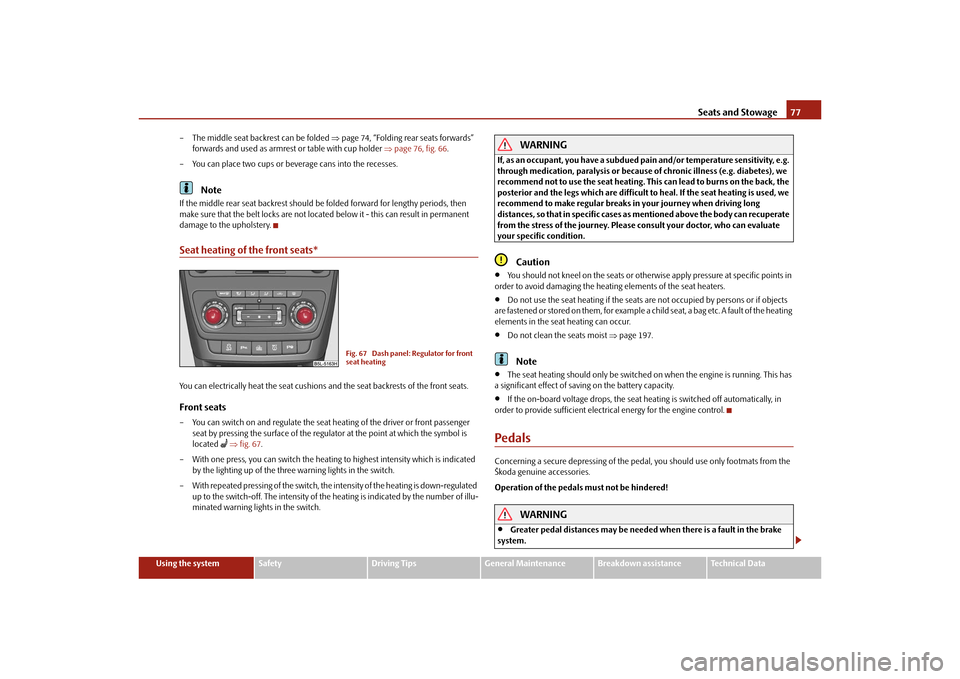
damage to the upholstery.Seat heating of the front seats*You can electrically heat the seat cushions and the seat backrests of the front seats.Front seats– You can switch on and regulate the seat heating of the driver or front passenger
seat by pressing the surface of the regulator at the point at which the symbol is
located
fig. 67 .
– With one press, you can switch the heating to highest intensity which is indicated by the lighting up of the three warning lights in the switch.
– With repeated pressing of the switch, the intensity of the heating is down-regulated up to the switch-off. The intensity of the heating is indicated by the number of illu-
minated warning lights in the switch.
WARNING
If, as an occupant, you have a subdued pain and/or temperature sensitivity, e.g.
through medication, paralysis or because of chronic illness (e.g. diabetes), we
recommend not to use the seat heating. This can lead to burns on the back, the
posterior and the legs which are difficult to heal. If the seat heating is used, we
recommend to make regular breaks in your journey when driving long
distances, so that in specific cases as mentioned above the body can recuperate
from the stress of the journey. Please consult your doctor, who can evaluate
your specific condition.
Caution
You should not kneel on the seats or otherwise apply pressure at specific points in
order to avoid damaging the heating elements of the seat heaters.
Do not use the seat heating if the seats ar e not occupied by persons or if objects
are fastened or stored on them, for example a child seat, a bag etc. A fault of the heating
elements in the seat heating can occur.
Do not clean the seats moist page 197.Note
The seat heating should only be switched on when the engine is running. This has
a significant effect of saving on the battery capacity.
If the on-board voltage drops, the seat heating is switched off automatically, in
order to provide sufficient electrical energy for the engine control.
PedalsConcerning a secure depressing of the peda l, you should use only footmats from the
Škoda genuine accessories.
Operation of the pedals must not be hindered!
WARNING
Greater pedal distances may be needed when there is a fault in the brake
system.
Fig. 67 Dash panel: Regulator for front
seat heating
s2ug.6.book Page 77 Friday, April 9, 2010 2:24 PM
Page 79 of 271

Seats and Stowage
78
Do not place any footmats or other additional floor coverings in the area of
the pedals in order to ensure that all the pedals can be fully depressed and are
able to return unobstructed to their initial position - risk of accident!
There must be no objects on the floor which could roll under the pedals. You
would then no longer be able to apply the brakes, operate the clutch or acceler-
ator - risk of accident!
luggage compartmentLoading the luggage compartmentPlease observe the following in the interest of having good handling characteristics of
your vehicle:
– Distribute the items of luggage as evenly as possible.
– Place heavy objects as far forward as possible.
– Attach the items of luggage to the lashing eyes or the fixing net* page 79.
In the event of an accident, there is such a high kinetic energy which is produced by
small and light objects that they can cause se vere injuries. The magnitude of the kinetic
energy depends on the speed at which the vehi cle is travelling and on the weight of the
object. The speed at which the vehicle is travelling is in this case the more significant
factor.
Example: In the event of a frontal collision at a speed of 50 km/h, an unsecured object
with a weight of 4.5 kg produces an ener gy, which corresponds to 20 times its own
weight. This means that it results in a weight of approx. 90 kg. You can imagine the inju-
ries that can occur, if this “bullet” is fl ying through the interior compartment and hits
an occupant.
WARNING
Store the objects in the luggage compartment and attach them to the
lashing eyes, e.g. with the fixing nets.
Loose objects in the passenger compartment can be thrown forward during
a sudden manoeuvre or in case of an a ccident and can injure the occupants or
other oncoming traffic. This risk is still increased, if the objects which are flying
around are hit by a deployed airbag. In this case, the objects which are thrown
back can injure the occupants - hazard.
Please note that the handling properti es of your vehicle may be affected
when transporting heavy objects as a result of the displacement of the centre of
gravity. The speed and style of driv ing must be adjusted accordingly.
The items carried in the luggage compartment should be stowed in such a
way that no objects are able to slip forward if there are any sudden driving or
braking manoeuvres undertaken - risk of injury!
Never drive with the boot lid fully opened or slightly ajar otherwise exhaust
gases may get into the interior of the vehicle - risk of poisoning!
On no account exceed the permissible axle loads and the permissible gross
weight of the vehicle - risk of accident!
Never transport occupants in the luggage compartment!Note
Tyre pressure must be adjusted to the load page 216.Vehicles of category N1On vehicles of the category N1, which are not fitted with a protective grille, a lashing
set which complies with the standard EN 12195 (1 - 4) must be used for fastening the
load.
WARNING (continued)
WARNING (continued)
s2ug.6.book Page 78 Friday, April 9, 2010 2:24 PM
Page 81 of 271

Seats and Stowage
80
Move the hook into another position
– Fold up the hook in direction of arrow page 79, fig. 70 until an angle of
approx. 45° is reached.
– Move the hook in direction of arrow page 79, fig. 70 into the desired position
and fold down the hook as far as the stop in direction of arrow .Remove the hook from the fastening strip– Fold the hook in direction of arrow until it slackens.Install the hook on the fastening strip– Position the hook on the fastening strip in the vertical position in direction of arrow and lightly press it on.
– Fold the hook down in opposite direct ion of the arrow until it locks fully.
WARNING
Please refer to the following guidelines page 78.Fixing nets - Net programme*Fig. 71 Fixing net: double horizontal pock et, floor fixing net / double vertical pocketFixing examples of the fixing net as double horizontal pocket, floor fixing net fig. 71
- left, and double vertical pocket fig. 71 - right.
The fixing nets* and the installation inst ruction are located in the luggage compart-
ment.
WARNING
The whole strength of the net makes it possible to load the pocket with
objects of up to 3.5 kg in weight. Heavy objects are not secured sufficiently - risk
of injury and net damage!
The load to be transported must be fixed in place in such a way that it cannot
move during the journey and when braking.Caution
Do not place any objects with sharp edge s in the nets - risk of net damage.The luggage compartment cover
You can use the luggage compartment cover behind the head
restraints for storing light and soft items.The luggage compartment cover can be remo ved as required if one must transport
bulky goods.Removing the luggage compartment cover– Fold the seat backrests a little forward in order to facilitate the removal of the luggage compartment cover.
– Unhook the support straps fig. 72.
– Place the cover in th e horizontal position.
A1
A2
A3
A4
A5
A4
Fig. 72 Removing the luggage compart-
ment cover
A1
s2ug.6.book Page 80 Friday, April 9, 2010 2:24 PM
Page 83 of 271

Seats and Stowage
82
Variable loading floor in the luggage compartment*Remove variable loading floorFig. 74 Luggage compartment: Fold up variable loading floor / removeThe variable loading floor makes it easier to handle bulky goods and creates an even
luggage compartment floor when the rear seat backrests are folded forward. The
maximum permissable surface load of the variable loading floor is 75 kg.Removing the variable loading floor– You can fold together the loading floor by moving it in direction of arrow
fig. 74 .
– Raise the variable loading floor in direction of arrow fig. 74 .
– Pull on both sides of the locking levers in direction of arrow fig. 74 .
– Pull the variable loading floor up and out in direction of arrow .
– The installation of the variable loading floor is carried out in the reverse order.Secure the variable loading floor in the raised position– Fold up the hooks on the fastening strip in direction of arrow page 79, fig. 70 .
– Fold up the variable loading floor behind the seat backrests of the rear seats.
– Fold down the hooks in direction of arrow page 79, fig. 70 as far as the stop.
– Support the variable loading floor on the hooks folded downwards.
WARNING
Pay attention when installing the variable loading floor that the carrier rails and
the variable loading floor are correctly fixed, otherwise the occupants are at
risk.
Note
If the variable loading floor* is installed, no flexible storage compartment can be
installed.Remove carrier railsFig. 75 Luggage compartment: Slacken check points / remove carrier railsRemove carrier rails– Slacken the check points fig. 75 on the carrier rails using the vehicle key or a
flat screwdriver.
– Grasp the carrier rail at the position fig. 75 and slacken it by pulling in the
direction of the arrow.
– Grasp the carrier rail at the position , slacken it by pulling in the direction of
the arrow and take it out.
– The carrier rail on the other side of the luggage compartment can be removed in
the same way.
A1
A2
A3A4
A1
A3
AB
AA
A1
AA
A2
s2ug.6.book Page 82 Friday, April 9, 2010 2:24 PM
Page 84 of 271

Seats and Stowage83
Using the system
Safety
Driving Tips
General Maintenance
Breakdown assistance
Technical Data
Install carrier rails– Position the carrier rails on the sides of the luggage compartment.
– Press both check points on each carrier rail up to the stop.
– Check the attachment of the carrier rails by pulling it.
WARNING
Pay attention when installing the variable loading floor that the carrier rails and
the variable loading floor are correctly fixed, otherw ise the occupants are at
risk.Variable loading floor* with spare wheel*Use variable loading floorFig. 76 Luggage compartment: Fold the side parts of the loading floor / example for using the
variable loading floorThe variable loading floor makes it easier to handle bulky goods and creates an even
luggage compartment floor when the rear seat backrests are folded forward. The
maximum permissable surface load of the variable loading floor is 75 kg.
You can fold down the side parts of the vari able loading floor in direction of arrow in
order to enlarge the space foreseen for stowing items of luggage fig. 76 .
Note
If the variable loading floor with spare wh eel* is installed, no flexible storage
compartment can be installed.
The variable loading floor with spare wheel* can be secured in the raised position
in the same way as the variable loading floor without spare wheel* page 82, “Secure
the variable loading floor in the raised position”.
Removeable storage boxThe storage box is housed under the variab le loading floor. If necessary, you can
remove it.
There is a space for the vehicle tool kit under the storage box page 223.
WARNING
The removeable storage box must be lo cated under the variable loading floor
for the safe use of the variable loading floor.
Fig. 77 Luggage compartment: Storage
box
AA
s2ug.6.book Page 83 Friday, April 9, 2010 2:24 PM
Page 95 of 271

Seats and Stowage
94
Removeable through-loading bag*The removeable through-loading bag is solely used for transporting
skis.Loading– Open a rear side door of the vehicle.
– Fold the backrest of the middle seat forwards page 74.
– Place the empty removeable through-load ing bag in the gap between the front and
rear seats in such a way that the end of the bag with the zip lies in the luggage
compartment.
– Open the boot lid.
– Push the skis into the removeable through-loading bag from the luggage compart- ment .
– Close the removeable through-loading bag with the zip.Securing– Pull the securing belt with both lock to ngues out of the pocket of the removeable
through-loading bag.
– Insert the lock tongues fig. 98 in the belt locks of the rear middle seat belt
, first of all on the one side and then on the other side.
– Place the securing belt in the middle of the skis between the heel and the tip of the
bindings and pull the secu ring belt tight at the free end of the belt .
WARNING
After placing the skis into the remove able through-loading bag, you must
secure it with the securing belt .
The securing belt must hold the skis tight.
Ensure that the securing belt for skis grasps the middle between the tip and
the heel element of the bi nding (see also imprint on the removeable through-
loading bag).Note
The removeable through-loading bag is foreseen for two pairs of skis. The total
weight of the skis which are transported must not exceed 10 kg.
You must put the skis and the sticks in the removeable through-loading bag with
the tips facing the rear.
If there are several pairs of skis in the removeable through-loading bag, ensure that
the bindings are positioned at the same height.
The removeable through-loading bag must never be folded together or stowed
when moist.
Fig. 98 Securing the removeable
through-loading bag
AA
AC
AB
AA
s2ug.6.book Page 94 Friday, April 9, 2010 2:24 PM
Page 131 of 271

Communication
130
Connection with an already paired mobile phone
After switching on the ignition, the connec tion is automatically established for the
already paired mobile phone
10). Check on the mobile unit if the automatic connection
was established.
Disconnecting the connection
By withdrawing the ignition key.
By disconnecting the device in the information display.
By disconnecting the device in the mobile phone.
Solving connection problems
If the system announces No paired phone found , check the operating state of the
telephone:
Is the telephone switched on?
Is the PIN code entered?
Is Bluetooth
® active?
Is the visibility of the mobile phone active?
Was the telephone already paired with the hands-free system?
WARNING
In the event of air transport, the Bluetooth
® function of the hands-free system
must be switched off by a specialist garage!
Note
Not valid for all mobile phones which enable a communication via Bluetooth
®.
You can ask at an authorised Škoda Service Partner if your telephone is compatible
with the universal telephone preinstallation GSM II.
If a suitable adapter is available for yo ur mobile phone, use your mobile phone
exclusively in the adapter so that the radiation in the vehicle drops to a minimum.
Inserting the mobile phone into the ad apter ensures an optimal sending and
receiving power and offers at the same ti me the advantage of the battery charging.
The range of the Bluetooth
® connection to the hands-free system is restricted to
the vehicle interior. The range is dependent on local factors, e.g. obstacles between the devices and mutual interferences with other de
vices. If your mobile phone is e.g. in a
jacket pocket, this can lead to diffic ulties when establishing the Bluetooth
® connection
with the hands-free system or the data transfer.
Inserting the mobile phone with the adapter*Only one telephone mount* is factory-fitted. An adapter for the telephone can be
purchased from the range of the Škoda original accessories.Inserting the mobile phone with the adapter– First of all push the adapter fig. 119 in the direction of arrow up to the stop
into the mount. Press the adapter slightly downwards, until it locks securely into
position.
– Insert the mobile phone into the adapter (as specified in manufacturer's instructions).Removing the mobile phone with the adapter– Press simultaneouly the side locks of th e mount and remove the mobile phone and
adapter fig. 119 .
Caution
Taking the mobile phone out of the adapter du ring the call can lead to interruption of
the connection. When taking out the mobile phone, the connection to the factory-
fitted antenna is interrupted, this reduces the quality of the transmitting and receiving
signal. The charging of the mobile phone battery is also interrupted.
Fig. 119 Universal preparation for the
phone
AA
AA
s2ug.6.book Page 130 Friday, April 9, 2010 2:24 PM