2010 SKODA YETI maintenance
[x] Cancel search: maintenancePage 174 of 271

Driving and the Environment173
Using the system
Safety
Driving Tips
General Maintenance
Breakdown assistance
Technical Data
Driving and the EnvironmentThe first 1 500 kilometres and then afterwardsA new engine
The engine has to be run in during the first 1 500 kilometres.Up to 1 000 kilometres– Do not drive faster than 3/4 of the maximum speed of the gear in use, that is 3/4 of
the maximum permissi ble engine speed.
– Do not use full throttle.
– Avoid high engine revolutions.
– Do not tow a trailer.From 1 000 up to 1 500 kilometres– Increase the power output of the engine gradually up to the full speed of the gear
engaged, that is up to the maxi mum permissible engine revolutions.
During the first operating hours the engine ha s higher internal friction than later until
all of the moving parts have harmonized. Th e driving style which you adopt during the
first approx.1 500 kilometres plays a decisive part in the success of running in your
vehicle.
You should not drive at unnecessarily high engine revolutions even after the
running-in period is complete . The maximum permissible en gine speed is marked by
the beginning of the red zone on the scale of the revolutions counter. Shift up into the
next higher gear on a vehi cle fitted with manual gear box before the red zone is
reached. Extremely high engine revolutions are automatically governed, by the way.
For a vehicle fitted with a manual gearbox the converse situation also applies: Do not
drive at engine revolutions which are too low. Shift down as soon as the engine is no
longer running smoothly.
Caution
All the speed and engine revolution figures ap ply only when the engine is at its normal
operating temperature. Never rev up an engine which is cold, neither when the vehicle
is stationary nor when driving in individual gears.
For the sake of the environment
Not driving at unnecessari ly high engine revolutions and shifting to a higher gear as
early as possible are ways to minimise fu el consumption and operating noise levels
and protects the environment.New tyresNew tyres have to be “run in” since they do not offer optimal grip at first. You should
take account of this fact for the first 500 kilometres and drive particularly carefully.New brake padsAllow for the fact that new brake pads do no t achieve their full braking efficiency until
approximately 200 kilometres. New brake pads must be first “run in” before they
develop their optimal friction force. You ca n, however, compensate for this slightly
reduced braking force by increasing the pressure on the brake pedal.
This guideline also applies to any new brake pads installed at a future date.
During the running-in pe riod, you should avoid excessive stresses on the brakes. This
includes, for example, violent braking, part icularly from very high speeds, and also
when crossing mountain passes.
s2ug.6.book Page 173 Friday, April 9, 2010 2:24 PM
Page 176 of 271

Driving and the Environment175
Using the system
Safety
Driving Tips
General Maintenance
Breakdown assistance
Technical Data
guidelines given in this chapter in order to
make best use of these characteristics and
to maintain their effectiveness.
The optimal engine speed should be obtained when accelerating, in order to avoid a
high fuel consumption and resonance of the vehicle.
Looking ahead when driving
A vehicle's highest fuel consumption occurs it accelerates.Avoid accelerating and braking unnecessarily. If you drive with forsight you will not
need to brake so often and will also then not have to accelerate so much. Let your
vehicle coast to a stop, for example, if this is possible, when you see that the next set of
traffic lights is at red.Shifting gears and saving energy
Shifting up early saves on fuel.Manual gearbox– Drive no more than about one length of your vehicle in first gear.
– Shift up into the next higher gear at approx. 2 000 to 2 500 revs.Automatic gearbox– Depress the accelerator pedal slowly. Do not depress it beyond the kickdown
position, however. An effective way of achieving good fuel economy is to shift up
early. You will consume
more fuel if you drive at unnecessaril y high revolutions in any given gear.
The fig. 151 shows the ratio of fuel consumption to the speed of your vehicle in the
relevant gear. Fuel consumption in 1st gear is the highest. The consumption is the
lowest in the highest gear.
You will achieve good fuel economy by shif ting up early and shifting down late.
Note
Also use the information supplied by the multi-functional indicator* page 20.Avoiding full throttle
Driving more slowly means saving fuel.Sensitive use of the accelerator will not only significantly reduce fuel consumption but
also positively influence environmenta l pollution and wear of your vehicle.
You should avoid exploiting the top speed of your vehicle wherever possible. Fuel
consumption, pollutant emissions and vehicl e noises increase disproportionally at
high speeds.
The fig. 152 shows the ratio between the fuel consumption and the speed of your
vehicle. You will cut your fuel consumption by half if you only make use three-quar ters
of the possible top speed of your vehicle.
Fig. 151 Fuel consumption in litres/100
km. and speed in km/h.
Fig. 152 Fuel consumption in litres/100
km. and speed in km/h.
s2ug.6.book Page 175 Friday, April 9, 2010 2:24 PM
Page 177 of 271
Driving and the Environment
176
Reducing idling
Idling also costs fuel.It is worthwhile switching off the engine in a traffic jam or when waiting at a level
crossing or at traffic lights with a lengthy red phase. Even after just 30 - 40 seconds you
will have saved more fuel th an that is needed when you start the engine up again.
If an engine is only idling it takes much longer for it to reach its normal operating
temperature. Wear-and-tear and pollutant emis sions, though, are particularly high in
the warming-up phase. This is why you should drive off right after starting the engine.
Do avoid high engine revolu tions at this time, however.Regular servicing
A poorly tuned engine consumes an unnecessarily high amount of fuel.Having your vehicle serviced regularly at a specialist garge enables you to satisfy one
of the requirements for economical motoring even before you set off on your journey.
Keeping your vehicle properly serviced not on ly has a positive effect on the safety of
your vehicle and maintaining its value, but also saves on fuel.
A poorly tuned engine can result in a fu el consumption which is 10% higher than
normal.
The foreseen maintenance work should be undertaken exactly according to the
Service schedule by a specialist garage.
Also check the oil level after refueling. Oil consumption is dependent to a consider-
able extent on the load and speed of the en gine. Oil consumption could be as high as
0.5 litres/1 000 km depending on your style of driving.
It is quite normal that a new engine has a higher oil consumption at first, and reaches
its lowest level only after a certain running in time. It is therefore not possible to
correctly assess the oil consumption of a new vehicle until after you have driven about
5 000 km.
For the sake of the environment
You can achieve additional improvements in your fuel economy by using high-
lubricity oils.
Check the ground below your vehicle at regular intervals to detect any leakages in
good time. Please have your vehicle inspec ted by a specialist garge if you find any
stains caused by oil or other fluids on the floor.
Avoid driving short distances
Short distances result in an above-average high fuel consumption.– Avoid driving a distance of no more than 4 km if the engine is cold.
The engine and catalytic converter mu st first have reached their optimal operating
temperature in order to effectively reduce fuel consumption and pollutant emissions.
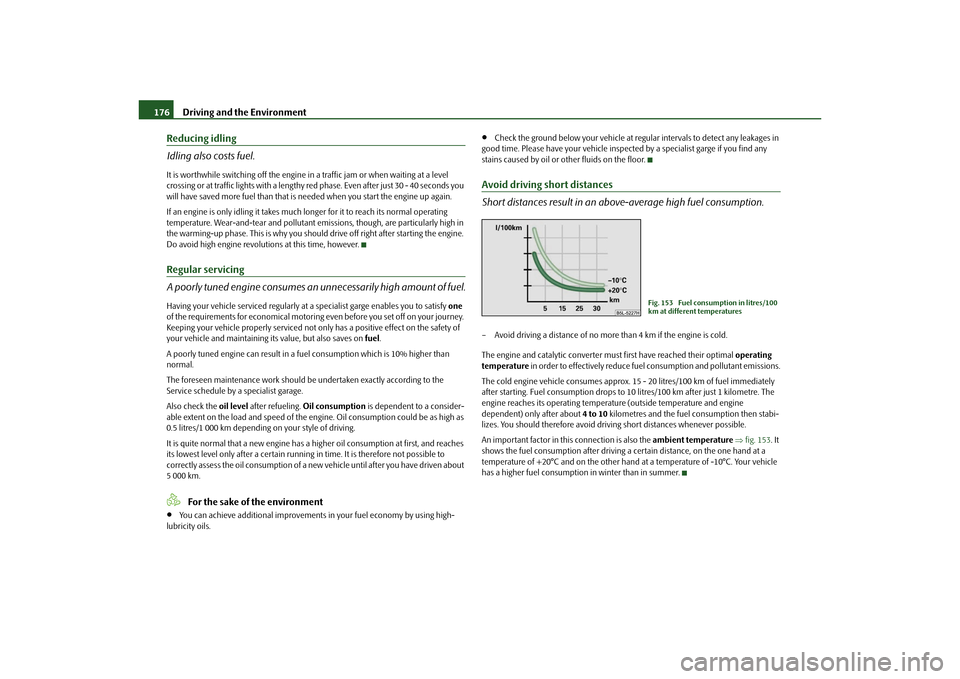
The cold engine vehicle cons umes approx. 15 - 20 litres/100 km of fuel immediately
after starting. Fuel co nsumption drops to 10 litres/100 km after just 1 kilometre. The
engine reaches its operating temperat ure (outside temperature and engine
dependent) only after about 4 to 10 kilometres and the fuel consumption then stabi-
lizes. You should therefore avoid driving short distances whenever possible.
An important factor in this connection is also the ambient temperature fig. 153 . It
shows the fuel consumption af ter driving a certain distance, on the one hand at a
temperature of +20°C and on the other hand at a temperature of -10°C. Your vehicle
has a higher fuel consumptio n in winter than in summer.
Fig. 153 Fuel consumption in litres/100
km at different temperatures
s2ug.6.book Page 176 Friday, April 9, 2010 2:24 PM
Page 178 of 271

Driving and the Environment177
Using the system
Safety
Driving Tips
General Maintenance
Breakdown assistance
Technical Data
Checking tyre inflation pressures
Tyres which are correctly inflated save fuel.Always ensure that your tyres are inflated to the correct pressure at all times. The rolling
resistance will be increased if the tyre filling pressure is too low. This will not only
increase fuel consumption but also tyre we ar and the driving behaviour will worsen.
Always check the inflation pr essure of the tyres when cold.
Do not drive with winter tyres all year round for this costs about 10 % more fuel. They
are also louder and have poorer handling characteristics and higher wear at tempera-
tures more than 10°C.No unnecessary ballast
Transporting ballast costs fuel.The fact that every kilogram of extra weight increases your fuel consumption means
that it is worth taking a look in the luggage compartment to avoid transporting any
unnecessary ballast.
It is particularly in town traffic, when one is accelerating quite often, that the vehicle
weight will have a significant effect upon the fuel consumption. A rule of thumb here
is that an increase in weight of 100 kilograms will cause an increase in fuel consump-
tion of about 1 litre/100 kilometres.
You may frequently also leave a roof rack fitted on just out of convenience, although
you no longer need it. The increased aerodyna mic drag of your vehicle causes it to use
about 10% more fuel than normal at a speed of 100 - 120 km/h, even when you are not
carrying a load on the roof.Saving electricity
Generating electricity costs fuel.– Switch off electrical components as soon as you no longer need them.
When the engine is running, the alternator generates and supplies electrical power.
The greater the load on the alternator as a result of having a large number of electrical components switched on, the more fuel
will be consumed for operating the
alternator.
Keeping a log of your fuel consumptionIf you really wish to keep a close check on your fuel consumption, it is best to enter
the figures in a logbook. This does not take much time but is a very worthwhile exer-
cise. It enables you to detect any change (p ositive and negative) at an early stage and
to take any appropriate action.
If you find that your fuel consumption is too high, you should reflect on how, where
and in what conditions you have driven the vehicle since you last refuelled.Environmental compatibilityEnvironmental protection has played a major role in the design, selection of materials
and manufacture of your new Škoda. Particular emphasis has been paid to a number
of aspects, including:
Design measures
Joints designed to be easily detached.
Simplified disassembly due to the modular structure system.
Improved purity of differ ent classes of materials.
Identification of all plastic parts in accordance with VDA Recommendation°260.
Reduced fuel consumption and exhaust emission CO
2.
Minimum fuel leakage during accidents.
Reduced noise.
Choice of materials
Extensive use of re cyclable material.
Air conditioning filled with CFC-free refrigerant.
No cadmium.
No asbestos.
Reduction in the “vaporisation” of plastics.
s2ug.6.book Page 177 Friday, April 9, 2010 2:24 PM
Page 180 of 271

Driving and the Environment179
Using the system
Safety
Driving Tips
General Maintenance
Breakdown assistance
Technical Data
Avoiding damage to your vehicleWhen driving on poor roads and lanes or when driving over kerbstones, steep ramps
etc., you must pay particular attention to ensuring that any low-slung parts of the
vehicle, such as spoiler and exhaust, do not touch the ground and get damaged.
This particularly applies to models with a lowered suspen sion (sport suspension) and
also when your vehicle is fully laden.Driving through bodies of water on roadsIn order to avoid damage to the vehicle wh en driving through bodies of water (e.g.
flooded roads), observe the following:
Determine the depth of the water when driv ing through bodies of water. The water
can reach at the maximum the web on the lower sill of the vehicle fig. 154 .
Drive no more than at walking speed. At a higher speed, a water wave can form in
front of the vehicle which can cause water to penetrate into the air induction system of
the engine or into other parts of the vehicle.
Never let the vehicle stand in the water, never drive backwards and do not switch
off the engine.
WARNING
Driving through water, mud, sludge etc. can reduce the braking power and
extend the braking distance - risk of accident!
Avoid sudden and severe braking manoeuvres immediately after driving
through bodies of water.
After driving through bodies of water, the brakes must be cleaned and dried
as soon as possible by intermittent braking. Only apply the brakes for the
purpose of drying and cleaning the brake discs if the traffic conditions permit
this. Do not place any other road users in jeopardy.Caution
When driving through bodies of water, pa rts of the vehicle such as the engine,
gearbox, catalytic converter, chassis or electrics can be severely damaged.
Oncoming vehicles can generate water waves which ca n exceed the permissible
water level for your vehicle.
Potholes, mud or rocks can be hidden under the water making it difficult or impos-
sible to drive through the body of water.
Do not drive through salt water. The salt can lead to corrosion. Immediately rinse
all the parts of the vehicle, which came into contact with the salt water, with fresh
water.Note
After driving through a body of water, we recommend that the vehicle is checked by a
specialist garage.Off-road drivingImportant information
WARNING
Never drive too fast, particularly not around curves, and never undertake
extreme driving manoeuvres.
Always adjust your speed and adapt your style of driving to suit road, off-
road, traffic and weather conditions.
Fig. 154 Crossing bodies of water
WARNING (continued)
s2ug.6.book Page 179 Friday, April 9, 2010 2:24 PM
Page 182 of 271

Driving and the Environment181
Using the system
Safety
Driving Tips
General Maintenance
Breakdown assistance
Technical Data
The first priority
should always be safety.
Never overestimate your own capabilities and never underestimate the difficulties of
driving off-road.
We cannot discuss all the possible driving situations in this manual, because there are
so many types of terrains which may hide different risks and dangers. The examples
listed in this manual are general rules for safe off-road driving. It is however not
possible to predict if these rules are valid for all the situations which may occur. Before
driving through unknown terrain, it is ther efore important that you know what lies
ahead of you. This way you can estima te any possible danger in advance.
For the sake of the environment
When driving off-road, show respect and appreciation for the environment and its
preservation for future generations.Before driving off-road for the first timeBefore driving off-road, we recommend that you take part in an Off-road driver
training course. This is especial l y i m p o r t a n t i f y o u h a v e l i t t l e o r n o e x p e r i e n c e o f d r i v i n g
off-road. In a driver training course, you learn how to use th e vehicle in many different
off-road situations and how to handle the vehicle safely when driving through rough
terrain.
Driving off-road requires entirely different skills from the driver and a very different
behaviour than driving on the road. Your pers onal safety and that of your passengers
depend on you, your capabili ties and your cautiousness.
Do not drive off-road where it is not suitable for your vehicle or where the demands
on you are too high. Although your vehicle can handle off-road driving, it is not
designed for travels with expedition characteristics.
Before each journey off-road, make sure that the vehicle is appropriately equipped for
the planned journey page 182. The standard equipmen t of your vehicle may not be
sufficient for your journey. With the standard tyres you can drive with your off-road
vehicle through easy terrain, such as flat forest roads, meadows and fields. Please note
however, that driving the vehicle on a diffic ult, muddy and sandy ground is restricted
and that the traction of the standard tyres is reduced when driving off-road. If you have
planned prolonged or difficul t off-road trips, we recommend that you equip your
vehicle with suitable off-road tyres.
WARNING
Observe the important guidelines page 179.Rules of conduct for responsible off-road drivingObserve the valid national legal requirements when driving off-road.Explanation of technical termsFig. 155 Embankment angle / slope angle
Fig. 156 Ground clearance / ramp angleThe technical data page 245, “Angle (in degree)” refer to ideal conditions. These
values may differ depending on the load and composition of the soil and the environ-
ment. The driver is responsible to decide whether a vehicle can overcome a certain
situation.
s2ug.6.book Page 181 Friday, April 9, 2010 2:24 PM
Page 184 of 271

Driving and the Environment183
Using the system
Safety
Driving Tips
General Maintenance
Breakdown assistance
Technical Data
Fill up your tank. The fuel consumption of the vehicle is much higher when driving
off-road than when driving on the road.
Install the towing eye at the front or at the rear before driving off-road. It is not
always possible to install the towing eye if the vehicle got stuck.
Always check the inflation pressure of a ll the tyres and if necessary correct it.
Check the vehicle tool kit and supplement it according to your needs.
Fill with engine oil up to the line , so that the engine is sufficiently supplied with
engine oil when the vehicle is in a tilted position page 205, “Check engine oil level”.
Top up wash fluid.
Stow your load as low as possible in th e vehicle and attach all the items which are
loose.
Off-road driving
Never be alone when driving off-road and be prepared to encounter unexpected
situations. Travel together with at least two off-road vehicles. Equipment with which
you can call for help in an emer gency is particularly useful.
Drive slowly through unclear terrain.
You must stop when encountering difficul t passages and explore the continuation
of the route on foot. If you cannot go on or if you doubt the safety of the route, turn
back and choose another way.
Drive slowly over hilltops. Ma ke sure that the wheels of the vehicle do not lift off
the ground, as this could severely damage the vehicle and it may become disabled.
Drive slowly on difficult stretches of the route. When driving on a slippery ground,
s h i f t u p i n to t h e n e xt h i g h e r g e a r a n d m a ke s u re t h a t t he v e h i c l e a l w a y s s t a y s i n m o t i o n.
Do not drive too fast so that you do n't lose control over your vehicle.
If your vehicle got stuck in sand, snow or sludge, it may be more effective to reverse
the vehicle than trying to drive forwards.
Place stones, footmats or pieces of wood under the spinning wheels in order to
achieve traction on a sandy or slippery ground.
Do no drive throug h water before reading what you must take into account
page 179.
Keep sufficient distance from other vehicles even at low speeds. When the first
vehicle suddenly gets stuck, the following vehi cle can still stop in time without getting
stuck itself.
Do not plan day trips which are too far in distance.
Do not use the cruise control system when driving off-road. It is only intended for
driving on the road.
WARNING
The intelligent engineering of your ve hicle cannot overcome the physical
limits of your vehicle.
Be very alert and look ahead when driving off-road. Excessive speed or
incorrect driving manoeuvres can caus e damage to the vehicle and lead to
serious injuries.
Observe the important guidelines page 179.Caution
Pay attention to the ground clearance of the vehicle! The vehicle can be severely
damaged and become disabled once it touches the ground.
Never drive off-road with an almost empty fuel tank. The fuel supply to the engine
can be interrupted and therefore the cata lytic converter can be severely damaged.
Do not leave your foot on the clutch pedal or let the clutch slip when driving off-
road. Overwise you may unintentionally de press the clutch pedal on uneven ground
leading to a loss of control over the vehicle. In addition, the force for connecting the
engine and the gearbox is lost. Moreover, driving while letting the clutch slip causes a
fast wear of the clutch linings.Note
The fuel consumption is high er when driving off-road than when driving on conven-
tional roads, especially through difficult terr ain. When you prepare for your journey, be
aware of an increase in fuel consumption; the nearest filling station may be far away.
AA
s2ug.6.book Page 183 Friday, April 9, 2010 2:24 PM
Page 186 of 271
Driving and the Environment185
Using the system
Safety
Driving Tips
General Maintenance
Breakdown assistance
Technical Data
Crossing bodies of waterParticular attention is required when driving through bodies of water page 179.Driving through snow-covered terrain– Before you drive through snow-covered te rrain, mount snow chains on the front
wheels or on the rear wheels page 220, “Snow chains” in order to achieve the
best possible traction.
–Switch on the Off-road mode page 170.
Even harmless looking sections of terrain can be dangerous. This applies in particular
for sections where no ruts or other tracks are visible.
WARNING
Driving through snow-covered terrain poses special dangers. Never choose
a dangerous route and never take a risk which could jeopardize your safety and
that of your passengers. If you cannot go on or if you doubt the safety of the
route, turn back and choose another way.
Potholes, troughs, trenches, precipices , sheets of ice or other obstructions
are often completely or partially obscured by snow.
The hidden dangers of snow can cause an accident, serious injuries or your
vehicle to break down under extreme weather conditions.
Driving over steep terrainDriving uphill and downhill– Stop the vehicle before driv ing uphill or downhill, exit the vehicle and explore the
situation.
– Walk a stretch and check the firmness of the soil and look for obstructions or other hidden dangers.
– Check how the route continues beyond the slope.
–Switch on the Off-road mode page 170. – Drive slowly and steadily straight uphill or downhill.
– Do not stop the vehicle on a hillside or attempt to turn around.
– You must prevent the engine from cutting out.
Driving uphill– Check before driving over a hilltop, how it
continues on the other side. If you drive
up a steep hill, the vehicle faces the sky and you cannot see what is directly in front
of the vehicle.
– Switch on the Off-road mode page 170.
– Do not shift gears or release the clutch during the climbing phase.
– Depress the accelerator only as much as is necessary in order to handle the slope.If you can go no further on a slope– Never attempt to make a turn with the vehicle on a hillside.
– If the engine cuts out, press the foot brake and restart the engine.
– Engage the reverse gear and carefully drive backwards in your own tracks.
– Press the foot brake in order to maintain a constant speed.Driving downhill– Switch on the Off-road mode page 170.
– Shift into first gear or select the first driving stage, while in the Tiptronic mode, to drive downhill on steep hillsides in order to use the Downhill Drive Support to its
maximum.
– Press the foot brake gently, so you do not lose the control over your vehicle.
– If it is feasible and safe, drive straight down (maximum gradient).
– Do not release the clutch or shift into Neutral.
WARNING
Never attempt to drive uphill or downhill if it is too steep for your vehicle.
The vehicle could slip or roll over - risk of accident!
s2ug.6.book Page 185 Friday, April 9, 2010 2:24 PM