2010 SKODA OCTAVIA TOUR roof rack
[x] Cancel search: roof rackPage 4 of 199

Contents3
Using the system
Safety
Driving Tips
General Maintenance
Breakdown assistance
Technical Data
ContentsLayout of this Owner's Manual
(explanations)
. . . . . . . . . . . . . . . . . . . . . . . . . .
Using the system
. . . . . . . . . . . . . . . . . . . . . .
Cockpit
. . . . . . . . . . . . . . . . . . . . . . . . . . . . . . . . . . . . . . . .
Overview . . . . . . . . . . . . . . . . . . . . . . . . . . . . . . . . . . . .
The brief instruction
. . . . . . . . . . . . . . . . . . . . . . . . . .
Basic functions and important information . . . . .
Instruments and Indic ator/Warning Lights
. . .
Overview of the instrument cluster . . . . . . . . . . . . .
Engine revolutions counter . . . . . . . . . . . . . . . . . . . .
Speedometer . . . . . . . . . . . . . . . . . . . . . . . . . . . . . . . .
Engine coolant temperature Display . . . . . . . . . . .
Fuel gauge . . . . . . . . . . . . . . . . . . . . . . . . . . . . . . . . . . .
Counter for distance driven . . . . . . . . . . . . . . . . . . .
Service Interval Display . . . . . . . . . . . . . . . . . . . . . . .
Digital clock . . . . . . . . . . . . . . . . . . . . . . . . . . . . . . . . . .
Recommended gear* . . . . . . . . . . . . . . . . . . . . . . . . .
Multi-functional indicator (onboard computer)*
Warning lights . . . . . . . . . . . . . . . . . . . . . . . . . . . . . . . .
Unlocking and locking
. . . . . . . . . . . . . . . . . . . . . . . .
Key . . . . . . . . . . . . . . . . . . . . . . . . . . . . . . . . . . . . . . . . . .
Changing the battery in the remote control key .
Electronic immobiliser . . . . . . . . . . . . . . . . . . . . . . . .
Child safety lock . . . . . . . . . . . . . . . . . . . . . . . . . . . . . .
Central locking system . . . . . . . . . . . . . . . . . . . . . . . .
Remote control* . . . . . . . . . . . . . . . . . . . . . . . . . . . . . .
Synchronisation of the remote control . . . . . . . . . .
Anti-theft alarm system* . . . . . . . . . . . . . . . . . . . . . .
Power windows* . . . . . . . . . . . . . . . . . . . . . . . . . . . . .
Lights and Visibility
. . . . . . . . . . . . . . . . . . . . . . . . . . .
Lights . . . . . . . . . . . . . . . . . . . . . . . . . . . . . . . . . . . . . . . .
Interior lighting . . . . . . . . . . . . . . . . . . . . . . . . . . . . . . . Visibility . . . . . . . . . . . . . . . . . . . . . . . . . . . . . . . . . . . . . .
Windshield wiper and wash system . . . . . . . . . . . . .
Rear-view mirror . . . . . . . . . . . . . . . . . . . . . . . . . . . . . .
Seats and Stowage
. . . . . . . . . . . . . . . . . . . . . . . . . . . . .
Front seats . . . . . . . . . . . . . . . . . . . . . . . . . . . . . . . . . . . .
Head restraints . . . . . . . . . . . . . . . . . . . . . . . . . . . . . . . .
Middle rear head restraint* . . . . . . . . . . . . . . . . . . . .
Rear seats . . . . . . . . . . . . . . . . . . . . . . . . . . . . . . . . . . . .
Pedals . . . . . . . . . . . . . . . . . . . . . . . . . . . . . . . . . . . . . . . .
luggage compartment . . . . . . . . . . . . . . . . . . . . . . . . .
Net partition* (Combi) . . . . . . . . . . . . . . . . . . . . . . . .
The roof rack* . . . . . . . . . . . . . . . . . . . . . . . . . . . . . . . .
Cup holder . . . . . . . . . . . . . . . . . . . . . . . . . . . . . . . . . . .
Note holder . . . . . . . . . . . . . . . . . . . . . . . . . . . . . . . . . .
Ashtray* . . . . . . . . . . . . . . . . . . . . . . . . . . . . . . . . . . . . . .
Cigarette lighter*, power sockets . . . . . . . . . . . . . . .
Storage compartments . . . . . . . . . . . . . . . . . . . . . . . .
Overview . . . . . . . . . . . . . . . . . . . . . . . . . . . . . . . . . . . . .
Storage compartment on the front passenger side
Storage compartment on the driver's side . . . . . . .
Storage compartment on the dash panel . . . . . . . .
Storage compartment in front centre console* . .
Storage compartment in the front doors . . . . . . . .
Front seat armrest with storage compartment* . .
Rear seat armrest with storage compartment* . . .
Storage compartment in rear centre console* . . .
Seat backrest with opening for skis* . . . . . . . . . . . .
Clothes hooks* . . . . . . . . . . . . . . . . . . . . . . . . . . . . . . .
Heating and air conditioning system
. . . . . . . . . .
Air outlet vents . . . . . . . . . . . . . . . . . . . . . . . . . . . . . . . .
Heating . . . . . . . . . . . . . . . . . . . . . . . . . . . . . . . . . . . . . .
Climatic* . . . . . . . . . . . . . . . . . . . . . . . . . . . . . . . . . . . . .
Starting-off and Driving
. . . . . . . . . . . . . . . . . . . . . . .
Setting steering wheel position . . . . . . . . . . . . . . . . .
Ignition lock . . . . . . . . . . . . . . . . . . . . . . . . . . . . . . . . . . Starting the engine . . . . . . . . . . . . . . . . . . . . . . . . . . . .
Switching off the engine . . . . . . . . . . . . . . . . . . . . . . .
Shifting . . . . . . . . . . . . . . . . . . . . . . . . . . . . . . . . . . . . . .
Handbrake . . . . . . . . . . . . . . . . . . . . . . . . . . . . . . . . . . .
Rear parking aid* . . . . . . . . . . . . . . . . . . . . . . . . . . . . .
Cruise control system (CCS)* . . . . . . . . . . . . . . . . . .
Communication
. . . . . . . . . . . . . . . . . . . . . . . . . . . . . . .
Mobile phones and two-way radio systems . . . . .
Safety
. . . . . . . . . . . . . . . . . . . . . . . . . . . . . . . . . . . . . . .
Passive Safety
. . . . . . . . . . . . . . . . . . . . . . . . . . . . . . . . .
Basic information . . . . . . . . . . . . . . . . . . . . . . . . . . . . .
Correct seated position . . . . . . . . . . . . . . . . . . . . . . .
Seat belts
. . . . . . . . . . . . . . . . . . . . . . . . . . . . . . . . . . . . . .
Why seat belts? . . . . . . . . . . . . . . . . . . . . . . . . . . . . . . .
The physical principle of a frontal collision . . . . . .
Important safety information regarding the use of seat
belts . . . . . . . . . . . . . . . . . . . . . . . . . . . . . . . . . . . . . . . . .
How are seat belts correctly fastened? . . . . . . . . . .
Airbag system
. . . . . . . . . . . . . . . . . . . . . . . . . . . . . . . . .
Description of the airbag system . . . . . . . . . . . . . . .
Front airbags . . . . . . . . . . . . . . . . . . . . . . . . . . . . . . . . .
side airbags* . . . . . . . . . . . . . . . . . . . . . . . . . . . . . . . . .
Head airbags* . . . . . . . . . . . . . . . . . . . . . . . . . . . . . . . .
Deactivating an airbag . . . . . . . . . . . . . . . . . . . . . . . .
Transporting children safely
. . . . . . . . . . . . . . . . . .
What you should know about transporting children!
Child seat . . . . . . . . . . . . . . . . . . . . . . . . . . . . . . . . . . . .
Attaching a child seat using the “ISOFIX” system .
Attaching child seat using the “Top Tether”* system
6799101015151516161616171818182230303031313136373739424245
4647505252535454565761626364646465656666666767676868696970707173777777
78798080818284848585858689898990919494959799101103103105108109
s2bs.2.book Page 3 Monday, September 27, 2010 9:53 AM
Page 63 of 199
Seats and Stowage
62WARNING
The belt locks and the belts must be in their original position after folding
back the seat cushions and the seat backrests - they must be ready to use.
The seat backrests must be securely interlocked in position so that no
objects in the luggage compartment can slide forwards if there is sudden
braking - risk of injury!
Pay attention that the rear seat backrest is correctly interlocked. It is only
then that the three-point seat belt for th e middle seat can reliably fulfil its func-
tion.
First check for yourself that the cross road is inserted into the mounts in
the front position!
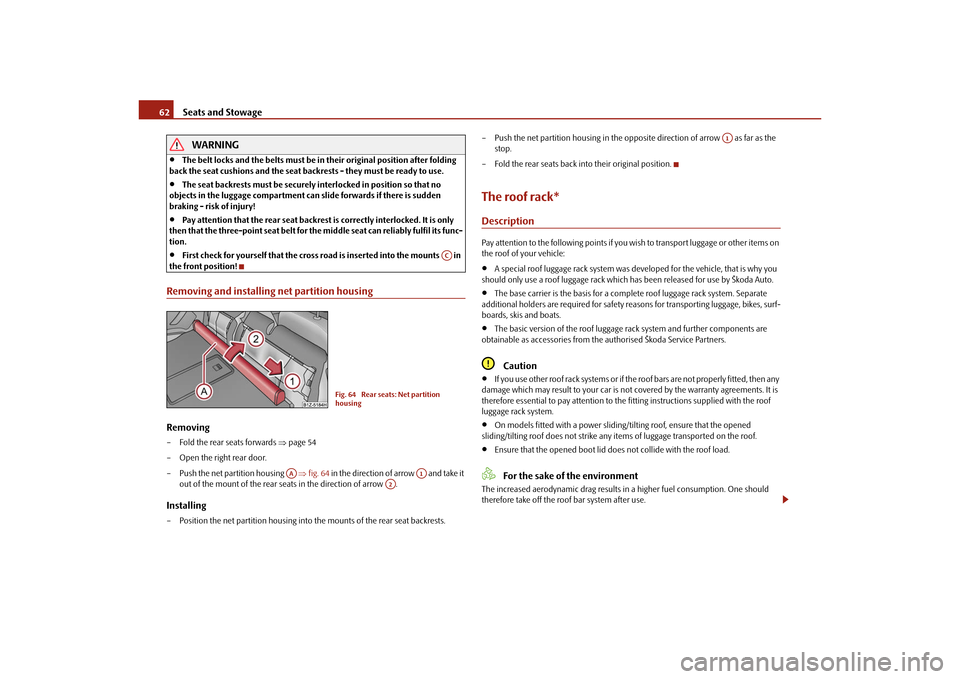
Removing and installing net partition housingRemoving– Fold the rear seats forwards page 54
– Open the right rear door.
– Push the net partition housing fig. 64 in the direction of arrow and take it
out of the mount of the rear seats in the direction of arrow .Installing– Position the net partition housing into the mounts of the rear seat backrests. – Push the net partition housing in the oppo
site direction of arrow as far as the
stop.
– Fold the rear seats back into their original position.
The roof rack*DescriptionPay attention to the following points if you wish to transport luggage or other items on
the roof of your vehicle:
A special roof luggage rack system was de veloped for the vehicle, that is why you
should only use a roof luggage rack which has been released for use by Škoda Auto.
The base carrier is the basi s for a complete roof luggage rack system. Separate
additional holders are required for safety reasons for transporting luggage, bikes, surf-
boards, skis and boats.
The basic version of the roof luggage rack system and further components are
obtainable as accessories from the authorised Škoda Service Partners.Caution
If you use other roof rack systems or if the roof bars are not properly fitted, then any
damage which may result to yo ur car is not covered by the warranty agreements. It is
therefore essential to pay attention to the fitting instructions supplied with the roof
luggage rack system.
On models fitted with a power sliding/tilting roof, ensure that the opened
sliding/tilting roof does not strike any items of luggage transported on the roof.
Ensure that the opened boot lid do es not collide with the roof load.For the sake of the environment
The increased aerodynamic drag results in a higher fuel consumption. One should
therefore take off the roof bar system after use.
AC
Fig. 64 Rear seats: Net partition
housing
AA
A1
A2
A1
s2bs.2.book Page 62 Monday, September 27, 2010 9:53 AM
Page 64 of 199

Seats and Stowage63
Using the system
Safety
Driving Tips
General Maintenance
Breakdown assistance
Technical Data
Note
A roof rail is obtainable from a specialist garage if hasn't been fitted onto an estate car
at the works, which carries out the professional fitting.Lashing points (Octavia)Perform the assembly and the disassembly according to the attached instructions.
Note
If you have any questions, please contact a specialist garage.
The figure is not valid for an estate car.
Roof loadDistribute weight evenly over the roof luggage rack system. The maximum permissible
roof load (including roof rack system) of 75 kg and the maximum permissible total
weight of the vehicle should not be exceeded.
You cannot make full use of the permissible ro of load if you use a roof luggage rack
system with a lower load carrying capacity . The load transported on the roof luggage
rack system must not exceed the weight limit which is stated in the fitting instructions.
WARNING
The items which you transport on the roof bar system must be reliably
attached - risk of accident!
You must on no account exceed the pe rmissible roof load, the permissible
axle loads and the permissible gross weight of your vehicle - risk of accident!
Please note that the handling proper ties of your vehicle change when you
transport heavy or bulky items on the roof bar system as a result of the
displacement of the centre of gravity and the increased wind attack area - risk
of accident! You must absolutely adapt your style of driving and the speed of
the vehicle to the specific circumstances.
Cup holderCup holder in front centre consoleYou can place two cups or beve rage cans into the recesses fig. 66 .
WARNING
Do not place any hot beverages into the cup holder. If the vehicle moves, the
hot beverages may spill - risk of scalding!
Do not use any cups or beakers which are made of brittle material (e.g. glass,
porcelain). You might be injured by them in the event of an accident.
Fig. 65 Attachment points for base roof
carrier
WARNING (continued)
Fig. 66 Front centre console: Cup holder
s2bs.2.book Page 63 Monday, September 27, 2010 9:53 AM
Page 123 of 199

Driving and the Environment
122
Checking tyre inflation pressures
Tyres which are correctly inflated save fuel.Always ensure that your tyres are inflated to the correct pressure at all times. The rolling
resistance will be increased if the inflation pressure is too low. This will not only
increase fuel consumption but also tyre we ar and the driving behaviour will worsen.
Always check the inflation pr essure of the tyres when cold.
Do not drive with winter tyres all year round for this costs about 10 % more fuel.
Winter tyres are also louder.No unnecessary ballast
Transporting ballast costs fuel.The fact that every kilogram of extra weight increases your fuel consumption means
that it is worth taking a look in the lu ggage compartment to avoid transporting any
unnecessary ballast.
It is particularly in town traffic, when one is accelerating quite often, that the vehicle
weight will have a significant effect upon the fuel consumption. A rule of thumb here
is that an increase in weight of 100 kilogr ams will cause an increase in fuel consump-
tion of about 1 litre/100 kilometres.
You may frequently also leave a roof rack fitted on just out of convenience, although
you no longer need it. The increased aerodyna mic drag of your vehicle causes it to use
about 10 % more fuel than normal at a speed of 100 - 120 km/h, even when you are
not carrying a load on the roof.Saving electricity
Generating electricity costs fuel.– Switch off electrical components as soon as you no longer need them.
When the engine is running, the alternator generates and supplies electrical power.
The greater the load on the alternator as a result of having a large number of electrical
components switched on, the more fuel will be consumed for operating the
alternator.
Keeping a log of your fuel consumptionIf you really wish to keep a close check on your fuel consumption, it is best to enter
the figures in a logbook. This does not take much time but is a very worthwhile exer-
cise. It enables you to detect any change (p ositive and negative) at an early stage and
to take any appropriate action.
If you find that your fuel consumption is too high, you should reflect on how, where
and in what conditions you have driven the vehicle since you last refuelled.Environmental compatibilityEnvironmental protection has played a major role in the design, selection of materials
and manufacture of your new Škoda. Particular emphasis has been paid to a number
of aspects, including:
Design measures
Joints designed to be easily detached.
Simplified disassembly due to the modular structure system.
Improved purity of differ ent classes of materials.
Identification of all plastic parts in accordance with VDA Recommendation°260.
Reduced fuel consumption and exhaust emission CO
2.
Minimum fuel leakage during accidents.
Reduced noise.
Choice of materials
Extensive use of recyclable material.
Air conditioning filled wi th CFC-free refrigerant.
No cadmium.
No asbestos.
Reduction in the “vaporisation” of plastics.
Manufacture
Solvent-free cavity protection.
s2bs.2.book Page 122 Monday, September 27, 2010 9:53 AM
Page 131 of 199
Taking care of your vehicle and cleaning the vehicle
130
There are no particular points to note be fore washing your vehicle in an automatic
vehicle wash system other than the usua l precautionary measures (closing the
windows and the sliding/tilting roof etc.).
If you have any particular attached parts fitted to your car - such as spoiler, roof rack
system, two-way radio aerial - it is best to first of all consult the operator of the car
wash plant.
It is important to degrease the lips of the windscreen wiper rubbers after passing
through the automatic vehicle wash system.Washing vehicle by handIt is important to first soften the dirt with plenty of water and rinse it off as thoroughly
as possible before washin g your vehicle by hand.
One should then clean the vehicle using a soft washing sponge, washing glove or a
washing brush and only slight pressure. Work from the top to the bottom - beginning
with the roof. Only place slight pressure on the vehicle paintwork during cleaning Only
use a car shampoo for stubborn dirt.
Wash out the sponge or washing glove thoroughly at short intervals.
Clean wheels, door sills and similar parts last. Use a second sponge for such areas.
Rinse off the vehicle well after giving it a wash and dry it off using a chamois leather.
WARNING
The ignition should always be switched off when you wash your vehicle -
risk of accident!
Protect your hands and arms from sharp-edged metal parts when you are
cleaning the underfloor, the inside of the wheel housings or the wheel trims -
risk of cuts.Caution
Do not wash your vehicle in bright sunlight - risk of paint damage.
Ensure that the jet of water is not aimed di rectly at the locking cylinders or at the
door and panel joints if you spray your vehi cle in winter down with a hose - risk of
freezing.
Do not use any insect sponges, rough kitc hen sponges or similar cleaning products
- risk of damage to the surface of paintwork.For the sake of the environment
Only wash your vehicle at wa shing bays specifically reserved for this purpose. This
ensures that no water which may be contaminated by oil flows into the sewage system.
It is not even permitted to wash your vehicl e in certain areas except at such specific
washing bays.Washing with a high-pressure cleanerWhen you wash your vehicle with a high-press ure cleaner, it is essential to comply with
the instructions for use of the cleaning equi pment. This applies in particular to the
pressure used and to the spraying distance . Maintain a sufficiently large distance to
soft materials such as rubber hoses or insulation material.
On no account use circular spray nozzles or so-called dirt cutters!
WARNING
It is particularly important that you do not clean tyres with circular spray jets.
Visible but also invisible damage to tyres may occur even at a relatively large
spraying distance and if sprayed only for a short time - risk of accident!
Caution
The water containing wax must be no hotter than 60 °C, otherwise the vehicle can be
damaged.Wax treatmentGood wax treatment is an effective way of protecting the paintwork from harmful envi-
ronmental influences and minor mechanical damage.
The vehicle must be treated with a high-quali ty hard wax polish at the latest, when no
more drops form on the clean paintwork.
s2bs.2.book Page 130 Monday, September 27, 2010 9:53 AM
Page 194 of 199

Index193
Using the system
Safety
Driving Tips
General Maintenance
Breakdown assistance
Technical Data
Stability system . . . . . . . . . . . . . . . . . . . . . . . . . . . . . . 111
Starting the engine . . . . . . . . . . . . . . . . . . . . . . . . . . . . 78
after fuel tank has run empty . . . . . . . . . . . . . . . 79
Diesel engines . . . . . . . . . . . . . . . . . . . . . . . . . . . . 79
Petrol engines . . . . . . . . . . . . . . . . . . . . . . . . . . . . . 79
Steering active driver-steering recommendation . . . . 113
Steering force assistance . . . . . . . . . . . . . . . . . . . . . 116
Storage compartments . . . . . . . . . . . . . . . . . . . . . . . . 65
Storage facilities . . . . . . . . . . . . . . . . . . . . . . . . . . . . . . 65
Sun visors . . . . . . . . . . . . . . . . . . . . . . . . . . . . . . . . . . . . 47
Switching lights on and off . . . . . . . . . . . . . . . . . . . . . 42
Switching off the engine . . . . . . . . . . . . . . . . . . . . . . . 79
TTaking care of your vehicle . . . . . . . . . . . . . . . . . . . 129
TCS Warning light . . . . . . . . . . . . . . . . . . . . . . . . . . . . . 26
Temperature outside . . . . . . . . . . . . . . . . . . . . . . . . . . . . . . . . . . . 20
the first 1 500 kilometres . . . . . . . . . . . . . . . . . . . . . 118
The roof luggage rack system . . . . . . . . . . . . . . . . . . 62
Thickness of brake pads Warning light . . . . . . . . . . . . . . . . . . . . . . . . . . . . . 28
Tool . . . . . . . . . . . . . . . . . . . . . . . . . . . . . . . . . . . . . . . . 159
Top Tether . . . . . . . . . . . . . . . . . . . . . . . . . . . . . . . . . . 109
Towing a trailer . . . . . . . . . . . . . . . . . . . . . . . . . . . . . . 125
Towing device . . . . . . . . . . . . . . . . . . . . . . . . . . . . . . . 126
towing vehicle . . . . . . . . . . . . . . . . . . . . . . . . . . . . . . . 167
Tow-starting . . . . . . . . . . . . . . . . . . . . . . . . . . . . . . . . . 167
Traction control system . . . . . . . . . . . . . . . . . . . . . . 112 Traction control system (TCS)
Warning light . . . . . . . . . . . . . . . . . . . . . . . . . . . . . . 26
Trailer . . . . . . . . . . . . . . . . . . . . . . . . . . . . . . . . . . . . . . . 125 General Maintenance . . . . . . . . . . . . . . . . . . . . . 125
Transporting children . . . . . . . . . . . . . . . . . . . . . . . . 103
Tread depth . . . . . . . . . . . . . . . . . . . . . . . . . . . . . . . . . 152
Turn signal lights . . . . . . . . . . . . . . . . . . . . . . . . . . . . . . 44 Warning light . . . . . . . . . . . . . . . . . . . . . . . . . . . . . . 23
Two-way radio systems . . . . . . . . . . . . . . . . . . . . . . . . 84
Tyre . . . . . . . . . . . . . . . . . . . . . . . . . . . . . . . . . . . . . . . . . 151
Tyre inflation pressure Warning light . . . . . . . . . . . . . . . . . . . . . . . . . . . . . . 27
Tyre repair kit . . . . . . . . . . . . . . . . . . . . . . . . . . . . . . . . 160
Tyres Winter tyres . . . . . . . . . . . . . . . . . . . . . . . . . . . . . . 155
UUnderbody protection . . . . . . . . . . . . . . . . . . . . . . . . 133
Unlocking . . . . . . . . . . . . . . . . . . . . . . . . . . . . . . . . . . . . 31Remote control . . . . . . . . . . . . . . . . . . . . . . . . . . . . 36VVehicle tool kit . . . . . . . . . . . . . . . . . . . . . . . . . . . . . . . 159
Visors . . . . . . . . . . . . . . . . . . . . . . . . . . . . . . . . . . . . . . . . 47WWarning lights . . . . . . . . . . . . . . . . . . . . . . . . . . . . . . . . 22
Warning symbols . . . . . . . . . . . . . . . . . . . . . . . . . . . . . 22
Warning triangle . . . . . . . . . . . . . . . . . . . . . . . . . . . . . 159 Washing . . . . . . . . . . . . . . . . . . . . . . . . . . . . . . . . . . . . 129
with a high-pressure cleaner . . . . . . . . . . . . . . 130
Washing the vehicle . . . . . . . . . . . . . . . . . . . . . . . . . 129
Washing vehicle by hand . . . . . . . . . . . . . . . . . . . . 130
Wax treatment . . . . . . . . . . . . . . . . . . . . . . . . . . . . . . 130
Wheel Changing . . . . . . . . . . . . . . . . . . . . . . . . . . . . . . . 161
Spare . . . . . . . . . . . . . . . . . . . . . . . . . . . . . . . . . . . 160
Wheel bolts . . . . . . . . . . . . . . . . . . . . . . . . . . . . . . . . . 154
Wheel trim . . . . . . . . . . . . . . . . . . . . . . . . . . . . . 151, 163
Wheels . . . . . . . . . . . . . . . . . . . . . . . . . . . . . . . . . . . . . 151
Window . . . . . . . . . . . . . . . . . . . . . . . . . . . . . . . . . . . . . . 39
Windows de-icing . . . . . . . . . . . . . . . . . . . . . . . . . . . . . . . . . 131
Windscreen washer nozzles . . . . . . . . . . . . . . . . . . . . 47
Windshield washer fluid reservoir . . . . . . . . . . . . 150
Windshield washer system . . . . . . . . . . . . . . . . . . . 150
Windshield wiper . . . . . . . . . . . . . . . . . . . . . . . . . . . . . 47
Winter tyres . . . . . . . . . . . . . . . . . . . . . . . . . . . . . . . . 155
Wiper blades Replacing the wiper blades . . . . . . . . . . . . . . . . . 49
s2bs.2.book Page 193 Monday, September 27, 2010 9:53 AM