2010 SKODA OCTAVIA TOUR height
[x] Cancel search: heightPage 11 of 199
The brief instruction
10
The brief instructionBasic functions and im portant informationIntroduction
The chapter of the brief instruction is only used as a quick reference of
the most important operating elements of the vehicle. It is necessary to
observe all the information which is contained in the following chapters
of the Owner's Manual.Unlocking and locking the vehicle Unlocking the vehicle
Unlocking the boot lid
Locking the vehicle
Folding out/folding up of the key bit
Further information page 36, “Unlocking and locking the vehicle”.
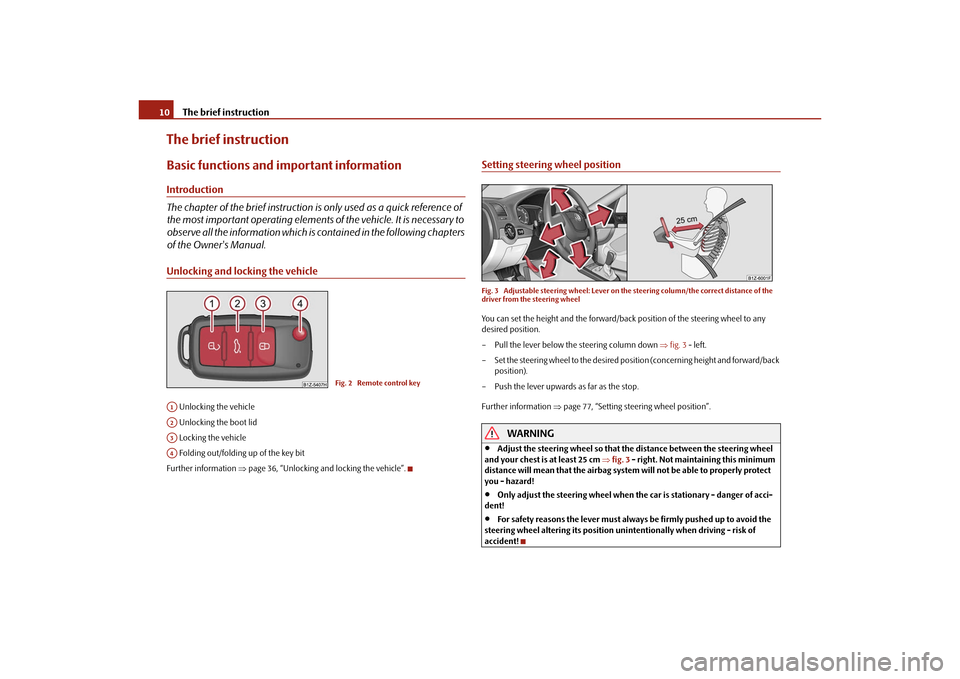
Setting steering wheel positionFig. 3 Adjustable steering wheel: Lever on the steering column/the correct distance of the
driver from the steering wheelYou can set the height and the forward/back position of the steering wheel to any
desired position.
– Pull the lever below the steering column down fig. 3 - left.
– Set the steering wheel to the desired posi tion (concerning height and forward/back
position).
– Push the lever upwards as far as the stop.
Further information page 77, “Setting steering wheel position”.
WARNING
Adjust the steering wheel so that the distance between the steering wheel
and your chest is at least 25 cm fig. 3 - right. Not maintaining this minimum
distance will mean that the airbag system will not be able to properly protect
you - hazard!
Only adjust the steering wheel when the car is stationary - danger of acci-
dent!
For safety reasons the lever must always be firmly pushed up to avoid the
steering wheel altering its position uni ntentionally when driving - risk of
accident!
Fig. 2 Remote control key
A1A2A3A4s2bs.2.book Page 10 Monday, September 27, 2010 9:53 AM
Page 12 of 199

The brief instruction11
Using the system
Safety
Driving Tips
General Maintenance
Breakdown assistance
Technical Data
Seat belt height adjuster– Move the height adjuster in the desired direction up or down fig. 4 .
– Then pull firmly on the belt to ensure that the seat belt height adjuster has correctly
locked in place.
Further information page 91, “Seat belt height adjuster”.
WARNING
Adjust the height of the belt in such a way that the shoulder part of the belt is
positioned approximately across the middle of your shoulder - on no account
across your neck!Adjusting the front seats
Adjusting a seat in a forward/back direction
Adjusting height of seat*
Adjust the angle of the seat backrest
Adjusting lumbar support*
Further information page 52, “Adjusting the front seats”.
WARNING
Only adjust the driver seat when the ve hicle is stationary - risk of injury!Electric exterior mirror adjustment*Further information page 50, “Exterior mirror”.
Fig. 4 Front seat: Seat belt height
adjusterFig. 5 Controls at seat
Heating of the external mirror
Adjusting left and right exterior mirrors simultaneously
Adjusting the right-hand exterior mirror
Switching off operating control
A1A2A3A4
Fig. 6 Inner part of door: Rotary knob
s2bs.2.book Page 11 Monday, September 27, 2010 9:53 AM
Page 53 of 199
Seats and Stowage
52
Seats and StowageFront seatsBasic informationThe front seats have a wide range of differ ent settings and can thus be matched to the
physical characteristics of the driver and front passenger. Correct adjustment of the
seats is particularly important for:
safely and quickly reaching the controls,
a relaxed, fatigue-free body position,
achieving the maximum protection offered by the seat belts and the airbag
system.
WARNING
Never transport more occupants than the maximum seating in the vehicle.
Each occupant must correctly fasten the seat belt belonging to the seat.
Children must be fastened page 103, “Transporting children safely” with a
suitable restraint system.
The front seats and the head restraints must always be adjusted to match
the body size of the seat occupant as well as the seat belts must always be
correctly fastened in order to provide an optimal protection for you and your
occupants.
Keep your feet in the footwell at al l times while driving. Never place your
feet on the dash panel, out of the window or on the seats. This is particularly
important for the front seat passenger. You will be exposed to increased risk of
injury if it becomes necessary to apply the brake or in the event of an accident.
If an airbag is deployed, you may suffer fatal injuries when adopting an incor-
rect seated position!
It is important for the driver and front passenger to maintain a distance of at
least 25 cm from the steering wheel or dash panel. Not maintaining this
minimum distance will mean that the airbag system will not be able to properly
protect you - hazard! The front seats and the head restraints must always also
be correctly adjusted to match the body size of the occupant.
Ensure that there are no objects in the footwell as any objects may get
behind the pedals during a driving or braking manoeuvre. You would then no
longer be able to operate the clutch, to brake or accelerate.
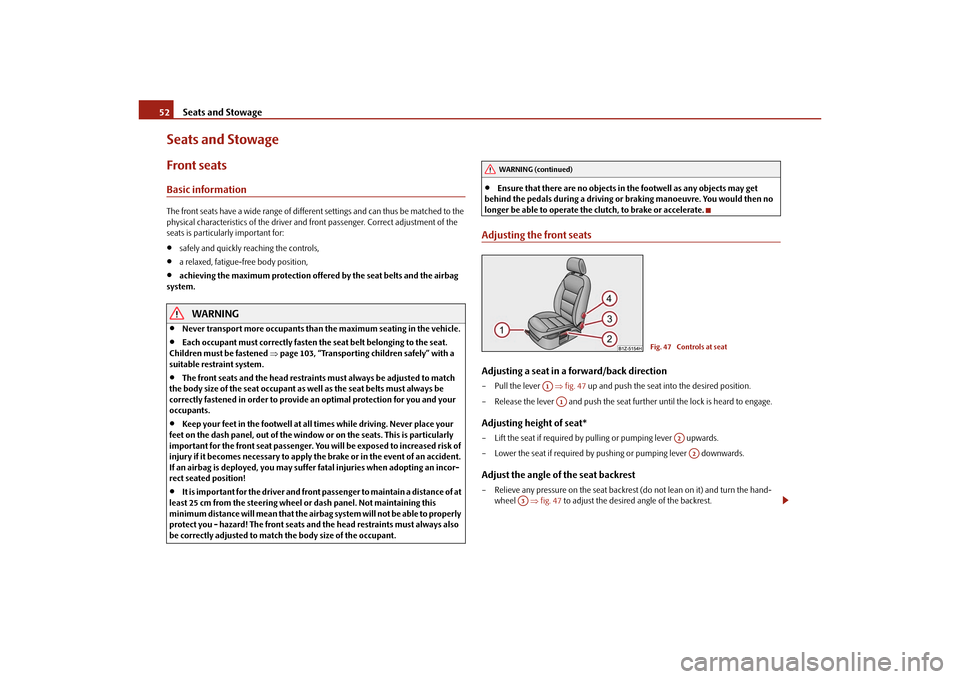
Adjusting the front seatsAdjusting a seat in a forward/back direction– Pull the lever fig. 47 up and push the seat into the desired position.
– Release the lever and push the seat further until the lock is heard to engage.Adjusting height of seat*– Lift the seat if required by pu lling or pumping lever upwards.
– Lower the seat if required by pushing or pumping lever downwards.Adjust the angle of the seat backrest– Relieve any pressure on the seat backrest (do not lean on it) and turn the hand- wheel fig. 47 to adjust the desired angle of the backrest.
WARNING (continued)
Fig. 47 Controls at seat
A1A1
A2A2
A3
s2bs.2.book Page 52 Monday, September 27, 2010 9:53 AM
Page 54 of 199

Seats and Stowage53
Using the system
Safety
Driving Tips
General Maintenance
Breakdown assistance
Technical Data
Adjusting lumbar support*– Turn the wheel until you have set the most comfortable curvature of the seat
upholstery in the area of your spine.
The driver's seat should be adjusted in such a way that the pedals can be fully pressed
to the floor with slightly bent legs.
The seat backrest on the driver's seat should be adjusted in such a way that the upper
point of the steering wheel can be easi ly reached with slightly bent arms.
WARNING
Only adjust the driver seat when the vehicle is stationary - risk of injury!
Take care when adjusting the seat! Adjusting the seat without care can lead
to bruises or injuries.
The seat backrests must not be angled too far back when driving otherwise
this will affect proper operation of the se at belts and of the airbag system - risk
of injury!
Head restraintsFig. 48 Adjusting head restraint/pulling outBest protection is achieved if the top edge of the head restraint is at the same level as
the upper part of your head.
Adjusting the height of a head restraint– Grasp the side of the head restraint with both hands and push the head restraint up
or down in direction of arrow fig. 48 .
– Move the head restraint downwards if required by pressing the locking button with one hand in direction of arrow and by pressing with the other hand the head
restraint downwards.Removing and installing a head restraint– Pull the head restraint up out of the seat backrest as far as the stop (on the rear
head restraints fold forward the seat backrest).
– Press the locking button in the direction of arrow fig. 48 and pull the head
restraint out.
– To re-insert the head restraint, push it do wn into the seat backrest far enough until
you hear the locking button engage.
The position of the front and rear outer head restraints is adjustable in height. The
middle rear head restraint* is adjustable in two positions.
The head restraints must be adjusted to ma tch the size of the seat occupant. Correctly
adjusted head restraints together with the seat belts offer effective protection for the
occupants page 86, “Correct seated position”.
WARNING
The head restraints must be correctly adjusted in order to offer effective
protection for the occupants in the event of an accident.
Do not drive under any circumstance with removed head restraints - risk of
injury!
If the rear seats are occupied, the rear head restraint must not be in the
lower position.
A4
A1A2
A2
s2bs.2.book Page 53 Monday, September 27, 2010 9:53 AM
Page 68 of 199

Seats and Stowage67
Using the system
Safety
Driving Tips
General Maintenance
Breakdown assistance
Technical Data
WARNING
The storage compartment is not a substi tute for the ashtray and must also
not be used for such purposes - risk of fire!
Do not put any highly inflammable obje cts or objects which are sensitive to
heat (e.g. lighters, spra ys, spectacles, carbonated drinks) in the storage
compartment.
During the journey, no objects must be in the storage compartment. In the
event of a vehicle collision these objects could be thrown out of the compart-
ment - risk of injuries!
Storage compartment in front centre console*– Press on the bottom part of the storage compartment in the area fig. 73 - the
lid opens.
WARNING
The storage compartment is not a substitu te for the ashtray and must also not
be used for such purposes - risk of fire!
Storage compartment in the front doorsA bottle holder is located in the area of the storage compartment for the front
doors.
WARNING
Use the area page 67, fig. 74 of the storage compar tment only for storing
objects which do not project so that the effectiveness of the side airbag is not
impaired.Front seat armrest with storage compartment*Fig. 75 Armrest: Storage compartm ent/cooling of storage compartmentThe armrest is adjustable for height and length.
Fig. 73 Front centre console: Storage
compartment
AA
Fig. 74 Storage compartment in the
front doors
AB
AA
s2bs.2.book Page 67 Monday, September 27, 2010 9:53 AM
Page 69 of 199
Seats and Stowage
68
Opening storage compartment
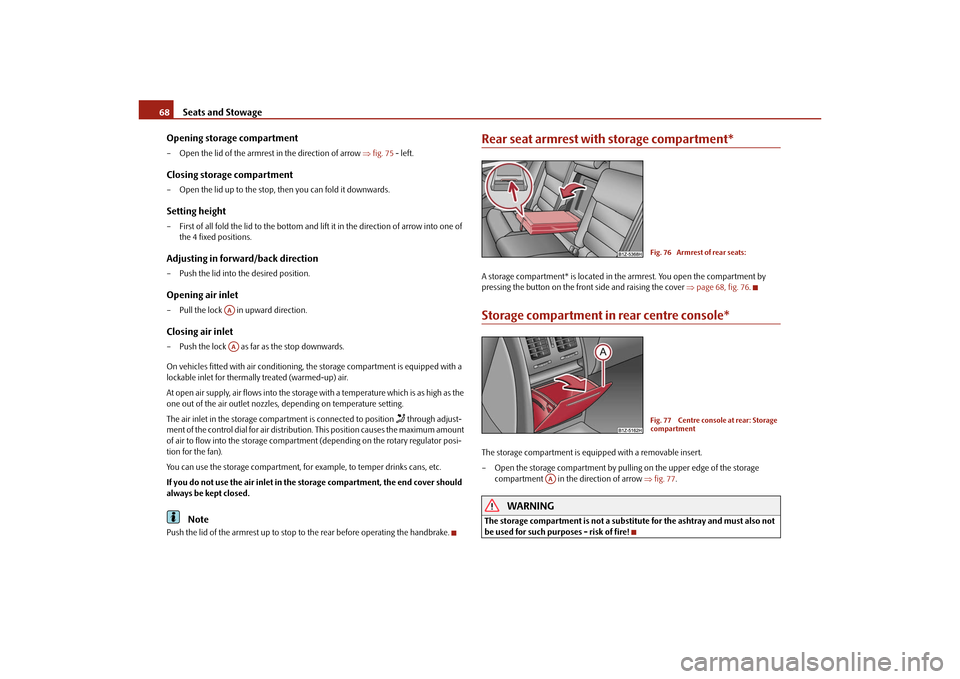
– Open the lid of the armrest in the direction of arrow fig. 75 - left.Closing storage compartment– Open the lid up to the stop, then you can fold it downwards.Setting height– First of all fold the lid to the bottom and lift it in the direction of arrow into one of
the 4 fixed positions.Adjusting in forward/back direction– Push the lid into the desired position.Opening air inlet– Pull the lock in upward direction.Closing air inlet– Push the lock as far as the stop downwards.
On vehicles fitted with ai r conditioning, the storage co mpartment is equipped with a
lockable inlet for thermally treated (warmed-up) air.
At open air supply, air flows into the storag e with a temperature which is as high as the
one out of the air outlet nozzles, depending on temperature setting.
The air inlet in the storage compartment is connected to position
through adjust-
ment of the control dial for air distribution. This position causes the maximum amount
of air to flow into the storage compartmen t (depending on the rotary regulator posi-
tion for the fan).
You can use the storage compartment, for example, to temper drinks cans, etc.
If you do not use the air inlet in the storage compartment, the end cover should
always be kept closed.
Note
Push the lid of the armrest up to stop to the rear before operating the handbrake.
Rear seat armrest with storage compartment*A storage compartment* is located in the armrest. You open the compartment by
pressing the button on the front side and raising the cover page 68, fig. 76 .Storage compartment in rear centre console*The storage compartment is equipped with a removable insert.
– Open the storage compartment by pullin g on the upper edge of the storage
compartment in the direction of arrow fig. 77 .
WARNING
The storage compartment is not a substitute for the ashtray and must also not
be used for such purposes - risk of fire!
AAAA
Fig. 76 Armrest of rear seats:Fig. 77 Centre console at rear: Storage
compartment
AA
s2bs.2.book Page 68 Monday, September 27, 2010 9:53 AM
Page 71 of 199
Heating and air conditioning system
70
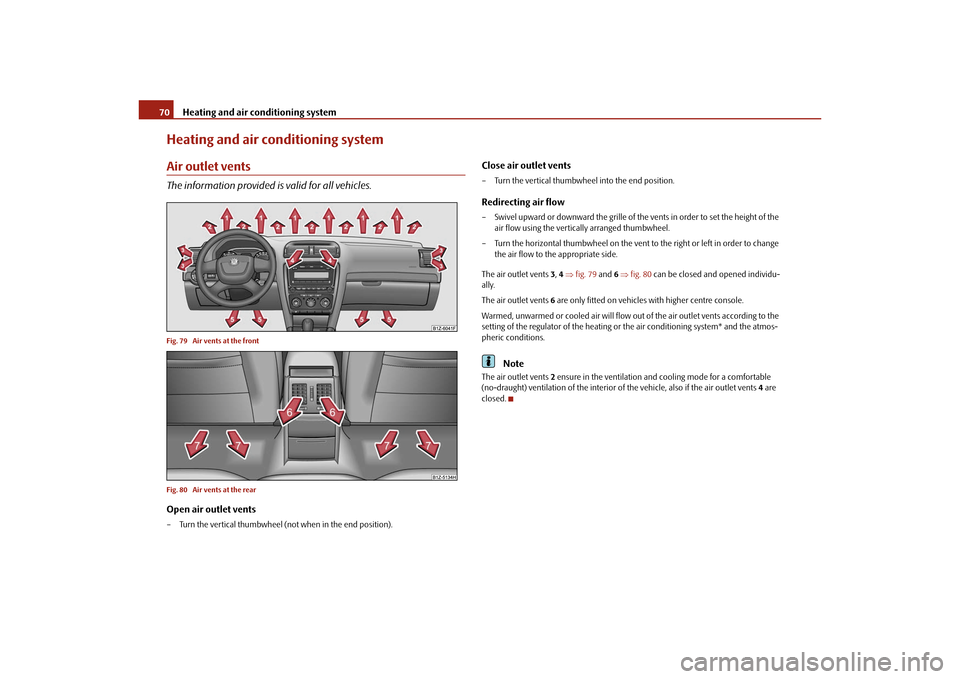
Heating and air conditioning systemAir outlet ventsThe information provided is valid for all vehicles.Fig. 79 Air vents at the front
Fig. 80 Air vents at the rearOpen air outlet vents– Turn the vertical thumbwheel (not when in the end position).
Close air outlet vents– Turn the vertical thumbwhe el into the end position.Redirecting air flow– Swivel upward or downward the grille of th e vents in order to set the height of the
air flow using the vertically arranged thumbwheel.
– Turn the horizontal thumbwheel on the vent to the right or left in order to change
the air flow to the appropriate side.
The air outlet vents 3 , 4 fig. 79 and 6 fig. 80 can be closed and opened individu-
ally.
The air outlet vents 6 are only fitted on vehicles with higher centre console.
Warmed, unwarmed or cooled air will flow out of the air outlet vents according to the
setting of the regulator of the heating or the air conditioning system* and the atmos-
pheric conditions.
Note
The air outlet vents 2 ensure in the ventilation and cooling mode for a comfortable
(no-draught) ventilation of the interior of the vehicle, also if the air outlet vents 4 are
closed.
s2bs.2.book Page 70 Monday, September 27, 2010 9:53 AM
Page 78 of 199

Starting-off and Driving77
Using the system
Safety
Driving Tips
General Maintenance
Breakdown assistance
Technical Data
Starting-off and DrivingSetting steering wheel positionFig. 83 Adjustable steering wheel: Lever below steering columnYou can set the height and the forward/back position of the steering wheel to the
desired position.
– Adjust the driver seat page 11.
– Pull the lever below the steering column down fig. 83 - left. Observe the guide-
lines .
– Set the steering wheel to the desired position (concerning height and forward/back position).
– Push the lever upwards as far as the stop.
WARNING
You must not adjust the steering wheel when the vehicle is moving!
The driver must maintain a distance of at least 25 cm to the steering wheel
fig. 83 - right. Not maintaining this minimum distance will mean that the
airbag system will not be able to properly protect you - hazard!
For safety reasons the lever must always be firmly pushed up to avoid the
steering wheel altering its po sition unintentionally when driving - risk of acci-
dent!
If you adjust the steering wheel furthe r towards the head, you will reduce
the protection offered by the driver airbag in the event of an accident. Make
sure the steering wheel is aligned to the chest.
When driving, hold the steering wheel with both hands firmly on the outer
edge in the 9 o'clock and 3 o'clock po sition. Never hold the steering wheel
firmly in the 12 o'clock position or in another way (e.g. in the middle of the
steering wheel or at the inne r steering wheel edge). In such cases, injuries to the
arms, the hands and the head can occur when the driver airbag is deployed.
Ignition lockPetrol engines
- ignition switched off, engine off, the steering can be locked.
- ignition switched on
- start engine
Diesel engines - interruption of fuel supply, ignition swit ched off, engine off, the steering can be
locked.
- heating glow plugs on, ignition switched on
WARNING (continued)
Fig. 84 Ignition lock positions
A1A2A3A1A2
s2bs.2.book Page 77 Monday, September 27, 2010 9:53 AM