2010 SKODA OCTAVIA technical data
[x] Cancel search: technical dataPage 146 of 275

Seat belts145
Using the system
Safety
Driving Tips
General Maintenance
Breakdown assistance
Technical Data
Seat beltsWhy seat belts?It is a proven fact that seat belt s offer good protection in accidents fig. 128 . Thus
wearing a seat belt is a legal requirement in most countries.
Seat belts which have been correctly fasten ed and adjusted hold the occupants of the
car in the correct seated position fig. 128 . The belts reduce the kinetic energy
(energy of motion) to a considerable exte nt. They also prevent uncontrolled move-
ments which, in turn, may well result in severe injuries.
The occupants of a vehicle who have fastened and correctly adjusted their seat belt,
profit to a major extent from the fact that the kinetic energy is optimally absorbed by
the belts. The structure of the front end of the vehicle and other passive safety meas-
ures, such as the airbag system, also cont ribute to reducing the kinetic energy. The
energy produced is thus absorbed and there is less risk of injury.
Accident statistics prove that seat belts which are fastened and properly adjusted
reduce the risk of an injury and enhance the chance of survival in a major accident
page 145.
It is important that you pay attention to safety measures, particularly when trans-
porting children in the vehicle page 159, “What you should know about trans-
porting children!”.
WARNING
Fasten your seat belt each time before setting off, also when driving in town!
This also applies to the people seated at the rear - risk of injury!
Expectant women must also always wear a seat belt. This is the only way of
ensuring optimal protection for the unborn child page 147.
It is important for the belt webbing to be properly routed if the seat belts are
to offer the maximum protection. You can see a description of how safety belts
should be fitted properly on the next pages.Note
Please comply with any differing legal requirements when using the seat belts.The physical principle of a frontal collisionFig. 129 The driver is catapulted forward if not wearing a belt / The rear seat occupant is cata-
pulted forward if not wearing a beltThe physical principle of a frontal a ccident can be explained quite simply:
Motion energy, so-called kinetic energy, is produced as soon as the vehicle is moving,
both for the vehicle and its occupants. The magnitude of this kinetic energy depends
essentially on the speed at which the vehicl e is travelling and on the weight of the
vehicle and the occupants. The greater the speed and weight increase, the greater the
amount of energy which has to be ab sorbed in the event of an accident.
Fig. 128 Driver wearing seat belt
s43s.1.book Page 145 Thursday, May 13, 2010 1:21 PM
Page 148 of 275

Seat belts147
Using the system
Safety
Driving Tips
General Maintenance
Breakdown assistance
Technical Data
How are seat belts correctly fastened?Fastening three-point seat belts
Fasten your seat belt before starting!Fig. 130 Routing of webbing over the shoulders and the lap belt– Correctly adjust the front seat and the head restraint before fastening your seat belt
page 70.
– Slowly pull the belt webbing at the tongue of the lock over your chest and pelvis
.
– Insert the tongue of the lock into the seat belt buckle belonging to the seat until it is heard to lock in place.
– Pull on the belt to check that it has also reliably engaged in the lock.
Each three-point seat belt is equipped with an inertia reel. This inertia reel offers you
complete freedom of movement if the belt is unreeled slowly. If the brakes are applied
suddenly, the inertia reel will block. It also blocks the belts when the car accelerates,
when driving uphill and when cornering.
Expectant mothers must also wear the seat belt .
WARNING
The shoulder part of the seat belt must never run across your neck but must
run approximately over the middle of the shoulder and fit snugly against the
chest. The lap part of the belt must run across the hip and must never be routed across the stomach. It must always fit snugly
fig. 130 - left. Adjust the belt
webbing as required.
The lap part of the belt should be posi tioned as low as possible at the pelvis
of an expectant mother in order to avoid exerting any pressure on the lower
abdomen fig. 130 - right.
Always ensure that the webbing of the seat belts is properly routed. Seat
belts which are not correctl y adjusted can themselves cause injuries even in
minor accidents.
A seat belt which is hanging too loose can result in injuries as your body is
moved forward by the kinetic energy pr oduced in an accident and is then
suddenly held firm by the belt.
Only insert the lock tongue into the lock which is the correct one for your
seat. This will affect the protection which the belt offers and increase the risk of
an injury.
Seat belt height adjusterThe seat belt height adjuster makes it possible for you to adapt the routing of the three-
point seat belt in the area of the shoulder to match your body size.
– Move the height adjuster in the desired direction up or down fig. 131 .
– Then pull firmly on the belt to ensure that the seat belt height adjuster has correctly
locked in place.
WARNING (continued)
Fig. 131 Front seat: Seat belt height
adjuster
s43s.1.book Page 147 Thursday, May 13, 2010 1:21 PM
Page 150 of 275
Seat belts149
Using the system
Safety
Driving Tips
General Maintenance
Breakdown assistance
Technical Data
It is essential to pay attent ion to relevant safety regulations if the vehicle or indi-
vidual parts of the system are scrapped. Specialist garages are familiar with these regu-
lations and will be able to provide you with detailed information in this respect.
When disposing of vehicle or parts of the system, it is important to comply with the
national legal requirements.
s43s.1.book Page 149 Thursday, May 13, 2010 1:21 PM
Page 152 of 275

Airbag system151
Using the system
Safety
Driving Tips
General Maintenance
Breakdown assistance
Technical Data
When are the airbags deployed?The airbag system is designed in such a wa y that the driver and front passenger airbag
are deployed in the event of a violent frontal collision.
In the case of a violent side collision , the side airbag* on the side of the vehicle at
which the collision occurs, is deployed to gether with the relevant head airbag*.
In special cases, the front as well as th e relevant side and head airbags may be
deployed together.
The airbags are not deployed in the case of minor frontal and side collisions, in the
case of rear-end collisi ons and vehicle rollover.
Deployment factors
It is not possible to state globally which deployment conditions apply to the airbag
system in every situation as the circumstances which exist in the case of accidents vary
greatly. An important role in this case is played by factors such as the type of object
against which the vehicle impacts (hard, soft ), the angle of impact, the relative speed
during the accident etc.
A decisive factor for the deployment of the airbags is the deceleration which occurs
during a collision. The control unit analyses the nature of the collision and activates the
relevant restraint system. If the vehicle deceleration which occurs and is measured
during the collision remains below the prescribed reference values specified in the
control unit, the airbags are no t deployed although the vehicle may well suffer severe
damage to the bodywork as a consequence of the accident.
The airbags are not deployed if:
ignition off,
a minor frontal collision,
a minor side collision,
a rear-end collision,
Rollover of the vehicle.Note
A grey white, non harmful gas is released when airbag is inflated. This is perfectly
normal and is not an indicati on of a fire in the vehicle.
In the event of an accident in which the airbags are deployed:
The interior lighting comes on (if the switch for the interior light is in the door
contact position),
The hazard warning light is switched on,
All the doors are unlocked,
the fuel supply to the engine is interrupted.
Front airbagsDescription of the front airbags
The airbag system is not a su bstitute for the seat belt!Fig. 133 Driver airbag in th e steering wheel / front passenger airbag in the dash panelThe front airbag for the driver is housed in the steering wheel fig. 133 - left. The front
airbag for the front passenger* is housed in the dash panel above the storage compart-
ment fig. 133 - right. The installation positions are each marked with the “AIRBAG”
logo.
The front airbag system, in combination with three-point safety belts, offers additional
protection for the head and chest area of the driver and front passenger in the event of
a frontal collision of major severity page 152.
The airbag is not a substitute for the seat belt, but is part of the complete passive
vehicle safety concept. Please note that an airbag can only offer you optimal
protection in combination with a seat belt which is fastened .
s43s.1.book Page 151 Thursday, May 13, 2010 1:21 PM
Page 154 of 275

Airbag system153
Using the system
Safety
Driving Tips
General Maintenance
Breakdown assistance
Technical Data
passenger seat where the child is seated
with its back facing in direction of
travel (in some countries also when the child is facing the direction of travel). If
this is not done, there is a risk of the ch ild suffering severe or even fatal injuries
if the front passenger airbag is deploy ed. In certain countries national legal
provisions also require that the side or head passenger airbags be deactivated.
When transporting a child on the front passenger seat, please comply with the
appropriate national regu lations regarding the use of child safety seats.
There must not by any further persons, animals or objects positioned
between the front seated occupants and the deployment area of the airbag.
The steering wheel and the surface of the airbag module in the dash panel
on the passenger side must not be stuck onto, covered or modified in any other
way. These parts should only be cleaned with a dry cloth or a cloth moistened
with water. No objects such as cup holders, mobile phone mounts, etc. may be
attached to the covers of the airbag modules or be located within the imme-
diate area.
No modifications of any kind may be made to parts of the airbag system.
Any work on the airbag system includ ing installing and removing system
components because of other repair wo rk (e.g. removing the steering wheel)
must only be carried out by a specialist garage.
Never carry out changes on the front bumper or on the body.
Never place any objects on the surface of the front passenger airbag module
in the dash panel.
Side airbags*Description of side airbags
The side airbag together with the head airbag offers enhanced occu-
pant protection in the event of a side collision.The front side airbags are housed in the upholstery of the seat backrests of the front
seats fig. 136 .
The side airbag system in combination with the three-point seat belts, offers additional
protection for the upper area of the body (chest, stomach and pelvis) of the occupants
of the vehicle in the event of severe side collisions page 154.
Apart from their normal protective function, a further task of the seat belts is to also
hold the occupents of the front or rear exteri or seats in a correct seated position in the
event of a side collision so as to enable th e side airbag to offer the maximum protec-
tion.
You should therefore always fasten the seat belts, not only because this is required by
law, but also for safety reasons and for your own protection.
Each time the side airbags are deployed, th e head airbag* and the front belt tensioner
on the side of the car on which the collision occures, are automatically deployed at the
same time in order to provide the occupant with enhanced protection.
WARNING (continued)
Fig. 136 Installation position of side
airbag in driver seat
s43s.1.book Page 153 Thursday, May 13, 2010 1:21 PM
Page 156 of 275
Airbag system155
Using the system
Safety
Driving Tips
General Maintenance
Breakdown assistance
Technical Data
Always work with an authorised Škoda dealer or have it carried out by a
competent specialist workshop.
Only hang light items of clothing on the clothes hooks to the vehicle. Never
leave any heavy or sharp-edged objects in the pockets of the items of clothing.
Ensure that there are no excessive forc es, such as violent knocks, kicks etc.,
impact on the backrests of the seats otherwise the system may be damaged.
The side airbags would not be deployed in such a case!
Any seat or protective covers which you fit to the driver or front passenger
seats must only be of the type expressly authorised by Škoda Auto. In view of
the fact that the airbag inflates out of the backrest of the seat, use of non-
approved seat or protective covers would considerably impair the protective
function of the side airbag.
Any damage to the original seat covers in the area of the side airbag module
must be repaired without dela y by your specialist garage.
The airbag modules in the front seats must not display any damage, cracks
or deep scratches. It is not permissible to use force in order to open the
modules.
Any work on the side airbag system including removing and installing
system components because of other repair work (e.g. removing seats) must
only be carried out by a specialist garage.
Head airbags*Description of the head airbags
The head airbag together with the side airbag offers enhanced occu-
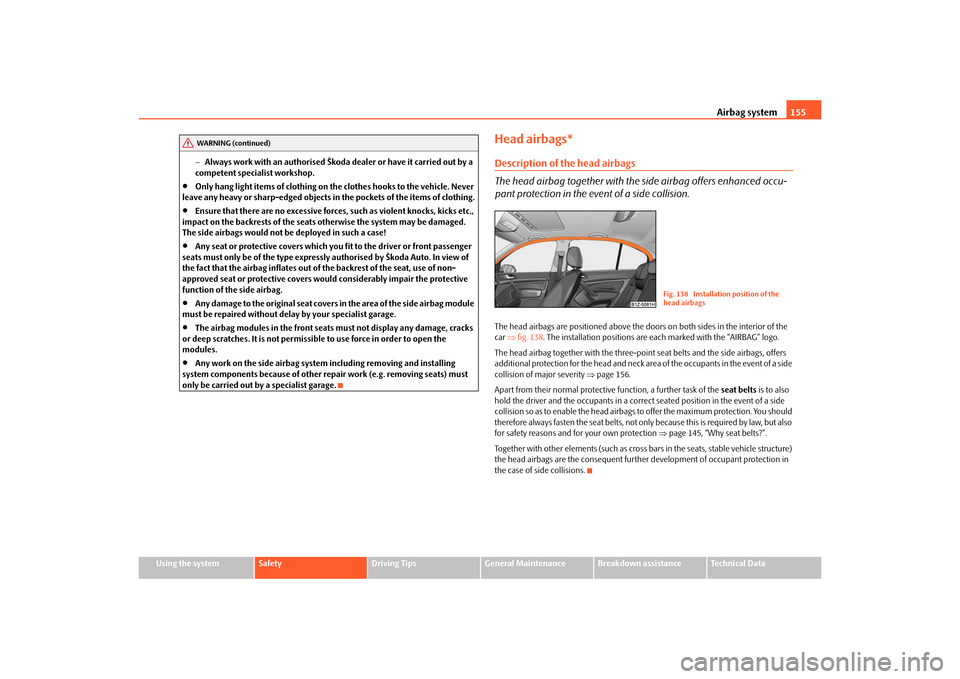
pant protection in the event of a side collision.The head airbags are positioned above the door s on both sides in the interior of the
car fig. 138 . The installation positions are each marked with the “AIRBAG” logo.
The head airbag together with the three-poin t seat belts and the side airbags, offers
additional protection for the head and neck ar ea of the occupants in the event of a side
collision of major severity page 156.
Apart from their normal protective function, a further task of the seat belts is to also
hold the driver and the occupants in a correct seated position in the event of a side
collision so as to enable the head airbags to offer the maximum protection. You should
therefore always fasten the seat belts, not only because this is required by law, but also
for safety reasons and for your own protection page 145, “Why seat belts?”.
Together with other elements (such as cross bars in the seats, stable vehicle structure)
the head airbags are the consequent further development of occupant protection in
the case of side collisions.
WARNING (continued)
Fig. 138 Installation position of the
head airbags
s43s.1.book Page 155 Thursday, May 13, 2010 1:21 PM
Page 158 of 275

Airbag system157
Using the system
Safety
Driving Tips
General Maintenance
Breakdown assistance
Technical Data
being deployed. When the deployed head airbag is inflated, parts of the acces-
sories fitted may in certain circumstances be thrown into the interior of the car
and cause injuries to the occupants
page 214, “Accessories, changes and
replacement of parts”.
Any work on the head airbag system including installing and removing
system components because of other repair work (e.g. removing headliner)
must only be carried out by a specialist garage.
Deactivating an airbagDeactivating airbags
If any airbags have been deactivated, switch them on again as soon as
possible so that they are able to again provide their proper protection.There is the technical means installed within your vehicle to switch off the front, side*
or head* airbag (take out of commission).
This is why you should have the deactivation of the airbags carried out by a specialist
garage.
On vehicles equipped with the switch for de activation of the airbags, you can deacti-
vate the front passenger airbag by means of this switch page 157.
Deactivation of airbags is envisaged only for particular instances, such as if:
you must in exceptional cases use a child seat on the front passenger seat where
the child has its back to the direction of tr avel of the vehicle (in some countries this
must be in the direction of travel due to other legal regulations applying) page 159,
“Important safety information regarding the use of child safety seats”,
you are not able to maintain the distan ce of at least 25 cm between middle of
steering wheel and chest, despite the driver seat being correctly adjusted,
special attachments are required in the ar ea of the steering wheel because of a
physical disability,
you have installed other seats (e.g. orthopaedic seats without side airbags). Monitoring the airbag system
The functionality of the airbag system is al
so monitored electronically when one airbag
has been switched off.
If the airbag was switched off using diagnostic equipment:
The warning light for the airbag system li ghts up for 4 seconds after switching on
the ignition and then flashes for 12 seconds afterwards in 2 second intervals.
The following situation applies if the ai rbag has been switched off using the
switch for the airbag* in the storage compartment:
the airbag indicator light in the instrume nt cluster comes on for about 4 seconds
each time the igniti on is switched on,
if the airbags are switched off, this is in dicated in the middle of the dash panel by
the lighting up of the indicator light
fig. 140 - right.
Note
Your authorised Škoda Service Partner will be able to advise you whether national
legislation in your country allows airbags in your vehicle to be deactivated, and which
ones.Switch for the front passenger airbag*Fig. 140 Storage compartment: Switch for the front passenger airbag / indicator light for a
switched off front seat passenger airbagThe front passenger airbag is deactivated with the switch.
WARNING (continued)
s43s.1.book Page 157 Thursday, May 13, 2010 1:21 PM
Page 160 of 275

Transporting children safely159
Using the system
Safety
Driving Tips
General Maintenance
Breakdown assistance
Technical Data
Transporting children safelyWhat you should know about transporting children!An introduction to the subject
Accident statistics have revealed that children are generally more safely
transported on the rear seats than on the front passenger seat.Children younger than 12 years of age should normally travel on the rear seat of the
vehicle (take note of any national legal provis ions which differ from this). They should
be secured there by means of a child restraint system or by using the existing seat belts
depending on their age, body size and we ight. The child seat should be mounted
behind the front passenger seat for safety reasons.
The physical principle of an accident does, of course, also apply to children
page 145, “The physical principle of a fronta l collision”. They differ from adults in
that their muscles and bone structure of children are not yet fully developed. Thus chil-
dren are exposed to increased risk of injury.
Children should be transporte d by using special child safety seats in order to reduce
this risk of injury.
Use only child safety seats which are officia lly approved and are suitable for children
and which comply with the ECE-R 44 standard, which classifies child safety seats into
5 groups page 161. Child restraint systems which have been tested for conformity
to ECE-R 44 standard have a non-detachable test seal (a large E within a circle and
below this the test number) attached to the seat.
We recommend that you use child safety seats from the Škoda genuine accessories.
These child seats were developed and also tested for use in Škoda vehicles. They fulfil
the ECE-R 44 standard.
WARNING
Always comply with legal provisions and instructions from the relevant child
safety seat manufacturer when inst alling and using the child seat page 159.
Note
Any varying national legal regulations take priority over the information provided in
these instructions for use, or stated in this chapter.Important safety information regarding the use of child safety seats
Correct use of child safety seats cons iderably reduces the risk of injury!
WARNING
All the occupants of the car - in particular children - must wear a seat belt
when the car is moving.
Children, who are less than 1.50 m in height and who weigh less than 36 kg,
must not use a normal seat belt without a child restraint system otherwise this
may result in injuries to the stomach and neck areas. Comply with the national
legal requirements.
One should never carry children, and also not babies! - on one's lap.
You can transport a child safely in a suitable child safety seat page 161,
“Child seat”!
Only one child may be fastened with a seat belt into a child safety seat.
Never leave the child sitting unattended in the seat.
Certain outside climatic conditions can cause life-threatening tempera-
tures in the vehicle.
Never allow your child to be transported in a vehicle without the use of a
suitable restraint system.
Children should also never stand up in a vehicle or kneel on the seats when
the vehicle is moving. In the event of an accident the child will be thrown
through the vehicle and may as a result suffer fatal injuries, and also injure
other occupants.
Children are exposed to an increased risk of injury in the event of an acci-
dent if they lean forward or adopt an in correct seated position when the vehicle
is moving. This particularly applies to children who are transported on the front
s43s.1.book Page 159 Thursday, May 13, 2010 1:21 PM