2010 SATURN AURA power steering
[x] Cancel search: power steeringPage 245 of 428

Steering
Electric Power Steering
If the vehicle has the electric power steering system and
the engine stalls while driving, the power steering
assist system will continue to operate until you are able
to stop the vehicle. If power steering assist is lost
because the electric power steering system is not
functioning, the vehicle can be steered but it will take
more effort.
If you turn the steering wheel in either direction several
times until it stops, or hold the steering wheel in the
stopped position for an extended amount of time, you
may notice a reduced amount of power steering
assist. The normal amount of power steering assist
should return shortly after a few normal steering
movements.
The electric power steering system does not require
regular maintenance. If you suspect steering system
problems and/or the POWER STEERING message is
displayed in the Driver Information Center, contact your
dealer/retailer for service repairs. SeeDIC Warnings
and Messages on page 4-42.
Hydraulic Power Steering
If the vehicle has the hydraulic power steering system
and power steering assist is lost because the engine
stops or the power steering system is not functioning,
the vehicle can be steered but it will take more effort.
Steering Tips
It is important to take curves at a reasonable speed.
Traction in a curve depends on the condition of the tires
and the road surface, the angle at which the curve is
banked, and vehicle speed. While in a curve, speed is
the one factor that can be controlled.
If there is a need to reduce speed, do it before entering
the curve, while the front wheels are straight.
Try to adjust the speed so you can drive through the
curve. Maintain a reasonable, steady speed. Wait
to accelerate until out of the curve, and then accelerate
gently into the straightaway.
5-9
ProCarManuals.com
Page 271 of 428

Service............................................................6-3
Accessories and Modifications..........................6-3
California Proposition 65 Warning.....................6-4
California Perchlorate Materials Requirements.....6-4
Doing Your Own Service Work.........................6-4
Adding Equipment to the Outside of the
Vehicle......................................................6-5
Fuel................................................................6-5
Gasoline Octane............................................6-6
Gasoline Specifications....................................6-6
California Fuel...............................................6-6
Additives.......................................................6-7
Fuel E85 (85% Ethanol)..................................6-8
Fuels in Foreign Countries...............................6-9
Filling the Tank............................................6-10
Filling a Portable Fuel Container.....................6-12
Checking Things Under the Hood....................6-12
Hood Release..............................................6-13
Engine Compartment Overview.......................6-14
Engine Oil...................................................6-17
Engine Oil Life System..................................6-20
Engine Air Cleaner/Filter................................6-21
Automatic Transmission Fluid.........................6-23
Cooling System............................................6-24
Engine Coolant.............................................6-25
Engine Overheating.......................................6-28Overheated Engine Protection
Operating Mode........................................6-30
Power Steering Fluid.....................................6-30
Windshield Washer Fluid................................6-32
Brakes........................................................6-33
Battery........................................................6-35
Jump Starting...............................................6-36
Headlamp Aiming...........................................6-40
Bulb Replacement..........................................6-41
Halogen Bulbs..............................................6-41
Taillamps, Turn Signal, Sidemarker, Stoplamps
and Back-up Lamps...................................6-41
License Plate Lamp......................................6-43
Replacement Bulbs.......................................6-43
Windshield Wiper Blade Replacement..............6-44
Tires..............................................................6-44
Tire Sidewall Labeling...................................6-45
Tire Terminology and Definitions.....................6-48
Inflation - Tire Pressure.................................6-51
High-Speed Operation...................................6-52
Tire Pressure Monitor System.........................6-53
Tire Pressure Monitor Operation.....................6-54
Tire Inspection and Rotation...........................6-57
When It Is Time for New Tires.......................6-59
Buying New Tires.........................................6-60
Different Size Tires and Wheels......................6-61
Section 6 Service and Appearance Care
6-1
ProCarManuals.com
Page 287 of 428
A. SeeEngine Air Cleaner/Filter on page 6-21.
B. Power Steering Fluid Reservoir. SeePower Steering
Fluid on page 6-30.
C. Engine Oil Fill Cap. See “When to Add Engine Oil”
underEngine Oil on page 6-17.
D. Engine Oil Dipstick. See “Checking Engine Oil”
underEngine Oil on page 6-17.
E. Electric Engine Cooling Fans (Out of View). See
Cooling System on page 6-24.
F. Engine Coolant Surge Tank. SeeEngine Coolant on
page 6-25.
G. Pressure Cap. SeeCooling System on page 6-24.
H. Brake Master Cylinder Reservoir. See “Brake
Fluid” underBrakes on page 6-33.
I. Automatic transmission Fluid Dipstick. See “Checking
the Fluid Level” underAutomatic Transmission
Fluid on page 6-23.
J. SeeBattery on page 6-35.
K. Underhood Fuse Block. SeeEngine Compartment
Fuse Block on page 6-100.
L. Windshield Washer Fluid Reservoir. See “Adding
Washer Fluid” underWindshield Washer Fluid
on page 6-32.Engine Oil
Checking Engine Oil
It is a good idea to check the engine oil level at each
fuel fill. In order to get an accurate reading, the oil must
be warm and the vehicle must be on level ground.
The engine oil dipstick handle is a yellow loop. See
Engine Compartment Overview on page 6-14for
the location of the engine oil dipstick.
1. Turn off the engine and give the oil several minutes
to drain back into the oil pan. If this is not done, the
oil dipstick might not show the actual level.
2. Pull out the dipstick and clean it with a paper towel
or cloth, then push it back in all the way. Remove it
again, keeping the tip down, and check the level.
6-17
ProCarManuals.com
Page 300 of 428
If the temperature overheat gage is no longer in the
overheat zone or an overheat warning no longer
displays, the vehicle can be driven. Continue to drive
the vehicle slow for about 10 minutes. Keep a safe
vehicle distance from the car in front of you. If the
warning does not come back on, continue to drive
normally.
If the warning continues, pull over, stop, and park the
vehicle right away.
If there is no sign of steam, idle the engine for three
minutes while parked. If the warning is still displayed,
turn off the engine until it cools down. Also, see
“Overheated Engine Protection Operating Mode”
following.
Overheated Engine Protection
Operating Mode
This emergency operating mode allows your vehicle to
be driven to a safe place in an emergency situation.
If an overheated engine condition exists, an overheat
protection mode which alternates firing groups of
cylinders helps prevent engine damage. In this mode,
you will notice a significant loss in power and engine
performance. The temperature gage will indicate
an overheat condition exists. Driving extended miles
(km) and/or towing a trailer in the overheat protection
mode should be avoided.Notice:After driving in the overheated engine
protection operating mode, to avoid engine damage,
allow the engine to cool before attempting any
repair. The engine oil will be severely degraded.
Repair the cause of coolant loss, change the oil and
reset the oil life system. SeeEngine Oil on
page 6-17.
Power Steering Fluid
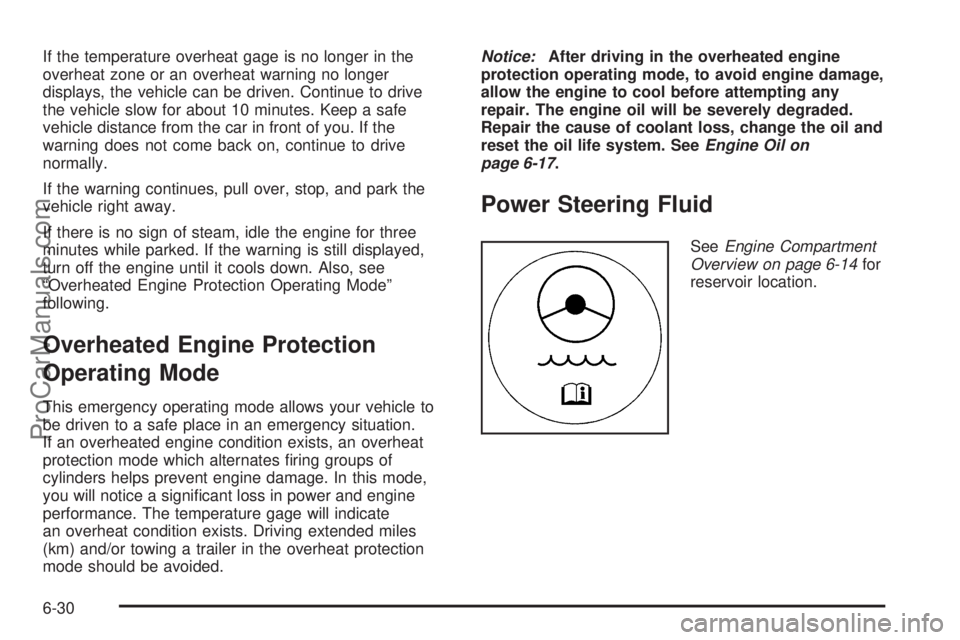
SeeEngine Compartment
Overview on page 6-14for
reservoir location.
6-30
ProCarManuals.com
Page 301 of 428

When to Check Power Steering Fluid
Power steering fluid is used in all vehicles with
V6 engines. Vehicles with the 4-cylinder engine have
electric power steering and do not use power steering
fluid.
It is not necessary to regularly check power steering
fluid unless a leak is suspected in the system, or
an unusual noise is heard. A fluid loss in this system
could indicate a problem. Have the system inspected
and repaired.
How to Check Power Steering Fluid
To check the power steering fluid, do the following:
1. Turn the key off and let the engine compartment
cool down.
2. Wipe the cap and the top of the reservoir clean.
3. Unscrew the cap and wipe the dipstick with a
clean rag.
4. Replace the cap and completely tighten it.
5. Remove the cap again and look at the fluid level on
the dipstick.If the vehicle has the 3.6L V6 engine, the fluid level
should be between the MIN (Minimum) and MAX
(Maximum) marks when the engine is cold, and at the
MAX mark when the engine is hot. If the fluid is at
the MIN mark when the engine is cold or hot, power
steering fluid should be added.
The fluid level should be within the crosshatch area on
the dipstick.
If the fluid is at or below the ADD or MIN mark on the
dipstick, add just enough fluid to bring the level
within the crosshatch area.
What to Use
To determine what kind of fluid to use, see
Recommended Fluids and Lubricants on page 7-10.
Always use the proper fluid.
Notice:Use of the incorrect uid may damage the
vehicle and the damages may not be covered by
the vehicle’s warranty. Always use the correct uid
listed inRecommended Fluids and Lubricants
on page 7-10.
6-31
ProCarManuals.com
Page 318 of 428

(C) Aspect Ratio:A two-digit number that
indicates the tire height-to-width measurements.
For example, if the tire size aspect ratio is 60, as
shown in item C of the illustration, it would mean
that the tire’s sidewall is 60 percent as high as it
is wide.
(D) Construction Code
:A letter code is used to
indicate the type of ply construction in the tire.
The letter R means radial ply construction;
the letter D means diagonal or bias ply
construction; and the letter B means belted-bias
ply construction.
(E) Rim Diameter
:Diameter of the wheel in
inches.
(F) Service Description
:These characters
represent the load index and speed rating of the
tire. The load index represents the load carry
capacity a tire is certified to carry. The speed
rating is the maximum speed a tire is certified to
carry a load.
Tire Terminology and Denitions
Air Pressure:The amount of air inside the
tire pressing outward on each square inch of the
tire. Air pressure is expressed in pounds per
square inch (psi) or kilopascal (kPa).
Accessory Weight
:This means the combined
weight of optional accessories. Some examples of
optional accessories are, automatic transmission,
power steering, power brakes, power windows,
power seats, and air conditioning.
Aspect Ratio
:The relationship of a tire’s height
to its width.
Belt
:A rubber coated layer of cords that is
located between the plies and the tread. Cords
may be made from steel or other reinforcing
materials.
Bead
:The tire bead contains steel wires wrapped
by steel cords that hold the tire onto the rim.
6-48
ProCarManuals.com
Page 369 of 428
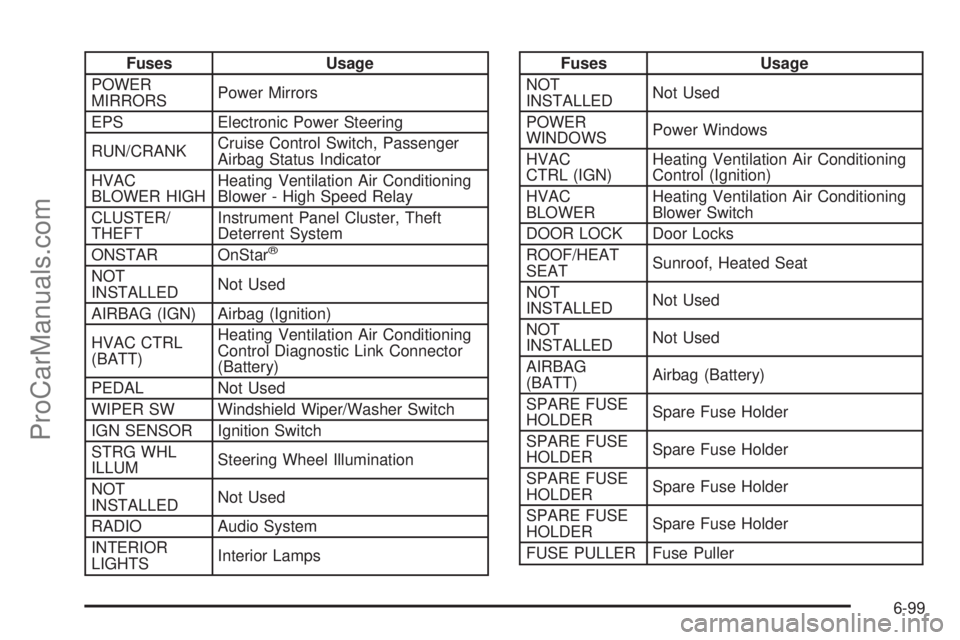
Fuses Usage
POWER
MIRRORSPower Mirrors
EPS Electronic Power Steering
RUN/CRANKCruise Control Switch, Passenger
Airbag Status Indicator
HVAC
BLOWER HIGHHeating Ventilation Air Conditioning
Blower - High Speed Relay
CLUSTER/
THEFTInstrument Panel Cluster, Theft
Deterrent System
ONSTAR OnStar
®
NOT
INSTALLEDNot Used
AIRBAG (IGN) Airbag (Ignition)
HVAC CTRL
(BATT)Heating Ventilation Air Conditioning
Control Diagnostic Link Connector
(Battery)
PEDAL Not Used
WIPER SW Windshield Wiper/Washer Switch
IGN SENSOR Ignition Switch
STRG WHL
ILLUMSteering Wheel Illumination
NOT
INSTALLEDNot Used
RADIO Audio System
INTERIOR
LIGHTSInterior Lamps
Fuses Usage
NOT
INSTALLEDNot Used
POWER
WINDOWSPower Windows
HVAC
CTRL (IGN)Heating Ventilation Air Conditioning
Control (Ignition)
HVAC
BLOWERHeating Ventilation Air Conditioning
Blower Switch
DOOR LOCK Door Locks
ROOF/HEAT
SEATSunroof, Heated Seat
NOT
INSTALLEDNot Used
NOT
INSTALLEDNot Used
AIRBAG
(BATT)Airbag (Battery)
SPARE FUSE
HOLDERSpare Fuse Holder
SPARE FUSE
HOLDERSpare Fuse Holder
SPARE FUSE
HOLDERSpare Fuse Holder
SPARE FUSE
HOLDERSpare Fuse Holder
FUSE PULLER Fuse Puller
6-99
ProCarManuals.com
Page 371 of 428

Fuses Usage
1 Air Conditioner Clutch
2 Electronic Throttle Control
4Transmission Control Module
Ignition 1
5 Mass Airflow Sensor (LY7)
6 Emission
7 Left Headlamp Low-Beam
8 Horn
9 Right Headlamp Low-Beam
10 Front Fog Lamps
11 Left Headlamp High-Beam
12 Right Headlamp High-Beam
13Engine Control Module BATT
(LY7 & LE5)
14 Windshield Wiper
15 Antilock Brake System (IGN 1)
16Engine Control Module IGN 1
(LY7 & LE5)
17 Cooling Fan 1
18 Cooling Fan 2
19Run Relay, Heating, Ventilation, Air
Conditioning BlowerFuses Usage
20 Body Control Module 1
21 Body Control Module Run/Crank
22 Rear Electrical Center 1
23 Rear Electrical Center 2
24 Antilock Brake System
25 Body Control Module 2
26 Starter
41 Electric Power Steering
42Transmission Control Module
Battery
43Ignition Module (LE5); Injectors,
Ignition Coils Odd (LY7)
44Injectors (LE5); Injectors, Ignition
Coils Even (LY7)
45 Post Cat 02 Sensor Heaters (LY7)
46 Daytime Running Lamps
47 Center High-Mounted Stoplamp
50 Driver Power Window
52 AIR Solenoid
54 Regulated Voltage Control
55 Antilock Brake System BATT
6-101
ProCarManuals.com