2010 PORSCHE CAYENNE steering
[x] Cancel search: steeringPage 197 of 379

Driving and Driving Safety
197
Recommended procedure
fDeactivate the Low Range off-road driving
program.
fClean headlights and tail lights and check them
for signs of damage.
fClean the front and rear lincense plates.
fClean the tire tread with a jet of water and
remove any foreign objects.
fClean wheels, wheel housings and the under-
body with a jet of water.
fCheck whether the car has picked up plant
parts or branches.
These materials increase the risk of fire and
can damage fuel lines, brake hoses, boots of
the axle joints and drive shafts.
fAfter off-road driving, always check the entire
floor assembly, tires, body structure, steering
system, running gear and exhaust system for
signs of damage.fAfter driving for an extended period through
mud, sand, water or substances with a similar
soiling effect, check the brake discs, brake
pads, wheels and axle joints and have them
cleaned.
fIf you experience severe vibrations after
driving off road, check the wheels for foreign
substances.
These substances can produce an imbalance
which might be responsible for the vibrations.
Removing these deposits may remedy the
problem.
Uphill driving
Danger!
Danger of serious personal injury or death
and risk of damage if the vehicle should
overturn.
fDo not turn around when driving uphill.
fIf it is not possible to climb a gradient, the car
must be backed down in reverse gear.
fDo not drive over embankments or slopes at
steep diagonal angles.
fIf the vehicle starts to tilt, immediately steer in
the direction of the tilt (line of slope).
fWhen driving uphill, never let the vehicle roll
backward when in idle or not in gear.
Exclusive use of the footbrake is too risky in such situations.
10_Cayenne_21_KW17.book Seite 197 Donnerstag, 9. April 2009 3:33 15
Page 200 of 379

200
Driving and Driving Safety Soiling can impair the braking action.
fCheck and clean the brakes if they have been
soiled.
Danger of steering assistance failing during
a long journey in the water if the drive belt
slips.
fIf the steering assistance fails, more effort will
be required to steer.
Danger of damaging electrical systems
fAvoid driving through salt water.
Notes on operation
fActivate the Low Range program.
fSwitch the air conditioner off.
fSwitch the headlights off.Tips on driving
fAvoid high engine speeds (max. 2,500 rpm).
fDo not perform manual gear changes when
driving, and try to avoid stopping.
Moving off in the water can be difficult due to
the high resistance and the loose surface
involved.
fStart the water crossing at a shallow place at
walking speed.
fAfter checking the body of water, take the
shortest path through it.
fNever drive into the water at high speed. The
resulting “bow wave” could damage the engine
and its accessories.
fAdjust your driving style to the unfamiliar sur-
roundings.
fCross the body of water slowly and at a con-
stant speed.
fNever turn around when crossing a body of
water.
fIf it is not possible to cross the body of water,
the car must be backed out of it in reverse
gear.
The servo pump and alternator can fail if the car is
driven through water for an extended period.
fIf the servo pump fails, substantially more
force will have to be exerted in order to steer. Maintenance Note
The car requires a special check after the water
crossing.
fRemove mud from the tire tread.
fBriefly apply the brakes in order to dry them
after driving through the water.10_Cayenne_21_KW17.book Seite 200 Donnerstag, 9. April 2009 3:33 15
Page 217 of 379

Luggage Compartment, Loadspace and Storage
217
Off-road roof-mounted Headlights
Cayenne S TranssyberiafPlease read the separate instructions for fitting
and operating the off-road roof-mounted
headlights.DisclaimerThe off-road roof-mounted headlights provided
with your Cayenne S Transsyberia have been
designed and manufactured solely for off-road
use. The use of these lights while on a public road
in your country may not be legal or may be legal
only under specified conditions. Check your
national, state/provincial and local laws or
regulations regarding any restrictions and/or
limitations for public highway use prior to
installation. It is common in many countries, for
example, that such roof-mounted headlights must
be hooded or covered while you are on a public
road.
Under no circumstances should the electrical
circuits for these lights be connected to the
circuits for the other lights provided with your
vehicle.
Safety Notes!
fCompletely remove the off-road roof-mounted
headlights before using an automatic car wash
– risk of damage to the vehicle!
fBefore every trip, and at regular intervals
during long trips, check that the off-road
roof-mounted headlights are secured to the
vehicle properly.
fWith the off-road roof-mounted headlights
fitted, do not exceed a maximum speed of
110 mph (180 km/h).
Nevertheless, Porsche recommends that you
do not exceed the posted speed limit.
fDriving, braking and steering behaviour
change due to the higher center of gravity and
the greater wind-resistant area. You should
adapt your driving style appropriately.
fSince fuel consumption and noise are
increased when the off-road roof-mounted
headlights are fitted, they should not remain on the vehicle when not in use.
Note on operation
If the engine is not running and the off-road
roof-mounted headlights are switched on, the
vehicle battery will be discharged.
Switching the off-road roof-mounted
headlights on/offThe off-road roof-mounted headlights are ready for
operation when the side lights are switched on.
fSwitch the off-road roof-mounted headlights on
and off using the button in the roof console.
10_Cayenne_21_KW17.book Seite 217 Donnerstag, 9. April 2009 3:33 15
Page 219 of 379

Luggage Compartment, Loadspace and Storage
219
Compact disc player
Caution!
To avoid damage to compact disc player and
discs.
fUse only compact discs labeled as shown,
having no dirt, damage or warpage.
fNever attempt to disassemble or oil any part
of the player unit. Do not insert any object
other than a disc into the slot.Remember there
are no user-serviceable parts inside the
compact disc player.
fDo not allow the disc to sustain any finger-
prints, scrapes or stickers on the surfaces.
This may cause poor sound quality.
Hold the disc only on the edge or center hole.
fWhen not in use, take the disc out of the player,
put the disc back into its case and store it
away from dust, heat, damp and direct sun-
light.
Leaving the disc on the dashboard in the sun
can damage the disc.fIf the disc gets dirty, clean the disc by wiping
the surfaces from the center to the outside in
a radial direction with a soft cloth.
Do not use a conventional record cleaner or
anti-static record preservative.
Disc cleaners are available in audio stores.
Car Telephone and Aftermarket Alarms Important legal and safety information
regarding the use of cellular telephones
Some states may prohibit the use of cellular tele-
phones while driving a vehicle. Check the laws and
regulations on the use of cellular telephones in the
areas where you drive.
Danger!
Risk of an accident.
Severe personal injury or death can result in
the event of an accident.
Looking away from the road or turning your
attention away from your driving can cause
an accident and lead to serious personal
injury or death.
When using your cellular telephone, you should
always:
fGive full attention to your driving - pull off the
road and park before making or answering a
call if traffic conditions so require; andfKeep both hands on the steering wheel - use
hands-free operation (if available) - pull off the
road and park before using a hand-held tele-
phone.
It is essential to observe the telephone
manufacturer's instructions before operating
the telephone.
Any portable telephone or radio transmitter which
is used in a Porsche must be properly installed in
accordance with the technical requirements of
Porsche.
The transmission power must not exceed
10 W.
The devices must possess a type approval for
your vehicle and have an “e” symbol.
If you should require equipment with transmission
power values greater than 10 W, please consult
your authorized Porsche dealer for this purpose.
He is familiar with the technical requirements for
installing devices of this kind.
The antennas for all radios and telephones with a
transmitting antenna must be externally mounted.
The improper installation of radios or telephones
or use of a radio or telephone with a transmitting
antenna inside the car may cause the warning
lights to come on.
Improper installation of such equipment can
create a discharged battery or excessive current
draw from added equipment.
10_Cayenne_21_KW17.book Seite 219 Donnerstag, 9. April 2009 3:33 15
Page 220 of 379

220
Luggage Compartment, Loadspace and Storage If aftermarket systems are installed by non-dealer-
ship technicians or outside the selling dealer,
problems may result. Installation of aftermarket
equipment is not covered under the New Car
Warranty.
fConsult your authorized Porsche dealer about
the installation of non Porsche approved equip-
ment.
Reception quality
The reception quality of your car telephone will
change constantly when you are driving. Interfe-
rence caused by buildings, landscape and wea-
ther is unavoidable. It may become particularly
difficult to hear when using the hands-free function
due to external noise such as engine and wind
noise.
Automatic car-wash
fUnscrew external antennas before using an au-
tomatic car-wash.
Porsche Communication
Management (PCM)
Warning!
There is danger of accident if you set or
operate the on-board computer, radio, navi-
gation system, telephone or other equipment
when driving.
This could distract you from traffic and
cause you to lose control of the vehicle re-
sulting in serious personal injury or death.
fOperate the components while driving only if
the traffic situation allows you to do so safely.
fCarry out any complicated operating or setting
procedures only with the vehicle stationary.
fIf it is necessary to operate these components
while the vehicle is in motion, use the function keys on the multi-functional steering wheel.
fRefer to the separate operating instructions
before putting the PCM into operation.
When put into operation for the first time, a
distance of approx. 3 miles (5 km) must be driven
in order for the navigation system to complete the
process of fine calibration. The same applies
when the tires are changed (e.g. summer/winter
tires) or new tires fitted. Full location accuracy is
not yet achieved during the fine-calibration
process.If the vehicle has been transported (e.g. ferry, car
train), the system may take a few minutes after
being switched on before it determines the current
location.
Serious tire slip (e.g. spinning wheels on snow)
may result in temporarily inaccurate navigation.
When the battery has been disconnected, it may
take up to 15 minutes before the navigation
system is operational once more.
Satellite radioYou must have the satellite radio activated before
you can put it into operation. You will need a
contract with a provider in order to use this radio.
fRefer to the separate radio operating instruc-
tions before putting into operation.
10_Cayenne_21_KW17.book Seite 220 Donnerstag, 9. April 2009 3:33 15
Page 249 of 379
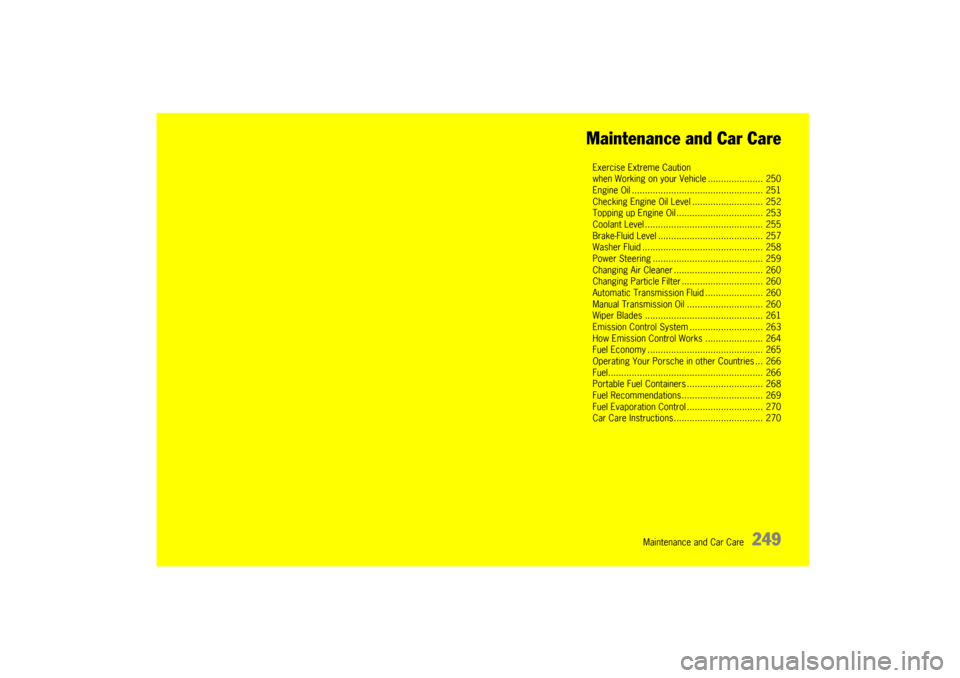
Maintenance and Car Care
249 Maintenance and Car Care
Exercise Extreme Caution
when Working on your Vehicle ..................... 250
Engine Oil .................................................. 251
Checking Engine Oil Level ........................... 252
Topping up Engine Oil ................................. 253
Coolant Level ............................................. 255
Brake-Fluid Level ........................................ 257
Washer Fluid .............................................. 258
Power Steering .......................................... 259
Changing Air Cleaner.................................. 260
Changing Particle Filter ............................... 260
Automatic Transmission Fluid ...................... 260
Manual Transmission Oil ............................. 260
Wiper Blades ............................................. 261
Emission Control System ............................ 263
How Emission Control Works ...................... 264
Fuel Economy ............................................ 265
Operating Your Porsche in other Countries ... 266
Fuel........................................................... 266
Portable Fuel Containers ............................. 268
Fuel Recommendations............................... 269
Fuel Evaporation Control ............................. 270
Car Care Instructions.................................. 270
10_Cayenne_21_KW17.book Seite 249 Donnerstag, 9. April 2009 3:33 15
Page 259 of 379

Maintenance and Car Care
259
Power Steering
Warning!
Risk of accident resulting in serious personal
injury or death. When the engine is stationary
(e.g. when on tow) or the hydraulic system
fails, there is no assistance for steering.
Therefore, substantially more force will have
to be exerted.
fExercise great care when on tow.
fHave the fault remedied at your nearest authorized Porsche dealer.
The flow noise heard at full steering lock is design-
related and does not indicate a defect in the
steering system.
Further important information concerning “mainte-
nance” can be found in a separate chapter.
fPlease see the chapter “EXERCISE EXTREME
CAUTION WHEN WORKING ON YOUR VEHICLE”
on Page 250.
Checking hydraulic fluidfUse only hydraulic fluid authorized by
Porsche.
fCheck the fluid level with the engine stopped
and cold (engine temperature approx. 68 °F or
20 °C).
1. Remove cover A.2. Open the reservoir cap.
3. The fluid level should lie between the MIN and
MAX marks on the dipstick.
Add hydraulic fluid if necessary.
4. Close cap carefully.
5. Put on cover A.
6. Close engine compartment lid.
Note on operation
fIf the fluid level drops significantly, please have
the cause remedied immediately by an
authorized Porsche dealer.
10_Cayenne_21_KW17.book Seite 259 Donnerstag, 9. April 2009 3:33 15
Page 272 of 379

272
Maintenance and Car Care
Warning!
Moisture which gets on the brakes during a
car wash can reduce braking efficiency or
make the brake pull unevenly which could
increase the danger of an accident, causing
serious personal injuries or death.
fAfter washing the vehicle, test the brakes and
steering and briefly brake the discs dry.
When doing so, make sure that vehicles travel-ling behind you are not affected.
Automatic car washes
fPlease see the chapter “WIPER BLADES” on
Page 261.
Optional add-on parts or parts which project be-
yond the contours of the vehicle may be damaged
by design features (e.g. brushes) of automatic car
washes.The following parts are particularly
susceptible to damage:
– Windshield wipers and rear wiper (always
switch them off – wiper stalk in position0 – to
prevent them wiping unintentionally in intermit-
tent or sensor operation).
– Door mirrors (always fold in).
– External antennas (always unscrew).
– Roof Transport System (always remove com-
pletely).
– Off-road roof-mounted headlights (always
remove completely).
– Spoiler.
– Wheels (the wider the rim and the lower the tire
height, the greater the risk of damage).
fPlease consult the operator before using
automatic car washes.
fWash and dry by hand all points not reached by
a car wash, such as door and lid seams or
door sills.
Note
Automatic car washes spray water at odd angles
and high pressures, which are not seen in normal
driving. Therefore, water can sometimes find its
way into the passengers compartment during or
shortly after the car wash.
10_Cayenne_21_KW17.book Seite 272 Donnerstag, 9. April 2009 3:33 15