2010 PORSCHE 911 GT3 ignition
[x] Cancel search: ignitionPage 62 of 251

Operation, Safety
61
Switching off Stability Control (SC) and
Traction Control (TC)fPress SC+TC OFF button.
Stability Control and Traction Control switch off
completely after a short delay.
The light-emitting diode in the button is lit up.
When the system is switched off, the multifunc-
tional PSM light on the instrument panel is lit
and the message “SC+TC OFF” appears conti-
nuously on the on-board computer.
A gong signal also sounds.
fPush the on-board computer lever forward to
acknowledge the additional message under
the digital speedometer.– All PSM functions are deactivated.
– The ABS remains active.
Note
If the PSM is deactivated directly using the
SC+TC OFF button, the light-emitting diode of the
SC OFF button also lights up.
Switching Stability Control (SC) and
Traction Control (TC) back onfPress SC+TC OFF button.
PSM is switched on after a short delay.
The light-emitting diode in the button and the
multi-functional PSM light on the instrument
panel go out.
The on-board computer shows a message.
– The multifunctional light on the instrument
panel lights up for a lamp check when the
ignition is switched on.
– The light flashes to indicate PSM control
operations.
– In conjunction with a message on the on-board
computer, the light indicates that PSM is fully
or partially deactivated.
An acoustic signal also sounds.
– The light indicates a fault in conjunction with a
message on the on-board computer.
PSM is out of order.fHave the fault repaired at your authorized
Porsche dealer immediately.
fPlease see the chapter “PUTTING VEHICLE
INTO OPERATION” on Page 218.
TowingfPlease see the chapter “TOWING” on
Page 235.Checks on test standsBrake tests must be performed only on plate-
type test stands or roller test stands.
The ignition must be off.
The following limit values must not be exceeded
on roller test stands:
– Testing speed 5 mph (8 km/h)
– Test duration 20 seconds
Handbrake tests on the brake test stand must
only be carried out with the ignition switched
off.
Power measurement
Power measurements on roller test stands are not
approved by Porsche.
Multifunctional PSM light
10_GT3_21.book Seite 61 Donnerstag, 4. Juni 2009 12:48 12
Page 63 of 251

62
Operation, Safety
Sport modeWhen the Sport mode is switched on, the exhaust
gas back pressure in the lower and middle ranges
is reduced in the variable exhaust system. This
serves to produce a marked increase in torque in
the engine speed range from approx. 3000 rpm
and 4000 rpm. The best values for vehicle accele-
ration and low-end torque are achieved when
Sport mode is switched on.
Switching Sport mode on and off
fPress button in the centre console.
When Sport mode is switched on, the light-
emitting diode in the button is lit.
Note on operation
After the ignition is switched off, Sport mode is
automatically reset to Normal mode.10_GT3_21.book Seite 62 Donnerstag, 4. Juni 2009 12:48 12
Page 64 of 251

Operation, Safety
63
The previously selected PASM mode is always
activated after the engine is started.
There is no automatic return to Normal mode after
the ignition is switched off.
PASM makes two running-gear setups available to
the driver: “Normal” and “Sport”.
The selection is made via a button on the center
console.
When in Normal mode the running gear is in a
basic setup for roads and circuits with “irregular”
surfaces.
Sport mode provides a shock-absorber setting
for particularly high driving dynamics (e.g. on level
circuits).
The variable suspension system selects the appro-
priate damping level for each wheel according to
the situation and conditions of driving.
Example:
If the vehicle is driven in a very sporty manner in
Normal mode, PASM automatically adapts the
shock-absorber behavior to the driving situation
accordingly.
Switching on PASM Sport modefPress PASM button in the center console.
When PASM Sport mode is switched on, the
light-emitting diode in the button is lit up and a
message is shown on the on-board computer.Switching off PASM Sport modefPress PASM button in the center console.
The light-emitting diode in the button goes out
and the on-board computer displays a
message.
Dynamic Engine Mounting (PADM)The dynamic engine mounting with variable
damping is a system for improving driving
dynamics and enhancing driving comfort.
Depending on the driving situation, the ideal
mounting stiffness and damping is automatically
selected in a range between an almost rigid
connection of the engine to the body (improved
driving dynamics) and a decoupling of the engine
from the body (improved driving comfort).Warning messageDynamic engine mounting faults are indicated by
a warning message on the on-board computer.
fPlease see the chapter “WARNINGS ON THE
INSTRUMENT PANEL AND THE ON-BOARD
COMPUTER” on Page 148.
Porsche Active Suspension
Management (PASM)
10_GT3_21.book Seite 63 Donnerstag, 4. Juni 2009 12:48 12
Page 67 of 251

66
Operation, Safety
A, C - Switch for reading light on driver/passenger side
B- Switch for interior light and footwell lights
D-Orientation lightInterior LightsfPlease see the chapter “LOAD SWITCH-OFF
AFTER 2 HOURS OR 7 DAYS” on Page 208.For vehicles with automatic anti-dazzle
mirrors
fSwitch off the automatic anti-dazzle operation
of the mirrors before you switch on the interior
light.
Otherwise the mirrors may accidentally swivel
into the anti-dazzle position.
Interior lights, reading lightsSwitching off
fPress left half of switch.
Switching to continuous illumination
fPress right half of switch.
Switching on and off automatically
fMove switch to center position.
The interior and footwell lights are switched
on when a door is unlocked or opened or when
the ignition key is withdrawn from the ignition
lock.
The lights are switched off with a delay of
approx. 2 minutes after the doors are closed.
The light goes out immediately as soon as the
ignition is switched on or the vehicle is locked.
Orientation lightA light-emitting diode at the bottom of the interior
mirror improves orientation in the passenger
compartment when it is dark.
Note on operation
On vehicles with the Sport Chrono Package Plus,
the brightness of the orientation light can be
changed in PCM.
fPlease see the chapter “Individual Memory” in
the separate PCM Owner’s Manual.
10_GT3_21.book Seite 66 Donnerstag, 4. Juni 2009 12:48 12
Page 68 of 251

Operation, Safety
67
O - Initial position
1 - Ignition on
2 - Start engine
3 - Ignition offIgnition/Starter Switch with
anti-theft Steering Lock
Caution!
Risk of damage. If extra weight has been
added to the inserted ignition key such as,
e. g. a heavy bunch of keys and/or a key
fob, the ignition lock may be damaged.
fDo not attach any extra weight to the inserted ignition key.The ignition lock has a total of four ignition lock
positions.
The ignition key rebounds to the initial position
from every ignition lock position.
fFor your safety, fasten safety belts.
fPlease see the chapter “IMMOBILIZER” on
Page 18.
fPlease see the chapter “KEY WITH RADIO
REMOTE CONTROL” on Page 19.
Before starting the enginefApply the footbrake.
fMove the gearshift lever into neutral.
The clutch pedal must be depressed fully
before the starter will engage.Switch position 0 Initial position
The ignition key cannot be withdrawn when the
ignition is switched on or when the engine has
been started.
To withdraw the ignition key:
fStop the vehicle.
fSwitch ignition off.
fRemove ignition key.
Switch position 1 Ignition on
fTurn ignition key to position 1.
Ignition is switched on.
Note on operation
All electrical equipment can be switched on.
fPlease see the chapter “WARNINGS ON THE
INSTRUMENT PANEL AND THE ON-BOARD
COMPUTER” on Page 148.
10_GT3_21.book Seite 67 Donnerstag, 4. Juni 2009 12:48 12
Page 69 of 251

68
Operation, Safety
Switch position 2Start engine
fTurn ignition key to ignition lock position 2.
fPlease see the chapter “STARTING PROCE-
DURES” on Page 70.Switch position 3Ignition off
fTurn ignition key to ignition lock position 3.
Note on operation
The vehicle battery discharges if the ignition key is
left inserted.
If the vehicle battery is dead, the key can only be
pulled out of the ignition lock if the emergency
operation is performed:
fPlease see the chapter “EMERGENCY OPERA-
TION – PULLING OUT THE IGNITION KEY” on
Page 69.
Locking the steering columnAutomatic locking
The steering column is automatically locked when
the ignition key is withdrawn from the ignition lock.
Warning!
Risk of an accident, resulting in serious
personal injury or death.
The steering wheel will lock and will cause
loss of steering.
fNever remove key from the ignition lock or turn
the key off while the vehicle is moving.
fAlways withdraw the ignition key when leaving the vehicle.Automatic unlocking
The steering column is unlocked when the vehicle
is unlocked with the radio remote control.
Note
fTo avoid discharging the battery, always
remove the ignition key from the ignition lock.
Please see the chapter “BATTERY” on
Page 211.
Gong If you leave the key in the ignition/steering lock, a
gong will sound when the driver’s door is opened.
This is a reminder to remove the key.
10_GT3_21.book Seite 68 Donnerstag, 4. Juni 2009 12:48 12
Page 70 of 251
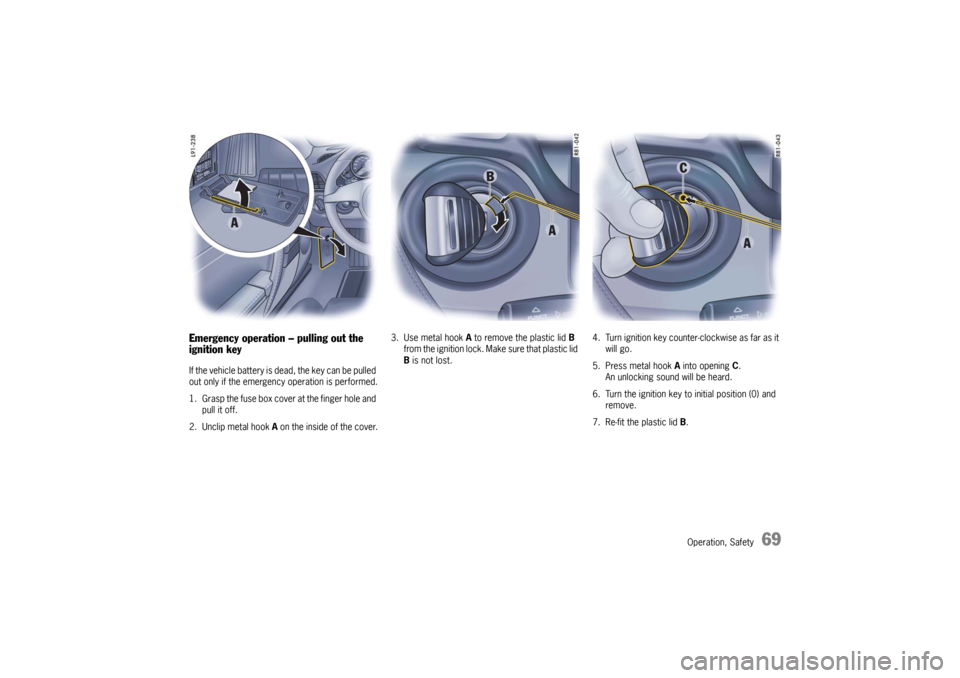
Operation, Safety
69
Emergency operation – pulling out the
ignition keyIf the vehicle battery is dead, the key can be pulled
out only if the emergency operation is performed.
1. Grasp the fuse box cover at the finger hole and
pull it off.
2. Unclip metal hook A on the inside of the cover.3. Use metal hook A to remove the plastic lid B
from the ignition lock. Make sure that plastic lid
B is not lost.4. Turn ignition key counter-clockwise as far as it
will go.
5. Press metal hook A into opening C.
An unlocking sound will be heard.
6. Turn the ignition key to initial position (0) and
remove.
7. Re-fit the plastic lid B.
10_GT3_21.book Seite 69 Donnerstag, 4. Juni 2009 12:48 12
Page 71 of 251

70
Operation, Safety
Starting Procedures fPlease see the chapter “IMMOBILIZER” on
Page 18.
fPlease see the chapter “EMISSION CONTROL
SYSTEM” on Page 168.
Warning!
Serious injury or death may result if you are
involved in a collision without having
fastened the safety belts.
fFasten safety belts before driving away. Before starting the engine fApply the footbrake.
fMove the gearshift lever into neutral.
The clutch pedal must be depressed fully
before the starter will engage.
Temperature sensors on the engine automatically
provide the correct fuel/air mixture required for
starting.
Therefore, it is not necessary to depress the
accelerator pedal while starting a cold or a
warm engine.
Starting the enginefTurn ignition key to ignition lock position 2.
fAs soon as the engine starts, release the
ignition key.
The first operation of the starter is ended
automatically when the engine starts.
If the engine does not start, subsequent starter
operations will not be ended automatically.
If the engine fails to start after 10 or 15 seconds
of cranking:
fWait about 10 seconds before engaging the
starter again.
fWhen starting the engine, be ready to drive
immediately.
Drive vehicle at moderate speeds and avoid
engine speeds above 4,200 rpm during the
first 5 minutes.
fDo not let the engine idle to warm up.
Danger!
Engine exhaust fumes have many compon-
ents which you can smell. They also contain
carbon monoxide (CO), which is a colorless
and odorless gas.
Carbon monoxide can cause unconscious-
ness and even death if inhaled.
fNever start or let the engine run in an
enclosed, unventilated area.
It is not recommended to sit in your car for
prolonged periods with the engine on and the
car not moving.
An unattended vehicle with a running engine
is potentially hazardous.
If warning lights should come on to indicate
improper operation, they would go
unnoticed.
fNever leave the engine idling unattended.
Risk of fire due to hot exhaust system.
fDo not park or operate the vehicle in areas
where the hot exhaust system may come in
contact with dry grass, brush, fuel spill or
other flammable material.
fIf your car catches on fire for any reason, call
the fire department.
Do not endanger your life by attempting to put out the fire.
10_GT3_21.book Seite 70 Donnerstag, 4. Juni 2009 12:48 12