2010 PORSCHE 911 GT3 weight
[x] Cancel search: weightPage 68 of 251

Operation, Safety
67
O - Initial position
1 - Ignition on
2 - Start engine
3 - Ignition offIgnition/Starter Switch with
anti-theft Steering Lock
Caution!
Risk of damage. If extra weight has been
added to the inserted ignition key such as,
e. g. a heavy bunch of keys and/or a key
fob, the ignition lock may be damaged.
fDo not attach any extra weight to the inserted ignition key.The ignition lock has a total of four ignition lock
positions.
The ignition key rebounds to the initial position
from every ignition lock position.
fFor your safety, fasten safety belts.
fPlease see the chapter “IMMOBILIZER” on
Page 18.
fPlease see the chapter “KEY WITH RADIO
REMOTE CONTROL” on Page 19.
Before starting the enginefApply the footbrake.
fMove the gearshift lever into neutral.
The clutch pedal must be depressed fully
before the starter will engage.Switch position 0 Initial position
The ignition key cannot be withdrawn when the
ignition is switched on or when the engine has
been started.
To withdraw the ignition key:
fStop the vehicle.
fSwitch ignition off.
fRemove ignition key.
Switch position 1 Ignition on
fTurn ignition key to position 1.
Ignition is switched on.
Note on operation
All electrical equipment can be switched on.
fPlease see the chapter “WARNINGS ON THE
INSTRUMENT PANEL AND THE ON-BOARD
COMPUTER” on Page 148.
10_GT3_21.book Seite 67 Donnerstag, 4. Juni 2009 12:48 12
Page 153 of 251

152
Warnings
PA S M N o r m a l / S p o r t I n d i c a t or for selected PASM mode
PASM failure Have the fault remedied at an authorized Porsche dealer.
PASM indicator faulty Have the fault remedied at an authorized Porsche dealer.
PADM failure Dynamic engine mounting failed.
Have the fault remedied at an authorized Porsche dealer.
System fault airbag Airbag is faulty.
Have the fault remedied at an authorized Porsche dealer.
Check passenger’s seat setting Weight sensing is impaired on the passenger's seat (Advanced Airbag).
Correct the seating position, set the backrest upright, do not support weight on the armrests, or lift on
the handles.
Depress clutch pedal Depress clutch pedal when starting.
System fault
visit workshopSeveral systems may have failed. Adjust your driving style. Reduce speed.
Have the fault remedied at an authorized Porsche dealer.
Failure
fuel level indicator
workshopHave the fault remedied at an authorized Porsche dealer.
Service in mls/days (km/days) Service indicator
Bring the vehicle in for service no later than after the distance/time shown has elapsed.
Please see the additional information in the “Maintenance” booklet.
Service now Service indicator
Have your vehicle serviced at an authorized Porsche dealer.
Flat tyre! Tire Pressure Monitoring has detected a serious pressure loss.
Stop at a suitable place and check tires for damage. Fill in tire sealant if necessary.
Instrument
panelOn-board
computerText display on on-board
computerMeaning/measure
10_GT3_21.book Seite 152 Donnerstag, 4. Juni 2009 12:48 12
Page 165 of 251

164
Maintenance, Car Care
Fuel Economy Fuel economy will vary depending on where,
when and how you drive, optional equipment
installed, and the general condition of your
car.
A car tuned to specifications and correctly
maintained, will help you to achieve optimal
fuel economy.
fHave your vehicle tuned to specifications.
Air cleaner should be dirt free to allow proper
engine “breathing”.
Battery should be fully charged.
Wheels should be properly aligned.
Tires should be inflated at correct pressure.
fAlways monitor your fuel consumption.
fDrive smoothly, avoid abrupt changes in speed
as much as possible.
fAvoid jack rabbit starts and sudden stops.
fDo not drive longer than necessary in the lower
gears. Shifting into a higher gear early without
lugging the engine will help save fuel.
fProlonged “warm up” idling wastes gas. Start
the vehicle just before you are ready to drive.
Accelerate slowly and smoothly.
fSwitch off the engine if stationary for longer
periods. fAny additional weight carried in the vehicle
reduces fuel economy. Always keep cargo to a
minimum and remove all unnecessary items.
fOrganize your trips to take in several errands
in one trip.
fAll electrical accessories contribute to incre-
ased fuel consumption.
fOnly switch on the air conditioning when neces-
sary.
The EPA estimated miles per gallon (mpg) is
to be used for comparison purposes, actual
mileage may be different from the estimated
mpg, depending on your driving speed,
weather conditions and trip length. Your
actual highway mileage will probably be less
than the estimated mpg.
fPlease observe all local and national speed
limits.
Operating your Porsche in other
Countries Government regulations in the United States and
Canada require that automobiles meet specific
emission regulations and safety standards. There-
fore, cars built for the U.S. and Canada differ from
vehicles sold in other countries.
If you plan to take your Porsche outside the conti-
nental limits of the United States or Canada, there
is the possibility that
– unleaded fuel may not be available;
– unleaded fuel may have a considerably lower
octane rating. Excessive engine knock and
serious damage to both engine and catalytic
converters could result;
– service may be inadequate due to lack of
proper service facilities, tools or diagnostic
equipment;
– replacement parts may not be available or very
difficult to get.
Porsche cannot be responsible for the
mechanical damage that could result
because of inadequate fuel, service or parts
availability.
If you purchased your Porsche abroad and want to
bring it back home, be sure to find out about
shipping and forwarding requirements, as well as
current import and customs regulations.
10_GT3_21.book Seite 164 Donnerstag, 4. Juni 2009 12:48 12
Page 188 of 251

Practical Tips, Emergency Service
187
B Vehicle load limit
Is the maximum total weight limit specified of
the load (passengers and cargo) for the
vehicle. This is the maximum weight of passen-
gers and cargo that can be loaded into the
vehicle.
Please see the chapter “LOADING INFORMA-
TION” on Page 195.
C Tire size for the front axle
Check with your authorized Porsche dealer
about the current release status.
D Recommended tire pressure for the front axle
These values are for cold tires (68 °F/20 °C).
E Tire size for the rear axle
Check with your authorized Porsche dealer
about the current release status.
F Recommended tire pressure for the rear axle.
These values are for cold tires (68 °F/20 °C).
G In vehicles with collapsible spare wheel:
Size and tire pressure of the spare wheel.
Tire traction
Warning!
When driving on wet or slushy roads, a
wedge of water may build up between the
tires and the road. This phenomenon is
known as “hydroplane” and may cause
partial or complete loss of traction, vehicle
control or stopping ability.
fReduce speed on wet surface to prevent this. Tire life Tire life depends on various factors, i. e., road
surfaces, traffic and weather conditions, driving
habits, type of tires and tire care.
fInspect your tires for wear and damage before
driving off. If you notice uneven or substantial
wear, wheels might need alignment or tires
should be balanced or replaced.
Tire wear The original equipment tires on your Porsche have
built-in tire wear indicators. They are molded into
the bottom of the tread grooves and will appear as
approximately 1/2 in. (12 mm) bands when the
tire tread depth is down to 1/16 of an in.
(1.6 mm).
When the indicators appear in two or more
adjacent grooves, it is time to replace the tires.
We recommend, however, that you do not let the
tires wear down to this extent.
Worn tires cannot grip the road surface properly
and are even less effective on wet roads.
In the United States, state laws may govern the
minimum tread depth permissible. Follow all such
laws.
10_GT3_21.book Seite 187 Donnerstag, 4. Juni 2009 12:48 12
Page 191 of 251

190
Practical Tips, Emergency Service
Parking at the curb
Warning!
Hard impacts against curbs (or traffic
islands) are dangerous and may cause
hidden tire damage which is not noticeable
until later. Such damage can result in
accidents at high speeds causing serious
personal injury or death.
Depending on the force of impact, the edge
of the rim can also be damaged.
fIf you are in doubt, have the wheel checked by
an expert, particularly if you suspect damage
on the inside.
fIf you must drive over a curb or other obstacle,
drive slowly and at an obtuse angle. Exercise care when parking along curbs.
Wheel alignment, wheel balancing As a precaution, have wheels with summer tires
balanced in the spring, and those with mud and
snow tires before winter.
Unbalanced wheels may affect car handling and
tire life.
Only the specified weights may be used for wheel
balancing.
Self-adhesive weights must not come into contact
with cleaning agents, since they could drop off.
Uneven tread wear indicates wheel imbalance. In
this event, the vehicle should be checked at an
authorized Porsche dealer.
Warning!
If, during a trip, uneven running or vibrations
occur that could be caused by damage to
tires or the car, the speed must be reduced
immediately, but without braking sharply.
If you continue your trip without having the
cause of the fault remedied, you might lose
control of your vehicle which could cause
serious personal injury or death.
fStop the vehicle and check the tires.
fIf no cause for the fault can be found, drive
carefully to the nearest authorized Porsche dealer.
Wheels with Tire Pressure Monitoring
(TPM) sensorsBefore changing wheels, make sure that the
wheels are compatible with your vehicle's TPM.
fCheck this with your authorized Porsche
dealer.
10_GT3_21.book Seite 190 Donnerstag, 4. Juni 2009 12:48 12
Page 196 of 251

Practical Tips, Emergency Service
195
Loading InformationDefinitionsThe Curb weight - actual weight of your vehicle -
vehicle weight including standard and optional
equipment, fluids and emergency tools. This
weight does not include passengers and cargo.
The Gross Vehicle Weight is sum of the curb
weight and the weight of passengers and cargo
combined.
The Gross Vehicle Weight Rating is the
maximum total weight of vehicle, passengers,
luggage and optional equipment.
The Gross Axle Weight Rating is the maximum
load limit for the front or the rear axle. This infor-
mation is located on the safety compliance sticker
located in the driver’s side door jamb.
For determining the compatibility of the tire and
vehicle load capabilities:
fPlease see the chapter “TECHNICAL DATA” on
Page 236.
The load capacity coefficient (e.g. “102”) is a
minimum requirement.The Gross Combined Weight Rating is the
maximum total weight rating of vehicle, passen-
gers and cargo.
The Vehicle Capacity Weight - Load Limit - is
the maximum total weight limit specified of the
load (passengers and cargo) for the vehicle. This
is the maximum weight of passengers and cargo
that can be loaded into the vehicle. This informa-
tion can be found on the tire pressure plate.
The maximum loaded vehicle weight is the
sum of curb weight, accessory weight, vehicle
capacity weight and production options weight.
The load rating is the maximum load that a tire
is rated to carry for a given inflation pressure.
The maximum load rating is the load rating for
a tire at the maximum permissble inflation
pressure.
The cargo capacity is the permissible weight of
cargo, the substracted weight of passengers from
the load limit.
fNever exceed the permissible limits.
Danger!
Risk of loss of control, damage to the vehicle
and serious personal injury or death.
fNever exceed the specified axle loads.
Overloading can shorten the service life of the
tires and car, as well as lead to dangerous
vehicle reactions and long braking distances.
Damage due to overloading is not covered by the vehicle warranty.
10_GT3_21.book Seite 195 Donnerstag, 4. Juni 2009 12:48 12
Page 197 of 251

196
Practical Tips, Emergency Service
Example for determining the combined weight of
occupants and cargoVehicle Load CapacityfThe combined weight of occupants and cargo
should never exceed the weight shown on the
tire plate in the vehicle.
Please see the chapter “TIRE PRESSURE
PLATE” on Page 235.
fNever exceed the number of passengers
shown on the tire pressure plate in the vehicle.Determining the combined weight of
occupants and cargo:
fAdd the weight of all occupants and then add
the total luggage weight (figure).
Steps for determining correct load limit
1. Locate the statement "The combined weight of
occupants and cargo should never exceed XXX
pounds" on your vehicle’s placard.
2. Determine the combined weight of the driver
and passengers that will be riding in your
vehicle. 3. Subtract the combined weight of the driver and
passengers from XXX kilograms or XXX
pounds.
4. The resulting figure equals the available
amount of cargo and luggage load capacity.
For example, if the "XXX" amount equals
400 lbs. and there will be two - 150 lb passen-
gers in your vehicle, the amount of available
cargo and luggage load capacity is 100 lbs.
(400 - 300 (2 x 150) = 100 lbs.)
5. Determine the combined weight of luggage
and cargo being loaded on the vehicle. That
weight may not safely exceed the available
cargo and luggage load capacity calculated in
Step 4.10_GT3_21.book Seite 196 Donnerstag, 4. Juni 2009 12:48 12
Page 229 of 251
228
Practical Tips, Emergency Service
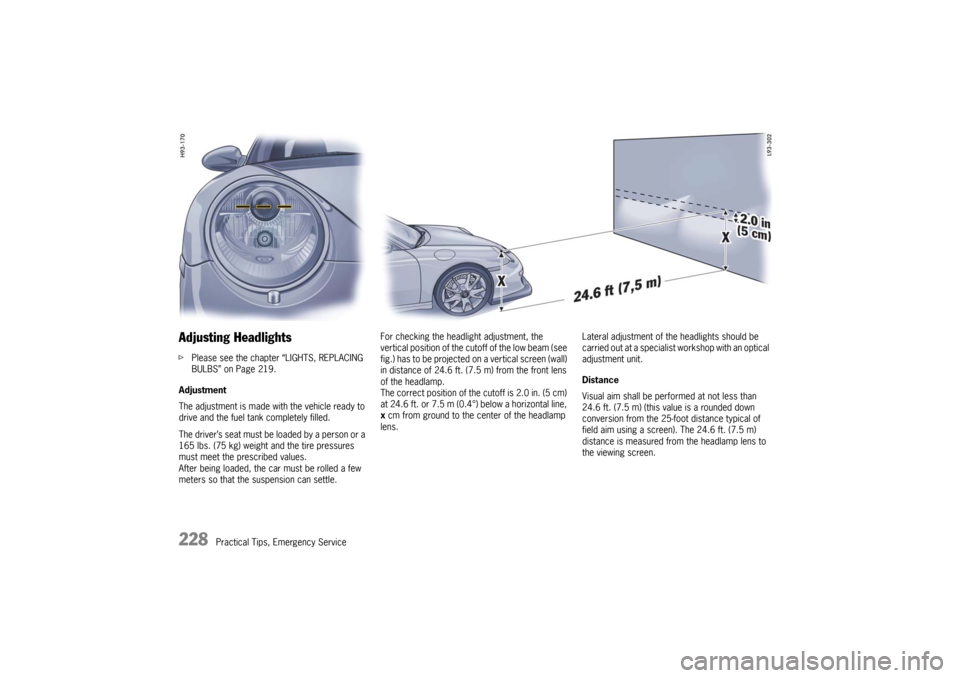
Adjusting HeadlightsfPlease see the chapter “LIGHTS, REPLACING
BULBS” on Page 219.
Adjustment
The adjustment is made with the vehicle ready to
drive and the fuel tank completely filled.
The driver’s seat must be loaded by a person or a
165 lbs. (75 kg) weight and the tire pressures
must meet the prescribed values.
After being loaded, the car must be rolled a few
meters so that the suspension can settle.
For checking the headlight adjustment, the
vertical position of the cutoff of the low beam (see
fig.) has to be projected on a vertical screen (wall)
in distance of 24.6 ft. (7.5 m) from the front lens
of the headlamp.
The correct position of the cutoff is 2.0 in. (5 cm)
at 24.6 ft. or 7.5 m (0.4°) below a horizontal line,
x cm from ground to the center of the headlamp
lens.Lateral adjustment of the headlights should be
carried out at a specialist workshop with an optical
adjustment unit.
Distance
Visual aim shall be performed at not less than
24.6 ft. (7.5 m) (this value is a rounded down
conversion from the 25-foot distance typical of
field aim using a screen). The 24.6 ft. (7.5 m)
distance is measured from the headlamp lens to
the viewing screen.
10_GT3_21.book Seite 228 Donnerstag, 4. Juni 2009 12:48 12