2010 PORSCHE 911 GT3 warning
[x] Cancel search: warningPage 26 of 251

Operation, Safety
25
Automatic door locking Your authorized Porsche dealer can program
diverse types of automatic door locking in the
control unit of the central locking system:
Ty p e 1
Doors lock automatically when the ignition is
switched on.
Ty p e 2
Doors lock automatically when a speed of
3 - 6 mph (5 - 10 km/h) is exceeded. Ty p e 3
Doors lock automatically when the ignition is
switched on. If doors are opened with the engine
running, they lock again automatically when a
speed of 3 - 6 mph (5 - 10 km/h) is exceeded.
Ty p e 4
The doors do not lock automatically.
Note
Automatically locked doors can be unlocked with
the central locking button or opened by pulling on
the inside door handle twice.
fOn vehicles with the Sport Chrono Package
Plus, the PCM can be used to activate
automatic door locking.
Please see the chapter “Individual Memory” in
the separate PCM Owner’s Manual.
Warning!
In an emergency situation where you need to
exit the car through an automatically locked
door, remember the following procedure to
open the door.
fUnlock the doors by pressing the central
locking button or
fpull the inside door handle twice to open the door.
10_GT3_21.book Seite 25 Donnerstag, 4. Juni 2009 12:48 12
Page 27 of 251

26
Operation, Safety
A- Light-emitting diode for alarm systemAlarm System,
Passenger Compartment
MonitoringThis device complies with:
Part 15 of the FCC Rules
RSS-210 of Industry Canada.
Operation is subject to the following two condi-
tions:
1. This device may not cause harmful interfe-
rence, and2. this device must accept any interference
received, including interference that may
cause undesired operation.
Note
The manufacturer is not responsible for any radio
or TV interference caused by unauthorized modifi-
cations to this equipment.
Such modification could void the user’s authority
to operate the equipment.
Warning!
Any changes or modifications not expressly
approved by Porsche could void the user’s autho-
rity to operate this equipment.
The alarm system and passenger compartment
monitoring system are switched on when the
doors are locked with the key or remote control.
fPlease see the chapter “CENTRAL LOCKING”
on Page 22.
Unlocking the vehicle by using the key in the
door lock and opening the door may activate
the alarm system within 10 seconds. Switching off the alarm system if it is
triggered accidentallyfUnlock the vehicle with the remote control.
The alarm system and passenger compartment
monitoring system are switched off automatically
when the doors are unlocked.
Function indication If the alarm system is activated, light-emitting
diode A in the central locking switch flashes.
If, after locking, the light-emitting diode does not
flash or, after ten seconds, it emits double
flashes, then not all alarm contacts are closed.
Additionally, a brief horn signal sounds.
When the doors are unlocked, the alarm system
and passenger compartment monitoring system
are switched off and the light-emitting diode goes
off.
10_GT3_21.book Seite 26 Donnerstag, 4. Juni 2009 12:48 12
Page 29 of 251

28
Operation, Safety
A - Power window in driver’s door
B - Power window in passenger’s door
Power Windows
Warning!
Risk of injury when the door windows close.
This applies especially if the windows are
closed with the one-touch operation,
because with this function the window goes
up automatically.
fMake sure that fingers, hands, arms or other
parts are not in the way when the windows are
closed.
fRemove the ignition key to shut off power to
the window switches when the vehicle is not
attended by a responsible person. Uninformed
persons could injure themselves by operating
the power windows.
fDo not leave children in the car unattended.
Risk of an accident.
fDo not put anything on or near the windows that may interfere with the driver’s vision.
Readiness for operation of power windows – When the ignition is switched on
(engine switched on or off) or
– with doors closed and ignition key withdrawn,
but only until door is first opened.
One-touch operation for closing the door
windows is available only when the ignition is
switched on.
10_GT3_21.book Seite 28 Donnerstag, 4. Juni 2009 12:48 12
Page 30 of 251

Operation, Safety
29
Opening/closing windowsThe two rocker switches A and B in the driver’s
door and the switch in the passenger’s door have
a two-stage function:
Opening
fPress the rocker switch down to the first stage
until the window has reached the desired
position.
Closing
fPress the rocker switch upwards to the first
stage until the window has reached the desired
position.
One-touch operation
fPress the rocker switch upwards or
downwards to the second stage.
Window moves to its final position.
Press again to stop the window in the desired
position.
One-touch operation for closing the passenger’s
window is available once the window is approxima-
tely half-way closed.
Anti-crushing protectionIf a side window is blocked during closing, it will
stop and open again by about an inch.
Warning!
Risk of serious personal injuries.
If the rocker switch is pressed again within
10
seconds of the window being blocked, the
window will close with its full closing force.
Anti-crushing protection is disabled.
fOnce the anti-crushing protection acts to stop
the window and opens it slightly, do not press
the rocker switch again within 10 seconds
without checking to make sure that nothing is
blocking the path of the window.The window will close with full closing force.
One-touch operation is disabled for 10 seconds
after blockage of a side window.
Automatic window lowering fPlease see the chapter “DOORS” on Page 21.Storing end position of the windowsIf the battery is disconnected and reconnected,
the windows will not be raised automatically when
the door is closed.
1. Close the windows with the rocker switch
once.
2. Press the rocker switch upwards again to store
the end position of the windows in the control
unit.
10_GT3_21.book Seite 29 Donnerstag, 4. Juni 2009 12:48 12
Page 31 of 251

30
Operation, Safety
Door mirrorsBefore driving the vehicle, adjust the outside and
inside mirrors.
It is important for safe driving that you have clear,
unobstructed vision to the rear.
Warning!
Risk of an accident, resulting in serious
personal injury or death.
fDo not put anything on or near the windows or
the mirrors that may interfere with the driver’s vision.
Adjusting 1. Switch on ignition.
2. By turning the control switch A, select the
driver’s side or the passenger’s side.
3. Move the door mirror glasses in the approp-
riate direction by tilting the control switch.
If the electrical adjustment facility fails
fAdjust mirror by pressing on the mirror face.
Folding in door mirrors
Warning!
Risk of injury to fingers if the mirror acciden-
tally flips back when being folded in.
fExercise extreme caution when folding in
mirror by hand. Do not let go of the mirror
before the locking lever is locked or the mirror is fully unfolded.
10_GT3_21.book Seite 30 Donnerstag, 4. Juni 2009 12:48 12
Page 33 of 251
32
Operation, Safety Note
The incident light in the area of the sensors must
not be restricted, e.g. by stickers on the
windshield.
Switching off the automatic anti-glare
operation
fPress switch B.
Light-emitting diode C goes out.
Switching on the automatic anti-glare
operation
fPress switch B.
Light-emitting diode C lights up. Warning!
Risk of injury. Electrolyte fluid can emerge
from a broken mirror glass.
This fluid irritates the skin and eyes.
fIf the electrolyte fluid should come into contact
with the eyes or skin, immediately rinse it off
with clean water.
See a doctor if necessary.
Risk of damage to the paintwork, leather and
plastic parts. Electrolyte fluid can be
removed only while it is still wet.
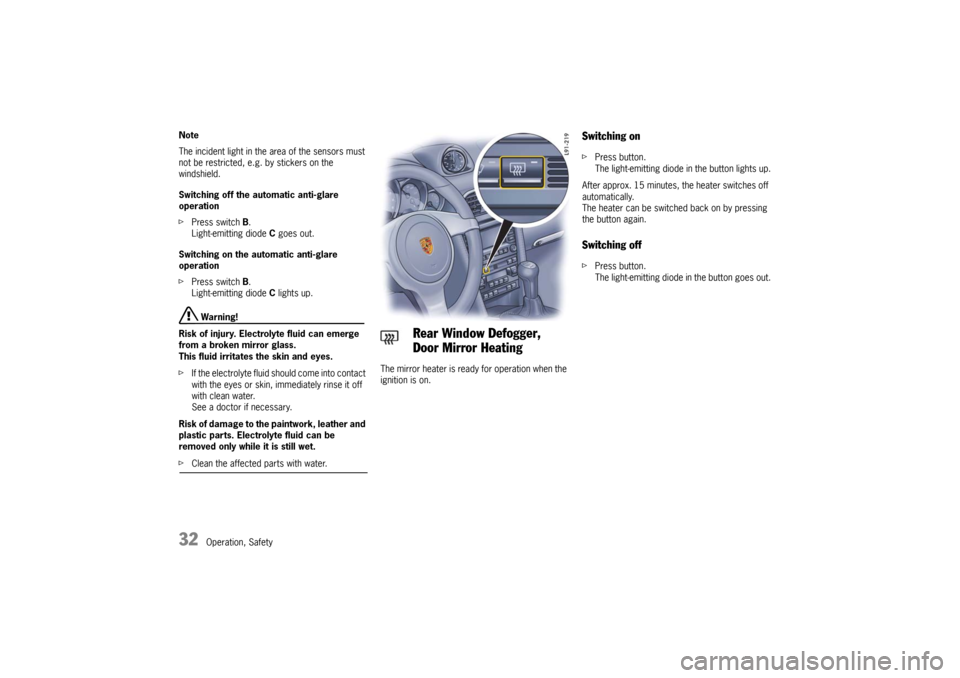
fClean the affected parts with water. The mirror heater is ready for operation when the
ignition is on.
Switching on fPress button.
The light-emitting diode in the button lights up.
After approx. 15 minutes, the heater switches off
automatically.
The heater can be switched back on by pressing
the button again.Switching off fPress button.
The light-emitting diode in the button goes out.
Rear Window Defogger,
Door Mirror Heating
10_GT3_21.book Seite 32 Donnerstag, 4. Juni 2009 12:48 12
Page 34 of 251

Operation, Safety
33
Seat Adjustment and Head
Restraints
Warning!
The seat may move unexpectedly if you
attempt to adjust while driving. This could
cause sudden loss of control, resulting in
serious personal injury or death.
fDo not adjust seats while the vehicle is in
motion.
The backrest locks must be engaged at all
times while the vehicle is in motion.
Safety belts only offer protection when the
backrest is upright and the belts are properly
positioned on the body.
Improperly positioned safety belts or safety
belts worn by passengers in an excessively
reclined position can cause serious personal
injury or death in an accident.
fDo not operate the car with the driver or
passenger backrests excessively reclined
(see “Seat position”).
Risk of injury if persons or animals are in the
movement range of the seat during seat
adjustment.
fAdjust the seat so that no one is put at risk.
Caution!
Risk of damage to windshield, sun visor, etc.
when the seat is adjusted or folded back or
forward.
fAdjust the seat so that the seat backrest is not in contact with any other object.
The driver and passenger seat provide integrated
head restraints in the backrests. The head
restraints are not adjustable. Warning!
All occupants, including the driver, should not
operate a vehicle or sit in a vehicle's seat until the
head restraints and backrests, respectively, are
placed in their proper positions so that the risk of
neck injuries is minimized in the event of a crash.
For proper positioning of the head restraint, the
seatback's inclination should be adjusted such
that the head restraint is in an upright position.
Driver and passengers should be seated upright
and in the center of their seats.
Seat positionAn ergonomically correct sitting position is
important for safe and fatigue-free driving.
We recommend the following procedure for adjus-
ting the driver’s seat to suit individual
requirements:
1. Adjust the seat until, with the clutch pedal fully
depressed, your leg remains at a slight angle.
2. Rest your outstretched arm on the steering
wheel.
Set the backrest angle (not applicable for
Sports bucket seat) and the steering-wheel
position so that your wrist rests on the outer
rim of the steering wheel. At the same time,
the shoulders must still be in noticeable
contact with the backrest.
3. Adjust the seat height (not applicable for
Sports bucket seat) to give yourself enough
headroom and a good overview of the vehicle.
4. Electrically adjustable seat:
Adjust the seat angle until your thighs rest
lightly on the seat cushion.
10_GT3_21.book Seite 33 Donnerstag, 4. Juni 2009 12:48 12
Page 37 of 251

36
Operation, Safety
A- Seat heating, left
B- Seat heating, rightHeated SeatsTwo-stage seat heating is ready for operation
when the engine is running.
Switching onHigh heating power
fPress button once.
Both light-emitting diodes in the button
light up.
Low heating power
fPress button twice.
One light-emitting diode in the button lights up.Switching offfPress button as often as necessary until the
light-emitting diodes go out.
Steering Wheel Adjustment
Warning!
Risk of accident.
The steering wheel may move further than
desired if you attempt to adjust it when
driving.
You can lose control of the vehicle, causing
serious personal injury or death.
fDo not adjust the steering wheel when driving.
10_GT3_21.book Seite 36 Donnerstag, 4. Juni 2009 12:48 12