Page 176 of 318

The tethered fuel cap is located
behind a hinged fuel door on
the driver side of the vehicle.
To remove the fuel cap, turn it slowly
counterclockwise. On some vehicles
you may have to push in while
turning the cap.
While refueling, hang the fuel cap
inside of the fuel door.
When reinstalling the cap, turn it
clockwise until it clicks, otherwise
the Malfunction Indicator Lamp may
turn on. SeeMalfunction Indicator
Lamp on page 4-14.
{CAUTION
Fuel can spray out on you if
you open the fuel cap too quickly.
If you spill fuel and then something
ignites it, you could be badly
burned. This spray can happen if
the tank is nearly full, and is more
likely in hot weather. Open the fuel
cap slowly and wait for any hiss
noise to stop. Then unscrew the
cap all the way.
Be careful not to spill fuel. Do not
top off or overfill the tank and wait a
few seconds after you have finished
pumping before removing the nozzle.
Clean fuel from painted surfaces as
soon as possible. See Exterior Care
on page 9-75.
When replacing the fuel cap, turn
it clockwise until it clicks. Make
sure the cap is fully installed.
The diagnostic system can
determine if the fuel cap has been left off or improperly
installed. This would allow fuel to
evaporate into the atmosphere.
See
Malfunction Indicator Lamp
on page 4-14.
{CAUTION
If a fire starts while you are
refueling, do not remove the
nozzle. Shut off the flow of fuel
by shutting off the pump or by
notifying the station attendant.
Leave the area immediately.
Notice: If you need a new fuel
cap, be sure to get the right type.
Your dealer/retailer can get one for
you. If you get the wrong type, it
may not t properly. This may
cause the malfunction indicator
lamp to light and may damage the
fuel tank and emissions system.
See Malfunction Indicator Lamp
on page 4-14.
8-42 Driving and Operating
Page 184 of 318
Trailer Brakes
Does the trailer have its own
brakes? Be sure to read and follow
the instructions for the trailer
brakes so they are installed,
adjusted and maintained properly.
Because the vehicle has anti-lock
brakes, do not tap into the vehicle’s
brake system. If you do, both brake
systems will not work well, or at all.
Trailer Wiring Harness
All of the electrical circuits required
for the trailer lighting system can be
accessed at the driver’s side rear
lamp connector. This connector is
located under the carpet at the rear
corner of the cargo compartment.
Conversions and
Add-Ons
Add-On Electrical
Equipment
Notice:Do not add anything
electrical to the vehicle unless you
check with your dealer/retailer
rst. Some electrical equipment
can damage the vehicle and the
damage would not be covered by
the vehicle’s warranty. Some
add-on electrical equipment can
keep other components from
working as they should. Add-on equipment can drain the
vehicle battery, even if the vehicle is
not operating.
The vehicle has an airbag system.
Before attempting to add anything
electrical to the vehicle, see
Servicing the Airbag-Equipped
Vehicle on page 2-34
.
8-50 Driving and Operating
Page 201 of 318
How to Inspect the Engine Air
Cleaner/Filter
To inspect the air cleaner/filter
remove the filter from the vehicle
and lightly shake the filter to release
loose dust and dirt. If the filter
remains caked with dirt, a new filter
is required.To inspect or replace the engine air
cleaner/filter:
1. Release the two clips that hold
the cover. 2. Lift the cover.
3. Inspect or replace the engine air
cleaner/filter.
4. Reinstall the cover.
1.8L Engine
Vehicle Care 9-17
Page 204 of 318

What to Use
Use a 50/50 mixture of clean,
drinkable water and DEX-COOL®
coolant, which will not damage
aluminum parts. If this coolant
mixture is used, nothing else
needs to be added.
{CAUTION
Adding only plain water to the
cooling system can be dangerous.
Plain water, or some other liquid
such as alcohol, can boil before
the proper coolant mixture will.
The vehicle’s coolant warning
system is set for the proper coolant
mixture. With plain water or the
wrong mixture, the engine could
get too hot but would not get the
overheat warning. The engine
could catch fire and you or
others could be burned. Use a
50/50 mixture of clean, drinkable
water and DEX-COOL
®coolant.Notice:
If an improper coolant
mixture is used, the engine could
overheat and be badly damaged.
The repair cost would not be
covered by the vehicle warranty.
Too much water in the mixture
can freeze and crack the engine,
radiator, heater core, and other
parts.
•Gives freezing protection down to
−34°F (− 38°C).
•Gives boiling protection up to
265°F (129°C).
•Protects against rust and
corrosion.
•Helps keep the proper engine
temperature.
•Lets the warning lights and gages
work as they should.
Notice: Using coolant other than
DEX-COOL can cause premature
engine, heater core or radiator
corrosion. In addition, the engine
coolant may require changing sooner, at 30,000 miles
(50 000 km) or 24 months,
whichever occurs rst. Any
repairs would not be covered
by the vehicle warranty. Always
use DEX-COOL (silicate-free)
coolant in your vehicle.
Checking Coolant
The vehicle must be on a level
surface. When the engine is cold,
the coolant level should be at LOW,
or a little higher. When the engine
is warm, the level should be up to
FULL, or a little higher. If it is not,
there could be a leak at the pressure
cap or in the radiator hoses, heater
hoses, radiator, water pump, or
somewhere else in the cooling
system.
See
Engine Compartment Overview
on page 9-6 for the location of
the coolant recovery tank.
9-20 Vehicle Care
Page 210 of 318

Brakes
This vehicle has disc brakes.
Disc brake pads have built-in wear
indicators that make a high-pitched
warning sound when the brake pads
are worn and new pads are needed.
The sound can come and go or be
heard all the time the vehicle is
moving, except when applying the
brake pedal firmly.
{CAUTION
The brake wear warning sound
means that soon the brakes will
not work well. That could lead to
an accident. When the brake wear
warning sound is heard, have the
vehicle serviced.
Notice: Continuing to drive
with worn-out brake pads could
result in costly brake repair. Some driving conditions or climates
can cause a brake squeal when
the brakes are first applied or
lightly applied. This does not mean
something is wrong with the brakes.
Properly torqued wheel nuts are
necessary to help prevent brake
pulsation. When tires are rotated,
inspect brake pads for wear and
evenly tighten wheel nuts in the
proper sequence to torque
specifications in
Capacities and
Specications on page 11-2 .
Brake linings should always be
replaced as complete axle sets.
Brake Pedal Travel
See your dealer/retailer if the brake
pedal does not return to normal
height, or if there is a rapid increase
in pedal travel. This could be a sign
that brake service might be required.
Brake Adjustment
Every time the brakes are applied,
with or without the vehicle moving,
the brakes adjust for wear.
Replacing Brake System Parts
The braking system on a vehicle is
complex. Its many parts have to be
of top quality and work well together
if the vehicle is to have really good
braking. The vehicle was designed
and tested with top-quality brake
parts. When parts of the braking
system are replaced, be sure to get
new, approved replacement parts.
If this is not done, the brakes might
not work properly. For example,
installing disc brake pads that are
wrong for the vehicle, can change
the balance between the front and
rear brakes — for the worse. The
braking performance expected can
change in many other ways if the
wrong replacement brake parts are
installed.
9-26 Vehicle Care
Page 211 of 318

Brake Fluid
The brake master cylinder and, on
manual transmission vehicles, the
clutch hydraulic system use the
same reservoir. The reservoir is filled
with DOT-3 brake fluid as indicated
on the reservoir cap. SeeEngine
Compartment Overview on page 9-6
for the location of the reservoir. There are only two reasons why the
brake fluid level in the reservoir
might go down:
•The brake fluid level goes down
because of normal brake lining
wear. When new linings are
installed, the fluid level goes
back up.
•A fluid leak in the brake and/or
clutch hydraulic system can also
cause a low fluid level. Have the
brake and/or clutch hydraulic
system fixed, since a leak means
that sooner or later the brakes
and/or clutch will not work well.
Do not top off the brake/clutch fluid.
Adding fluid does not correct a leak.
If fluid is added when the linings are
worn, there will be too much fluid
when new brake linings are installed. Add or remove brake fluid, as
necessary, only when work is done
on the brake/clutch hydraulic system.
{CAUTION
If too much brake fluid is added,
it can spill on the engine and burn,
if the engine is hot enough. You
or others could be burned, and
the vehicle could be damaged.
Add brake fluid only when work
is done on the brake hydraulic
system.
When the brake fluid falls to a low
level, the brake warning light comes
on. See Brake System Warning
Light on page 4-17.
Vehicle Care 9-27
Page 224 of 318
FusesUsage
17 Turn Signal Lamps,
Hazard Lamps
18 Charging System
19 Starting System,
Multiport Fuel
Injection System/
Sequential Multiport
Fuel Injection
System
20 Starting System,
Multiport Fuel
Injection System/
Sequential Multiport
Fuel Injection
System
21 Empty
22 Starting System
23 Engine Immobilizer
SystemFuses
Usage
24 Main Body ECU,
Gages, Daytime
Running
Lights (DRL),
Air Conditioning
System, Wireless
Remote Control,
Theft Deterrent
System
25 Audio System
26 Interior Lamps,
Personal Lamps,
Clock
27 Spare
28 Spare
29 Spare
30 Audio System
31 OnStar
®
Fuses Usage
32 Multiport
Fuel Injection
System/Sequential
Multiport Fuel
Injection System,
Horn, Emission
Control System 1,
Emission Control
System 2
33 Horn
34 Multiport Fuel
Injection System/
Sequential Multiport
Fuel Injection
System, Horn,
Ignition, Meter
35 PTC Heater 1
36 PTC Heater 3
37 Air Conditioning
Inverter
9-40 Vehicle Care
Page 225 of 318
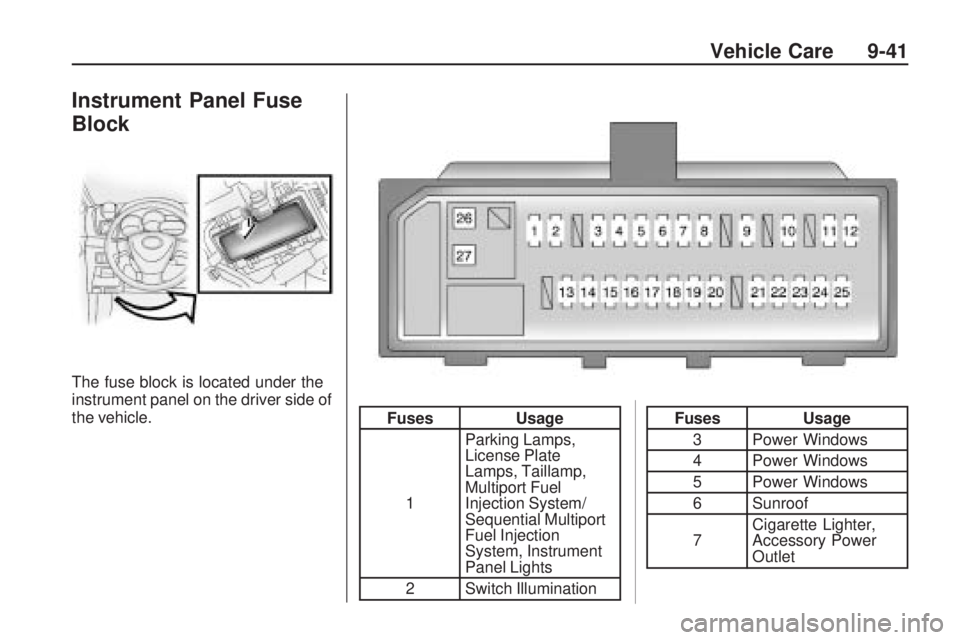
Instrument Panel Fuse
Block
The fuse block is located under the
instrument panel on the driver side of
the vehicle.
FusesUsage
1 Parking Lamps,
License Plate
Lamps, Taillamp,
Multiport Fuel
Injection System/
Sequential Multiport
Fuel Injection
System, Instrument
Panel Lights
2 Switch IlluminationFuses Usage
3 Power Windows
4 Power Windows
5 Power Windows
6 Sunroof
7 Cigarette Lighter,
Accessory Power
Outlet
Vehicle Care 9-41