2010 PONTIAC VIBE ECU
[x] Cancel search: ECUPage 226 of 318

FusesUsage
8 Outside Rearview
Mirrors, Audio
System, Main Body
Engine Control
Unit (ECU), Clock,
Brake Transmission
Shift Interlock
9 Empty
10 Empty
11 Airbag System,
Multiport Fuel
Injection System/
Sequential Multiport
Fuel Injection
System, Front
Passenger Occupant
Classification
System
12 Gages and Meters
13 Air Conditioning
System, Rear
Window Defogger
14 Windshield Wipers
15 Rear Window WipersFuses Usage
16 Windshield Washer
17 Main Body ECU,
Electric Power
Steering, Electric
Cooling Fans,
Brake Transmission
Shift Interlock,
Antilock Braking
System (ABS),
Multiport Fuel
Injection System/
Sequential Multiport
Fuel Injection
System, Tire
Pressure Monitoring
System (TPMS),
Vehicle Stability
Control System
18 Back-up Lamps,
Charging System,
Rear Window
Defogger
19 Onboard Diagnosis
SystemFuses
Usage
20 Stoplamps, Center
High-Mounted
Stoplamps (CHMSL),
ABS, Vehicle
Stability Control
System, Multiport
Fuel Injection
System/Sequential
Multiport Fuel
Injection System,
Brake Transmission
Shift Interlock
21 Power Door Lock
System
22 Outside Rearview
Mirrors, Audio
System, Main Body
ECU, Clock, Brake
Transmission Shift
Interlock, Cigarette
Lighter
23 All-Wheel Drive
System
24 Front Foglamps
9-42 Vehicle Care
Page 227 of 318

FusesUsage
25 Ignition, Outside
Rearview Mirrors,
Audio System, Main
Body ECU, Clock,
Brake Transmission
Shift Interlock,
Cigarette Lighter
26 Rear Window
Defogger, Heated
Mirrors, Multiport
Fuel Injection
System/Sequential
Multiport Fuel
Injection System
27 Power WindowsWheels and Tires
Tires
Your new vehicle comes
with high-quality tires made
by a leading tire manufacturer.
If you ever have questions about
your tire warranty and where to
obtain service, see your vehicle
Warranty booklet for details.
For additional information refer
to the tire manufacturer.
{CAUTION
Poorly maintained and improperly
used tires are dangerous.
•Overloading your tires can
cause overheating as a result
of too much flexing. You
could have an air-out and a
serious accident. See Vehicle
Load Limits on page 8-12 .
(Continued)
CAUTION (Continued)
•Underinflated tires pose the
same danger as overloaded
tires. The resulting accident
could cause serious injury.
Check all tires frequently to
maintain the recommended
pressure. Tire pressure
should be checked when
your tires are cold. See Tire
Pressure on page 9-49 .
•Overinflated tires are more
likely to be cut, punctured
or broken by a sudden
impact — such as when you
hit a pothole. Keep tires at
the recommended pressure.
•Worn, old tires can cause
accidents. If your tread is
badly worn, or if your tires
have been damaged,
replace them.
Vehicle Care 9-43
Page 245 of 318

Used Replacement Wheels
{CAUTION
Putting a used wheel on the
vehicle is dangerous. You cannot
know how it has been used or how
far it has been driven. It could fail
suddenly and cause a crash. If you
have to replace a wheel, use a
new GM original equipment wheel.
Tire Chains
{CAUTION
If the vehicle has P215/45R18
size tires, do not use tire chains.
There is not enough clearance.
Tire chains used on a vehicle
without the proper amount of
clearance can cause damage to(Continued)
CAUTION (Continued)
the brakes, suspension or other
vehicle parts. The area damaged
by the tire chains could cause you
to lose control of the vehicle and
you or others may be injured in a
crash.
Use another type of traction
device only if its manufacturer
recommends it for use on the
vehicle and tire size combination
and road conditions. Follow that
manufacturer’s instructions.
To help avoid damage to the
vehicle, drive slowly, readjust
or remove the device if it is
contacting the vehicle, and
do not spin the wheels.
If you do find traction devices that
will fit, install them on the front
tires. Notice:
If the vehicle has a tire
size other than P215/45R18 size
tires, use tire chains only where
legal and only when you must.
Use only SAE Class “S” type
chains that are the proper size
for the tires. Install them on the
front tires and tighten them as
tightly as possible with the
ends securely fastened. Drive
slowly and follow the chain
manufacturer’s instructions. If you
can hear the chains contacting the
vehicle, stop and retighten them.
If the contact continues, slow
down until it stops. Driving too
fast or spinning the wheels with
chains on will damage the vehicle.
Vehicle Care 9-61
Page 252 of 318
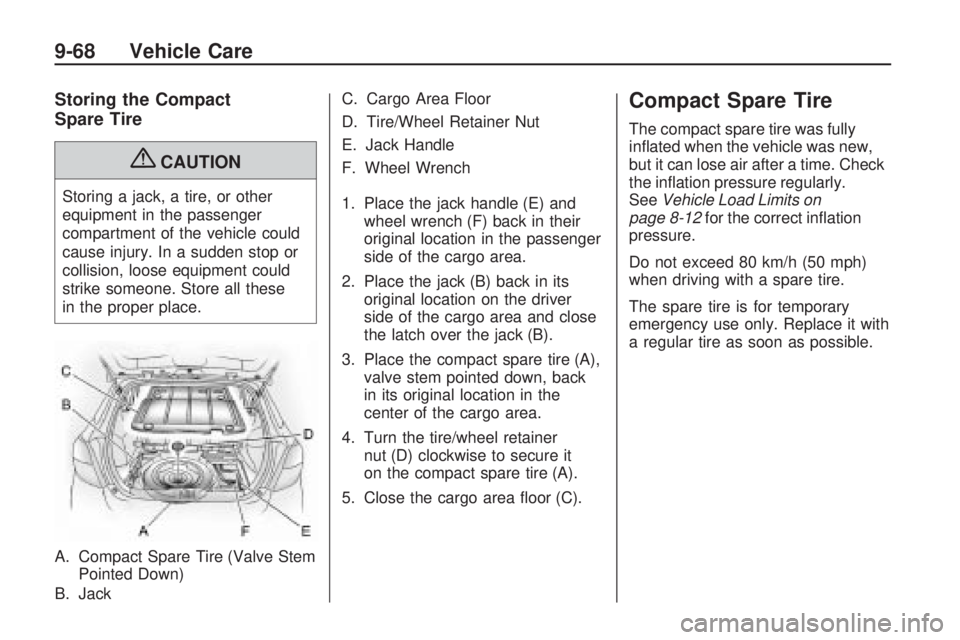
Storing the Compact
Spare Tire
{CAUTION
Storing a jack, a tire, or other
equipment in the passenger
compartment of the vehicle could
cause injury. In a sudden stop or
collision, loose equipment could
strike someone. Store all these
in the proper place.
A. Compact Spare Tire (Valve Stem Pointed Down)
B. Jack C. Cargo Area Floor
D. Tire/Wheel Retainer Nut
E. Jack Handle
F. Wheel Wrench
1. Place the jack handle (E) and
wheel wrench (F) back in their
original location in the passenger
side of the cargo area.
2. Place the jack (B) back in its original location on the driver
side of the cargo area and close
the latch over the jack (B).
3. Place the compact spare tire (A), valve stem pointed down, back
in its original location in the
center of the cargo area.
4. Turn the tire/wheel retainer nut (D) clockwise to secure it
on the compact spare tire (A).
5. Close the cargo area floor (C).
Compact Spare Tire
The compact spare tire was fully
inflated when the vehicle was new,
but it can lose air after a time. Check
the inflation pressure regularly.
See Vehicle Load Limits on
page 8-12 for the correct inflation
pressure.
Do not exceed 80 km/h (50 mph)
when driving with a spare tire.
The spare tire is for temporary
emergency use only. Replace it with
a regular tire as soon as possible.
9-68 Vehicle Care
Page 259 of 318
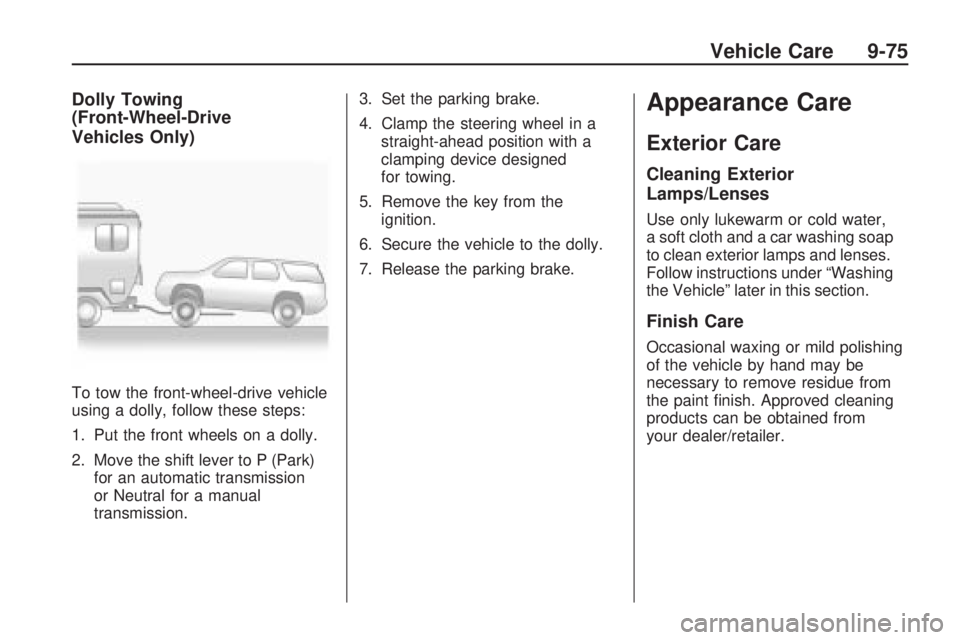
Dolly Towing
(Front-Wheel-Drive
Vehicles Only)
To tow the front-wheel-drive vehicle
using a dolly, follow these steps:
1. Put the front wheels on a dolly.
2. Move the shift lever to P (Park)for an automatic transmission
or Neutral for a manual
transmission. 3. Set the parking brake.
4. Clamp the steering wheel in a
straight-ahead position with a
clamping device designed
for towing.
5. Remove the key from the ignition.
6. Secure the vehicle to the dolly.
7. Release the parking brake.
Appearance Care
Exterior Care
Cleaning Exterior
Lamps/Lenses
Use only lukewarm or cold water,
a soft cloth and a car washing soap
to clean exterior lamps and lenses.
Follow instructions under “Washing
the Vehicle” later in this section.
Finish Care
Occasional waxing or mild polishing
of the vehicle by hand may be
necessary to remove residue from
the paint finish. Approved cleaning
products can be obtained from
your dealer/retailer.
Vehicle Care 9-75
Page 298 of 318

General Motors of Canada
also has a Mobility Program.
Call 1-800-GM-DRIVE (463-7483)
for details. TTY users call
1-800-263-3830.
Roadside Assistance
Program
For U.S. purchased vehicles, call
1-800-ROADSIDE (762-3743); (Text
telephone (TTY): 1-888-889-2438).
For Canadian purchased vehicles,
call 1-800-268-6800 .
Service is available 24 hours a day,
365 days a year.
Calling for Assistance
When calling Roadside Assistance,
have the following information ready:
•Your name, home address, and
home telephone number
•Telephone number of your
location
•Location of the vehicle
•Model, year, color, and license
plate number of the vehicle
•Odometer reading, Vehicle
Identification Number (VIN), and
delivery date of the vehicle
•Description of the problem
Coverage
Services are provided up to
5 years/100,000 miles (160 000 km),
whichever comes first.
In the U.S., anyone driving the
vehicle is covered. In Canada, a
person driving the vehicle without
permission from the owner is
not covered.
Roadside Assistance is not a part of
the New Vehicle Limited Warranty.
Pontiac and General Motors of
Canada Limited reserve the right to
make any changes or discontinue
the Roadside Assistance program at
any time without notification.
Pontiac and General Motors of
Canada Limited reserve the right to
limit services or payment to an owner
or driver if they decide the claims are
made too often, or the same type of
claim is made many times.
Services Provided •
Emergency Fuel Delivery:
Delivery of enough fuel for
the vehicle to get to the nearest
service station.
•Lock-Out Service: Service is
provided to unlock the vehicle if
you are locked out. A remote
unlock may be available if you
have OnStar
®. For security
reasons, the driver must present
identification before this service is
given.
•Emergency Tow From a Public
Road or Highway: Tow to the
nearest Pontiac dealer for
warranty service, or if the vehicle
was in a crash and cannot be
driven. Assistance is also given
when the vehicle is stuck in sand,
mud, or snow.
12-6 Customer Information
Page 308 of 318

Radio Frequency
Identication (RFID)
RFID technology is used in some
vehicles for functions such as tire
pressure monitoring and ignition
system security, as well as in
connection with conveniences such
as key fobs for remote door locking/
unlocking and starting, and in-vehicle
transmitters for garage door openers.
RFID technology in GM vehicles
does not use or record personal
information or link with any other
GM system containing personal
information.
Radio Frequency
Statement (US, Can)
This vehicle has systems that
operate on a radio frequency that
comply with Part 15 of the Federal
Communications Commission (FCC)
Rules and with RSS-210/211 of
Industry and Science Canada.
Operation is subject to the following
two conditions:
1. The device may not causeinterference.
2. The device must accept any interference received, including
interference that may cause
undesired operation of the device.
Changes or modifications to any of
these systems by other than an
authorized service facility could void
authorization to use this equipment.
12-16 Customer Information
Page 310 of 318

B
Battery............................... 9-28
Jump Starting ................... 9-69
Power Protection ................ 5-5
Blade Replacement, Wiper ....9-30
Brakes ............................... 9-26
Antilock ........................... 8-32
Fluid ............................... 9-27
Parking ........................... 8-33
Braking ................................ 8-4
Break-In, New Vehicle ..........8-16
Bulb Replacement ................9-37
Fog Lamps ........................ 5-4
Halogen Bulbs ..................9-33
Headlamp Aiming ..............9-32
Headlamps ...................... 9-33
Headlamps and Parking Lamps ......................... 9-33
License Plate Lamps .........9-36
Taillamps ......................... 9-35
Buying New Tires .................9-56
C
California
Fuel Requirements ............8-39
Perchlorate Materials Requirements ................. 9-3
Warning ............................ 9-2
Canadian Vehicle Owners .......... ii
Capacities and Specifications ................... 11-2
Carbon Monoxide Engine Exhaust ................8-23
Liftgate ............................. 1-6
Winter Driving .................... 8-9
Cargo Cover ............................... 3-2
Management System .......... 3-4
Tie Downs ......................... 3-4
Cautions, Danger, and Warnings ............................. iii
CD Player ............................ 6-9
Center Console Storage ......... 3-2
Chains, Tire ........................ 9-61
Charging System Light ..........4-14
Check Engine Lamp .............4-14Child Restraints
Infants and YoungChildren ....................... 2-38
Lower Anchors and Tethers for Children .................. 2-45
Older Children ..................2-37
Securing .................. 2-51, 2-53
Systems .......................... 2-41
Where to Put the Restraint ...................... 2-43
Cigarette Lighter .................... 4-8
Circuit Breakers ...................9-38
Climate Control Systems ......... 7-1
Cluster, IP ............................ 4-9
Clutch, Hydraulic ..................9-15
Collision Damage Repair .....12-10
Compact Spare Tire .............9-68
Control of a Vehicle ............... 8-3
Coolant Engine ............................ 9-19
Engine Temperature Gage . . . 4-11
Cooling System ...................9-19
Courtesy Transportation Program .......................... 12-8
i-2 INDEX