2010 PONTIAC VIBE steering
[x] Cancel search: steeringPage 223 of 318

FusesUsage
1 Electric
Cooling Fans
2 Electric
Cooling Fans
3 Antilock Braking
System (ABS),
Vehicle Stability
Control SystemFuses
Usage
4 ABS, Vehicle
Stability Control
System
5 Air Conditioning
System
6 Charging System
7 Electric Power
Steering
Fuses
Usage
8 Emission Control
System Main, Horn,
Ignition 2
9 Headlamp Main
10 Emission Control
System 2
11 Multiport Fuel
Injection System/
Sequential Multiport
Fuel Injection
System
12 Driver Side
Headlamp
13 Passenger Side
Headlamp
14 Driver Side
Low-Beam
Headlamp,
Front Foglamps
15 Passenger Side
Low-Beam
Headlamp
16 Multiport Fuel
Injection System/
Sequential Multiport
Fuel Injection
System
Vehicle Care 9-39
Page 226 of 318

FusesUsage
8 Outside Rearview
Mirrors, Audio
System, Main Body
Engine Control
Unit (ECU), Clock,
Brake Transmission
Shift Interlock
9 Empty
10 Empty
11 Airbag System,
Multiport Fuel
Injection System/
Sequential Multiport
Fuel Injection
System, Front
Passenger Occupant
Classification
System
12 Gages and Meters
13 Air Conditioning
System, Rear
Window Defogger
14 Windshield Wipers
15 Rear Window WipersFuses Usage
16 Windshield Washer
17 Main Body ECU,
Electric Power
Steering, Electric
Cooling Fans,
Brake Transmission
Shift Interlock,
Antilock Braking
System (ABS),
Multiport Fuel
Injection System/
Sequential Multiport
Fuel Injection
System, Tire
Pressure Monitoring
System (TPMS),
Vehicle Stability
Control System
18 Back-up Lamps,
Charging System,
Rear Window
Defogger
19 Onboard Diagnosis
SystemFuses
Usage
20 Stoplamps, Center
High-Mounted
Stoplamps (CHMSL),
ABS, Vehicle
Stability Control
System, Multiport
Fuel Injection
System/Sequential
Multiport Fuel
Injection System,
Brake Transmission
Shift Interlock
21 Power Door Lock
System
22 Outside Rearview
Mirrors, Audio
System, Main Body
ECU, Clock, Brake
Transmission Shift
Interlock, Cigarette
Lighter
23 All-Wheel Drive
System
24 Front Foglamps
9-42 Vehicle Care
Page 230 of 318

Tire Designations
Tire Size
The following illustration
shows an example of a typical
passenger vehicle tire size.
(A) Passenger (P-Metric) Tire
:The United States version of a
metric tire sizing system. The
letter P as the first character in
the tire size means a passenger
vehicle tire engineered to
standards set by the U.S.
Tire and Rim Association.
(B) Tire Width
:The three-digit
number indicates the tire section
width in millimeters from sidewall
to sidewall. (C) Aspect Ratio
:A two-digit
number that indicates the tire
height-to-width measurements.
For example, if the tire size
aspect ratio is 60, as shown in
item C of the illustration, it would
mean that the tire’s sidewall is
60 percent as high as it is wide.
(D) Construction Code
:A letter
code is used to indicate the type
of ply construction in the tire.
The letter R means radial ply
construction; the letter D means
diagonal or bias ply construction;
and the letter B means
belted-bias ply construction.
(E) Rim Diameter
:Diameter of
the wheel in inches.
(F) Service Description
:These
characters represent the load
index and speed rating of the tire.
The load index represents the
load carry capacity a tire is
certified to carry. The speed
rating is the maximum speed a
tire is certified to carry a load.
Tire Terminology and
Denitions
Air Pressure:The amount of air
inside the tire pressing outward
on each square inch of the tire.
Air pressure is expressed in
pounds per square inch (psi)
or kilopascal (kPa).
Accessory Weight
:This means
the combined weight of optional
accessories. Some examples
of optional accessories are,
automatic transmission, power
steering, power brakes, power
windows, power seats, and air
conditioning.
Aspect Ratio
:The relationship
of a tire’s height to its width.
Belt
:A rubber coated layer of
cords that is located between the
plies and the tread. Cords may
be made from steel or other
reinforcing materials.
9-46 Vehicle Care
Page 246 of 318

If a Tire Goes Flat
It is unusual for a tire to blowout
while you are driving, especially if
you maintain your vehicle’s tires
properly. If air goes out of a tire,
it is much more likely to leak out
slowly. But if you should ever have
a blowout, here are a few tips about
what to expect and what to do:
If a front tire fails, the flat tire
creates a drag that pulls the vehicle
toward that side. Take your foot off
the accelerator pedal and grip the
steering wheel firmly. Steer to
maintain lane position, and then
gently brake to a stop well out of
the traffic lane.
A rear blowout, particularly on a
curve, acts much like a skid and
may require the same correction
you would use in a skid. In any rear
blowout remove your foot from the
accelerator pedal. Get the vehicle
under control by steering the way
you want the vehicle to go. It may bevery bumpy and noisy, but you can
still steer. Gently brake to a stop,
well off the road if possible.
{CAUTION
Lifting a vehicle and getting under
it to do maintenance or repairs is
dangerous without the appropriate
safety equipment and training. If a
jack is provided with the vehicle, it
is designed only for changing a
flat tire. If it is used for anything
else, you or others could be badly
injured or killed if the vehicle slips
off the jack. If a jack is provided
with the vehicle, only use it for
changing a flat tire.
If a tire goes flat, avoid further tire
and wheel damage by driving slowly
to a level place. Turn on the hazard
warning flashers. See Hazard
Warning Flashers on page 5-3 .
{CAUTION
Changing a tire can be dangerous.
The vehicle can slip off the jack
and roll over or fall on you or other
people. You and they could be
badly injured or even killed. Find
a level place to change your tire.
To help prevent the vehicle from
moving:
1. Set the parking brake firmly.
2. Put an automatic transmission shift lever in
P (Park), or shift a manual
transmission to 1 (First) or
R (Reverse).
3. Turn off the engine and do not restart while the vehicle
is raised.
4. Do not allow passengers to remain in the vehicle.
(Continued)
9-62 Vehicle Care
Page 258 of 318

Here are some important things
to consider before recreational
vehicle towing:
•What is the towing capacity of the
towing vehicle? Be sure to read
the tow vehicle manufacturer’s
recommendations.
•What is the distance that will be
travelled? Some vehicles have
restrictions on how far and how
long they can tow.
•Is the proper equipment going to
be used? See your dealer/retailer
or trailering professional for
additional advice and equipment
recommendations.
•Is the vehicle ready to be towed?
Just as preparing the vehicle for a
long trip, make sure the vehicle is
prepared to be towed.
Dinghy Towing
If the vehicle has an automatic
transmission, it cannot be dinghy
towed. See “Dolly Towing” for more
information regarding towing the
vehicle.If the vehicle has a manual
transmission, it can be dinghy
towed.
When dinghy towing, be sure to
follow the posted legal speed limit.
1. Put the shift lever in Neutral.
2. Turn the ignition to
ACC/ACCESSORY to avoid
locking the steering wheel.
Make sure the audio system
is turned off and that nothing is
plugged into the power outlets.
3. Release the parking brake. After dinghy towing, let the engine
idle for more than three minutes
before driving the vehicle.
Do not tow the vehicle from the
rear. The vehicle could be badly
damaged and the repairs would
not be covered by the warranty.
Dolly Towing (All-Wheel-Drive
Vehicles)
All-wheel-drive vehicles must not
be towed with two wheels on the
ground. To properly tow these
vehicles, they should be placed on a
platform trailer with all four wheels off
of the ground.
9-74 Vehicle Care
Page 259 of 318
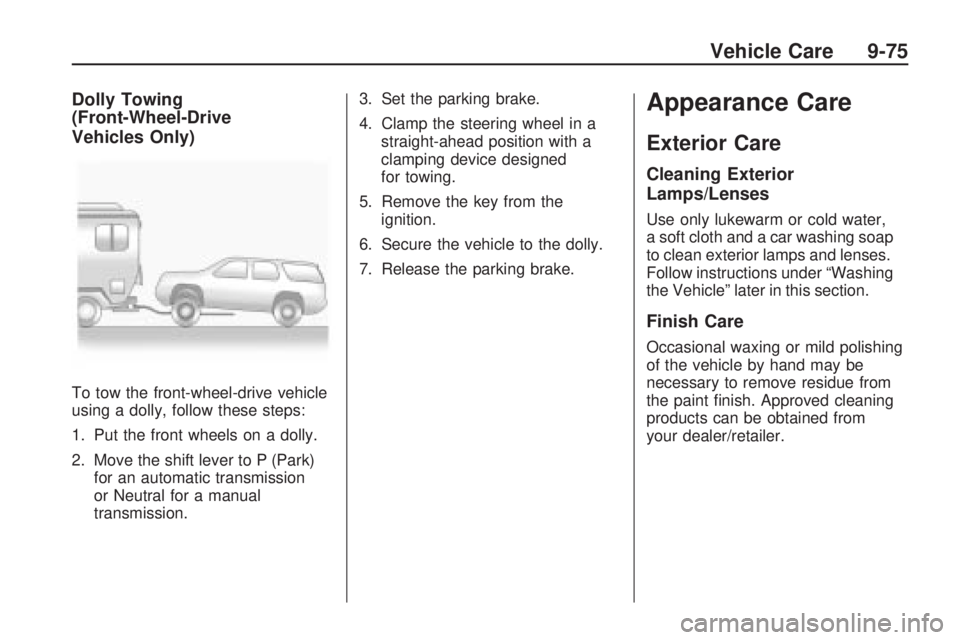
Dolly Towing
(Front-Wheel-Drive
Vehicles Only)
To tow the front-wheel-drive vehicle
using a dolly, follow these steps:
1. Put the front wheels on a dolly.
2. Move the shift lever to P (Park)for an automatic transmission
or Neutral for a manual
transmission. 3. Set the parking brake.
4. Clamp the steering wheel in a
straight-ahead position with a
clamping device designed
for towing.
5. Remove the key from the ignition.
6. Secure the vehicle to the dolly.
7. Release the parking brake.
Appearance Care
Exterior Care
Cleaning Exterior
Lamps/Lenses
Use only lukewarm or cold water,
a soft cloth and a car washing soap
to clean exterior lamps and lenses.
Follow instructions under “Washing
the Vehicle” later in this section.
Finish Care
Occasional waxing or mild polishing
of the vehicle by hand may be
necessary to remove residue from
the paint finish. Approved cleaning
products can be obtained from
your dealer/retailer.
Vehicle Care 9-75
Page 279 of 318

At Each Fuel Fill
It is important to perform these
underhood checks at each fuel ll.
Engine Oil Level Check
Check the engine oil level and
add the proper oil if necessary.
SeeEngine Oil on page 9-9 .
Notice: It is important to check
the engine oil regularly and keep it
at the proper level. Failure to keep
the engine oil at the proper level
can cause damage to the engine
not covered by the vehicle
warranty.
Engine Coolant Level Check
Check the engine coolant level and
add DEX-COOL
®coolant mixture
if necessary. See Engine Coolant
on page 9-19.
Windshield Washer Fluid Level
Check
Check the windshield washer fluid
level in the windshield washer fluid
reservoir and add the proper fluid if
necessary. See Washer Fluid on
page 9-24. Hood Latch Operation Check
Pull the primary hood latch
release handle inside the vehicle.
The secondary latch should keep
the hood from opening all the way
when the primary latch is released.
Make sure the hood closes firmly.
See
Hood on page 9-5.
At Least Once a Month
Tire Ination Check
Inspect the tires and make sure
the tires are inflated to the correct
pressures. Do not forget to check the
spare tire. See Tires on page 9-43.
At Least Twice a Year
Wiper Blade Check
Inspect wiper blades for wear,
cracking, or contamination. Clean
the windshield and wiper blades,
if contaminated. Replace wiper
blades that are worn or damaged.
SeeWiper Blade Replacement on
page 9-30 andExterior Care on
page 9-75 for more information. Weatherstrip Lubrication
Silicone grease on weatherstrips will
make them last longer, seal better,
and not stick or squeak. Apply
silicone grease with a clean cloth.
During very cold, damp weather
more frequent application may be
required. See
Recommended Fluids
and Lubricants on page 10-15 .
Fluid Level Check
Check the power steering pump, rear
axle, transfer case, and automatic
or manual transmission fluid levels
and add as needed. See Automatic
Transmission Fluid on page 9-12
or Manual Transmission Fluid on
page 9-14. Check for leaks. A fluid
loss in these systems could indicate
a problem. Have the system
inspected and repaired at once.
Service and Maintenance 10-11
Page 282 of 318

Proper procedures to perform these
services can be found in a service
manual. SeeService Publications
Ordering Information on page 12-12 .
•Inspect the front and rear
suspension and steering system
for damaged, loose, or missing
parts or signs of wear. Inspect
power steering cables for proper
hook-up, binding, cracks, chafing,
etc. Clean and then inspect the
drive axle boot seals for damage,
tears, or leakage. Replace seals if
necessary.
•Inspect the complete exhaust
system. Inspect the body near
the exhaust system. Look for
broken, damaged, missing, or
out-of-position parts as well as
open seams, holes, loose
connections, or other conditions
which could cause a heat build-up
in the floor pan or could let
exhaust fumes into the vehicle.
SeeEngine Exhaust on
page 8-23.
•Inspect the complete fuel system
for damage or leaks.
•Inspect the cooling system
hoses and have them replaced
if they are cracked, swollen or
deteriorated. Inspect all pipes,
fittings and clamps; replace as
needed. Clean the outside of
the radiator and air conditioning
condenser. To help ensure proper
operation, a pressure test of the
cooling system and pressure cap
is recommended at least once
a year.
•Inspect the throttle system for
interference or binding, and for
damaged or missing parts.
Replace parts as needed.
Replace any components that
have high effort or excessive
wear. Do not lubricate accelerator
and cruise control cables.
•Inspect the complete brake
system. Inspect brake lines
and hoses for proper hook-up,
binding, leaks, cracks, chafing,
etc. Inspect disc brake pads for
wear and rotors for surface
condition. Inspect other brake
parts, including calipers, parking
brake, etc. You may need to have
your brakes inspected more often
if your driving habits or conditions
result in frequent braking.
10-14 Service and Maintenance