2010 PONTIAC VIBE warning
[x] Cancel search: warningPage 93 of 318
that the fuel filler door is on the driver
side of the vehicle. The fuel gage
works only when the ignition switch is
turned to ON/RUN. When the gage
first indicates E or empty, there is still
about 2 gallons ( 7.6 L) of fuel left,
but more needs to be added right
away. When the vehicle is low on fuel
the low fuel warning light, located
below the empty mark, comes on.
Five things that do not indicate a
problem with the fuel gage:
•At the gas station, the fuel pump
shuts off before the gage reads
F or full.
•It takes a little more or less fuel
to fill up than the gage indicated.
For example, the gage may have
indicated the tank was half full,
but it actually took more or less
than half the tank’s capacity to
fill it.
•It takes the gage several minutes
to read F or full after filling the
vehicle with fuel.
•The gage moves a little when you
turn, stop or speed up.
•The gage does not go back to E
or empty when you turn off the
ignition.
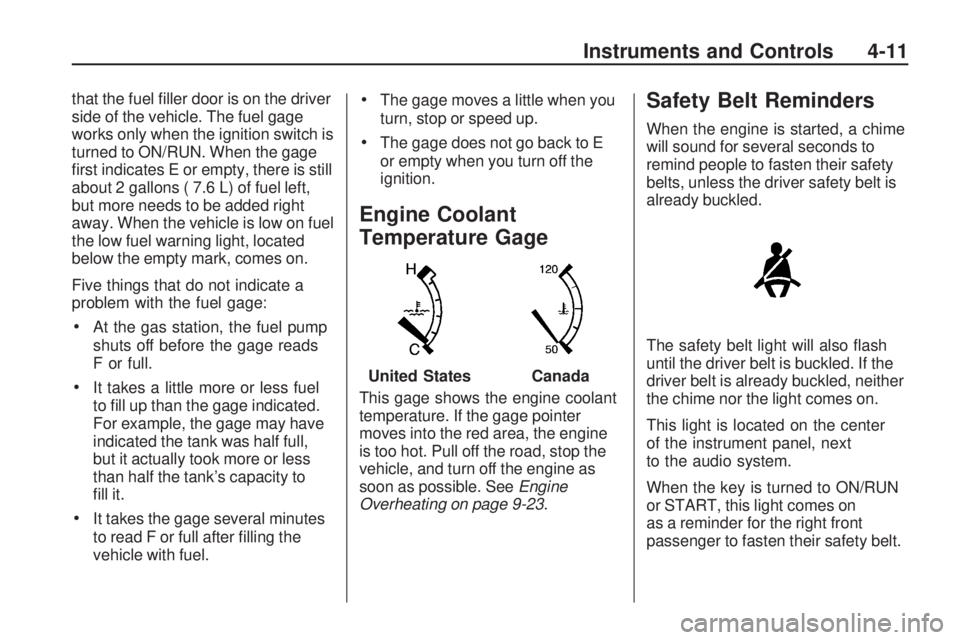
Engine Coolant
Temperature Gage
This gage shows the engine coolant
temperature. If the gage pointer
moves into the red area, the engine
is too hot. Pull off the road, stop the
vehicle, and turn off the engine as
soon as possible. SeeEngine
Overheating on page 9-23 .
Safety Belt Reminders
When the engine is started, a chime
will sound for several seconds to
remind people to fasten their safety
belts, unless the driver safety belt is
already buckled.
The safety belt light will also flash
until the driver belt is buckled. If the
driver belt is already buckled, neither
the chime nor the light comes on.
This light is located on the center
of the instrument panel, next
to the audio system.
When the key is turned to ON/RUN
or START, this light comes on
as a reminder for the right front
passenger to fasten their safety belt.
United States
Canada
Instruments and Controls 4-11
Page 99 of 318

Brake System Warning
Light
The vehicle’s hydraulic brake
system is divided into two parts.
If one part is not working, the other
part can still work and stop the
vehicle. For good braking both
parts need to be working well.
If the warning light comes on,
there is a brake problem. Have the
brake system inspected right away.
If the vehicle has anti-lock brakes,
this light should come on when the
key is turned to START. If it does not
come on, have it fixed so it will be
ready to warn if there is a problem.When the ignition is on, the brake
system warning light also comes
on when the parking brake is
set. The light will stay on if the
parking brake does not fully release.
If it stays on after the parking
brake is fully released, it means
there is a brake problem.
{CAUTION
The brake system might not be
working properly if the brake
system warning light is on. Driving
with the brake system warning light
on can lead to a crash. If the light
is still on after the vehicle has been
pulled off the road and carefully
stopped, have the vehicle towed
for service.
See Antilock Brake System (ABS)
Warning Light later in this section
and Antilock Brake System
(ABS) Warning Light on page 4-17 .
Antilock Brake System
(ABS) Warning Light
The ABS warning light comes on
briefly when the ignition key is turned
to ON/RUN. This is normal. If the
light does not come on then, have it
fixed so it will be ready to warn you if
there is a problem.
If the light stays on, turn the ignition
to LOCK/OFF. If the light comes
on while driving, stop as soon as
possible and turn the ignition off.
Then start the engine again to
reset the system. If the light still
stays on, or comes on again while
driving, the vehicle needs service.
If the regular brake system warning
light is not on, there are still
brakes, but no antilock brakes.
United States
Canada
United StatesCanada
Instruments and Controls 4-17
Page 100 of 318

If the regular brake system warning
light is also on, there are no antilock
brakes and there is a problem with
the regular brakes. SeeBrake
System Warning Light on page 4-17 .
Service All-Wheel Drive
Light
This light will come on briefly when
the ignition is turned on, and the
engine is not running, as a check
to show you it is working.
It should go out when the engine is
started. It should go out when the
engine is started. If it stays on, or
comes on while you are driving, you
may have a problem with the system.
Have it checked by your dealer/
retailer.
The four-wheel-drive indicator will
light up when the All-Wheel drive is
active.
Speed Sensitive Power
Steering (SSPS) Warning
Light
Vehicles with this feature, have a
warning light that comes on briefly
when the ignition is turned to
ON/RUN as a check to show it
is working.
If the warning light does not come
on, have it fixed so it will be able to
warn if there is a problem.
If the warning light stays on, or
comes on while driving, the Speed
Sensitive Power Steering may not be
working. See your dealer/retailer for
service.
StabiliTrak®Indicator
Light
This light warns that there is a
problem with the Traction Control
System (TCS) or the Vehicle
Stability Control (VSC) system.
The light comes on when the ignition
is turned to ON/RUN.
If the light comes on while driving,
the system is not working.
The TCS light comes on when the
VSC system warning light comes on,
even if the TRAC OFF button is not
pressed.
See StabiliTrak System on
page 8-35 for more information on
Vehicle Stability Control System.
4-18 Instruments and Controls
Page 101 of 318

SeeTraction Control System (TCS)
on page 8-33 for more information.
Contact your dealer/retailer, if
the light does not come on or if it
stays on.
Traction Control System
(TCS) Warning Light
This warning light comes on briefly
when the ignition is turned to
ON/RUN.
It also comes on when the Traction
Control System is turned off by
pressing the TRAC OFF button.
See Traction Control System (TCS)
on page 8-33 for more information. If it stays on or comes on while
driving, there is a problem with the
Traction Control System (TCS),
contact your dealer/retailer.
Tire Pressure Light
This light should come on briefly as
the engine is started.
If there is a tire with low tire
pressure, the light will stay on
or come back on.
See
Tire Pressure Monitor
Operation on page 9-52 for more
information.
Engine Oil Pressure
Light
{CAUTION
Do not keep driving if the oil
pressure is low. The engine can
become so hot that it catches fire.
Someone could be burned. Check
the oil as soon as possible and
have the vehicle serviced.
Notice: Lack of proper engine
oil maintenance can damage
the engine. The repairs would
not be covered by the vehicle
warranty. Always follow the
maintenance schedule in this
manual for changing engine oil.
The oil pressure light should come
on briefly as the engine is started. If it
does not come on have the vehicle
serviced by your dealer/retailer.
Instruments and Controls 4-19
Page 102 of 318
If the light comes on and stays on, it
means that oil is not flowing through
the engine properly. The vehicle
could be low on oil and might have
some other system problem.
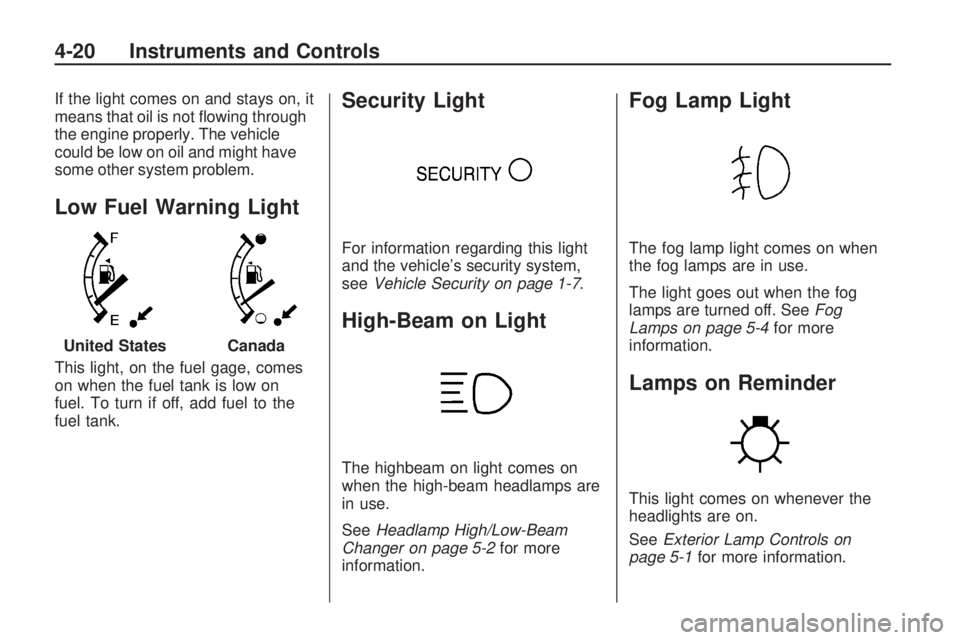
Low Fuel Warning Light
This light, on the fuel gage, comes
on when the fuel tank is low on
fuel. To turn if off, add fuel to the
fuel tank.
Security Light
For information regarding this light
and the vehicle’s security system,
seeVehicle Security on page 1-7 .
High-Beam on Light
The highbeam on light comes on
when the high-beam headlamps are
in use.
SeeHeadlamp High/Low-Beam
Changer on page 5-2 for more
information.
Fog Lamp Light
The fog lamp light comes on when
the fog lamps are in use.
The light goes out when the fog
lamps are turned off. See Fog
Lamps on page 5-4 for more
information.
Lamps on Reminder
This light comes on whenever the
headlights are on.
See Exterior Lamp Controls on
page 5-1 for more information.
United States
Canada
4-20 Instruments and Controls
Page 103 of 318

Taillamp Indicator Light
This light comes on when the
taillamps are on.
SeeExterior Lamp Controls on
page 5-1 for more information.
Low Washer Fluid
Warning Light
This light comes on when the
windshield washer fluid is low.
SeeWasher Fluid on page 9-24
for more information.
Cruise Control Light
The CRUISE light comes on when
the cruise control is on.
See Cruise Control on page 8-36 for
more information.
Door Ajar Light
This light comes on if any door, the
rear liftgate, or the rear liftglass
are not completely closed.
Vehicle
Personalization
Your vehicle may have lighting
and door lock features that can be
programmed to your preference.
You will need to schedule an
appointment with your dealer/
retailer if you would like to change
the way these features are currently
programmed. The following is a
list of the features that can be
programmed. See your dealer/
retailer to change the programming
of these features:
Driver Door Key Unlock Switch:
If this feature is programmed on, all
of the doors will unlock when the key
is turned twice in the driver’s door
lock cylinder. When the vehicle
left the factory this feature was
programmed on.
Canada Only
Canada Only
Instruments and Controls 4-21
Page 109 of 318

Lighting
Exterior LightingExterior Lamp Controls...........5-1
Headlamp High/Low-Beam Changer ............................
.5-2
Flash-to-Pass .......................
.5-2
Daytime Running Lamps (DRL) .....................
.5-2
Automatic Headlamp System .............................
.5-3
Hazard Warning Flashers .......5-3
Turn and Lane-Change Signals ..............................
.5-3
Fog Lamps ..........................
.5-4
Interior LightingInstrument Panel Illumination
Control ..............................
.5-4
Dome Lamps .......................
.5-4
Reading Lamps ....................
.5-5
Lighting FeaturesEntry Lighting ......................
.5-5
Battery Power Protection ........5-5
Exterior Lighting
Exterior Lamp Controls
The lever on the left side of the
steering column operates the
exterior lamps.
P/;(Exterior Lamps):
Turn the
outside band of the lever to operate
the lamps. For vehicles sold in the
U.S.,
Pappears on the instrument panel cluster when the exterior
lamps are on. For vehicles first
sold in Canada,
;appears in the
instrument panel cluster. See Lamps
on Reminder on page 4-20 .
The exterior lamp switch has three
positions:
((Off): Turns off all lamps, except
the Daytime Running Lamps (DRL).
;(Parking Lamps): Turns on the
parking lamps together with the
following:
•Sidemarker Lamps
•Taillamps
•License Plate Lamp
•Instrument Panel Lights
5(Headlamps): Turns on the
headlamps, together with the
previously listed lamps and lights.
Lighting 5-1
Page 111 of 318

Automatic Headlamp
System
When it is dark enough outside,
the automatic headlamp system
turns on the low-beam headlamps
at the normal brightness along with
other lamps such as the taillamps,
sidemarker, parking lamps and
instrument panel lights. An indicator
light on the instrument panel comes
on when the headlamps are on.
SeeInstrument Cluster on page 4-9 .
If the vehicle is driven through a
parking garage, overcast weather,
or a tunnel, the automatic headlamp
system may turn on. There is a
delay before the lights turn on when
starting the car at night.
Do not cover the automatic light
sensor, located on the top left corner
of the instrument panel. If the sensor
is covered the headlamps will stay on
continuously.
Hazard Warning Flashers
|
(Hazard Warning Flasher):
Press this button located on the
instrument panel, to make the front
and rear turn signal lamps flash on
and off. This warns others that you
are having trouble.
Press
|again to turn the
flashers off.
Turn and Lane-Change
Signals
An arrow on the instrument panel
cluster flashes in the direction of the
turn or lane change. Move the lever all the way up or
down to signal a turn.
Raise or lower the lever until the
arrow starts to flash to signal a
lane change. Hold it there until
the lane change is completed.
The lever returns to its starting
position whenever it is released.
If after signaling a turn or a
lane change the arrow flashes
rapidly or does not come on,
a signal bulb may be burned out.
Have the bulbs replaced. If the bulb
is not burned out, check the fuse.
See
Fuses and Circuit Breakers on
page 9-38.
Lighting 5-3