2010 PONTIAC VIBE mirror
[x] Cancel search: mirrorPage 144 of 318

Blizzard Conditions
Being stuck in snow can be in a
serious situation. Stay with the
vehicle unless there is help nearby.
If possible, use theRoadside
Assistance Program on page 12-6 .
To get help and keep everyone in the
vehicle safe:
•Turn on the hazard warning
flashers.
•Tie a red cloth to an outside
mirror.
{CAUTION
Snow can trap engine exhaust
under the vehicle. This may cause
exhaust gases to get inside.
Engine exhaust contains carbon
monoxide (CO) which cannot be
seen or smelled. It can cause
unconsciousness and even death.
(Continued)
CAUTION (Continued)
If the vehicle is stuck in the snow:
•Clear away snow from
around the base of your
vehicle, especially any that is
blocking the exhaust pipe.
•Check again from time to
time to be sure snow does
not collect there.
•Open a window about 5 cm
(two inches) on the side of
the vehicle that is away from
the wind to bring in fresh air.
•Fully open the air outlets on or
under the instrument panel.
•Adjust the Climate Control
system to a setting that
circulates the air inside the
vehicle and set the fan speed
to the highest setting. See
Climate Control System in the
Index.(Continued)
CAUTION (Continued)
For more information about
carbon monoxide, see Engine
Exhaust on page 8-23 .
Snow can trap exhaust gases
under your vehicle. This can cause
deadly CO (carbon monoxide) gas
to get inside. CO could overcome
you and kill you. You cannot see it
or smell it, so you might not know it
is in your vehicle. Clear away snow
from around the base of your
vehicle, especially any that is
blocking the exhaust.
Run the engine for short periods only
as needed to keep warm, but be
careful.
8-10 Driving and Operating
Page 179 of 318

•Vehicles with an automatic
transmission can tow in D (Drive).
Shift the transmission to a lower
gear if the transmission shifts too
often under heavy loads and/or
hilly conditions. For vehicles with
a manual transmission, it is better
not to use the highest gear.
•Use the Sport Shift mode and the
cruise control when towing.
•Obey speed limit restrictions
when towing a trailer. Do not drive
faster than the maximum posted
speed for trailers, or no more than
90 km/h (55 mph), to save wear
on the vehicle’s parts.
Driving with a Trailer
Towing a trailer requires a certain
amount of experience. Get to know
the rig before setting out for the open
road. Get acquainted with the feel of
handling and braking with the added
weight of the trailer. And always keep
in mind that the vehicle you are
driving is now longer and not as
responsive as the vehicle is by itself.Before starting, check all trailer
hitch parts and attachments, safety
chains, electrical connectors, lamps,
tires and mirror adjustments. If the
trailer has electric brakes, start the
vehicle and trailer moving and then
apply the trailer brake controller by
hand to be sure the brakes are
working. This checks the electrical
connection at the same time.
During the trip, check occasionally
to be sure that the load is secure,
and that the lamps and any
trailer brakes are still working.
Towing with StabiliTrak
When towing, the sound of the
StabiliTrak modulator might
be heard. StabiliTrak is reacting to
the vehicle movement caused
by the trailer, which mainly occurs
during cornering. This is normal
when towing heavier trailers.
Following Distance
Stay at least twice as far behind the
vehicle ahead as you would when
driving the vehicle without a trailer.
This can help to avoid situations that
require heavy braking and sudden
turns.
Passing
More passing distance is needed
when towing a trailer. Because the
rig is longer, it is necessary to go
much farther beyond the passed
vehicle before returning to the lane.
Backing Up
Hold the bottom of the steering wheel
with one hand. Then, to move the
trailer to the left, move that hand to
the left. To move the trailer to the
right, move your hand to the right.
Always back up slowly and, if
possible, have someone guide you.
Driving and Operating 8-45
Page 226 of 318

FusesUsage
8 Outside Rearview
Mirrors, Audio
System, Main Body
Engine Control
Unit (ECU), Clock,
Brake Transmission
Shift Interlock
9 Empty
10 Empty
11 Airbag System,
Multiport Fuel
Injection System/
Sequential Multiport
Fuel Injection
System, Front
Passenger Occupant
Classification
System
12 Gages and Meters
13 Air Conditioning
System, Rear
Window Defogger
14 Windshield Wipers
15 Rear Window WipersFuses Usage
16 Windshield Washer
17 Main Body ECU,
Electric Power
Steering, Electric
Cooling Fans,
Brake Transmission
Shift Interlock,
Antilock Braking
System (ABS),
Multiport Fuel
Injection System/
Sequential Multiport
Fuel Injection
System, Tire
Pressure Monitoring
System (TPMS),
Vehicle Stability
Control System
18 Back-up Lamps,
Charging System,
Rear Window
Defogger
19 Onboard Diagnosis
SystemFuses
Usage
20 Stoplamps, Center
High-Mounted
Stoplamps (CHMSL),
ABS, Vehicle
Stability Control
System, Multiport
Fuel Injection
System/Sequential
Multiport Fuel
Injection System,
Brake Transmission
Shift Interlock
21 Power Door Lock
System
22 Outside Rearview
Mirrors, Audio
System, Main Body
ECU, Clock, Brake
Transmission Shift
Interlock, Cigarette
Lighter
23 All-Wheel Drive
System
24 Front Foglamps
9-42 Vehicle Care
Page 227 of 318

FusesUsage
25 Ignition, Outside
Rearview Mirrors,
Audio System, Main
Body ECU, Clock,
Brake Transmission
Shift Interlock,
Cigarette Lighter
26 Rear Window
Defogger, Heated
Mirrors, Multiport
Fuel Injection
System/Sequential
Multiport Fuel
Injection System
27 Power WindowsWheels and Tires
Tires
Your new vehicle comes
with high-quality tires made
by a leading tire manufacturer.
If you ever have questions about
your tire warranty and where to
obtain service, see your vehicle
Warranty booklet for details.
For additional information refer
to the tire manufacturer.
{CAUTION
Poorly maintained and improperly
used tires are dangerous.
•Overloading your tires can
cause overheating as a result
of too much flexing. You
could have an air-out and a
serious accident. See Vehicle
Load Limits on page 8-12 .
(Continued)
CAUTION (Continued)
•Underinflated tires pose the
same danger as overloaded
tires. The resulting accident
could cause serious injury.
Check all tires frequently to
maintain the recommended
pressure. Tire pressure
should be checked when
your tires are cold. See Tire
Pressure on page 9-49 .
•Overinflated tires are more
likely to be cut, punctured
or broken by a sudden
impact — such as when you
hit a pothole. Keep tires at
the recommended pressure.
•Worn, old tires can cause
accidents. If your tread is
badly worn, or if your tires
have been damaged,
replace them.
Vehicle Care 9-43
Page 312 of 318
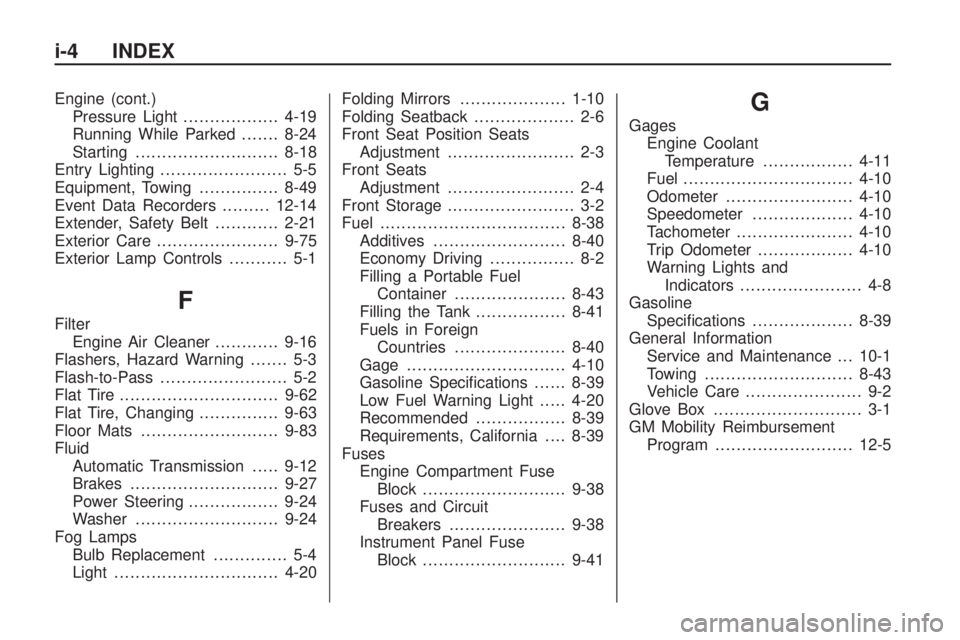
Engine (cont.)Pressure Light ..................4-19
Running While Parked .......8-24
Starting ........................... 8-18
Entry Lighting ........................ 5-5
Equipment, Towing ...............8-49
Event Data Recorders .........12-14
Extender, Safety Belt ............2-21
Exterior Care ....................... 9-75
Exterior Lamp Controls ........... 5-1
F
Filter
Engine Air Cleaner ............9-16
Flashers, Hazard Warning ....... 5-3
Flash-to-Pass ........................ 5-2
Flat Tire .............................. 9-62
Flat Tire, Changing ...............9-63
Floor Mats .......................... 9-83
Fluid Automatic Transmission .....9-12
Brakes ............................ 9-27
Power Steering .................9-24
Washer ........................... 9-24
Fog Lamps Bulb Replacement .............. 5-4
Light ............................... 4-20Folding Mirrors
....................1-10
Folding Seatback ................... 2-6
Front Seat Position Seats Adjustment ........................ 2-3
Front Seats Adjustment ........................ 2-4
Front Storage ........................ 3-2
Fuel ................................... 8-38
Additives ......................... 8-40
Economy Driving ................ 8-2
Filling a Portable Fuel Container ..................... 8-43
Filling the Tank .................8-41
Fuels in Foreign Countries ..................... 8-40
Gage .............................. 4-10
Gasoline Specifications ......8-39
Low Fuel Warning Light .....4-20
Recommended .................8-39
Requirements, California ....8-39
Fuses Engine Compartment FuseBlock ........................... 9-38
Fuses and Circuit Breakers ...................... 9-38
Instrument Panel Fuse Block ........................... 9-41
G
Gages
Engine CoolantTemperature .................4-11
Fuel ................................ 4-10
Odometer ........................ 4-10
Speedometer ................... 4-10
Tachometer ...................... 4-10
Trip Odometer ..................4-10
Warning Lights and Indicators ....................... 4-8
Gasoline Specifications ................... 8-39
General Information Service and Maintenance . . . 10-1
Towing ............................ 8-43
Vehicle Care ...................... 9-2
Glove Box ............................ 3-1
GM Mobility Reimbursement Program .......................... 12-5
i-4 INDEX
Page 314 of 318

Lights (cont.)Engine Oil Pressure ..........4-19
Flash-to-Pass ..................... 5-2
Fog Lamps ...................... 4-20
High-Beam On .................4-20
High/Low Beam Changer ..... 5-2
Low Fuel Warning .............4-20
Low Washer Fluid Warning ....................... 4-21
Safety Belt Reminders .......4-11
Security ........................... 4-20
Service All-Wheel-Drive ......4-18
Speed Sensitive Power Steering (SSPS)
Warning ....................... 4-18
StabiliTrak
®Indicator .........4-18
Taillamp Indicator ..............4-21
Tire Pressure ................... 4-19
Traction Control System (TCS) Warning ..............4-19
Load Rails and Hooks ............ 3-4
Locks Door ................................. 1-5
Power Door ....................... 1-6
Safety ............................... 1-6
Loss of Control ..................... 8-6
Low Fuel Warning Light ........4-20 Low Washer Fluid Warning
Light ............................... 4-21
Lower Anchors and Tethers for Children (LATCHE
SYSTEM) ........................ 2-45
M
Maintenance
Records ......................... 10-18
Replacement Parts ..........10-17
Maintenance Schedule Recommended Fluidsand Lubricants ............10-15
Scheduled Maintenance .....10-3
Malfunction Indicator Lamp ....4-14
Manual Mode ...................... 8-28
Manual Transmission ............8-29
Fluid ............................... 9-14
Mirrors Folding ............................ 1-10
Manual Rearview ..............1-11
Outlets ....................... 4-6, 4-7
Power ............................. 1-10
Monitor System, Tire Pressure ......................... 9-50
MP3 ................................... 6-11
N
Navigation System
Vehicle Data Recordingand Privacy ................12-15
New Vehicle Break-In ...........8-16
O
Odometer ........................... 4-10
Trip ................................ 4-10
Off-Road Recovery .......................... 8-6
Oil Pressure Light ..................4-19
Oil, Engine ........................... 9-9
Older Children, Restraints ......2-37
Online Owner Center ............12-4
OnStar
®System .................. 4-23
Operation, Infotainment System ............................. 6-2
Outlets Power ........................ 4-6, 4-7
Overheating, Engine .............9-23
i-6 INDEX
Page 315 of 318

P
ParkShifting Into ..................... 8-20
Shifting Out of ..................8-22
Parking ............................... 8-22
Brake .............................. 8-33
Over Things That Burn ......8-23
Passenger Airbag Status Indicator .......................... 4-13
Passenger Compartment Air Filter ................................ 7-4
Passenger Sensing System . . . 2-29
Perchlorate Materials Requirements, California ...... 9-3
Power Door Locks ........................ 1-6
Mirrors ............................ 1-10
Protection, Battery .............. 5-5
Retained Accessory (RAP) ...........8-18
Steering Fluid ................... 9-24
Windows ......................... 1-12
Power Steering Fluid ............9-24
Pregnancy, Using Safety Belts ............................... 2-20Privacy
Radio FrequencyIdentification (RFID) .....12-16
Program Courtesy Transportation .....12-8
Proposition 65 Warning, California .......................... 9-2
R
Radio Frequency
Identification (RFID) .........12-16
Statement ...................... 12-16
Radios AM-FM Radio .................... 6-4
Reception .......................... 6-8
Satellite ............................ 6-6
Reading Lamps ..................... 5-5
Rear Seats ........................... 2-7
Rear Window Washer/Wiper .... 4-6
Rearview Mirrors ..................1-11
Reclining Seatbacks ............... 2-4
Recommended Fluids and Lubricants ...................... 10-15
Recommended Fuel .............8-39
Records Maintenance ................... 10-18
Recreational Vehicle Towing . . . 9-73 Reimbursement Program, GM
Mobility ........................... 12-5
Remote Keyless Entry (RKE) System ............................. 1-3
Replacement Bulbs ..............9-37
Replacement Parts Airbags ........................... 2-36
Replacement Parts, Maintenance ................... 10-17
Replacing Airbag System ......2-36
Replacing LATCH System Parts After a Crash ...........2-51
Replacing Safety Belt System Parts After a Crash ............2-22
Reporting Safety Defects General Motors ...............12-14
U.S. Government ............12-13
Retained Accessory Power (RAP) .................... 8-18
Roadside Assistance Program .......................... 12-6
Roof Sunroof ........................... 1-13
Roof Rack ............................ 3-5
Rotation, Tires ..................... 9-55
Routing, Engine Drive Belt ....11-4
Running the Vehicle While Parked ............................ 8-24
INDEX i-7