2010 PEUGEOT 308 warning
[x] Cancel search: warningPage 160 of 315
134
Particular situations Emergency braking
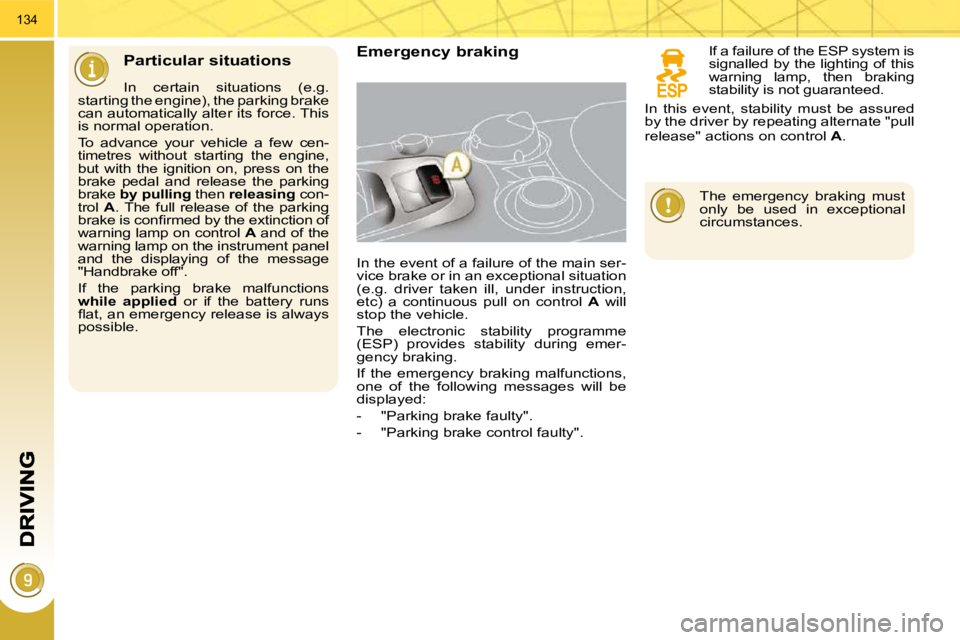
In the event of a failure of the main ser-
vice brake or in an exceptional situation
(e.g. driver taken ill, under instruction,
etc) a continuous pull on control A will
stop the vehicle.
The electronic stability programme
(ESP) provides stability during emer-
gency braking.
If the emergency braking malfunctions,
one of the following messages will be
displayed:
- "Parking brake faulty".
- "Parking brake control faulty".
In certain situations (e.g.
starting the engine), the parking brake
can automatically alter its force. This
is normal operation.
To advance your vehicle a few cen-
timetres without starting the engine,
but with the ignition on, press on the
brake pedal and release the parking
brake by pulling then releasing con-
trol A . The full release of the parking
brake is confi rmed by the extinction of
warning lamp on control A and of the
warning lamp on the instrument panel
and the displaying of the message
"Handbrake off".
If the parking brake malfunctions
while applied or if the battery runs
fl at, an emergency release is always
possible. If a failure of the ESP system is
signalled by the lighting of this
warning lamp, then braking
stability is not guaranteed.
The emergency braking must
only be used in exceptional
circumstances.
In this event, stability must be assured
by the driver by repeating alternate "pull
release" actions on control
A .
Page 162 of 315
136
HILL START ASSIST
System which keeps your vehicle im-
mobilised temporarily (approximately
2 seconds) when starting on a gradi-
ent, the time it takes to move your foot
from the brake pedal to the accelerator
pedal.
This function is only active when:
- the vehicle is completely stationary, with your foot on the brake pedal,
- in particular conditions on a slope,
- with the driver’s door closed.
The hill start assist function cannot be
deactivated.
Operation
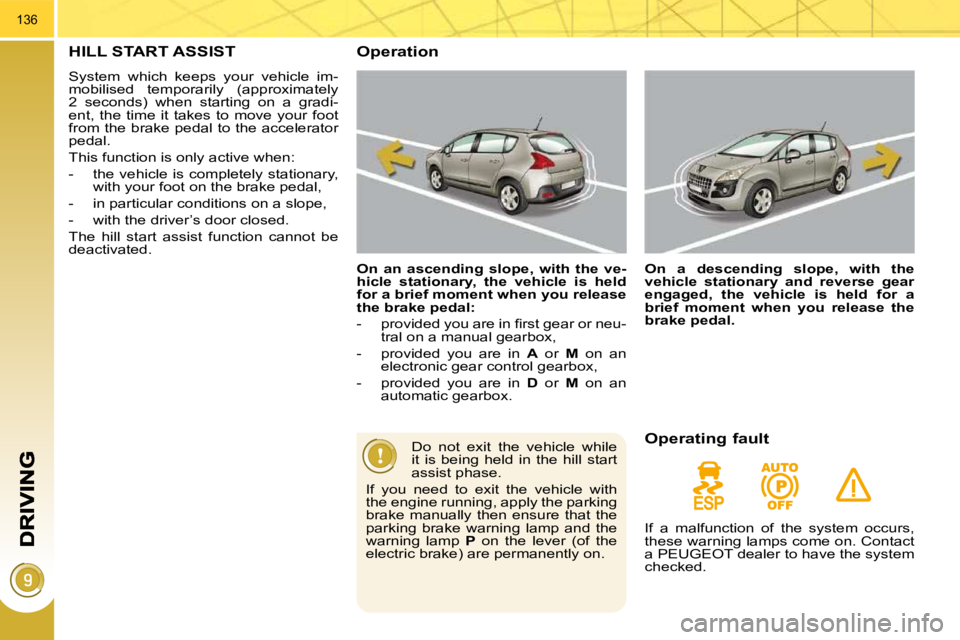
On an ascending slope, with the ve-
hicle stationary, the vehicle is held
for a brief moment when you release
the brake pedal:
- provided you are in fi rst gear or neu- tral on a manual gearbox,
- provided you are in A or M on an
electronic gear control gearbox,
- provided you are in D or M on an
automatic gearbox.
On a descending slope, with the
vehicle stationary and reverse gear
engaged, the vehicle is held for a
brief moment when you release the
brake pedal.
Do not exit the vehicle while
it is being held in the hill start
assist phase.
If you need to exit the vehicle with
the engine running, apply the parking
brake manually then ensure that the
parking brake warning lamp and the
warning lamp P on the lever (of the
electric brake) are permanently on.
Operating fault
If a malfunction of the system occurs,
these warning lamps come on. Contact
a PEUGEOT dealer to have the system
checked.
Page 173 of 315
149
Displays on the instrument panel
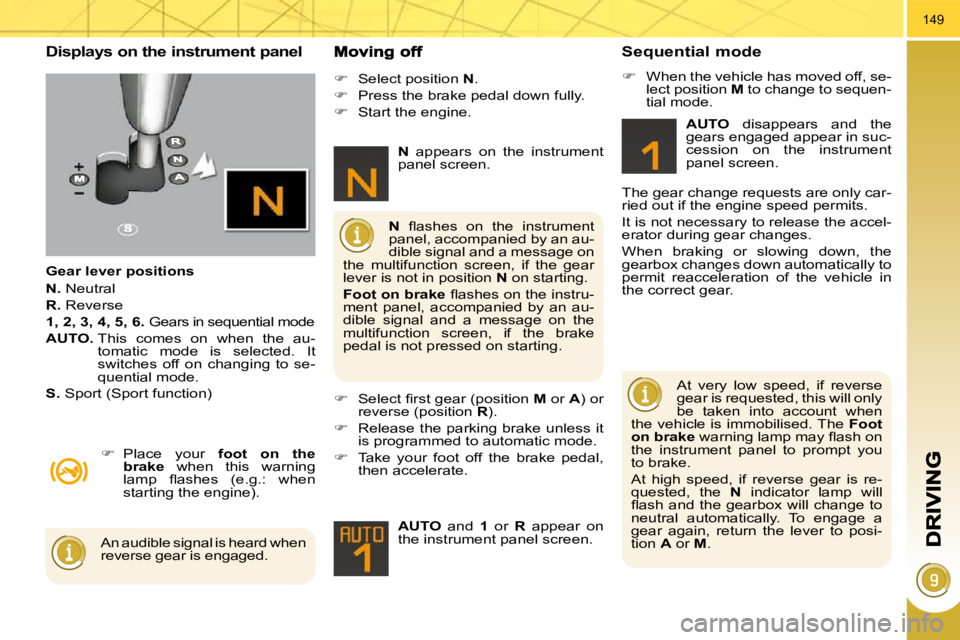
Gear lever positions
N. Neutral
R. Reverse
1, 2, 3, 4, 5, 6. Gears in sequential mode
AUTO. This comes on when the au-
tomatic mode is selected. It
switches off on changing to se-
quential mode.
S. Sport (Sport function)
Place your foot on the
brake when this warning
lamp fl ashes (e.g.: when
starting the engine).
Select position N .
Press the brake pedal down fully.
Start the engine.
Select fi rst gear (position M or A ) or
reverse (position R ).
Release the parking brake unless it
is programmed to automatic mode.
Take your foot off the brake pedal,
then accelerate.
AUTO and 1 or R appear on
the instrument panel screen.
N fl ashes on the instrument
panel, accompanied by an au-
dible signal and a message on
the multifunction screen, if the gear
lever is not in position N on starting.
Foot on brake fl ashes on the instru-
ment panel, accompanied by an au-
dible signal and a message on the
multifunction screen, if the brake
pedal is not pressed on starting.
An audible signal is heard when
reverse gear is engaged.
N appears on the instrument
panel screen.
Sequential mode
When the vehicle has moved off, se-
lect position M to change to sequen-
tial mode.
AUTO disappears and the
gears engaged appear in suc-
cession on the instrument
panel screen.
The gear change requests are only car-
ried out if the engine speed permits.
It is not necessary to release the accel-
erator during gear changes.
When braking or slowing down, the
gearbox changes down automatically to
permit reacceleration of the vehicle in
the correct gear.
At very low speed, if reverse
gear is requested, this will only
be taken into account when
the vehicle is immobilised. The Foot
on brake warning lamp may fl ash on
the instrument panel to prompt you
to brake.
At high speed, if reverse gear is re-
quested, the N indicator lamp will
fl ash and the gearbox will change to
neutral automatically. To engage a
gear again, return the lever to posi-
tion A or M .
Page 175 of 315
151
Stopping the vehicle Operating fault
With the ignition on, if this
warning lamp comes on and
AUTO fl ashes, accompanied
by an audible signal and a
message on the multifunction
screen, this indicates a malfunction of
the gearbox.
Have it checked by a PEUGEOT dealer.
It is essential to press the
brake pedal when starting the
engine.
When parking, is it essential to apply
the parking brake to immobilise the
vehicle, whatever the circumstances.
When immobilising the vehi-
cle, with the engine running, it
is essential to place the gear
lever in neutral N .
Before carrying out any work in the
engine compartment, check that the
gear lever is in neutral N and that
the parking brake is applied.
Sport function
Following selection of the sequential
mode or automatic mode, press but-
ton S to activate the Sport function
which offers you a more dynamic
style of driving.
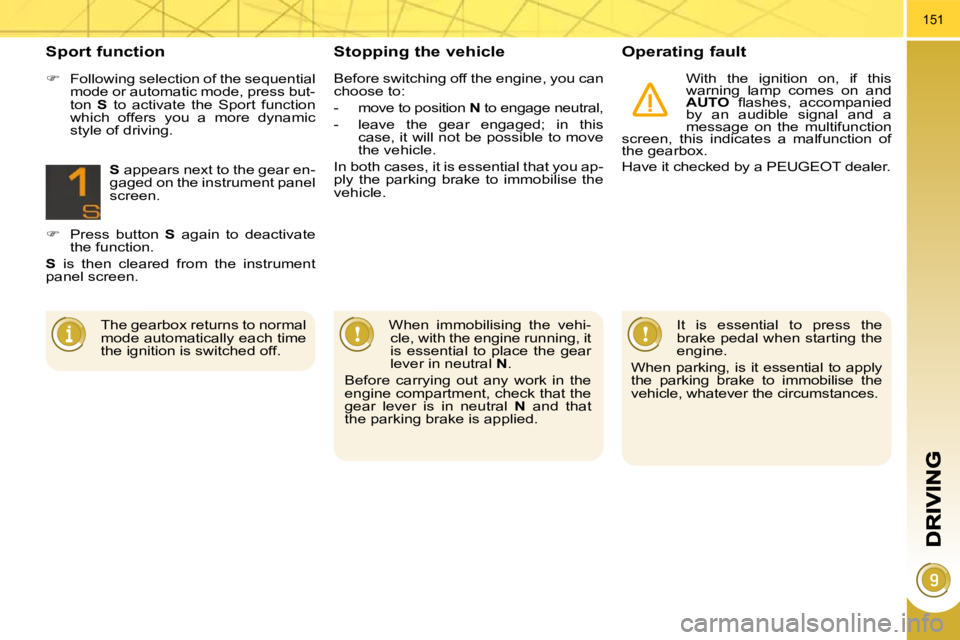
S appears next to the gear en-
gaged on the instrument panel
screen.
Press button S again to deactivate
the function.
S is then cleared from the instrument
panel screen.
The gearbox returns to normal
mode automatically each time
the ignition is switched off. Before switching off the engine, you can
choose to:
- move to position
N to engage neutral,
- leave the gear engaged; in this case, it will not be possible to move
the vehicle.
In both cases, it is essential that you ap-
ply the parking brake to immobilise the
vehicle.
Page 178 of 315
154
Stopping the vehicle
Before switching off the engine, you
can engage position P or N to place the
gearbox in neutral.
In both cases, apply the parking brake
to immobilise the vehicle, unless it is
programmed to automatic mode.
Operating fault
When the ignition is on, the
lighting of this warning lamp,
accompanied by an audible
signal and a message on the
multifunction screen, indicates
a gearbox malfunction.
In this case, the gearbox switches to
back-up mode and is locked in 3rd gear.
You may feel a substantial knock when
changing from P to R and from N to R .
This will not cause any damage to the
gearbox.
Do not exceed 60 mph (100 km/h), local
speed restrictions permitting.
Have it checked by a PEUGEOT dealer.
This warning lamp may also come on if
a door is opened.
You risk damaging the gearbox:
- if you press the accelerator and brake pedals at the same time,
- if you force the lever from posi- tion P to another position when
the battery is fl at.
To reduce fuel consumption when
stationary for long periods with the
engine running (traffi c jam...), posi-
tion the gear lever at N and apply
the parking brake, unless it is pro-
grammed in automatic mode.
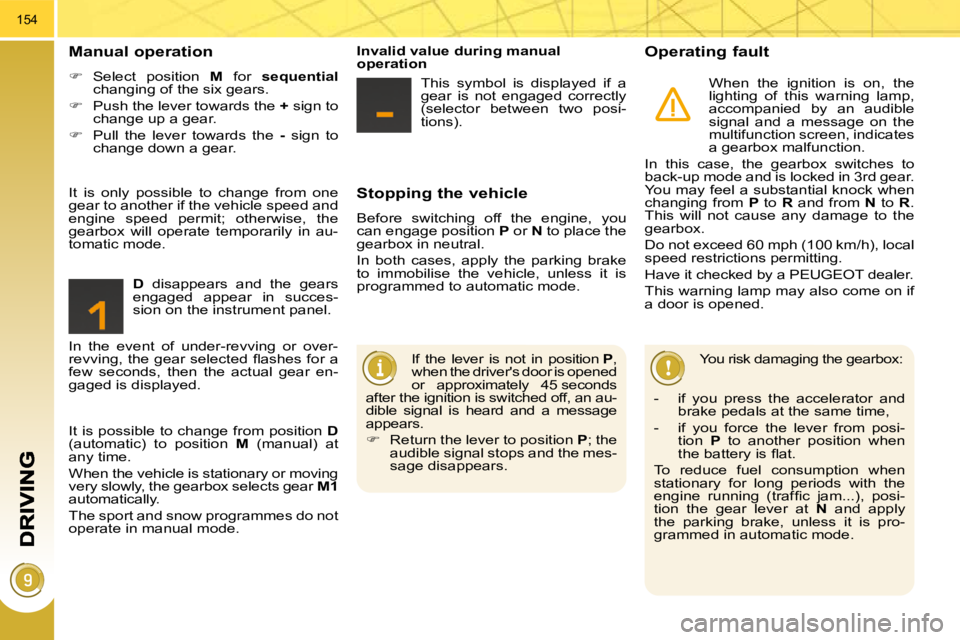
Manual operation
Select position M for sequential
changing of the six gears.
Push the lever towards the + sign to
change up a gear.
Pull the lever towards the - sign to
change down a gear.
D disappears and the gears
engaged appear in succes-
sion on the instrument panel.
If the lever is not in position P ,
when the driver's door is opened
or approximately 45 seconds
after the ignition is switched off, an au-
dible signal is heard and a message
appears.
Return the lever to position P ; the
audible signal stops and the mes-
sage disappears.
It is only possible to change from one
gear to another if the vehicle speed and
engine speed permit; otherwise, the
gearbox will operate temporarily in au-
tomatic mode.
Invalid value during manual
operation
This symbol is displayed if a
gear is not engaged correctly
(selector between two posi-
tions).
It is possible to change from position D
(automatic) to position M (manual) at
any time.
When the vehicle is stationary or moving
very slowly, the gearbox selects gear M1
automatically.
The sport and snow programmes do not
operate in manual mode.
In the event of under-revving or over-
revving, the gear selected fl ashes for a
few seconds, then the actual gear en-
gaged is displayed.
Page 180 of 315

156
The parking sensor system
cannot, in any circumstances,
replace the need for vigilance
and responsibility on the part
of the driver.
The parking sensors are
switched off :
- when you exit reverse gear,
- when the speed is higher than 6 mph (10 km/h) in forward gear,
- when the vehicle has been station- ary for more than three seconds in
forward gear. Deactivation Operating fault
The system will be deacti-
vated automatically when a
trailer is being towed or when
a bicycle carrier is fi tted (vehicle fi t-
ted with a towbar or bicycle carrier
recommended by PEUGEOT).
Reactivation
Press button A again, the warning
lamp switches off, the system is re-
activated.
Press button A , the warning lamp
comes on, the system is fully deacti-
vated. In bad weather or in winter, en-
sure that the sensors are not
covered with mud, ice or snow.
When reverse gear is engaged, an
audible signal (long beep) indicates
that the sensors may be dirty.
When the vehicle is being driven at
a speed below approximately 6 mph
(10 km/h), certain sources of noise
(motorcycles, lorries, pneumatic
drills, ...) may trigger the parking sen-
sor audible signals. If an operating fault occurs,
this warning lamp is displayed
on the instrument panel and/or
a message appears on the
multifunction screen, ac-
companied by an audible signal (short
beep), when reverse gear is engaged.
Consult a PEUGEOT dealer.
Page 186 of 315
CHECKS
163
Avoid prolonged contact of
used oil or fl uids with the skin.
Most of these fl uids are harmful to
health or indeed very corrosive.
Do not discard used oil or fl u-
ids into sewers or onto the
ground.
Take used oil to a PEUGEOT dealer
(France) or an authorised waste dis-
posal site.
Diesel additive level (Diesel
engine with particle emission
filter)
A low additive level is indicated by lighting
of the service warning lamp, accompanied
by an audible warning and a message on
the multifunction screen.
Used products
CHECKS
Battery
The battery does not require
any maintenance.
However, check that the ter-
minals are clean and correctly
tightened, particularly in sum-
mer and winter.
When carrying out work on the battery,
refer to the "Practical information" sec-
tion for details of the precautions to be
taken before disconnecting the battery
and following its reconnection.
Air filter
Refer to the Warranty and
Maintenance Record for de-
tails of the replacement inter-
vals for these components.
Depending on the environment
(e.g. dusty atmosphere) and the use of
the vehicle (e.g. city driving), replace
them twice as often if necessary
(refer to the "Engines" paragraph). Particle emission filter (Diesel)
It is imperative that the maintenance of
the particle emission fi lter is carried out
by a PEUGEOT dealer.
Oil filter Replace the oil fi lter each time
the engine oil is changed.
Refer to the Warranty and
Maintenance Record for details
of the replacement interval for
this component. Following prolonged opera-
tion of the vehicle at very low
speed or at idle, you may, in
exceptional circumstances, notice the
emission of water vapour at the ex-
haust on acceleration. This does not
affect the behaviour of the vehicle or
the environment.
Topping up
This additive must be topped up by a
PEUGEOT dealer without delay.
Dust filter/Anti-odour filter
(activated carbon)
Your vehicle is fi tted with a fi lter which
traps certain dust and limits odours in
the ventilation and air conditioning.
Refer to the Warranty and Maintenance
Record for its replacement interval.
Do not hesitate to change it if you notice
unpleasant odours, contact a PEUGEOT
dealer.
A clogged passenger compartment fi lter
may reduce the performance of the air
conditioning system and produce un-
pleasant odours.
Unless otherwise indicated, check
these components in accordance with
the Warranty and Maintenance Record
and according to your engine.
Otherwise, have them checked by a
PEUGEOT dealer.
Page 187 of 315
CHECKS
163
Avoid prolonged contact of
used oil or fl uids with the skin.
Most of these fl uids are harmful to
health or indeed very corrosive.
Do not discard used oil or fl u-
ids into sewers or onto the
ground.
Take used oil to a PEUGEOT dealer
(France) or an authorised waste dis-
posal site.
Diesel additive level (Diesel
engine with particle emission
filter)
A low additive level is indicated by lighting
of the service warning lamp, accompanied
by an audible warning and a message on
the multifunction screen.
Used products
CHECKS
Battery
The battery does not require
any maintenance.
However, check that the ter-
minals are clean and correctly
tightened, particularly in sum-
mer and winter.
When carrying out work on the battery,
refer to the "Practical information" sec-
tion for details of the precautions to be
taken before disconnecting the battery
and following its reconnection.
Air filter
Refer to the Warranty and
Maintenance Record for de-
tails of the replacement inter-
vals for these components.
Depending on the environment
(e.g. dusty atmosphere) and the use of
the vehicle (e.g. city driving), replace
them twice as often if necessary
(refer to the "Engines" paragraph). Particle emission filter (Diesel)
It is imperative that the maintenance of
the particle emission fi lter is carried out
by a PEUGEOT dealer.
Oil filter Replace the oil fi lter each time
the engine oil is changed.
Refer to the Warranty and
Maintenance Record for details
of the replacement interval for
this component. Following prolonged opera-
tion of the vehicle at very low
speed or at idle, you may, in
exceptional circumstances, notice the
emission of water vapour at the ex-
haust on acceleration. This does not
affect the behaviour of the vehicle or
the environment.
Topping up
This additive must be topped up by a
PEUGEOT dealer without delay.
Dust filter/Anti-odour filter
(activated carbon)
Your vehicle is fi tted with a fi lter which
traps certain dust and limits odours in
the ventilation and air conditioning.
Refer to the Warranty and Maintenance
Record for its replacement interval.
Do not hesitate to change it if you notice
unpleasant odours, contact a PEUGEOT
dealer.
A clogged passenger compartment fi lter
may reduce the performance of the air
conditioning system and produce un-
pleasant odours.
Unless otherwise indicated, check
these components in accordance with
the Warranty and Maintenance Record
and according to your engine.
Otherwise, have them checked by a
PEUGEOT dealer.