2010 OPEL COMBO brake
[x] Cancel search: brakePage 138 of 212
132 Self-help, vehicle care
Picture no: 18109s.tif
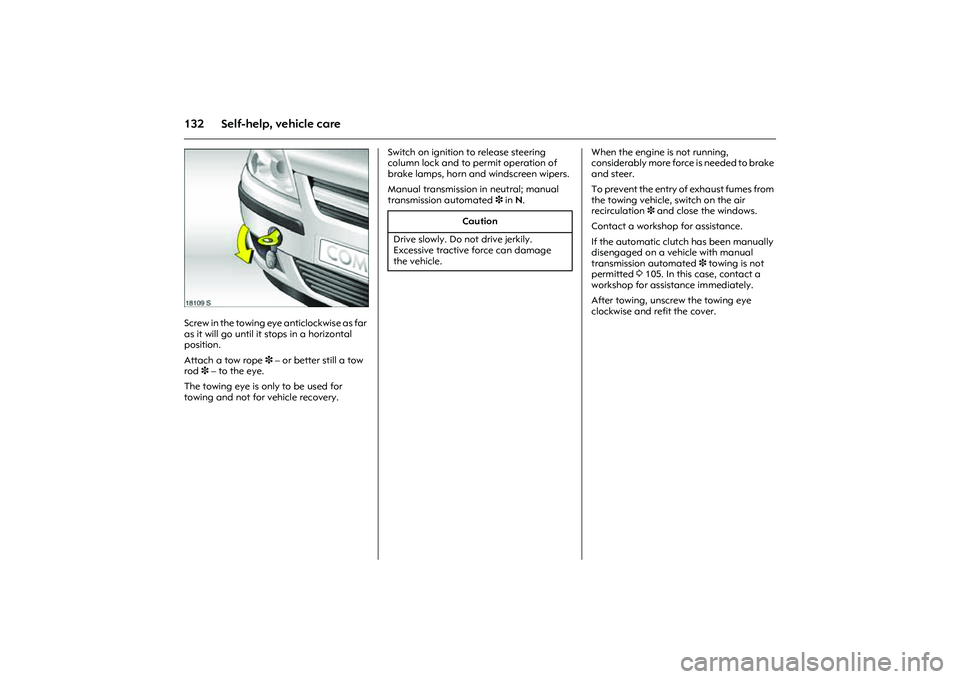
Screw in the towing eye anticlockwise as far
as it will go until it stops in a horizontal
position.
Attach a tow rope 3 – or better still a tow
rod3 – to the eye.
The towing eye is only to be used for
towing and not for vehicle recovery. Switch on ignition to release steering
column lock and to permit operation of
brake lamps, horn and windscreen wipers.
Manual transmission in neutral; manual
transmission automated 3 in N. When the engine is not running,
considerably more force is needed to brake
and steer.
To prevent the entry of exhaust fumes from
the towing vehicle, switch on the air
recirculation 3 and close the windows.
Contact a workshop for assistance.
If the automatic clutch has been manually
disengaged on a vehicle with manual
transmission automated 3 towing is not
permitted 3105. In this case, contact a
workshop for assistance immediately.
After towing, unscrew the towing eye
clockwise and refit the cover.
Caution
Drive slowly. Do not drive jerkily.
Excessive tractive force can damage
the vehicle.
Page 143 of 212

137
Self-help, vehicle care
Picture no: 12461s.tif
Combo van
The jack and the vehicle tools are secured
behind the driver’s seat.
The jack is secured in place by a wing
screw. The vehicle tools are secured to the
jack with rubber bands.
Changing wheels There may be a tyre repair kit instead of a
spare wheel 3142.
Make the following preparations and
observe the following information:
zPark the vehicle on a level, firm and non-
skid surface. The front wheels must be in
the straight-ahead position.
zSwitch on the hazard warning flashers,
apply the hand brake, engage first gear
or reverse.
zSet up the warning triangle correctly.
Warning triangle 3133.
zRemove the spare wheel from beneath
the vehicle floor 3134.
zNever change more than one wheel at
once. zUse the jack only to change wheels.
zIf the ground on which the vehicle is
standing is soft, a solid board (max. 1 cm
thick) should be placed under the jack.
zBlock the wheel diagonally opposite the
wheel to be changed by placing wedge
blocks or equivalent in front and behind
the wheel.
zNo people or animals may be in the
vehicle when it is jacked up.
zNever crawl under a jacked-up vehicle.
zDo not start the vehicle when it is raised
on the jack.
zBefore screwing in the wheel bolts, clean
them and lightly coat the taper of each
wheel bolt with commercially available
grease.
Page 148 of 212

142 Self-help, vehicle careTyre repair kit
3
Minor damage to the tyre tread or sidewall
can be repaired with the tyre repair kit.
Do not remove the foreign body from the
tyre.
T y r e d a m a g e e x c e e d i n g 4 m m o r t ha t i s o n
the rim cannot be repaired with the tyre
repair kit.
Important information 3145.
In the event of a flat tyre:
zSwitch on the hazard warning flashers,
apply the hand brake, engage first gear
or reverse.
zSet up the warning triangle correctly.
Warning triangle 3133.On the Combo, the tyre repair kit is located
behind a cover on the left in the side trim of
the luggage compartment. On the Combo
Van, it is located in a compartment behind
the driver’s seat.
To open the cover 3, press to release the
retaining lugs.
1. Remove bag containing tyre repair kit
from compartment. Carefully remove
parts from bag.
2. Remove the compressor.
Picture no: 13639T.tif
3. Remove the electrical connection
cable and air hose from the stowage
compartments on the underside of the
compressor.
9 Warning
Do not drive faster than 80 km/h.
Do not use the temporary spare wheel
for a lengthy period.
Steering and handling may be affected.
Page 156 of 212

150 Self-help, vehicle careNo. Circuit
38
Left tail lamp, left parking lamp
39
Right tail lamp, right parking lamp
40
Brake lamps
41
Fog lamps
42
Fog tail lamp
43
Main beam (left)
44
Main beam (right)
45
Ventilation fan
46
Engine control unit
47
Heated rear window
48
Starter
49
EPS
50
ABS
51
Petrol engine: manual transmission
automated
Diesel engine: engine control unit
Picture no: 11744s.tif Picture no:
No. Circuit
52
Radiator fan
No. Circuit
53
Cooling fan, air conditioning
system
54
Manual transmission automated
Page 163 of 212

157
Self-help, vehicle care
Picture no: 12449s.tif
Tail lamps 1. Disengage cover by pressing retaining
lugs and remove.
Picture no: 13725s.tif
2. Detach plug connector from bulb
mounting.
3. Grip the bulb housing from the outside,
slacken the two knurled nuts using the
wheel bolt spanner 3 and unscrew by
hand.
4. Detach bulb housing.
5. Press retaining lugs on bulb mounting
together and remove bulb mounting, as
shown in illustration 13726 S.
Picture no: 13726s.tif
Lamps from top to bottom:
6. Remove bulb from socket.
7. Insert a new bulb. Engage the bulb
mounting in the bulb housing. Insert the
bulb housing into the vehicle body.
Screw the fixing nuts onto setscrews by
hand and tighten. Engage the plug
connector. Place the cover in position
and close. Reversing light/brake light
Turn signal lamp
Reversing light
Fog tail lamp (country-specific version:
fog tail lamp at one side only).
Page 168 of 212
162 Self-help, vehicle careExterior lights
Headlamp and other lamp lens are made
of plastic. Do not use any abrasive or
caustic agents, do not use an ice scraper,
and do not clean them dry.
Plastic and rubber parts
Plastic and rubber parts can be cleaned
with the same cleaner as used to clean the
body. Use interior cleaner if necessary. Do
not use any other agent. Avoid solvents
and petrol in particular. Do not use high-
pressure jet cleaners.
Interior and upholstery
Clean the vehicle interior, including the
instrument panel fascia, using interior
cleaner.
The instrument panel is only to be cleaned
with a soft, damp cloth.
Clean the fabric upholstery with a vacuum
cleaner and brush. Remove stains with an
upholstery cleaner.
Clean seat belts with lukewarm water or
interior cleaner. Windows and windscreen wiper blades
Use a soft lint-free cloth or chamois leather
together with window cleaner and insect
remover.
When cleaning the rear window, make sure
the heating element inside the window is
not damaged.
For mechanical removal of ice, use a sharp-
edged ice scraper. Press the scraper firmly
against the glass so that no dirt can get
under it and scratch the glass.
Clean smearing wiper blades with a soft
cloth and window cleaner.
Locks
The locks are lubricated at the factory
using a high quality lock cylinder grease.
Use de-icing agent only where absolutely
necessary, as this removes grease and
impairs lock function. After using de-icing
agent, have the locks regreased by a
workshop. Engine compartment
Clean painted surfaces in the engine
compartment like any other painted
surface.
For best results, wash and wax the engine
compartment before and after winter.
Before washing the engine, cover the
alternator and brake fluid reservoir with
plastic sheeting.
When washing the engine with a steam-jet
cleaner, do not direct the steam jet at
components of the Anti-lock Braking
System 3, the automatic air conditioning
system 3 or the belt drive and its
components.
After an engine wash, have all engine room
components preserved thoroughly by a
workshop using protective wax.
Do not use high-pressure jet cleaners.
Caution
Close Velcro fasteners as open Velcro
fasteners on clothing could damage
seat upholstery.
Page 170 of 212

164 Opel Service, maintenanceOpel Service,
maintenance
Scheduled maintenanceThe service intervals apply to normal
operating conditions. For extreme
operating conditions, 3171.
Service interval display 3173.
European service intervals
Every 30,000 km or annually, whichever
occurs first.
International service intervals
Every 15,000 km or annually, whichever
occurs first.
Confirmations
Service is confirmed in the boxes provided
for such purposes in the Service and
Warranty Booklet. The workshop confirms
the date and mileage of service through a
stamp and signature.
Make sure that the Service and Warranty
Booklet has been correctly filled in as proof
of uninterrupted service is essential to the
granting of warranty or goodwill claims
and is a benefit when selling the vehicle.
Service planThe European service plan applies to the
following countries: Andorra, Austria,
Belgium, Cyprus, Czech Republic,
Denmark, Estonia, Finland, France,
Germany, Greece, Greenland, Hungary,
Iceland, Ireland, Italy, Latvia, Lithuania,
Luxembourg, Malta, the Netherlands,
Norway, Poland, Portugal, Slovakia,
Slovenia, Spain, Sweden, Switzerland,
Great Britain.
The International service plan applies to all
other countries. Scheduled maintenance ..................... 164
Service plan .......................................... 164
Additional service work ....................... 171
Recommended fluids and lubricants . 171
Inspection system ................................ 173
Genuine Opel Parts and Accessories . 174
Performing work .................................. 174
Engine oil .............................................. 175
Diesel fuel filter .................................... 177
Coolant ................................................. 177
Brakes ................................................... 178
Brake fluid ............................................ 179
Windscreen wiper replacement .......... 179
Windscreen washer system ................. 180
Battery .................................................. 180
Protecting electronic components ..... 180
Laying the vehicle up for a long
period of time .................................... 181
Putting the vehicle back into service . 181
Page 171 of 212

165 Opel Service, maintenance
European service plan⊕Additional work.
o Intervals are shorter under extreme operating conditions and when such is necessary due to conditions specific to the country.
Service work after year
1)
km (x 1000)
1)
1)Whichever occurs first.
1
302
603
904
1205
150
Visually inspect control, lighting and signal devices as well as airbags;
check steering column lock and ignition switchxxxxx
Remote control: replace batteries (don’t forget the spare key) every 2 years
Check and correct windscreen wipers, windscreen washer system and headlamp
washer systemxxxxx
Check and correct coolant level and frost protection (pale orange)
2)
Note freeze protection temperature in the Service and Warranty Booklet
(confirmation box)
2)If loss is great/leaks are present, carry out follow-up work with customer consent.
xxxxx
Check water hoses for leaks and check to make sure they are firmly seated x x x x x
Check and correct brake fluid level
2) xxx
Check battery clamps to make sure they are firmly seated and check the battery eye x x x x x
Vehicle System Check with TECH 2 x x x x x
Replace pollen filter or active charcoal filter x x
⊕o
if the air is heavily polluted or there are high levels of airborne dust, sand or pollen,
the air-conditioning system will produce an odourVerbal arrangement between the
customer and Opel Partner
Replace the air filter element every 4 years/60,000 km
⊕
Replace spark plugsevery 4 years/60,000 km
Z 16 YNGevery 2 years/30,000 km
Visually inspect the ribbed V-belt every 2 years/60,000 km
⊕
Replace ribbed V-belt
Y 13 DTJ, Z 13 DTJ, Y 13 DT, Z 13 DT, Z 17 DTH every 10 years/150,000 km
⊕
Check valve play and adjust
Z16 XEP, Z 17 DTHevery 10 years/150,000 km