Page 55 of 212
49
Seats, Interior
Seat belts are only designed for use by one
person at a time. They are not suitable for
persons younger than 12 years of age or
smaller than 150 cm.
For children up to 12 years of age, we
recommend the Opel child restraint system
353. Checking the seat belts
From time to time, check the functionality
of all seat belt system components and
check for damage. Have damaged
components replaced. Have seat belts and
deployed belt tensioners replaced in a
workshop after an accident.
Make sure that seat belts are not damaged
or trapped by sharp objects.
9 Warning
Fasten your seat belt before each trip.
In the event of an accident, persons not
wearing seat belts endanger their fellow
occupants and themselves.
Page 56 of 212
50 Seats, InteriorBelt tensioners In the event of a head-on or rear-end
collision of a certain severity, the front seat
belts are pulled down at the buckles and
thereby tightened.
Picture no: 11594s.tif
Actuation of belt tensioners
is indicated by illumination of control
indicator v; see next column.
Triggered belt tensioners must be replaced
by a workshop. Belt tensioners can only be
triggered once.
Picture no: 11702s.tif
Control indicator v for belt tensioners
The functionality of the belt tensioner
system is monitored electronically together
with the airbag systems and indicated via
control indicator v. When the ignition is
switched on, the control indicator comes on
for approx. 4 seconds. If it does not come
on, does not go out after 4 seconds or
comes on while driving, there is a fault in
the belt tensioner system or the airbag
systems 359. The systems may fail to
deploy in the event of an accident.
Triggered belt tensioners are indicated by
steady illumination of v.
Page 57 of 212

51
Seats, Interior
The system’s integrated self-diagnostics
allows faults to be quickly remedied. Important
zDo not affix or place accessories or other
objects within the deployment zone of
the belt tensioners (in the area of the belt
buckle). Do not make any modifications
to belt tensioner components and the
inertia real device because this will
invalidate the vehicle type approval. zThe belt tensioner and airbag system
control electronics can be found in the
centre console area. In order to avoid
malfunctions, do not store magnetic
objects in this area.
zWhen using the rear seat, make sure that
the components of the front seat belt are
not damaged by shoes or other objects.
Not dirt must get into the inertia reel of
the seat belt.
zWe recommend that you have the seats
removed by a workshop.
zThe belt tensioners only deploy once,
which can be detected by illumination of
the control indicator v. Have deployed
belt tensioners replaced by a workshop.
zThe applicable safety regulations must
be adhered to when the vehicle is
disposed of. The vehicle should therefore
be disposed of by a recycling company.
9 Warning
Have cause of fault remedied
immediately by a workshop.
9 Warning
Incorrect handling (e.g. removal or
fitting of seat belts or belt buckles) can
cause the belt tensioners to deploy, with
risk of injury.
Page 58 of 212

52 Seats, Interior
Picture no: 11595s.tif
Operation of the seat belts Fitting seat belts
The seat belt must not be twisted and must
lie snugly against the body. The backrest
must not be tilted back too far (maximum
approx. 25�).
Adjust the height so that the belt lies across
the shoulder. It must not lie across the
throat or upper arm.
Pull the belt out of the reel, guide it across
the body (making certain it is not twisted)
and engage the latch plate in the buckle.
Tension the lap belt frequently whilst
driving by tugging the shoulder belt.
Picture no: 11596s.tif
Loose or bulky clothing prevents the seat
belt from fitting snugly. Do not place
objects such as handbags or mobile
phones between the belt and your body.
Picture no: 11597s.tif
Height adjustment
Adjusting the height of the upper
anchorage point of the front seat belts:
1. Pull out the seat belt somewhat.
2. Press belt guide or, in 5-door saloon,
push button down.
3. Set desired height.
4. Allow to lock audibly into position.
Do not adjust height while driving.
9 Warning
On pregnant women in particular, the
lap belt must be positioned as low as
possible across the pelvis so as not to
put too much pressure on the abdomen.
9 Warning
The seat belt must not rest against hard
or fragile objects in the pockets of your
clothing.
Page 59 of 212
53
Seats, Interior
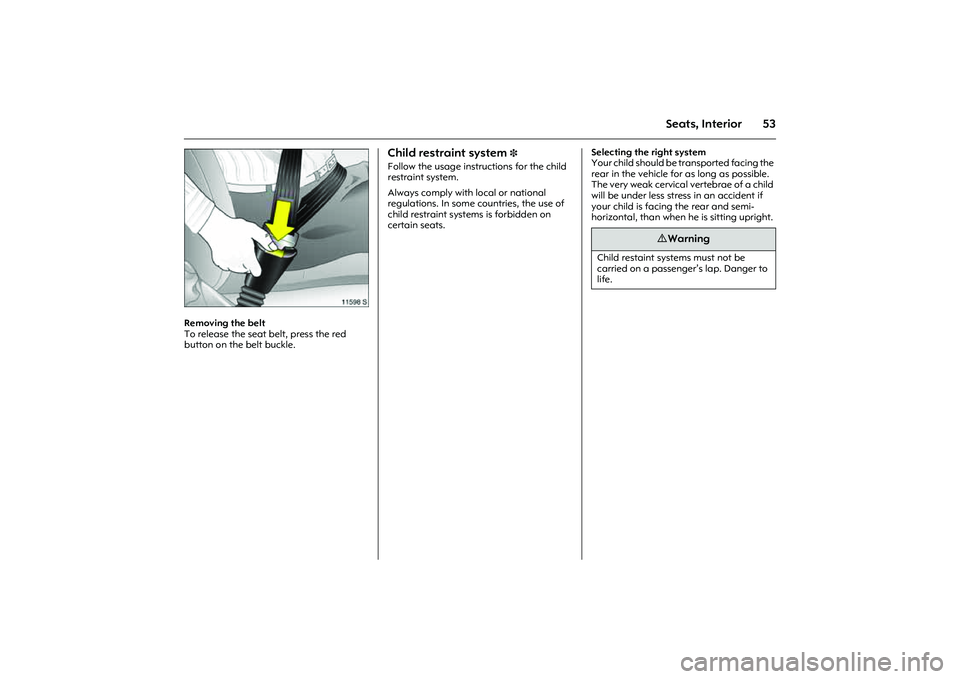
Picture no: 11598s.tif
Removing the belt
To release the seat belt, press the red
button on the belt buckle.
Child restraint system
3
Follow the usage instructions for the child
restraint system.
Always comply with local or national
regulations. In some countries, the use of
child restraint systems is forbidden on
certain seats. Selecting the right system
Your child should be transported facing the
rear in the vehicle for as long as possible.
The very weak cervical vertebrae of a child
will be under less stress in an accident if
your child is facing the rear and semi-
horizontal, than when he is sitting upright.
9 Warning
Child restaint systems must not be
carried on a passenger’s lap. Danger to
life.
Page 60 of 212
54 Seats, InteriorPermissible options for fitting a child safety seat
Weight and
age class
1)
1)We recommend the use of each system until the child reaches the upper weight limit.
On front
passenger seat On an outboard seat in
the rear row of seats On middle seat
2) in
the rear row of seats
2)For reasons of safety, we recommend that the child safety seat be installed on one of the outer
rear seats.Group 0:
up to 10 kg
or approx.
10 months
Group 0+:
up to 13 kg
or approx.
2yearsXU+ U
Group I:
9to18 kg
or approx.
8months to
4years XU+ U
Group II:
15 to 25 kg
or approx.
3to 7 years
Group III:
22 to 36 kg
or approx.
6to 12 years XU U
X = Child restraint systems are not to be
used on the front passenger seat.
U = universally suitable in conjunction
with three-point seat belt.
+ = Vehicle seat with ISOFIX mounting
available. Only the ISOFIX child
restraint systems that are approved
for the vehicle must be used when
mounting with ISOFIX.
Page 61 of 212

55
Seats, Interior
Note
zChildren under 12 years of age or 150 cm
must only travel in an appropriate child
restraint system on the seats in the rear
row 3.
zWhen transporting children, use the child
restraint systems suitable for the child’s
weight.
zBe sure that child restraint systems are
properly installed - see the instructions
accompanying the child restraint
system. zThe covers of the Opel child restraint
system can be wiped clean.
zDo not stick anything on the child
restraint systems and do not cover them
with any other materials.
zOnly allow the child to enter and exit on
the side of the vehicle facing away from
the road.
zA child restraint system which has been
subjected to stress in an accident must
be replaced.
zSecure or remove child restraint systems
that are in the vehicle but not in use.
Mounting clips
3 for ISOFIX child
restraint systems
The mounting eyes for the ISOFIX child
restraint system are located on the rear,
outer seats 3 between the seat back and
the seat cushion.
Fasten permitted ISOFIX child restraint
systems to the mounting brackets.
Closely follow the installation instructions
accompanying the ISOFIX child restraint
system.
Page 62 of 212

56 Seats, Interior
Picture no: 16424s.tif
Airbag system Front airbag
The front airbag system consists of one
airbag in the steering wheel and one in the
instrument panel. These can be identified
by the word AIRBAG.
The front airbag system comprises:
zan airbag with inflator in the steering
wheel and a second one in the
instrument panel 3,
zthe control electronics with impact
sensor,
zthe control indicator for airbag
systemsv in the instrument,
Picture no: 11734s.tif
The front airbag system will be triggered:
zdepending on the severity of the
accident,
zdepending on the type of impact,
zwithin the range shown in the illustration,
zindependently of the side airbag
system3.
The ignition must be switched on. Examples of events triggering the front
airbag system:
zImpact against a non-yielding obstacle:
the front airbags are triggered at low
vehicle speed.
zImpact against a yielding obstacle:
(such as another vehicle): the front
airbags are only triggered at a higher
vehicle speed.