2010 OPEL COMBO oil
[x] Cancel search: oilPage 172 of 212

166 Opel Service, maintenance⊕Additional work.
o Intervals are shorter under extreme operating conditions and when such is necessary due to conditions specific to the country.
Service work after year
1)
km (x 1000)
1)
1)Whichever occurs first.
1
302
603
904
1205
150
⊕
Replace toothed belt and tension roller
Z 16 YNGevery 6 years/90,000 km
Z 17 DTHevery 10 years/90,000 km
Z 16 XEPevery 10 years/150,000 km
Change engine oil and oil filter x x x x x
⊕o
Drain water from diesel fuel filter
(with high humidity and/or low fuel grade)xxxxx
Empty oil separator, Z 16 YNG every 4 years/60,000 km
Replace and drain water from fuel filter,
Z 13 DTJ, Z 17 DTHevery 2 years/60,000 km
Replace fuel filter, Z 16 YNG every 4 years/60,000 km
Check and adjust parking brake (wheels unladen); visually inspect wheel suspension
and spring suspension front and back, brake pipes, brake pressure hoses, fuel pipes,
gas lines on natural-gas powered vehicles and exhaust systemxx
Check external bodywork/underbody corrosion protection; note damage in
the Service and Warranty Bookletxxxxx
⊕o
Visually inspect front and rear wheel brakes
2)
2)If loss is great/leaks are present, carry out follow-up work with customer consent.
xx
Annual service check when the annual mileage is more than 20,000 km
Visually inspect engine, transmission (AT, MT), air conditioning compressor for leaks
2)
xxxxx
⊕o
Remove, clean and visually inspect brake drum every 4 years/60,000 km
Page 173 of 212

167 Opel Service, maintenance
⊕Additional work.
o Intervals are shorter under extreme operating conditions and when such is necessary due to conditions specific to the country.
Service work after year
1)
km (x 1000)
1)
1)Whichever occurs first.
1
302
603
904
1205
150
Visually inspect steering bellows, track rods and axle drive xxxxx
Check track-rod ends and suspension ball joints xxxxx
⊕
Change brake and clutch fluid (manual transmission automated) every 2 years
Undo wheel mounting and tighten to 110 Nm torque
xx During assembly, lightly lubricate wheel bolt tapers with grease or oil
Check tyre condition; check and correct tyre pressures (including the spare wheel)
With tyre inflation system, check the set to make sure that it is complete and not out
of date. Replace sealant bottle every 4 years
⊕
Annual service check when the annual mileage is more than 20,000 km
Visually inspect the first-aid kit (present and stowed in the right place, intact and not
out of date), lashing eyes and warning triangleevery 2 years
Check and correct headlamp aiming (including auxiliary headlamps) x x
⊕o
Lubricate door hinges, door brakes, lock cylinders, strikers, bonnet closure and
tailgate hinges.xx
Road test, final inspection (check steering column lock, ignition switch, instruments
and control indicators, entire brake system, steering, air conditioning system, engine,
body and chassis), reset service interval display using TECH 2xxxxx
⊕
For Germany only: carry out emissions inspection (AU), general inspection (HU) First after 3 years and then every
2 years thereafter
With commercial passenger transport, taxis, ambulances, hired vehicles, etc. annually
⊕
Carry out gas system test (GAP) and note it in the Service and Warranty Booklet First after 3 years and then every
2 years thereafter
With commercial passenger transport, taxis, ambulances, hired vehicles, etc. annually
Page 175 of 212

169 Opel Service, maintenance
⊕Additional work.
o Intervals are shorter under extreme operating conditions and when such is necessary due to conditions specific to the country.
Service work after year
1)
km (x 1000)
1)
1)Whichever occurs first.
1
152
303
454
605
75
⊕
Replace toothed belt and tension roller
Z 16 YNGevery 6 years/90,000 km
Z 17 DTHevery 10 years/90,000 km
Z 16 XEPevery 10 years/150,000 km
Change engine oil and oil filter x x x x x
⊕o
Drain water from diesel fuel filter
(with high humidity and/or low fuel grade)xxxxx
Empty oil separator, Z 16 YNG every 4 years/60,000 km
Replace and drain water from fuel filter,
Z 13 DTJ, Z 17 DTHevery 2 years/60,000 km
Replace fuel filter, Z 16 YNG every 4 years/60,000 km
Check and adjust parking brake (wheels unladen); visually inspect wheel suspension
and spring suspension front and back, brake pipes, brake pressure hoses, fuel pipes,
gas lines on natural-gas powered vehicles and exhaust systemxx
Check external bodywork/underbody corrosion protection; note damage in the
Service and Warranty Bookletxxxxx
⊕o
Visually inspect front and rear wheel brakes
2)
2)If loss is great/leaks are present, carry out follow-up work with customer consent.
xx
Annual service check when the annual mileage is more than 20,000 km
Visually inspect engine, transmission (AT, MT), air conditioning compressor for leaks
2)
xxxxx
⊕o
Remove, clean and visually inspect brake drum every 4 years/60,000 km
Page 176 of 212

170 Opel Service, maintenance⊕Additional work.
o Intervals are shorter under extreme operating conditions and when such is necessary due to conditions specific to the country.
Service work after year
1)
km (x 1000)
1)
1)Whichever occurs first.
1
152
303
454
605
75
Visually inspect steering bellows, track rods and axle drive x x x x x
Check track-rod ends and suspension ball joints x x x x x
⊕
Change brake and clutch fluid (manual transmission automated) every 2 years
Undo wheel mounting and tighten to 110 Nm torque
xx During assembly, lightly lubricate wheel bolt tapers with grease or oil
Check tyre condition; check and correct tyre pressures (including the spare wheel)
With tyre inflation system, check the set to make sure that it is complete and not
out of date. Replace sealant bottle every 4 years
⊕
Annual service check when the annual mileage is more than 20,000 km
Visually inspect the first-aid kit (present and stowed in the right place, intact and
not out of date), lashing eyes and warning triangleevery 2 years
Check and correct headlamp aiming (including auxiliary headlamps) x x
⊕o
Lubricate door hinges, door brakes, lock cylinders, strikers, bonnet closure and
tailgate hinges.xx
Road test, final inspection (check steering column lock, ignition switch, instruments
and control indicators, entire brake system, steering, air conditioning system, engine,
body and chassis), reset service interval display using TECH 2xxxxx
⊕
Carry out gas system test (GAP) and note it in the Service and Warranty Booklet First after 3 years and then every
2 years thereafter
With commercial passenger transport, taxis, ambulances, hired vehicles, etc. annually
Page 177 of 212

171
Opel Service, maintenance
Additional service workAdditional work ⊕
Additional work is work which is not
required for every service but can be
carried out along with a regular service.
Time allowances for such work are not
included within the scope of a regular
service and must be accounted for
separately. However, it is more cost
effective to carry out this work as part of a
planned service than to have it done
separately.
Extreme operating conditions o
Operating conditions are considered
extreme when one or more of the following
occur frequently:
zCold starts,
zStop-and-go,
zCaravan/trailer towing,
zDriving on inclines and/or in high
altitudes,
zPoor road conditions,
zSand and dust,
zExtreme temperature fluctuations.
Police vehicles, taxis and driving school
vehicles are also classified as operating
under extreme conditions.When operating conditions are extreme, it
may be necessary to have certain service
work carried out more frequently than the
planned service intervals.
We recommend obtaining technical advice
for the service requirements of your vehicle
based on the special conditions of use.
Recommended fluids and
lubricants Only use products which have been tested
and approved. Damage caused by using
non-approved operating materials is not
covered by the warranty.
9 Warning
Fuels are dangerous and require
appropriate care when handling. If
swallowed, immediately call a doctor.
Do not inhale fumes and avoid contact
with the skin. Keep out of the reach of
children. Fuels must not be allowed to
contaminate wastewater, groundwater
or soils. Dispose of empty containers
properly. Always keep in mind that fuels
are hazardous to health.
Page 178 of 212

172 Opel Service, maintenanceEngine oil
Engine oil is identified by its grade and
viscosity. When choosing which engine oil
to use, grade is more important than
viscosity.
The new GM-Dexos 2 engine oil grade is
currently the highest grade. If it is not
available, the other engine oil grades that
are listed must be used.
Engine oil grade for the European
service plan
Engine oil grade for the International
service planTopping up engine oil
Oil from different manufacturers and of
different brands can be mixed providing
they meet the specified engine oil criteria
(grade and viscosity).
Not every engine oil available on the
market satisfies the quality requirements,
so always check whether the required
specifications and classifications are
written on the container.
If an engine oil of the required grade is not
available, a maximum of 1 litre of
ACEA A3/B4 or A3/B3 oil may be used (just
once between oil changes). The viscosity
must comply with the requirements.
Using category ACEA A1/B1 and A5/B5
engine oil is expressly forbidden because it
can cause long-term damage to the engine
under certain operating conditions.Engine oil additives
The use of engine oil additives can cause
damage and void the warranty.
Engine oil viscosity
Only use engine oils of viscosity 0W-30,
0W-40, 5W-30 or 5W-40.
The SAE viscosity classification defines the
fluidity of the oil: the oil is more viscous
when cold than when hot.
Multigrade oil is indicated by two numbers.
The first number followed by a W gives the
viscosity at low temperature and the
second number gives the viscosity at high
temperature. GM-Dexos 2 = Petrol and
diesel engines
GM-LL-A-025 = Petrol engines
GM-LL-B-025 = Diesel engines
GM-Dexos 2 = Petrol and
diesel engines
GM-LL-A-025 = Petrol engines
GM-LL-B-025 = Diesel engines
ACEA-A3 = Petrol engines
ACEA-B4 = Diesel engines
without diesel
particle filter (DPF)
ACEA-C3 = Diesel engines with
DPF
Page 180 of 212
174 Opel Service, maintenanceGenuine Opel Parts and
Accessories We recommend that you use "Genuine
Opel Parts and Accessories" and
conversion parts approved expressly for
your vehicle type. These parts have
undergone special tests to establish their
reliability, safety and specific suitability for
Opel vehicles. Despite continuous market
monitoring, we cannot assess or guarantee
these attributes for other products, even if
they have been granted approval by the
relevant authorities or in some other form.
"Genuine Opel Parts and Accessories" and
conversion parts approved by Opel can be
obtained from your Opel Partner, who can
provide comprehensive advice on
permitted technical changes and ensure
correct installation.
Picture no: 17922s.tif
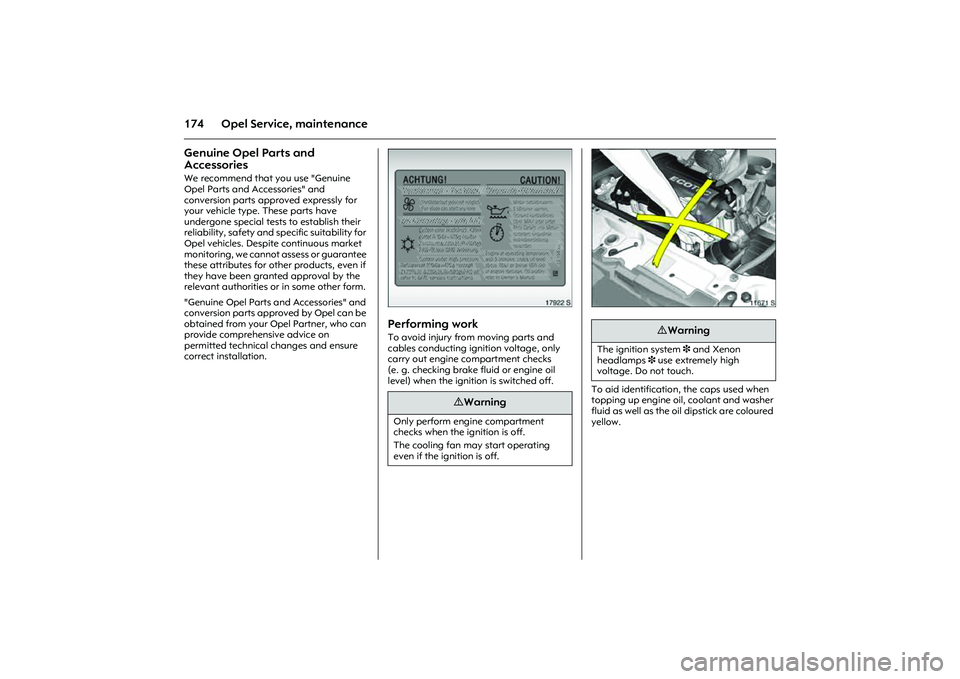
Performing work To avoid injury from moving parts and
cables conducting ignition voltage, only
carry out engine compartment checks
(e. g. checking brake fluid or engine oil
level) when the ignition is switched off.
Picture no: 11671s.tif
To aid identification, the caps used when
topping up engine oil, coolant and washer
fluid as well as the oil dipstick are coloured
yellow.
9 Warning
Only perform engine compartment
checks when the ignition is off.
The cooling fan may start operating
even if the ignition is off.
9 Warning
The ignition system 3 and Xenon
headlamps 3 use extremely high
voltage. Do not touch.
Page 181 of 212

175
Opel Service, maintenance
Picture no: 18113s.tif
Engine oil On vehicles with engine oil level check 3,
the engine oil level is monitored
automatically 370. We recommend that
you check the engine oil level before
starting a long journey.
Picture no: 13212s.tif
Check with the vehicle on a level surface.
The engine must be at operating
temperature and switched off for at least
5minutes.
Picture no: 16495s.tif
Pull out the dipstick, wipe it clean, insert it
to the stop on the handle, pull out and read
the engine oil level.
Push in the oil dipstick up to the stop on the
handle and give it half a turn.
Different dipsticks are used depending on
engine variant.
When the engine oil level has dropped to
the MIN mark, top up engine oil.