Page 276 of 338
CAUTION
●Use only Genuine NISSAN CVT Fluid
NS-2. Do not mix with other fluids.
● Using transmission fluid other than
Genuine NISSAN CVT Fluid NS-2 will
damage the CVT, which is not covered
by the NISSAN new vehicle limited
warranty.
When checking or replacement of CVT fluid is
required, we recommend your NISSAN dealer for
servicing.
WARNING
● When the engine is running, keep
hands, jewelry and clothing away from
any moving parts such as the cooling
fan and drive belts.
● Automatic transmission fluid is poison-
ous and should be stored carefully in
marked containers out of the reach of
children.
TEMPERATURE CONDITIONS FOR
CHECKING
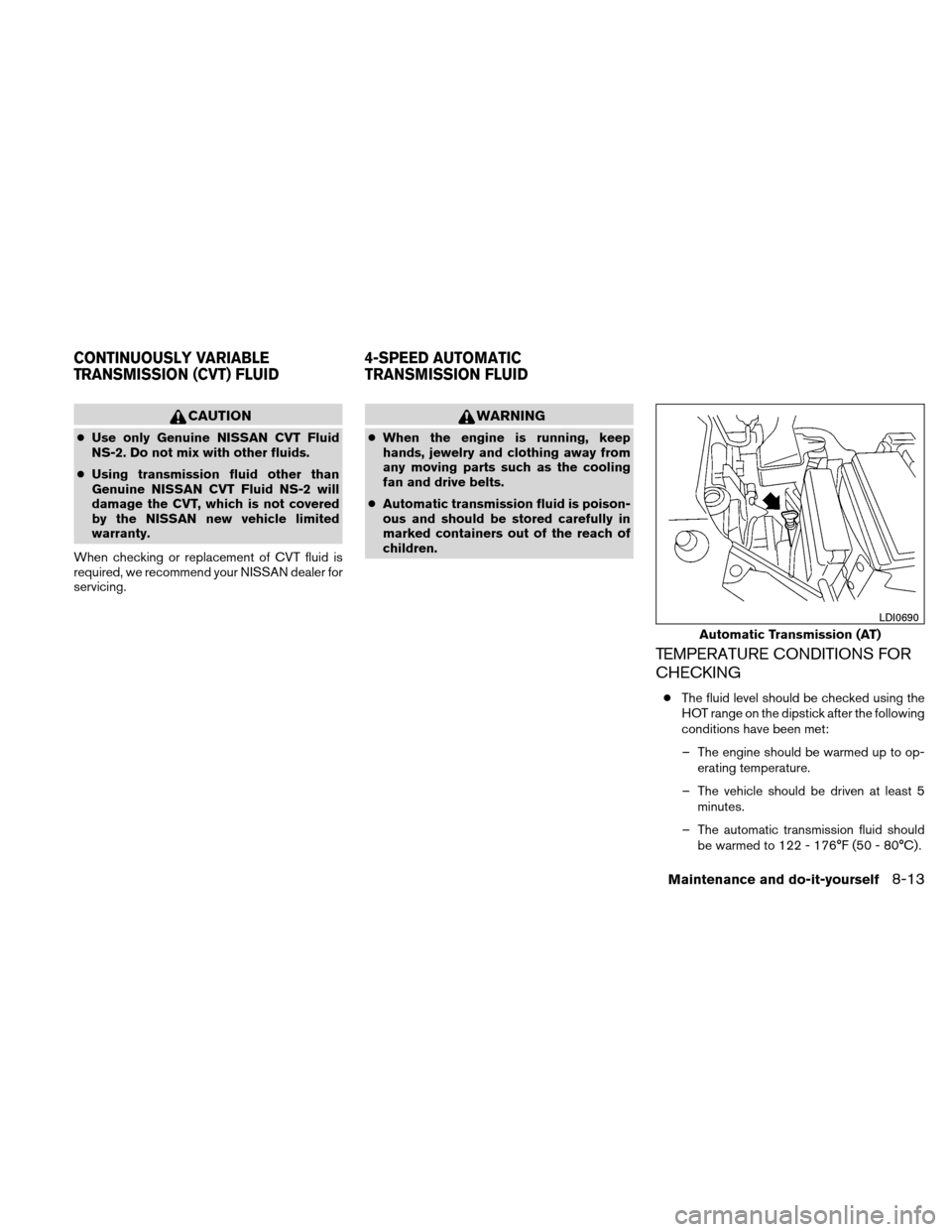
● The fluid level should be checked using the
HOT range on the dipstick after the following
conditions have been met:
– The engine should be warmed up to op- erating temperature.
– The vehicle should be driven at least 5 minutes.
– The automatic transmission fluid should be warmed to 122 - 176°F (50 - 80°C) .
Automatic Transmission (AT)
LDI0690
CONTINUOUSLY VARIABLE
TRANSMISSION (CVT) FLUID 4-SPEED AUTOMATIC
TRANSMISSION FLUID
Maintenance and do-it-yourself8-13
Page 277 of 338
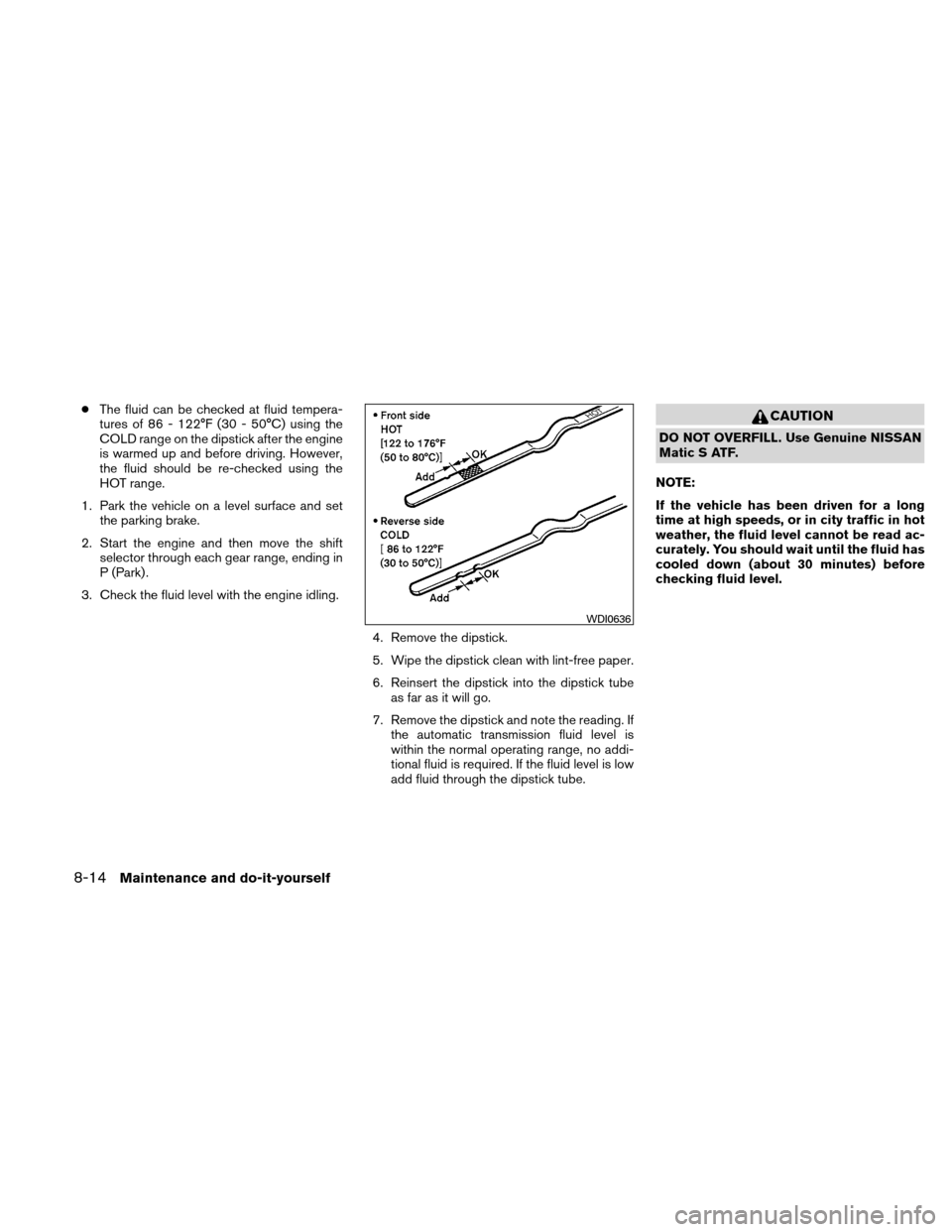
●The fluid can be checked at fluid tempera-
tures of 86 - 122°F (30 - 50°C) using the
COLD range on the dipstick after the engine
is warmed up and before driving. However,
the fluid should be re-checked using the
HOT range.
1. Park the vehicle on a level surface and set the parking brake.
2. Start the engine and then move the shift selector through each gear range, ending in
P (Park) .
3. Check the fluid level with the engine idling.
4. Remove the dipstick.
5. Wipe the dipstick clean with lint-free paper.
6. Reinsert the dipstick into the dipstick tubeas far as it will go.
7. Remove the dipstick and note the reading. If the automatic transmission fluid level is
within the normal operating range, no addi-
tional fluid is required. If the fluid level is low
add fluid through the dipstick tube.CAUTION
DO NOT OVERFILL. Use Genuine NISSAN
Matic S ATF.
NOTE:
If the vehicle has been driven for a long
time at high speeds, or in city traffic in hot
weather, the fluid level cannot be read ac-
curately. You should wait until the fluid has
cooled down (about 30 minutes) before
checking fluid level.
WDI0636
8-14Maintenance and do-it-yourself
Page 279 of 338
WINDSHIELD-WASHER FLUID
RESERVOIR
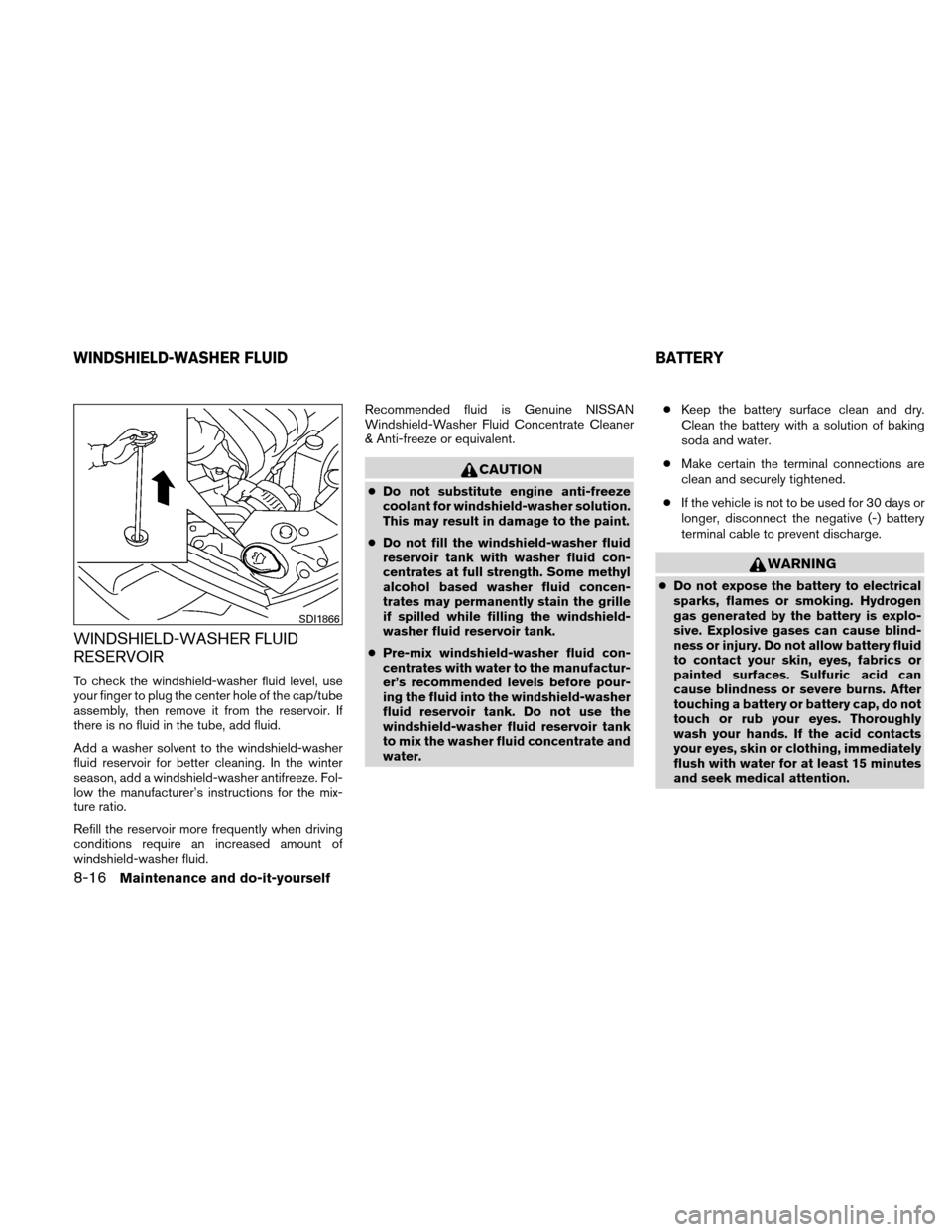
To check the windshield-washer fluid level, use
your finger to plug the center hole of the cap/tube
assembly, then remove it from the reservoir. If
there is no fluid in the tube, add fluid.
Add a washer solvent to the windshield-washer
fluid reservoir for better cleaning. In the winter
season, add a windshield-washer antifreeze. Fol-
low the manufacturer’s instructions for the mix-
ture ratio.
Refill the reservoir more frequently when driving
conditions require an increased amount of
windshield-washer fluid.Recommended fluid is Genuine NISSAN
Windshield-Washer Fluid Concentrate Cleaner
& Anti-freeze or equivalent.
CAUTION
●
Do not substitute engine anti-freeze
coolant for windshield-washer solution.
This may result in damage to the paint.
● Do not fill the windshield-washer fluid
reservoir tank with washer fluid con-
centrates at full strength. Some methyl
alcohol based washer fluid concen-
trates may permanently stain the grille
if spilled while filling the windshield-
washer fluid reservoir tank.
● Pre-mix windshield-washer fluid con-
centrates with water to the manufactur-
er’s recommended levels before pour-
ing the fluid into the windshield-washer
fluid reservoir tank. Do not use the
windshield-washer fluid reservoir tank
to mix the washer fluid concentrate and
water. ●
Keep the battery surface clean and dry.
Clean the battery with a solution of baking
soda and water.
● Make certain the terminal connections are
clean and securely tightened.
● If the vehicle is not to be used for 30 days or
longer, disconnect the negative (-) battery
terminal cable to prevent discharge.
WARNING
●Do not expose the battery to electrical
sparks, flames or smoking. Hydrogen
gas generated by the battery is explo-
sive. Explosive gases can cause blind-
ness or injury. Do not allow battery fluid
to contact your skin, eyes, fabrics or
painted surfaces. Sulfuric acid can
cause blindness or severe burns. After
touching a battery or battery cap, do not
touch or rub your eyes. Thoroughly
wash your hands. If the acid contacts
your eyes, skin or clothing, immediately
flush with water for at least 15 minutes
and seek medical attention.
SDI1866
WINDSHIELD-WASHER FLUID BATTERY
8-16Maintenance and do-it-yourself
Page 281 of 338
Vehicles operated in high temperatures or under
severe conditions require frequent checks of the
battery fluid level.
JUMP STARTING
If jump starting is necessary, see “Jump starting”
in the “In case of emergency” section of this
manual. If the engine does not start by jump
starting, the battery may have to be replaced.
Contact a NISSAN dealer.
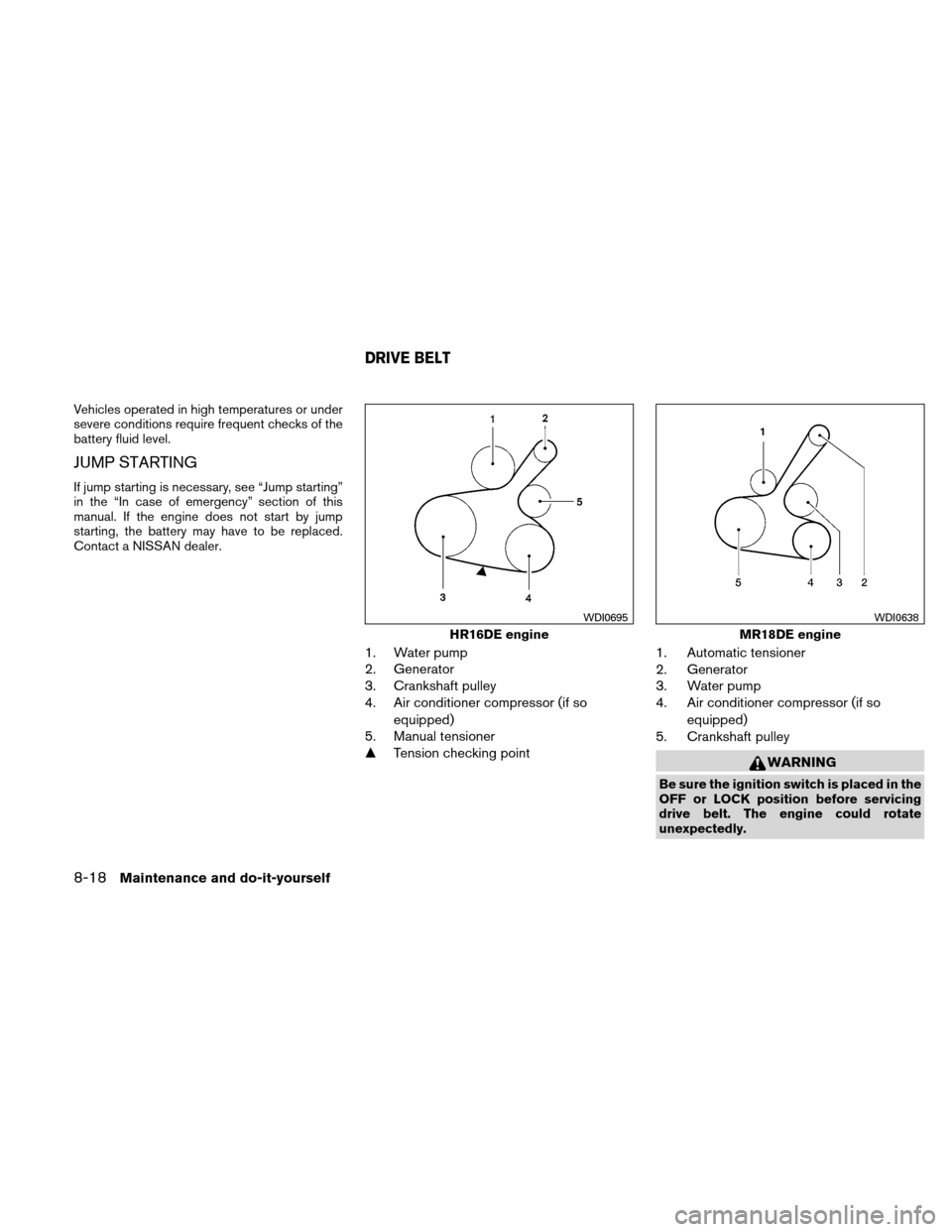
1. Water pump
2. Generator
3. Crankshaft pulley
4. Air conditioner compressor (if soequipped)
5. Manual tensioner
� Tension checking point 1. Automatic tensioner
2. Generator
3. Water pump
4. Air conditioner compressor (if so
equipped)
5. Crankshaft pulley
WARNING
Be sure the ignition switch is placed in the
OFF or LOCK position before servicing
drive belt. The engine could rotate
unexpectedly.
HR16DE engine
WDI0695
MR18DE engine
WDI0638
DRIVE BELT
8-18Maintenance and do-it-yourself
Page 282 of 338
1. Visually inspect the belt for signs of unusualwear, cuts, or fraying. If the belt is in poor
condition, have it replaced or adjusted by a
NISSAN dealer.
2. Have the belt checked regularly for condi- tion.
REPLACING SPARK PLUGS
Platinum-tipped spark plugs (if so
equipped)
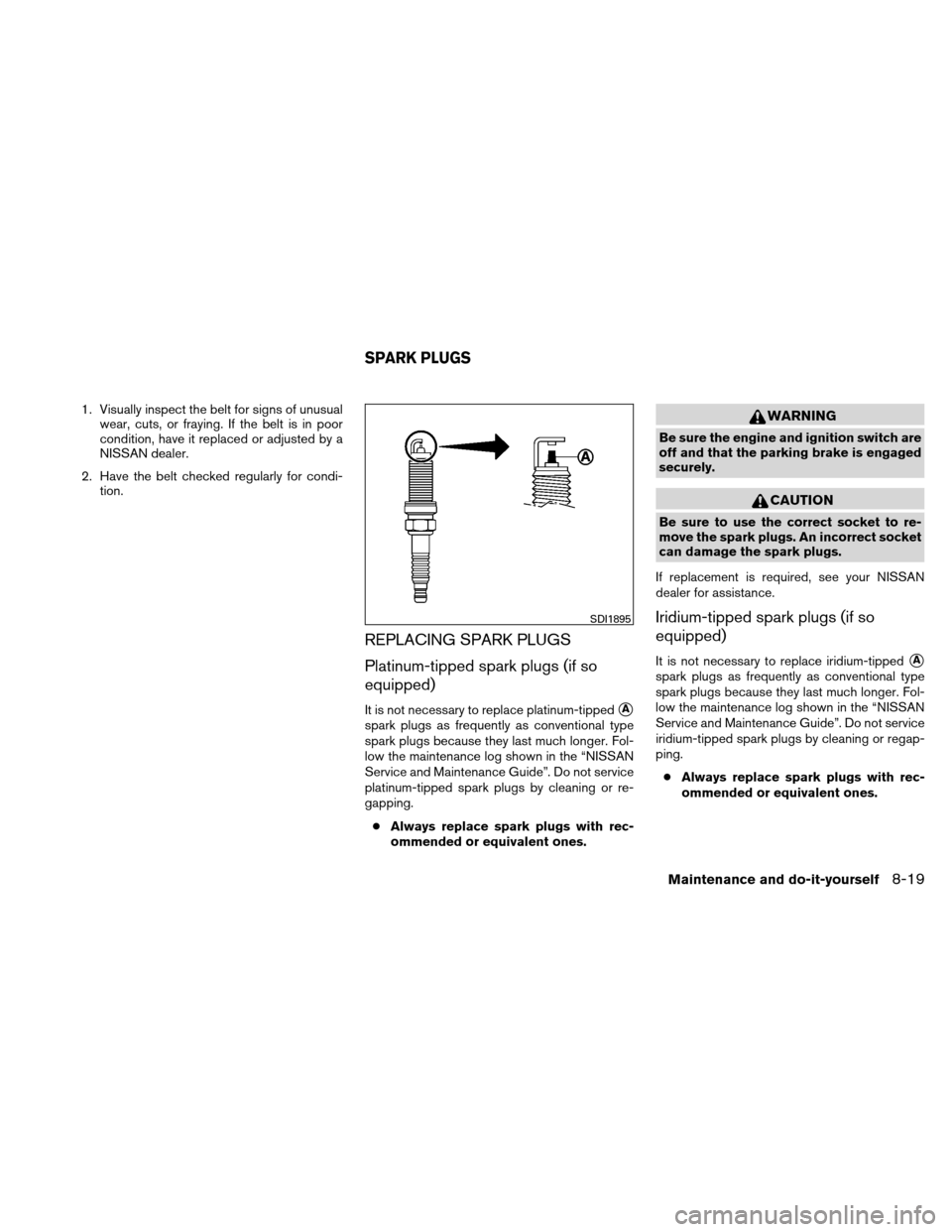
It is not necessary to replace platinum-tipped�A
spark plugs as frequently as conventional type
spark plugs because they last much longer. Fol-
low the maintenance log shown in the “NISSAN
Service and Maintenance Guide”. Do not service
platinum-tipped spark plugs by cleaning or re-
gapping.
● Always replace spark plugs with rec-
ommended or equivalent ones.
WARNING
Be sure the engine and ignition switch are
off and that the parking brake is engaged
securely.
CAUTION
Be sure to use the correct socket to re-
move the spark plugs. An incorrect socket
can damage the spark plugs.
If replacement is required, see your NISSAN
dealer for assistance.
Iridium-tipped spark plugs (if so
equipped)
It is not necessary to replace iridium-tipped�A
spark plugs as frequently as conventional type
spark plugs because they last much longer. Fol-
low the maintenance log shown in the “NISSAN
Service and Maintenance Guide”. Do not service
iridium-tipped spark plugs by cleaning or regap-
ping. ● Always replace spark plugs with rec-
ommended or equivalent ones.
SDI1895
SPARK PLUGS
Maintenance and do-it-yourself8-19
Page 283 of 338
WARNING
Be sure the engine and ignition switch are
off and that the parking brake is engaged
securely.
CAUTION
Be sure to use the correct socket to re-
move the spark plugs. An incorrect socket
can damage the spark plugs.
If replacement is required, see your NISSAN
dealer for assistance.
The air cleaner filter should not be cleaned and
reused. Replace it according to the maintenance
log shown in the “NISSAN Service and Mainte-
nance Guide.” When replacing the filter, wipe the
inside of the air cleaner filter housing and the
cover with a damp cloth.
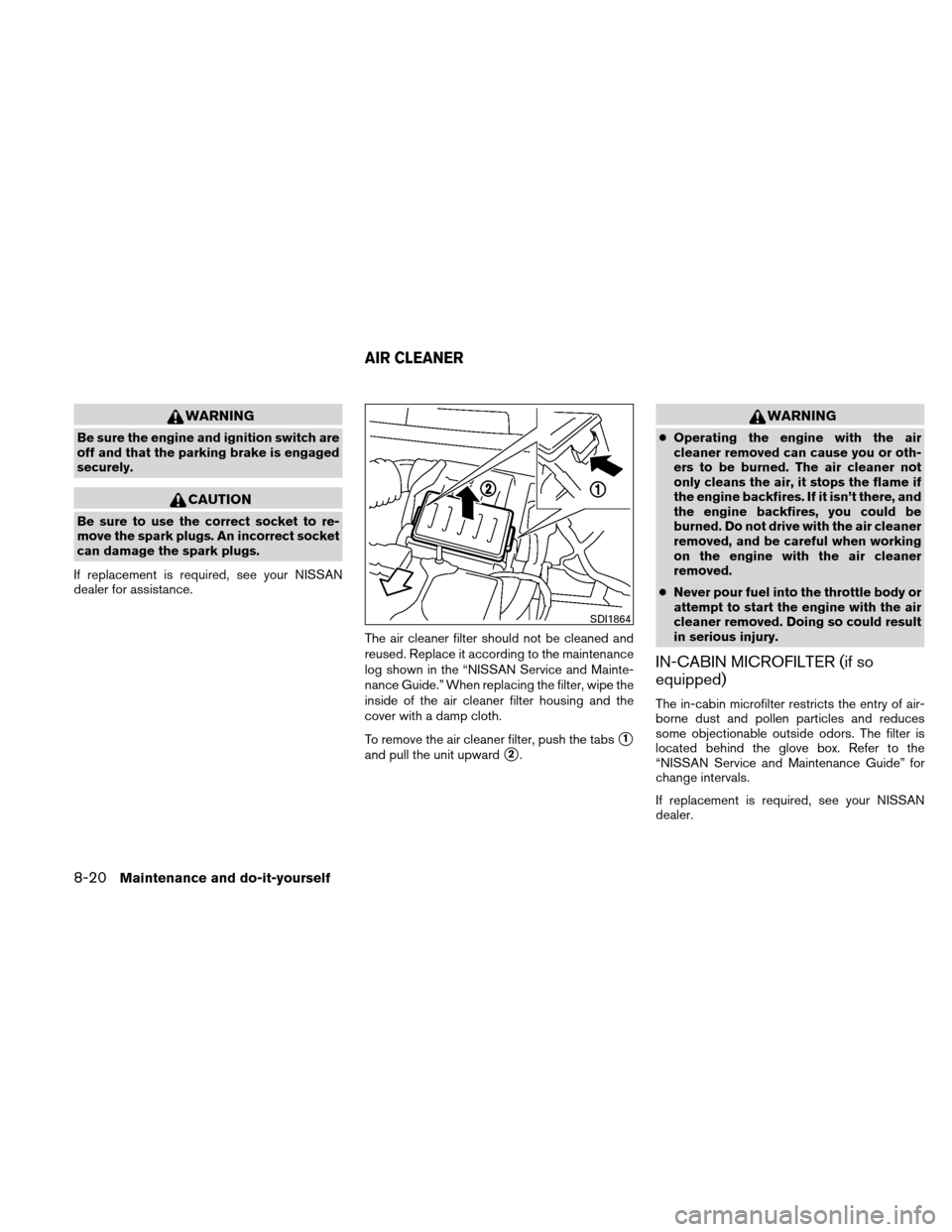
To remove the air cleaner filter, push the tabs
�1
and pull the unit upward�2.
WARNING
●Operating the engine with the air
cleaner removed can cause you or oth-
ers to be burned. The air cleaner not
only cleans the air, it stops the flame if
the engine backfires. If it isn’t there, and
the engine backfires, you could be
burned. Do not drive with the air cleaner
removed, and be careful when working
on the engine with the air cleaner
removed.
● Never pour fuel into the throttle body or
attempt to start the engine with the air
cleaner removed. Doing so could result
in serious injury.
IN-CABIN MICROFILTER (if so
equipped)
The in-cabin microfilter restricts the entry of air-
borne dust and pollen particles and reduces
some objectionable outside odors. The filter is
located behind the glove box. Refer to the
“NISSAN Service and Maintenance Guide” for
change intervals.
If replacement is required, see your NISSAN
dealer.
SDI1864
AIR CLEANER
8-20Maintenance and do-it-yourself
Page 286 of 338
Under some driving or climate conditions, occa-
sional brake squeak, squeal or other noise may
be heard. Occasional brake noise during light to
moderate stops is normal and does not affect the
function or performance of the brake system.
Proper brake inspection intervals should
be followed.For more information regarding
brake inspections, see the appropriate mainte-
nance schedule information in the “NISSAN Ser-
vice and Maintenance Guide”.
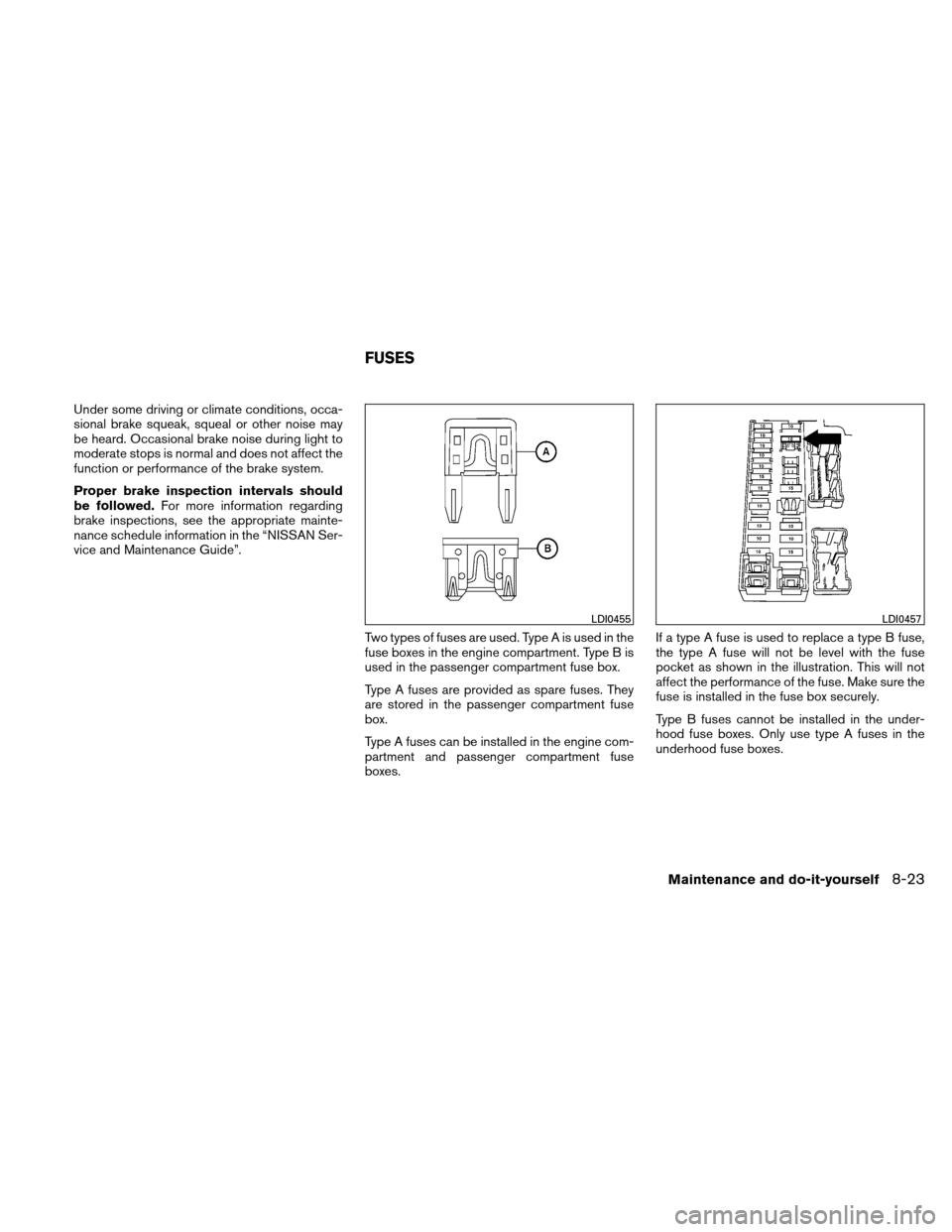
Two types of fuses are used. Type A is used in the
fuse boxes in the engine compartment. Type B is
used in the passenger compartment fuse box.
Type A fuses are provided as spare fuses. They
are stored in the passenger compartment fuse
box.
Type A fuses can be installed in the engine com-
partment and passenger compartment fuse
boxes.If a type A fuse is used to replace a type B fuse,
the type A fuse will not be level with the fuse
pocket as shown in the illustration. This will not
affect the performance of the fuse. Make sure the
fuse is installed in the fuse box securely.
Type B fuses cannot be installed in the under-
hood fuse boxes. Only use type A fuses in the
underhood fuse boxes.
LDI0455LDI0457
FUSES
Maintenance and do-it-yourself8-23
Page 287 of 338
ENGINE COMPARTMENT
CAUTION
Never use a fuse of a higher or lower
amperage rating than specified on the
fuse box cover. This could damage the
electrical system or cause a fire.
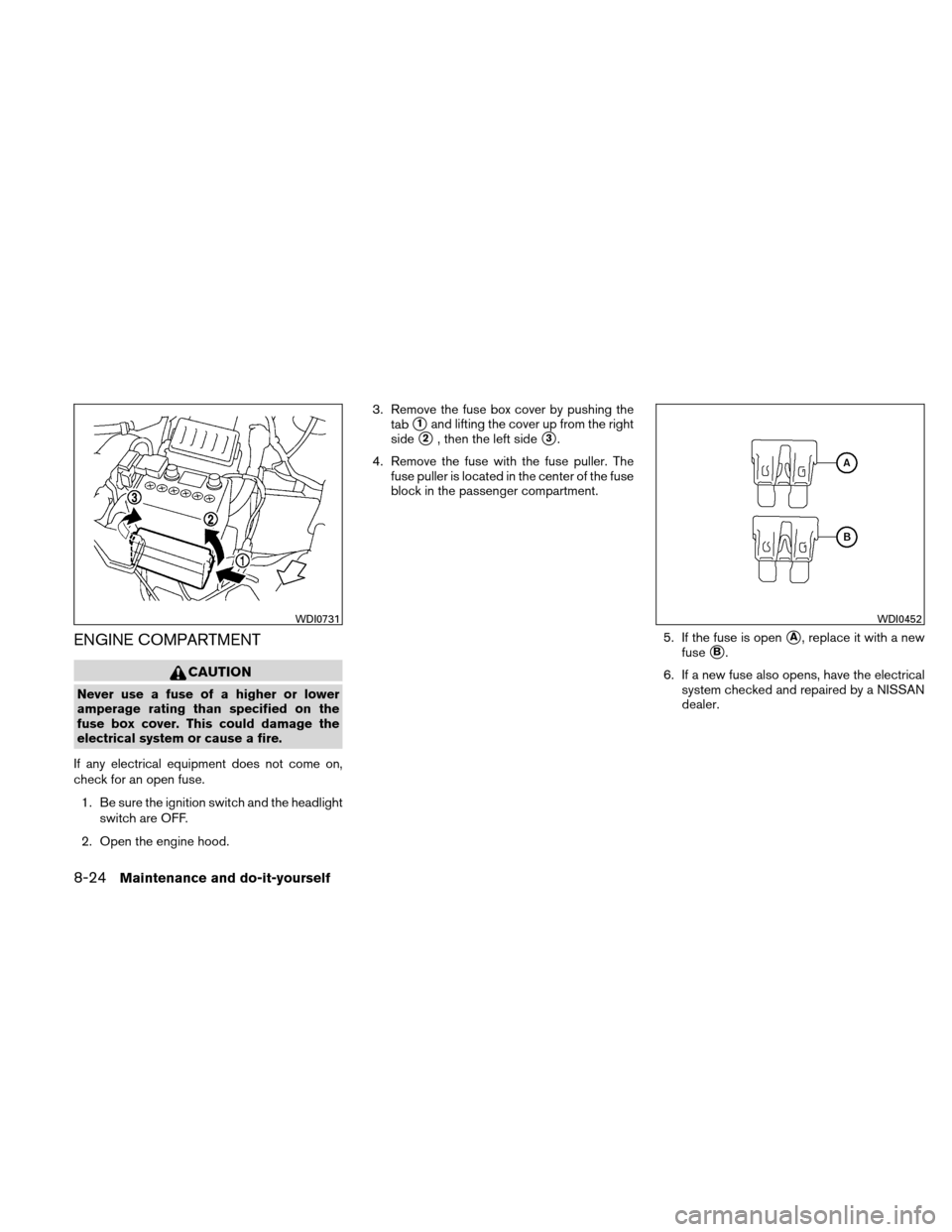
If any electrical equipment does not come on,
check for an open fuse. 1. Be sure the ignition switch and the headlight switch are OFF.
2. Open the engine hood. 3. Remove the fuse box cover by pushing the
tab
�1and lifting the cover up from the right
side
�2, then the left side�3.
4. Remove the fuse with the fuse puller. The fuse puller is located in the center of the fuse
block in the passenger compartment.
5. If the fuse is open
�A, replace it with a new
fuse
�B.
6. If a new fuse also opens, have the electrical system checked and repaired by a NISSAN
dealer.
WDI0731WDI0452
8-24Maintenance and do-it-yourself