Page 12 of 440
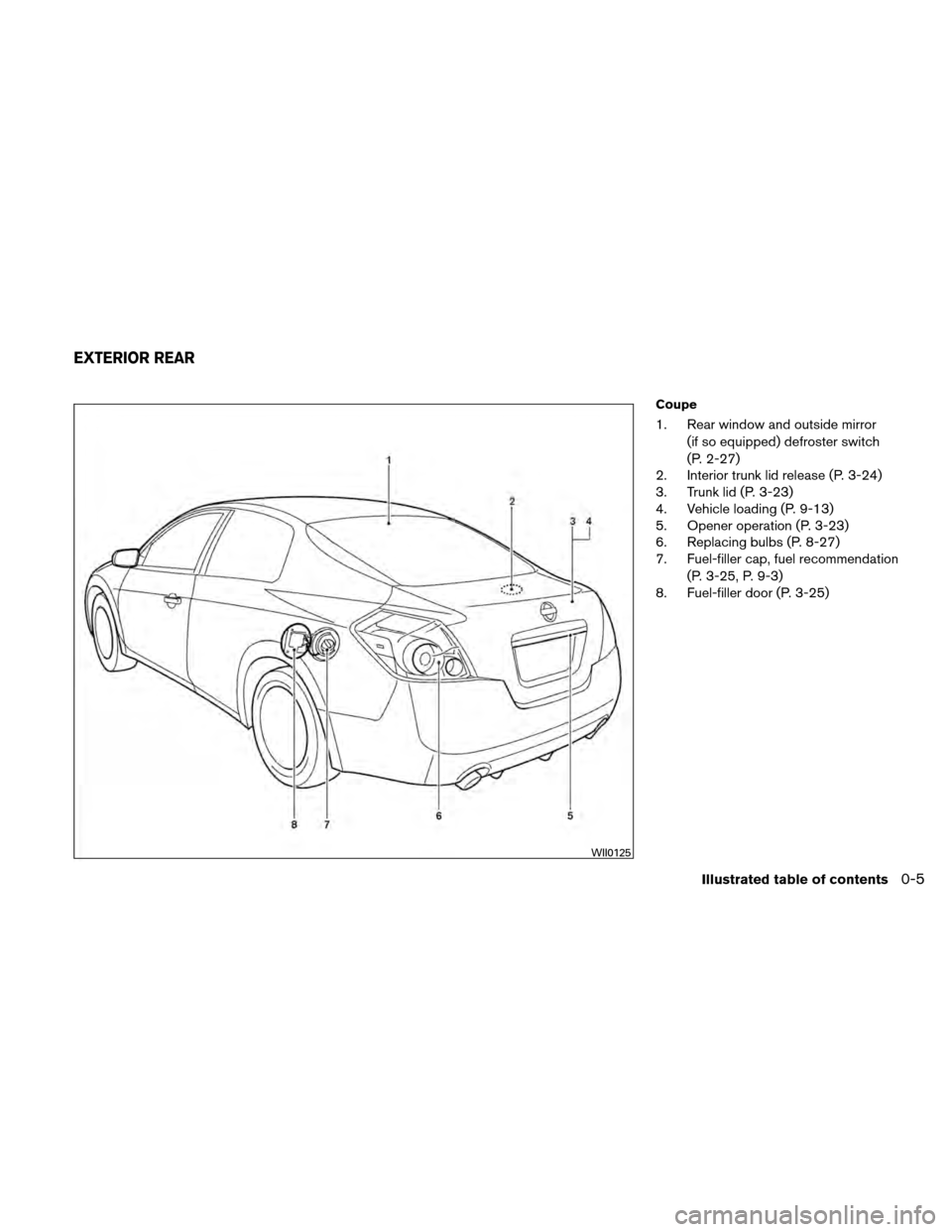
Coupe
1. Rear window and outside mirror(if so equipped) defroster switch
(P. 2-27)
2. Interior trunk lid release (P. 3-24)
3. Trunk lid (P. 3-23)
4. Vehicle loading (P. 9-13)
5. Opener operation (P. 3-23)
6. Replacing bulbs (P. 8-27)
7. Fuel-filler cap, fuel recommendation
(P. 3-25, P. 9-3)
8. Fuel-filler door (P. 3-25)
WII0125
EXTERIOR REAR
Illustrated table of contents0-5
Page 13 of 440
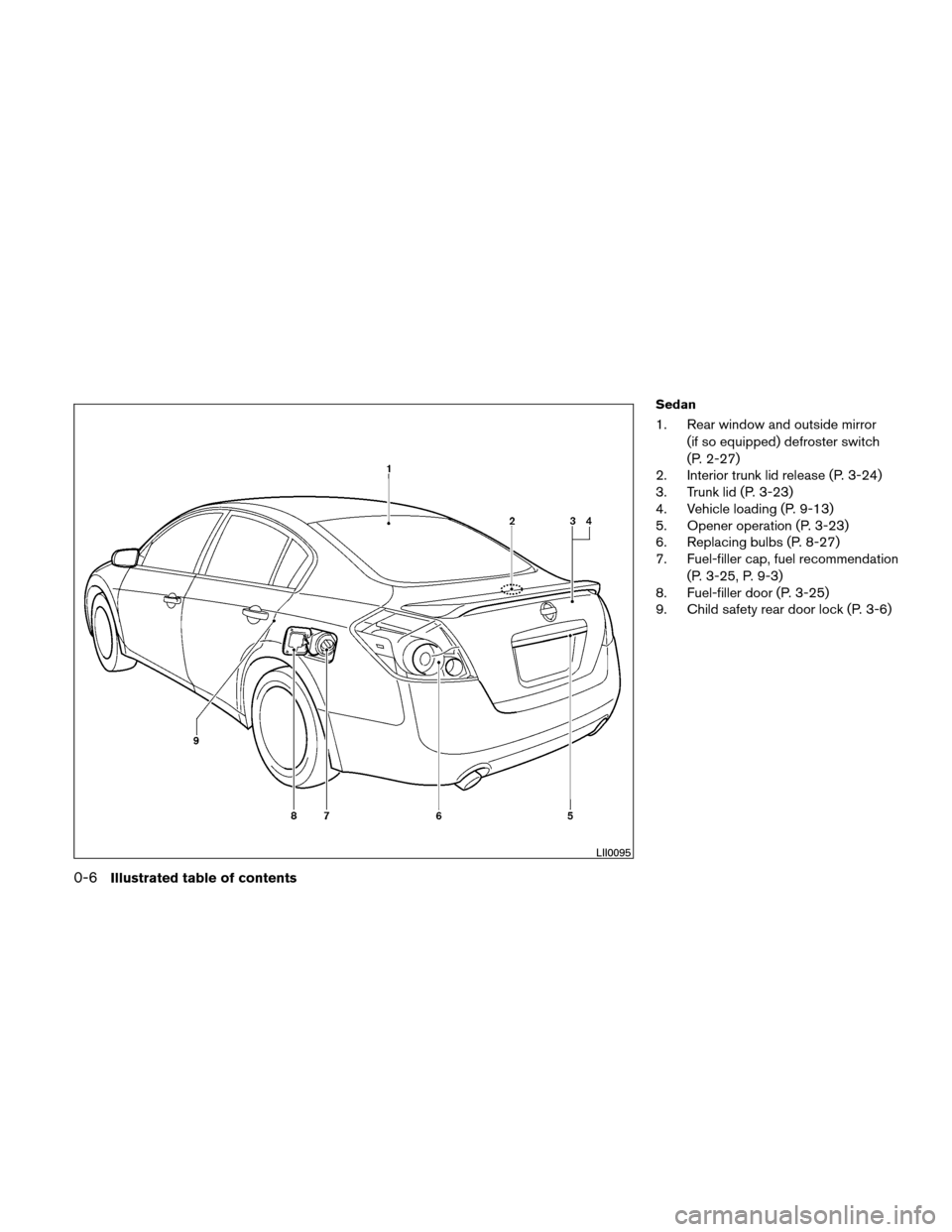
Sedan
1. Rear window and outside mirror(if so equipped) defroster switch
(P. 2-27)
2. Interior trunk lid release (P. 3-24)
3. Trunk lid (P. 3-23)
4. Vehicle loading (P. 9-13)
5. Opener operation (P. 3-23)
6. Replacing bulbs (P. 8-27)
7. Fuel-filler cap, fuel recommendation
(P. 3-25, P. 9-3)
8. Fuel-filler door (P. 3-25)
9. Child safety rear door lock (P. 3-6)
LII0095
0-6Illustrated table of contents
Page 14 of 440
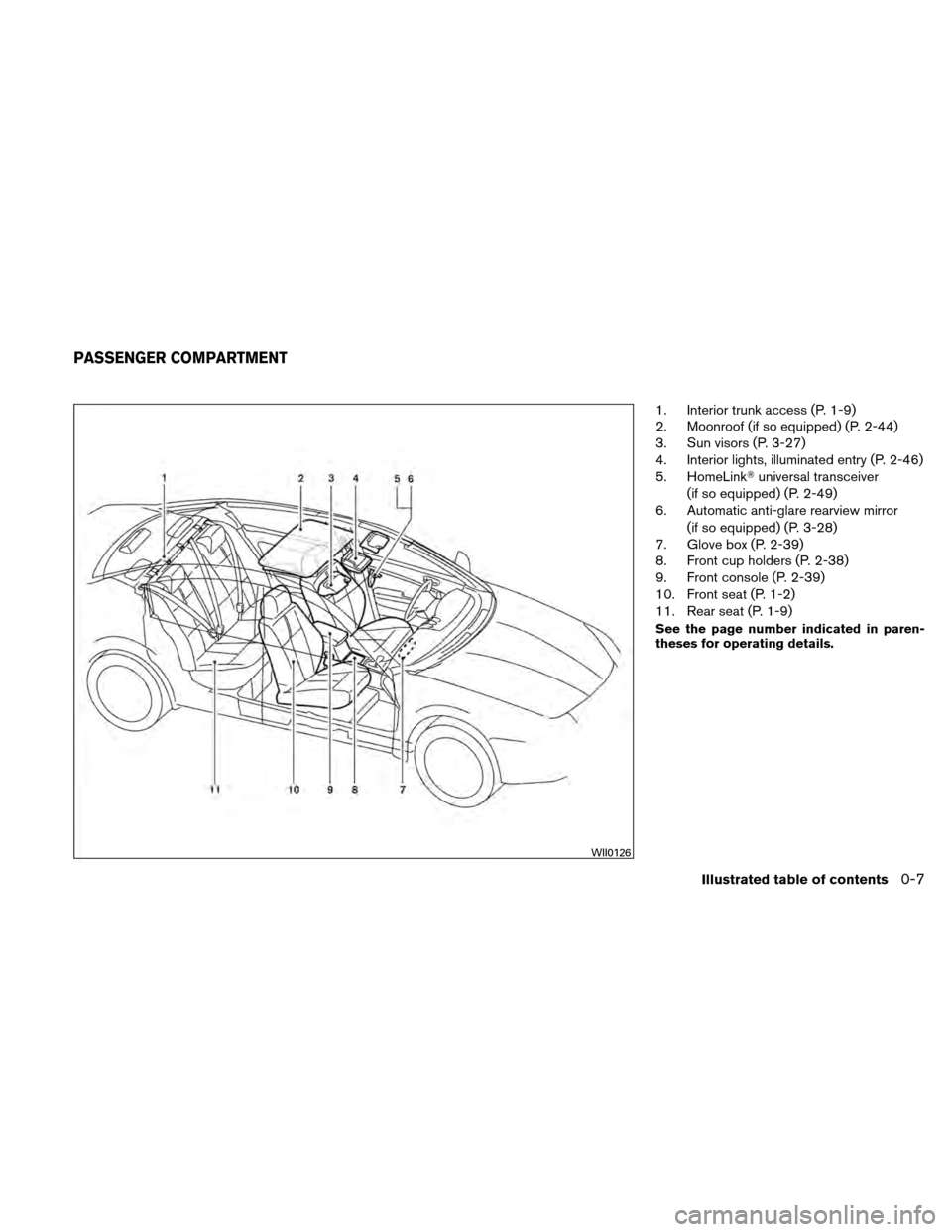
1. Interior trunk access (P. 1-9)
2. Moonroof (if so equipped) (P. 2-44)
3. Sun visors (P. 3-27)
4. Interior lights, illuminated entry (P. 2-46)
5. HomeLink�universal transceiver
(if so equipped) (P. 2-49)
6. Automatic anti-glare rearview mirror
(if so equipped) (P. 3-28)
7. Glove box (P. 2-39)
8. Front cup holders (P. 2-38)
9. Front console (P. 2-39)
10. Front seat (P. 1-2)
11. Rear seat (P. 1-9)
See the page number indicated in paren-
theses for operating details.
WII0126
PASSENGER COMPARTMENT
Illustrated table of contents0-7
Page 16 of 440
20. Vehicle information display controls(P. 2-17)
21. Hood release (P. 3-23)
22. Trunk opener (P. 3-23) Vehicle Dynamic Control (VDC) OFF
switch (P. 2-34)
NISSAN Intelligent Key™ port (P. 5-7)
*: Refer to the separate Navigation System Own-
er’s Manual (if so equipped) .
See the page number indicated in paren-
theses for operating details.
Illustrated table of contents0-9
Page 28 of 440
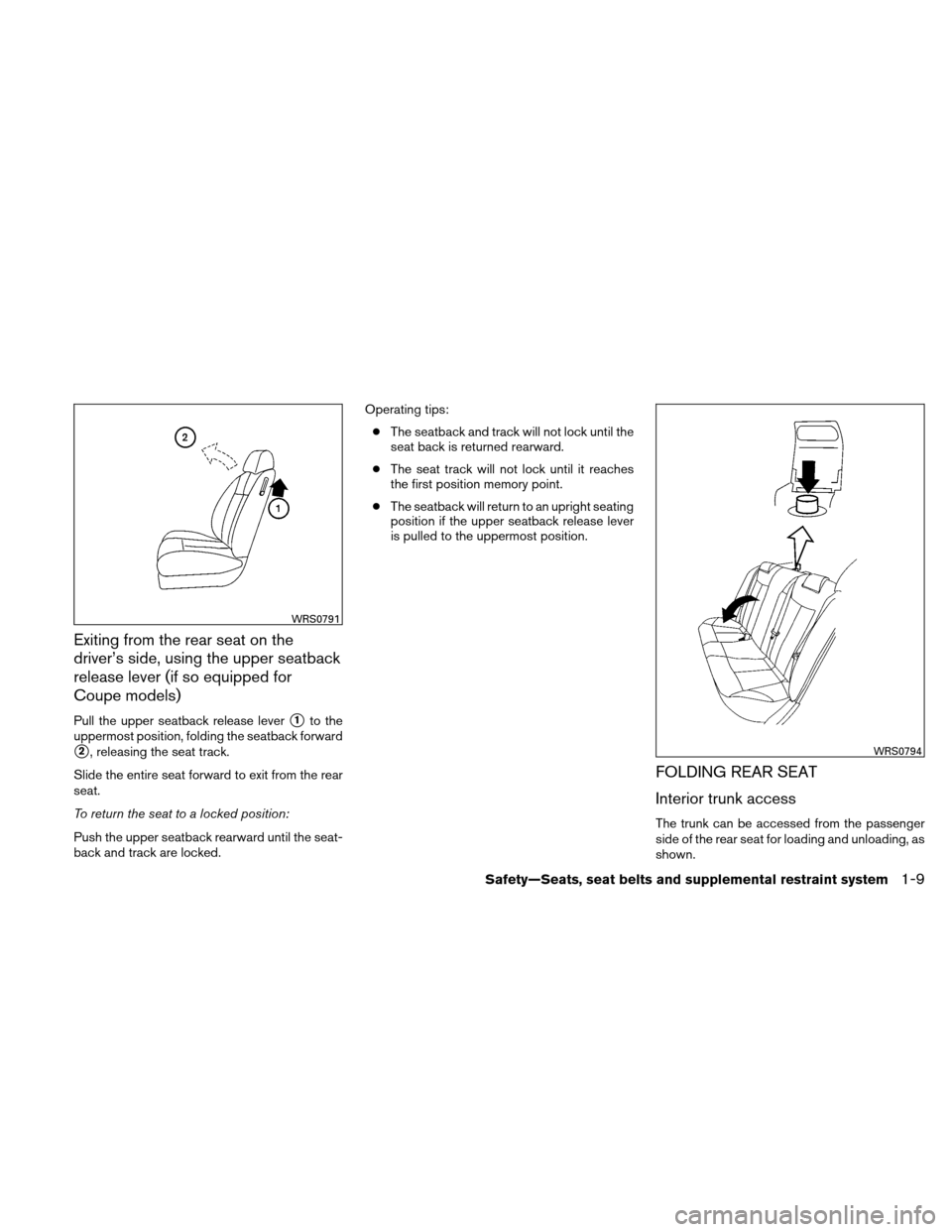
Exiting from the rear seat on the
driver’s side, using the upper seatback
release lever (if so equipped for
Coupe models)
Pull the upper seatback release lever�1to the
uppermost position, folding the seatback forward
�2, releasing the seat track.
Slide the entire seat forward to exit from the rear
seat.
To return the seat to a locked position:
Push the upper seatback rearward until the seat-
back and track are locked. Operating tips:
● The seatback and track will not lock until the
seat back is returned rearward.
● The seat track will not lock until it reaches
the first position memory point.
● The seatback will return to an upright seating
position if the upper seatback release lever
is pulled to the uppermost position.
FOLDING REAR SEAT
Interior trunk access
The trunk can be accessed from the passenger
side of the rear seat for loading and unloading, as
shown.
WRS0791
WRS0794
Safety—Seats, seat belts and supplemental restraint system1-9
Page 29 of 440
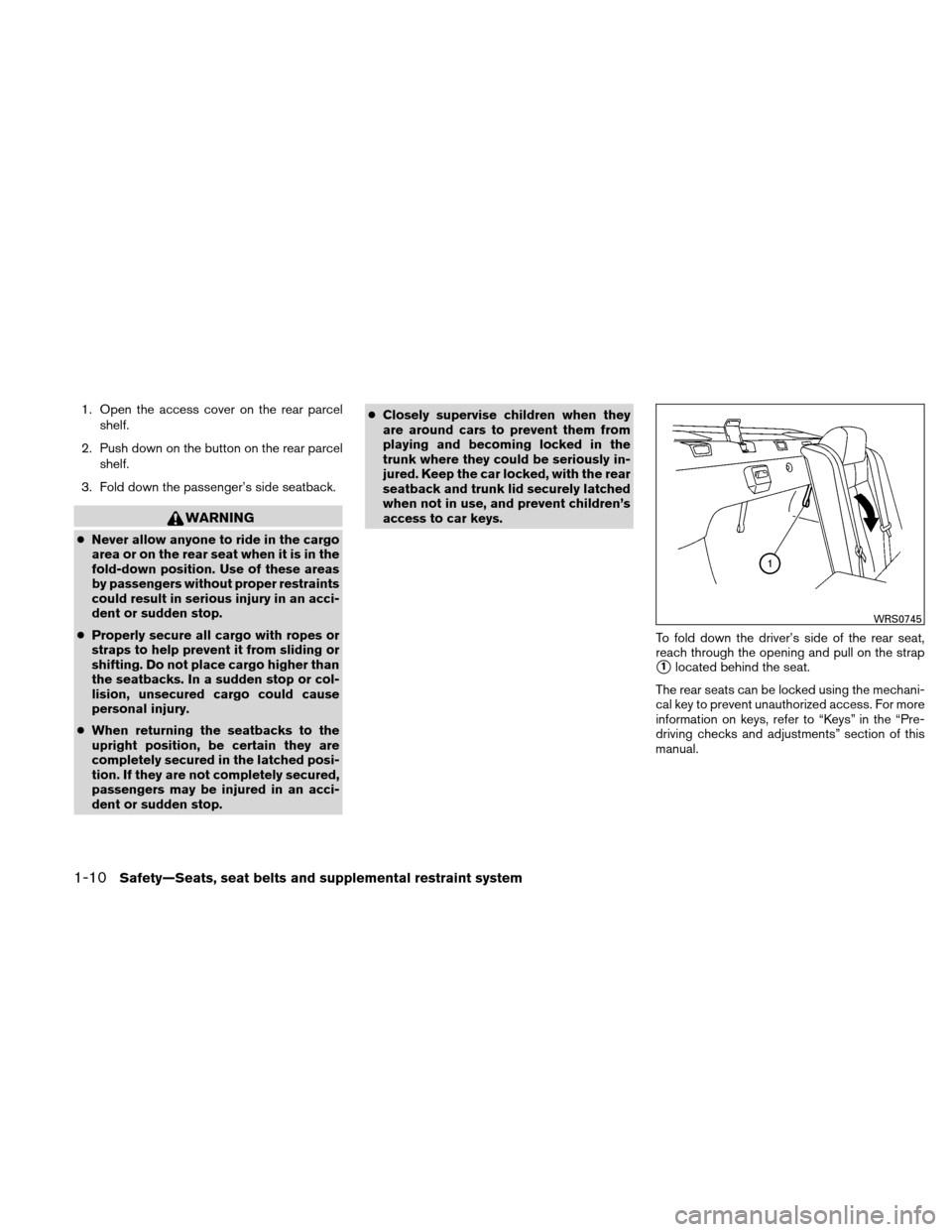
1. Open the access cover on the rear parcelshelf.
2. Push down on the button on the rear parcel shelf.
3. Fold down the passenger’s side seatback.
WARNING
● Never allow anyone to ride in the cargo
area or on the rear seat when it is in the
fold-down position. Use of these areas
by passengers without proper restraints
could result in serious injury in an acci-
dent or sudden stop.
● Properly secure all cargo with ropes or
straps to help prevent it from sliding or
shifting. Do not place cargo higher than
the seatbacks. In a sudden stop or col-
lision, unsecured cargo could cause
personal injury.
● When returning the seatbacks to the
upright position, be certain they are
completely secured in the latched posi-
tion. If they are not completely secured,
passengers may be injured in an acci-
dent or sudden stop. ●
Closely supervise children when they
are around cars to prevent them from
playing and becoming locked in the
trunk where they could be seriously in-
jured. Keep the car locked, with the rear
seatback and trunk lid securely latched
when not in use, and prevent children’s
access to car keys.
To fold down the driver’s side of the rear seat,
reach through the opening and pull on the strap
�1located behind the seat.
The rear seats can be locked using the mechani-
cal key to prevent unauthorized access. For more
information on keys, refer to “Keys” in the “Pre-
driving checks and adjustments” section of this
manual.
WRS0745
1-10Safety—Seats, seat belts and supplemental restraint system
Page 80 of 440
Windows........................................ 2-42
Power windows ............................... 2-42
Moonroof (if so equipped) ......................... 2-44
Automatic moonroof ........................... 2-44
Interior light ...................................... 2-46
Console light (if so equipped) ...................2-47
Personal Lights ................................... 2-48
Map lights ....................................... 2-48
Trunk light ....................................... 2-48
HomeLink� universal transceiver (if so equipped) .....2-49 Programming HomeLink�
.......................2-49
Programming HomeLink� for Canadian
customers .................................... 2-50
Operating the HomeLink� universal
transceiver .................................... 2-51
Programming trouble-diagnosis .................2-51
Clearing the programmed information ............2-51
Rolling code programming ......................2-51
Reprogramming a single HomeLink� button......2-52
If your vehicle is stolen ......................... 2-52
Page 82 of 440
20. Vehicle information display controls(P. 2-17)
21. Hood release (P. 3-23)
22. Trunk opener (P. 3-23) Vehicle Dynamic Control (VDC) OFF
switch (P. 2-34)
NISSAN Intelligent Key™ port (P. 5-7)
*: Refer to the separate Navigation System Own-
er’s Manual (if so equipped) .
See the page number indicated in paren-
theses for operating details.
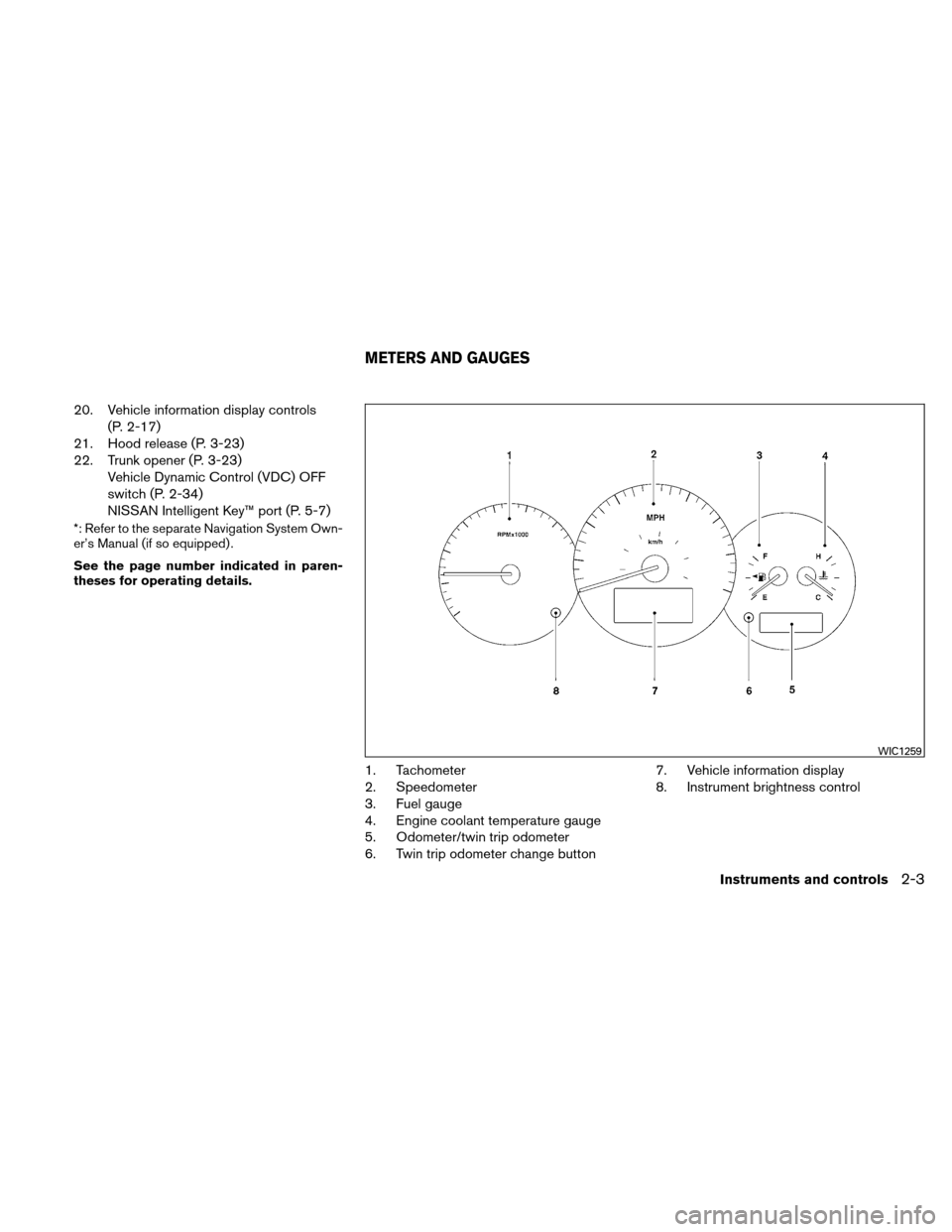
1. Tachometer
2. Speedometer
3. Fuel gauge
4. Engine coolant temperature gauge
5. Odometer/twin trip odometer
6. Twin trip odometer change button 7. Vehicle information display
8. Instrument brightness control
WIC1259
METERS AND GAUGES
Instruments and controls2-3