Page 523 of 670

6-6 For emergencies
6
5. If you do not see steam or spray coming from under the
hood, leave the engine on until the bar graph for the
engine coolant temperature warning display on the multi-
information display goes down. When it is in the middle
of the normal zone, you can start driving again. If the bar
graph stays in the red zone, turn off the engine.
6. When you do not see any more steam or spray, open the
hood. Look for obvious leaks, such as a split radiator
hose. Be careful as components will be hot. Any leak
source must be repaired.
7. If there is no obvious leak source, check the coolant level
in the reserve tank. If there is none, or if it is too low,
slowly add coolant.8. If the reserve tank needs coolant, you will probably also
need to add coolant to the radiator. Do not loosen or
remove the radiator cap until the engine has cooled down.
9. Start the engine, and slowly add coolant, up to the bottom
of the filler neck. Use plain water if you have to (and
replace it with the right coolant as soon as possible).
10. Replace the radiator cap and tighten it fully. Check the
engine coolant temperature display on the multi-informa-
tion display. You can start driving again when the bar
graph for the engine coolant temperature display returns
to the normal zone.
11. Have your vehicle checked by your authorized Mitsubishi
Motors dealer or a repair facility of your choice.
WARNING
!�Before raising the engine hood, check to see if there
is steam or spray coming from under the hood.
Steam or spray coming from an overheated engine
could seriously scald you.
Do not open the hood until there is no steam or
spray.
WARNING
!�Removing the radiator cap could scald you with
escaping hot water or steam. When checking the
radiator level, cover the cap with a cloth before try-
ing to remove it. Turn it slowly counterclockwise,
without pressing down, to the first notch. The pres-
sure in the system will then be let out. When the
pressure is COMPLETELY LET OUT, press down
and keep turning the cap counterclockwise until it
will come off.
BK0102103US.book 6 ページ 2009年10月26日 月曜日 午後1時38分
Page 526 of 670

For emergencies
6-9
6 How to change a tire
N00836900734
Before changing a tire, first stop your vehicle in a safe, flat
location.
1. Park the vehicle on level and stable ground.
2. Set the parking brake firmly.
3. On vehicles with manual transaxle, turn the ignition
switch to the “LOCK” position, and move the gearshift
lever to the “R” (Reverse) position.
On vehicles with continuously variable transmission
(CVT) or Twin Clutch SST, move the selector lever
(CVT) or the gearshift lever (Twin Clutch SST) to the “P”
(PARK) position, and turn the ignition switch to the
“LOCK” position.
4. Turn on the hazard flashers and set up a warning triangle,
flashing signal light, etc., at an adequate distance from the
vehicle, and have all your passengers leave the vehicle.5. To prevent the vehicle from rolling when it is raised on the
jack, place chocks or blocks (A) at the tire that is diago-
nally opposite from the tire (B) you are changing.
WARNING
!�The jack should not be used for any purpose other
than to change a tire. �Never get under the vehicle or put any portion of
your body under the vehicle while it is supported by
the jack.
BK0102103US.book 9 ページ 2009年10月26日 月曜日 午後1時38分
Page 527 of 670

6-10 For emergencies
6
NOTE�The chocks shown in the illustration do not come with
your vehicle. It is recommended that you purchase chocks
or blocks and keep them in the vehicle for use if needed.
�If chocks or blocks are not available, use stones or any
other objects that are large enough to hold the wheel in
position.
6. Get the jack, bar and wheel nut wrench ready.
Refer to “Tools and jack” on page 6-7.
Spare tire information
N00849600298
Compact spare tireThe compact spare tire is designed to save space in the trunk.
Its lighter weight makes it easier to use if a flat tire occurs.
WARNING
!�Be sure to apply chocks or blocks to the correct tire
when jacking up the vehicle. If the vehicle moves
while jacked up, the jack could slip out of position,
leading to an accident.
WARNING
!�Tires, including spare tire, degrade over time with
age even when they are not being used. It is recom-
mended that tires over 6 years generally be replaced
even if damage is not obvious.
CAUTION
!�While the compact spare tire is stowed, the inflation
pressure should be checked at least once a month to
assure that it remains at the recommended inflation
pressure. See the tire and loading information plac-
ard attached to the driver’s door sill.
Refer to “Tire and loading information placard” on
page 9-4.�Driving with an improperly inflated tire can cause
an accident. If you have no choice but to drive with
an under-inflated tire, keep your speed down and
avoid sudden steering or braking, if possible. Inflate
the tire to the correct pressure as soon as possible.
Refer to “Tire inflation pressures” on page 7-32.
BK0102103US.book 10 ページ 2009年10月26日 月曜日 午後1時38分
Page 530 of 670
For emergencies
6-13
6
To change a tire
N00849800388
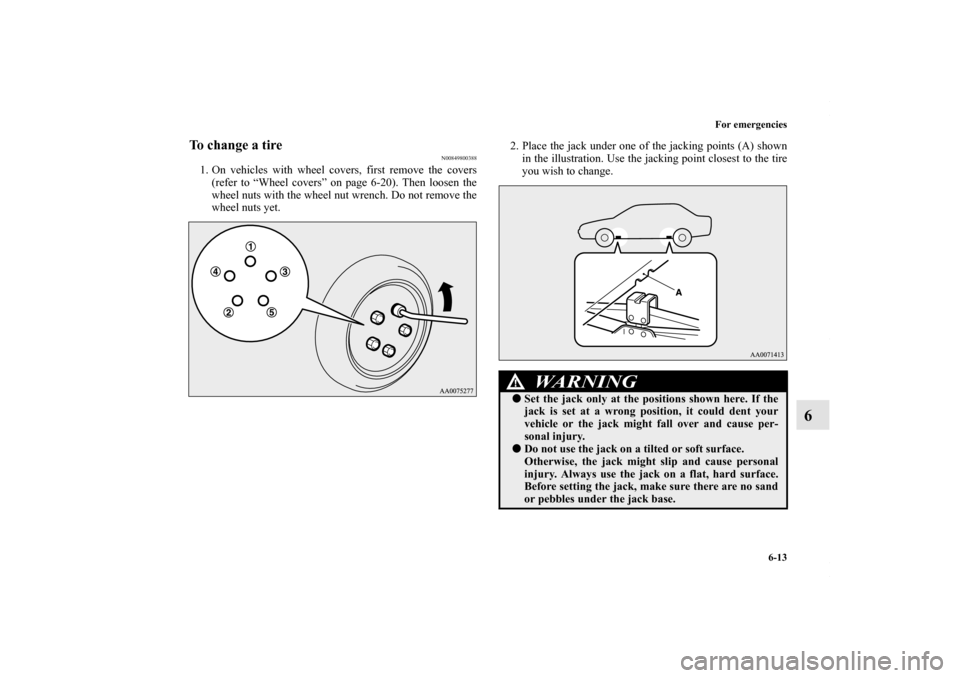
1. On vehicles with wheel covers, first remove the covers
(refer to “Wheel covers” on page 6-20). Then loosen the
wheel nuts with the wheel nut wrench. Do not remove the
wheel nuts yet.2. Place the jack under one of the jacking points (A) shown
in the illustration. Use the jacking point closest to the tire
you wish to change.
WARNING
!�Set the jack only at the positions shown here. If the
jack is set at a wrong position, it could dent your
vehicle or the jack might fall over and cause per-
sonal injury. �Do not use the jack on a tilted or soft surface.
Otherwise, the jack might slip and cause personal
injury. Always use the jack on a flat, hard surface.
Before setting the jack, make sure there are no sand
or pebbles under the jack base.
BK0102103US.book 13 ページ 2009年10月26日 月曜日 午後1時38分
Page 531 of 670
6-14 For emergencies
6
3. Rotate the jack by hand until the flange portion (B) fits in
the groove (C) at the top of the jack. 4. Insert the bar (D) into the wheel nut wrench (E). Then put
the end of the bar into the shaft’s jack end, as shown in the
illustration.
Slowly rotate the wheel nut wrench until the tire is raised
slightly off the ground surface.
WARNING
!�Stop jacking up the vehicle as soon as the tire is
raised off the ground. It is dangerous to raise the
vehicle any higher. �Never get under the vehicle or put any portion of
your body under the vehicle while it is supported by
the jack. �Do not bump the raised vehicle or leave it sitting on
the jack for a long time. Both are very dangerous. �Do not use a jack except the one that came with your
vehicle.
BK0102103US.book 14 ページ 2009年10月26日 月曜日 午後1時38分
Page 532 of 670
For emergencies
6-15
6
5. Remove the wheel nuts with the wheel nut wrench, then
take the wheel off. 6. Clean out any mud, etc. on the hub surface (F), hub bolts
(G) or in the installation holes (H) in the wheel, and then
mount the spare tire.�The jack should not be used for any purpose other
than to change a tire. �No one should be in your vehicle when using the
jack. �Do not start or run the engine while your vehicle is
on the jack.�Do not turn the raised wheel. The tires that are still
on the ground could turn and make your vehicle fall
off the jack.
CAUTION
!�Handle the wheel carefully when changing the tire,
to avoid scratching the wheel surface.
WARNING
!
BK0102103US.book 15 ページ 2009年10月26日 月曜日 午後1時38分
Page 533 of 670
6-16 For emergencies
6
7. [Vehicle with steel wheels]
• Normal wheels and compact spare wheel
Install the wheel nuts (tapered nuts) with their tapered
ends facing inward, then tighten by hand until the wheel is
no longer loose.
WARNING
!�Mount the spare wheel with the valve stem (I) facing
outboard. If you cannot see the valve stem (I), you
have installed the wheel backwards.
Operating the vehicle with the spare wheel installed
backwards can cause vehicle damage and result in
an accident.
BK0102103US.book 16 ページ 2009年10月26日 月曜日 午後1時38分
Page 540 of 670

For emergencies
6-23
6
Towing the vehicle by a tow truck
Towing manual transaxle vehicles with rear wheels off
the ground (Type B)Place the gearshift lever in the “Neutral” position.
Turn the ignition switch to the “ACC” position and secure the
steering wheel in a straight-ahead position with a rope or tie-
down strap. Never place the ignition switch in the “LOCK”
position when towing.Towing with front wheels off the ground (Type C)Release the parking brake.
Place the gearshift lever in the “Neutral” position (manual
transaxle) or the selector lever in the “N” (NEUTRAL) posi-
tion (CVT).
CAUTION
!�This vehicle must not be towed by a tow truck using
sling lift type equipment (Type A) as illustrated.
Using a sling lift will damage the bumper and front
end.�Do not tow all-wheel drive vehicles with the front or
rear wheels on the ground (Type B or Type C) as
illustrated. This could result in the driving system
damage or vehicle may jump at the carriage.
If you tow all-wheel drive vehicles, use Type D or
Type E equipment.�Do not tow continuously variable transmission
(CVT) vehicles with the driving wheels on the
ground (Type B) as illustrated. If the vehicle is
towed like this, the continuously variable transmis-
sion (CVT) fluid may not reach all parts of the
transmission, thus damaging it.
If you tow CVT vehicles, use Type C, D or E equip-
ment.�If the manual transaxle is malfunctioning or dam-
aged, transport the vehicle with the driving wheels
on a carriage (Type C, D or E) as illustrated.
�[For front-wheel drive vehicle equipped with the
active stability control (ASC)]
If the vehicle is towed with the ignition switch in the
“ON” position and only the front wheels raised off
the ground (Type C), the ASC may operate, result-
ing in an accident. When towing the vehicle with the
front wheels raised, keep the ignition switch in the
“LOCK” or “ACC” position.
WARNING
!�To prevent entry of exhaust gas from the towing
vehicle, set the selection switch to the recirculation
position.
CAUTION
!
BK0102103US.book 23 ページ 2009年10月26日 月曜日 午後1時38分


![MITSUBISHI LANCER 2010 8.G Owners Manual 6-16 For emergencies
6
7. [Vehicle with steel wheels]
• Normal wheels and compact spare wheel
Install the wheel nuts (tapered nuts) with their tapered
ends facing inward, then tighten by hand until](/manual-img/19/7448/w960_7448-532.png "MITSUBISHI LANCER 2010 8.G Owners Manual 6-16 For emergencies
6
7. [Vehicle with steel wheels]
• Normal wheels and compact spare wheel
Install the wheel nuts (tapered nuts) with their tapered
ends facing inward, then tighten by hand until")