Page 552 of 670

Vehicle care and maintenance
7-9
7
Vehicles with turbocharger
NOTE�Engine oil consumption is greatly influenced by payload,
engine speed, etc.
�The engine oil will deteriorate rapidly if the vehicle is
subjected to severe conditions (for example, repeated
operation on rough roads, in mountainous regions, on
roads with many uphill and downhill gradients, or over
short distances). Consequently, the oil will require earlier
replacement in accordance with the schedule in the
“WARRANTY AND MAINTENANCE MANUAL”.
CAUTION
!�Overfilling the crankcase will cause oil aeration and
loss of oil pressure, which could damage the engine.�For vehicles with turbocharger, engine oil must be
properly maintained to avoid engine and/or turbo-
charger damage. To better protect your engine and
turbocharger, use fully synthetic engine oil.
Good
WARNING
!�Used engine oil is poisonous, and can damage your
skin. Prolonged and repeated contact may cause
serious skin disorders, including dermatitis and can-
cer. Don’t let used oil touch your skin. Wash thor-
oughly after working with it.�Keep used oil out of the reach of children.
BK0102103US.book 9 ページ 2009年10月26日 月曜日 午後1時38分
Page 553 of 670
7-10 Vehicle care and maintenance
7
Engine oil identification markMitsubishi Motors recommends using only engine oils with the
ILSAC certification symbol on the front of the container.If you cannot find oils with the ILSAC certification symbol,
use an API classification SM or higher oil with the following
label.
This mark appears on the top of the oil container and tells you
two important things about the oil.ILSAC certification symbol
1- The top portion shows the quality of the oil.
2- The center portion shows the SAE grade of the oil viscosity.API service symbol
BK0102103US.book 10 ページ 2009年10月26日 月曜日 午後1時38分
Page 554 of 670
Vehicle care and maintenance
7-11
7
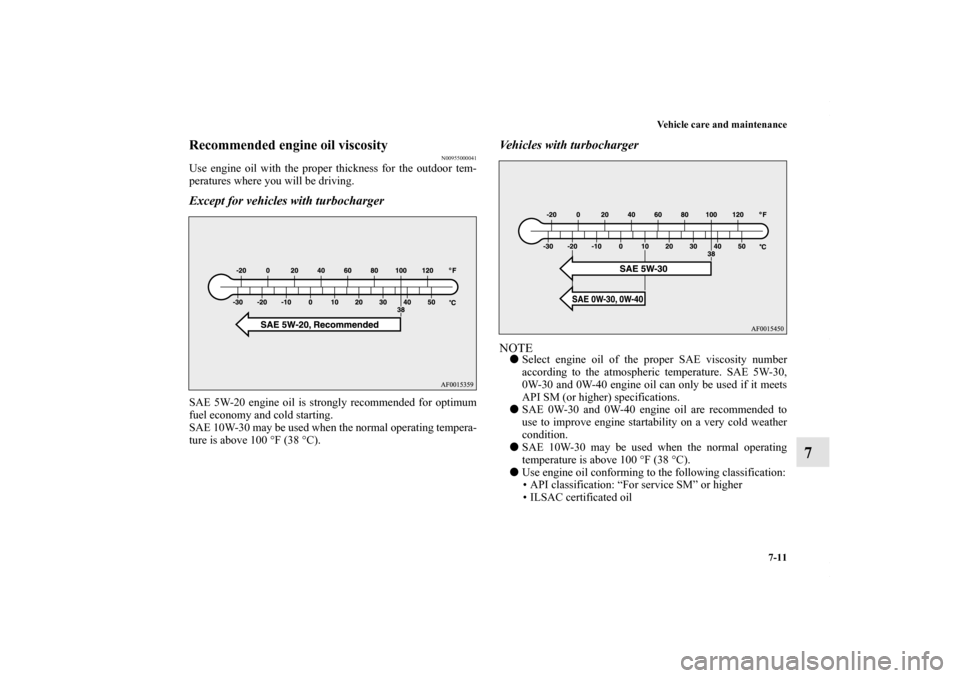
Recommended engine oil viscosity
N00955000041
Use engine oil with the proper thickness for the outdoor tem-
peratures where you will be driving.Except for vehicles with turbochargerSAE 5W-20 engine oil is strongly recommended for optimum
fuel economy and cold starting.
SAE 10W-30 may be used when the normal operating tempera-
ture is above 100 °F (38 °C).
Vehicles with turbochargerNOTE�Select engine oil of the proper SAE viscosity number
according to the atmospheric temperature. SAE 5W-30,
0W-30 and 0W-40 engine oil can only be used if it meets
API SM (or higher) specifications.
�SAE 0W-30 and 0W-40 engine oil are recommended to
use to improve engine startability on a very cold weather
condition.
�SAE 10W-30 may be used when the normal operating
temperature is above 100 °F (38 °C).
�Use engine oil conforming to the following classification:
• API classification: “For service SM” or higher
• ILSAC certificated oil
BK0102103US.book 11 ページ 2009年10月26日 月曜日 午後1時38分
Page 555 of 670
7-12 Vehicle care and maintenance
7
To replace the oil filter
N00955100013
The oil filter should be replaced at the time or mileage speci-
fied in the “WARRANTY AND MAINTENANCE MAN-
UAL”.
Only use high quality replacement filters on this vehicle. The
manufacturer’s specifications for Genuine Mitsubishi oil filters
require that the filter can withstand a pressure of 256 psi
(1.8 MPa). A Genuine Mitsubishi oil filter is the best replace-
ment filter.
Follow the installation instructions printed on the filter.
Engine coolant
N00937800467
To check the coolant level The coolant reserve tank (A) lets you quickly see when you
need to add coolant. When the engine is cold, the level in the
reserve tank should be between the “FULL” and “LOW”
marks. The radiator usually stays full so there is no reason to
remove the radiator cap (B) except when you check the coolant
freeze point or replace the antifreeze coolant.
BK0102103US.book 12 ページ 2009年10月26日 月曜日 午後1時38分
Page 557 of 670

7-14 Vehicle care and maintenance
7
Radiator capThe radiator cap must be tight sealed to prevent losing coolant
which may result in engine damage. Only use a Genuine
Mitsubishi Parts radiator cap, or an approved equivalent.
Points to remember �Do not overfill the reserve tank.
�Your vehicle uses a special radiator cap that stays sealed
and lets the coolant flow from the reserve tank back to the
radiator when the engine cools down. If you need to
change the cap, use the exact same kind.
�Check the coolant freeze point in the radiator with the
proper gauge, and only when it is safe. If you add anti-
freeze, the contents of the reserve tank must be protected
against freezing.
�Keep the front of the radiator and condenser clean.
�If the temperature of the engine coolant does not rise after
the engine is warmed-up, take your vehicle to an autho-
rized Mitsubishi Motors dealer or a repair facility of your
choice to have the thermostat checked, and replaced if
necessary.
�Do not top off the tank with plain water only. Water
by itself boils at a lower temperature and does not
stop rust or freezing. If the water freezes, it will
damage your cooling system. Do not use tapwater. It
can cause corrosion and rust.
WARNING
!�Wait for the engine to cool down before opening the
radiator cap. Otherwise hot steam or boiling coolant
could spray up from the radiator and scald you.
CAUTION
!
BK0102103US.book 14 ページ 2009年10月26日 月曜日 午後1時38分
Page 585 of 670

7-42 Vehicle care and maintenance
7
Fuel hoses
N00941000037
Check the hose surfaces for any heat and mechanical damage,
hard and brittle rubber, cracking, tears, cuts and abrasions. Pay
special attention to the hoses closest to high heat sources such
as the exhaust manifold. Check all the hose connections, such
as clamps and couplings, to make sure they are secure and that
there are no leaks. If you see any wear or damage, replace the
hoses immediately.Ignition cables
N00941100041
The ignition cables should be kept clean, properly connected,
and fully seated. Terminals should be fully seated and the nip-
ple assemblies should not be removed from the coil towers
unless the nipples are damaged or cable testing indicates high
resistance or broken insulation. Cracked or damaged cables
must be replaced.Intake valve clearance
N00950100050
Have the valve clearance checked at an authorized Mitsubishi
Motors dealer at the mileage specified in the “WARRANTY
AND MAINTENANCE MANUAL”.
If the engine sounds abnormally loud, have adjustments made
by an authorized Mitsubishi Motors dealer.
Fuel system (tank, pipe line and connection, and
fuel tank filler cap)
N00941300085
Check these regularly for damage or leaks in the fuel lines and
connections. Check the fuel tank filler cap for damage or loose-
ness. Pay special attention to the fuel lines closest to high heat
sources such as the exhaust manifold.Evaporative emission control system (except
evaporative emission canister)
N00941400116
If the fuel-vapor vent line is clogged or damaged, the fuel-
vapor mixture will escape, polluting the air.
Have the system checked at an authorized Mitsubishi Motors
dealer at the mileage specified in the “WARRANTY AND
MAINTENANCE MANUAL”.
WARNING
!�If you see a fuel leak or if you smell fuel, do not run
the engine. Any spark (including from the ignition),
flame or smoking material could cause an explosion
or fire. Call an authorized Mitsubishi Motors dealer
or a repair facility of your choice for assistance.
BK0102103US.book 42 ページ 2009年10月26日 月曜日 午後1時38分
Page 588 of 670

Vehicle care and maintenance
7-45
7
Exhaust system
N00942200108
The best way to keep carbon monoxide gas from entering
inside your vehicle is to have the engine exhaust system prop-
erly serviced.
Have a competent mechanic inspect the complete exhaust sys-
tem and nearby body areas for broken, damaged, deteriorated,
or mispositioned parts if you notice any of the following:
�A change in the sound of the exhaust system
�The smell of exhaust fumes inside the vehicle
�The underside or rear of the vehicle is damaged
Also check the exhaust system each time the vehicle is raised
for lubrication, oil changes, or required service. Any open
seams or loose connections could let dangerous exhaust fumes
seep into the luggage compartment and passenger compart-
ments. Check for any of the following conditions: �Check for holes or exhaust gas leaks caused by corrosion
or damage.
�Check the joints and connections for looseness or exhaust
gas leaks.
�Check the rubber hangers and brackets for damage.
Hood lock release mechanism and safety catch
N00942500114
The hood lock release mechanism and hood safety catch should
be checked, cleaned, and oiled when needed for easy move-
ment and to stop rust and wear. Use Multipurpose Grease
NLGI Grade 2 sparingly for all sliding parts of the hood latch
and release lever. Work the grease into the hood lock mecha-
nism until all the movable surfaces are covered.
Also, put a light coat of the same grease on the safety catch
wherever moving parts touch.
WARNING
!�Carbon monoxide gas from your vehicle’s exhaust is
poisonous. Breathing these fumes can cause uncon-
sciousness or death.
BK0102103US.book 45 ページ 2009年10月26日 月曜日 午後1時38分
Page 595 of 670

7-52 Vehicle care and maintenance
7
No.
Symbol
Electrical system
Capacity
1 Front fog lights 15 A
2 Engine 7.5 A
3 Automatic transaxle 20 A
4 Horn 10 A
5 Alternator 7.5 A
6 Headlight washer 20 A
7 Air conditioning 10 A
8/ETV/Oil cooler
fan (Twin
Clutch SST)Except for
vehicles with
turbocharger
15 A
ETVVehicles with
turbocharger
9 Security horn 20 A
10 Wiper deicer 15 A
11 — — —
12 Power gate 30 A
13 Daytime running lights 10 A
14Headlight
(high beam) (left)10 A
15Headlight
(high beam) (right)10 A
16Headlight
(low/high
beam) (left)Discharge 20 A
17Headlight
(low/high
beam) (right)Discharge 20 A
18Headlight
(low beam)
(left)Halogen 10 A
19Headlight
(low beam)
(right)Halogen 10 A
20ENG/POWERExcept for
vehicles with
turbocharger
10 A
I/C SPRAYVehicles with
turbocharger
21 Ignition coil 10 A
22ENG/POWERVehicles with
turbocharger20 A
ENG/POWERExcept for
vehicles with
turbocharger20 A
Fuel line heater 25 ANo.
Symbol
Electrical system
Capacity
BK0102103US.book 52 ページ 2009年10月26日 月曜日 午後1時38分

