2010 MITSUBISHI L200 turn off air bag
[x] Cancel search: turn off air bagPage 3 of 369

Instruments and Controls (Driver’s area)
E00100106135 1. Combination headlamps and dipper switch p. 3-30
Turn-signals lever p. 3-33
Front fog lamp switch* p. 3-34
Rear fog lamp switch* p. 3-35
Headlamp washer switch* p. 3-39
2.
Audio remote control switches* p. 5-40
3. Instruments p. 3-02
4. Wiper and washer switch p. 3-36
5. Cruise control switches* p. 4-50
6. Supplemental restraint system (SRS) - airbag (for driver’s seat)* p. 2-27
Horn switch p. 3-40
7. Ignition switch p. 4-11
8. Hands-free & voice recognition switches* p. 5-51
9. Steering wheel height adjustment p. 4-09
10. Fuel tank filler door release lever* p. 02
11. Bonnet release lever p. 8-03
12. Fuses p. 8-20
13. Active stability control (ASC) OFF switch Type 2* p. 4-48
14. Headlamp levelling switch* p. 3-32
15. Active stability control (ASC) OFF switch Type 1* p. 4-48 Rear differential lock switch* p. 4-35
16. Outside rear-view mirrors switch* p. 4-10 OverviewLHD
OCRE12E1
Page 4 of 369

1. Supplemental restraint system (SRS) - airbag (for driver’s
seat) p. 2-27
Horn switch p. 3-40
2.
Audio remote control switches* p. 5-40
3. Combination headlamps and dipper switch p. 3-30 Turn-signals lever p. 3-33
Front fog lamp switch* p. 3-34
Rear fog lamp switch* p. 3-35
Headlamp washer switch* p. 3-39
4. Cruise control switches* p. 4-50
5. Instruments p. 3-02
6. Wiper and washer switch p. 3-36
7. Ignition switch p. 4-11
8. Outside rear-view mirrors switch* p. 4-10
9. Active stability control (ASC) OFF switch Type 1* p. 4-48 Rear differential lock switch* p. 4-35
10. Headlamp levelling switch* p. 3-32
11. Active stability control (ASC) OFF switch Type 2* p. 4-48
12. Fuses p. 8-20
13. Bonnet release lever p. 8-03
14. Fuel tank filler door release lever* p. 02
15. Steering wheel height adjustment p. 4-09
16. Hands-free & voice recognition switches* p. 5-51 OverviewRHD
OCRE12E1
Page 58 of 369

Child restraint
E00406401297
When
transporting children in your vehicle, some
type of child restraint system should always be
used according to the size of the child. This is re-
quired by law in most countries.
The regulations concerning driving with children in
the front seat may differ from country to country.
You are advised to comply with the relevant regula-
tions. WARNING
l When
possible, put children in the rear
seat. Accident statistics indicate that chil-
dren of all sizes and ages are safer when
properly restrained in the rear seat rath-
er than in the front seat. (Double cab and
Club cab)
l Holding a child in your arms is no substi-
tute for a restraint system. Failure to use
a proper restraint system can result in se-
vere or fatal injury to the child.
l Each child restraint device or fixing is to
be used only by one child.
l When attaching a child restraint to the
rear seat, place the front seatbacks in the
upright position.
Otherwise, the child could be seriously in-
jured in the event of hard braking or a col-
lision. (Double cab and Club cab) Caution for installing the child re-
straint on vehicles with a front passen-
ger airbag
E00406500190
The
label shown here is attached on vehicles with a
front passenger airbag. WARNING
l Extreme Hazard!
Do
not use a rearward facing child re-
straint on a seat protected by an airbag in
front of it!
l A REARWARD FACING CHILD RE-
STRAINT must NOT be used in the front
passenger seat if the front passenger’s air-
bag has not been deactivated. The force
of an inflating airbag could kill or cause
serious injuries to the child.
Front passenger’s airbag ON NOTE
l If
you have a rearward facing child restraint
system that cannot be fitted to any seat other
than the front passenger seat, be sure to turn
OFF the front passenger’s airbag ON-OFF
switch before using it. (Refer to “To turn an
airbag off” on page 2-30.)
Front passenger’s airbag OFF Seat and seat belts
2-13 2
OCRE12E1
Page 73 of 369

WARNING
bags may not protect you properly, and
could cause serious or fatal injuries when
it inflates. • Before driving, adjust the driver’sseat as far back as possible while still
maintaining complete control of the ve-
hicle.
• Before driving, adjust the front passen- ger seat as far back as possible.
• Make sure all vehicle occupants are al- ways properly restrained using the
available seat belts.
• With seat belts properly fastened, the driver and passengers should sit well
back and upright without leaning
against the window or door.
l Do not sit on the edge of the seat, or lean
head or chest close to the steering wheel
or instrument panel.
Do not put feet or legs on or against the
instrument panel. WARNING
l Infants and small children should never
be unrestrained, stand up against the in-
strument panel or be held in your arms
or on your lap. They could be seriously in-
jured or killed in a collision, including
when the airbag inflates. They should be
properly seated in an appropriate child re-
straint system. See the “Child restraint”
section of this owner’s manual. WARNING
l A
REARWARD FACING CHILD RE-
STRAINT must NOT be used in the front
passenger seat if the front passenger’s air-
bag has not been deactivated. The force
of an inflating airbag could kill or cause
serious injuries to the child.
Front passenger’s airbag ON NOTE
l If
you have a rearward facing child restraint
system that cannot be fitted to any seat other
than the front passenger seat, be sure to turn
OFF the front passenger’s airbag ON-OFF
switch before using it. (Refer to “To turn an
airbag off” on page 2-30.)
Front passenger’s airbag OFF Seat and seat belts
2-28
2
OCRE12E1
Page 75 of 369
The airbags will operate only when the ignition
switch is in the “ON” or “START” position.
When
the airbag control unit detect an impact of suf-
ficient frontal or side force, it sends an ignition sig-
nal to the airbag modules to ignite materials in the
inflator and generate gas and inflate the airbags.
The airbags deployment produces a sudden, loud
noise, and releases some smoke and powder, but
these conditions are not injurious, and do not indi-
cate a fire in the vehicle. People with respiratory
problems may feel some temporary irritation from
chemicals used to produce the deployment; open
the windows after airbag deployment, if safe to do
so.
The airbags deflate very rapidly after deployment,
so there is little danger of obscured vision.
The time required from the sensors detecting an im-
pact to deflation of the airbags after deployment is
shorter than a blink of an eye. CAUTION
l
Airbags
inflate at an extremely rapid
speed. In certain situations, contact with
inflating airbags can result in abrasions,
light cuts, bruises, and the like.
Front passenger’s airbag ON-OFF
switch E00410100184
The front passenger’s airbag ON-OFF switch can
be
used to disable the front passenger’s airbag. If
you have a rearward facing child restraint system
that cannot be fitted to any seat other than the front
passenger seat, be sure to turn OFF the front passen-
ger’s airbag ON-OFF switch before using it. (Refer
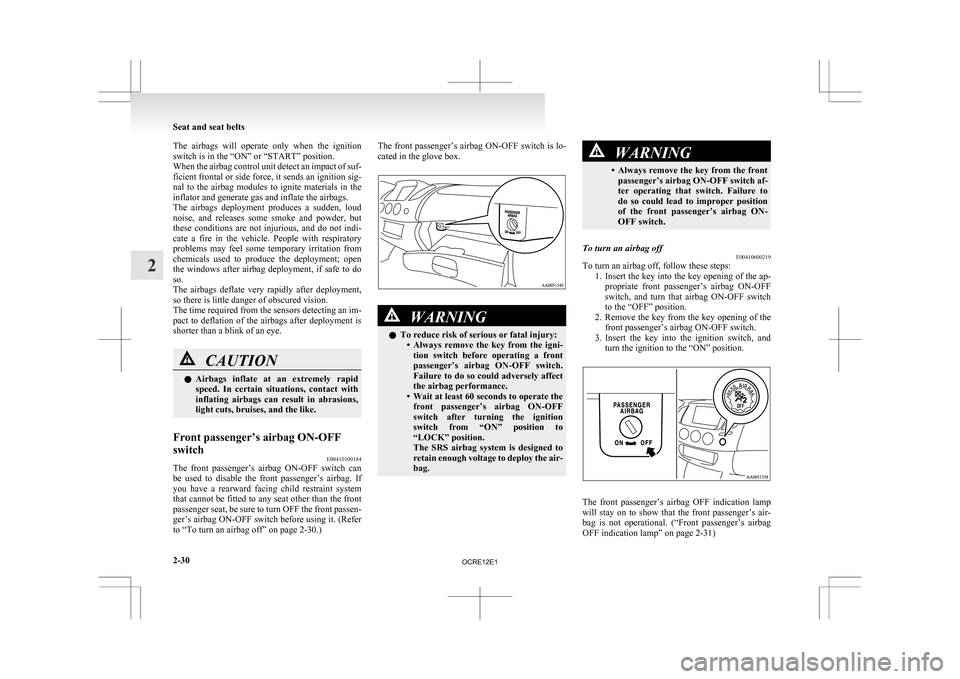
to “To turn an airbag off” on page 2-30.) The front passenger’s airbag ON-OFF switch is lo-
cated in the glove box.
WARNING
l To reduce risk of serious or fatal injury:
• Always
remove the key from the igni-
tion switch before operating a front
passenger’s airbag ON-OFF switch.
Failure to do so could adversely affect
the airbag performance.
• Wait at least 60 seconds to operate the front passenger’s airbag ON-OFF
switch after turning the ignition
switch from “ON” position to
“LOCK” position.
The SRS airbag system is designed to
retain enough voltage to deploy the air-
bag. WARNING
• Always
remove the key from the front passenger’s airbag ON-OFF switch af-
ter operating that switch. Failure to
do so could lead to improper position
of the front passenger’s airbag ON-
OFF switch.
To turn an airbag off E00410600219
To turn an airbag off, follow these steps:
1. Insert
the key into the key opening of the ap-
propriate front passenger’s airbag ON-OFF
switch, and turn that airbag ON-OFF switch
to the “OFF” position.
2. Remove the key from the key opening of the front passenger’s airbag ON-OFF switch.
3. Insert the key into the ignition switch, and turn the ignition to the “ON” position. The front passenger’s airbag OFF indication lamp
will
stay on to show that the front passenger’s air-
bag is not operational. (“Front passenger’s airbag
OFF indication lamp” on page 2-31) Seat and seat belts
2-30
2
OCRE12E1
Page 76 of 369

That airbag will remain OFF, and will NOT de-
ploy, until it is turned ON again.
WARNING
l To reduce risk of serious or fatal injury:
• If the indication lamp does not come
on when the front passenger’s airbag
ON-OFF switch is turned OFF, do not
fit a rearward facing child restraint
system to the front passenger seat.
• Do not turn OFF the front passen- ger’s airbag ON-OFF switch except
when a rearward facing child re-
straint system is fitted to the front pas-
senger seat.
To turn an airbag on E00410700106
To turn an airbag on, follow these steps:
1. Insert
the key into the key opening of the ap-
propriate front passenger’s airbag ON-OFF
switch, and turn that airbag ON-OFF switch
to “ON” position.
2. Remove the key from the key opening of that front passenger’s airbag ON-OFF switch. 3. Insert
the key into the ignition switch, and
turn the ignition to the “ON” position. The front passenger’s airbag OFF indication lamp
goes
off to show that the front passenger’s airbag is
operational.
That airbag will remain ON, and will be ready to
deploy, until it is again turned OFF. WARNING
l To reduce risk of serious or fatal injury:
• Turn
ON the front passenger’s airbag
ON-OFF switch immediately after re-
moving a rearward facing child re-
straint system from the front passen-
ger seat.
• If the indication lamp remains on when the front passenger’s airbag
ON-OFF switch is turned ON, do not
allow anyone to sit on the front passen-
ger seat. Front passenger’s airbag OFF indica-
tion lamp
E00410200257
The
front passenger’s airbag OFF indication lamp
is located in the instrument panel. When the front passenger’s airbag ON-OFF switch
is
turned OFF, the indication lamp will stay on to
show that the front passenger’s airbag is not opera-
tional.
When the front passenger’s airbag ON-OFF switch
is turned ON, the indication lamp goes off to show
that the front passenger’s airbag is operational. WARNING
l If
the indication lamp behaves in any of
the following ways, there may be a fault
in the airbag system.
Have the vehicle inspected at a
MITSUBISHI MOTORS Authorized
Service Point as soon as possible. Seat and seat belts
2-31 2
OCRE12E1
Page 77 of 369

WARNING
• The indication lamp does not come on when the front passenger’s airbag ON-
OFF switch is turned OFF.
• The indication lamp stays on when the front passenger’s airbag ON-OFF
switch is turned ON. WARNING
l Do not fit any accessory that makes the in-
dication lamp impossible to see, and do
not cover the indication lamp with a stick-
er. You would not be able to verify the sta-
tus of the passenger airbag system.
Driver’s and passenger’s front airbag
system E00407400330
The driver’s airbag is located under the padded cov-
er
in the middle of the steering wheel. The front pas-
senger’s airbag is contained in the instrument panel
above the glove box. The driver’s airbag and the front passenger’s air-
bag
are designed to inflate at the same time even if
the passenger seat is not occupied. Deployment of front airbags
E00407501354
The front airbags ARE DESIGNED TO DEPLOY
when…
Head-on collision with a solid wall at speed of
approximately 25 km/h (16 mph) or higher Moderate to severe frontal impact within the shaded
area between the arrowsSeat and seat belts
2-32
2
OCRE12E1