2010 MITSUBISHI L200 clutch
[x] Cancel search: clutchPage 178 of 369
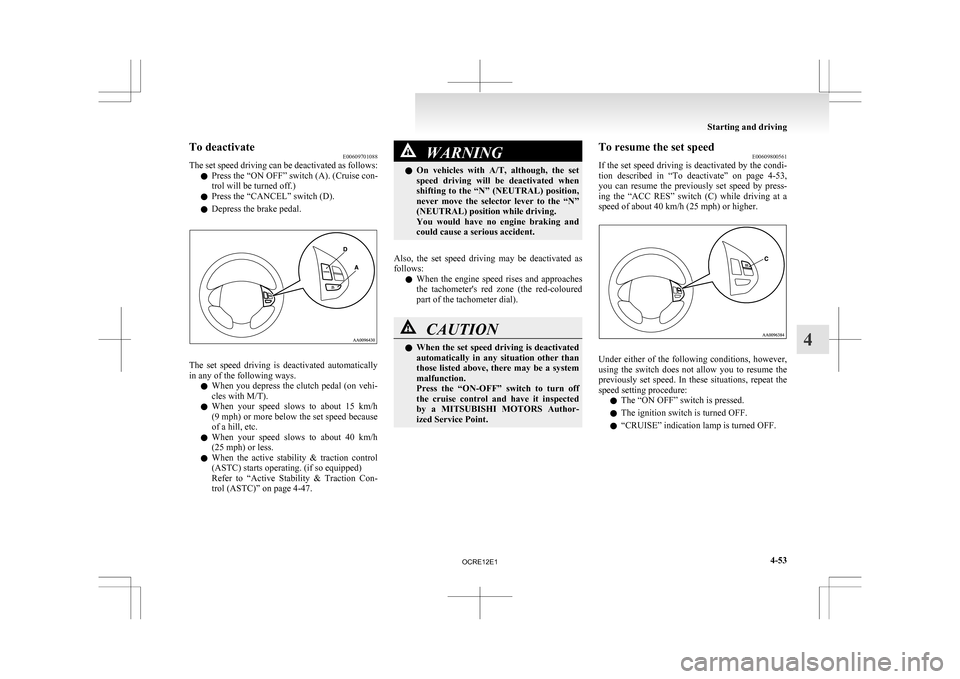
To deactivate
E00609701088
The
set speed driving can be deactivated as follows:
l Press the “ON OFF” switch (A). (Cruise con-
trol will be turned off.)
l Press the “CANCEL” switch (D).
l Depress the brake pedal. The set speed driving is deactivated automatically
in any of the following ways.
l When
you depress the clutch pedal (on vehi-
cles with M/T).
l When your speed slows to about 15 km/h
(9 mph) or more below the set speed because
of a hill, etc.
l When your speed slows to about 40 km/h
(25 mph) or less.
l When the active stability & traction control
(ASTC) starts operating. (if so equipped)
Refer to “Active Stability & Traction Con-
trol (ASTC)” on page 4-47. WARNING
l On
vehicles with A/T, although, the set
speed driving will be deactivated when
shifting to the “N” (NEUTRAL) position,
never move the selector lever to the “N”
(NEUTRAL) position while driving.
You would have no engine braking and
could cause a serious accident.
Also, the set speed driving may be deactivated as
follows: l When
the engine speed rises and approaches
the tachometer's red zone (the red-coloured
part of the tachometer dial). CAUTION
l
When
the set speed driving is deactivated
automatically in any situation other than
those listed above, there may be a system
malfunction.
Press the “ON-OFF” switch to turn off
the cruise control and have it inspected
by a MITSUBISHI MOTORS Author-
ized Service Point. To resume the set speed
E00609800561
If
the set speed driving is deactivated by the condi-
tion described in “To deactivate” on page 4-53,
you can resume the previously set speed by press-
ing the “ACC RES” switch (C) while driving at a
speed of about 40 km/h (25 mph) or higher. Under either of the following conditions, however,
using
the switch does not allow you to resume the
previously set speed. In these situations, repeat the
speed setting procedure:
l The “ON OFF” switch is pressed.
l The ignition switch is turned OFF.
l “CRUISE” indication lamp is turned OFF. Starting and driving
4-53 4
OCRE12E1
Page 181 of 369
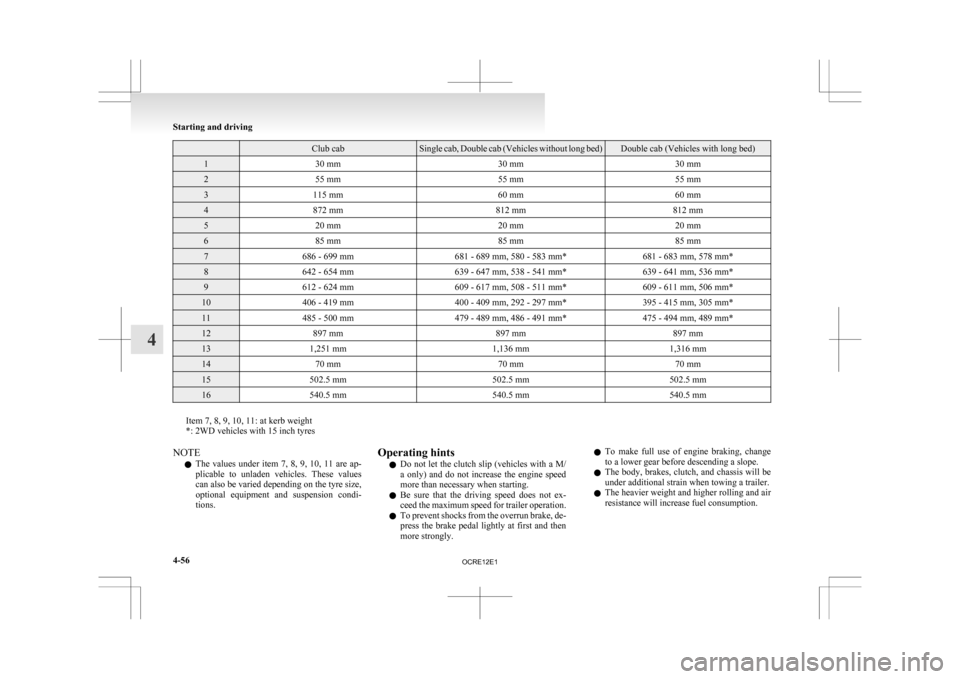
Club cab Single cab, Double cab (Vehicles without long bed) Double cab (Vehicles with long bed)
1
30 mm 30 mm30 mm2
55 mm 55 mm55 mm3
115 mm 60 mm60 mm4
872 mm 812 mm812 mm5
20 mm 20 mm20 mm6
85 mm 85 mm85 mm7
686 - 699 mm 681 - 689 mm, 580 - 583 mm* 681 - 683 mm, 578 mm*8
642 - 654 mm 639 - 647 mm, 538 - 541 mm* 639 - 641 mm, 536 mm*9
612 - 624 mm 609 - 617 mm, 508 - 511 mm* 609 - 611 mm, 506 mm*10
406 - 419 mm 400 - 409 mm, 292 - 297 mm* 395 - 415 mm, 305 mm*11
485 - 500 mm 479 - 489 mm, 486 - 491 mm* 475 - 494 mm, 489 mm*12
897 mm 897 mm897 mm13
1,251 mm 1,136 mm1,316 mm14
70 mm 70 mm70 mm15
502.5 mm 502.5 mm502.5 mm16
540.5 mm 540.5 mm540.5 mmItem 7, 8, 9, 10, 11: at kerb weight
*: 2WD vehicles with 15 inch tyres
NOTE
l The
values under item 7, 8, 9, 10, 11 are ap-
plicable to unladen vehicles. These values
can also be varied depending on the tyre size,
optional equipment and suspension condi-
tions. Operating hints
l Do
not let the clutch slip (vehicles with a M/
a only) and do not increase the engine speed
more than necessary when starting.
l Be sure that the driving speed does not ex-
ceed the maximum speed for trailer operation.
l To prevent shocks from the overrun brake, de-
press the brake pedal lightly at first and then
more strongly. l
To make full use of engine braking, change
to a lower gear before descending a slope.
l The body, brakes, clutch, and chassis will be
under additional strain when towing a trailer.
l The heavier weight and higher rolling and air
resistance will increase fuel consumption. Starting and driving
4-56
4
OCRE12E1
Page 298 of 369
Service precautions
....................................................................... 8-02
Catalytic converter ........................................................................ 8-02
Bonnet...........................................................................................8-03
Engine oil ......................................................................................8-04
Engine coolant .............................................................................. 8-06
Automatic transmission fluid*
......................................................8-07
Washer fluid ................................................................................. 8-08
Brake fluid .................................................................................... 8-08
Clutch fluid* ................................................................................. 8-09
Power steering fluid ...................................................................... 8-09
Battery .......................................................................................... 8-10
Tyres............................................................................................. 8-11
Clutch pedal free play* ................................................................. 8-15
Brake pedal free play .................................................................... 8-16
Parking brake lever stroke ............................................................ 8-16
Wiper blades ................................................................................. 8-17
General maintenance .................................................................... 8-18
For cold and snowy weather......................................................... 8-19
Fusible links.................................................................................. 8-19
Fuses............................................................................................. 8-20
Replacement of lamp bulbs .......................................................... 8-23Maintenance
8
OCRE12E1
Page 306 of 369
Clutch fluid*
E01001000281
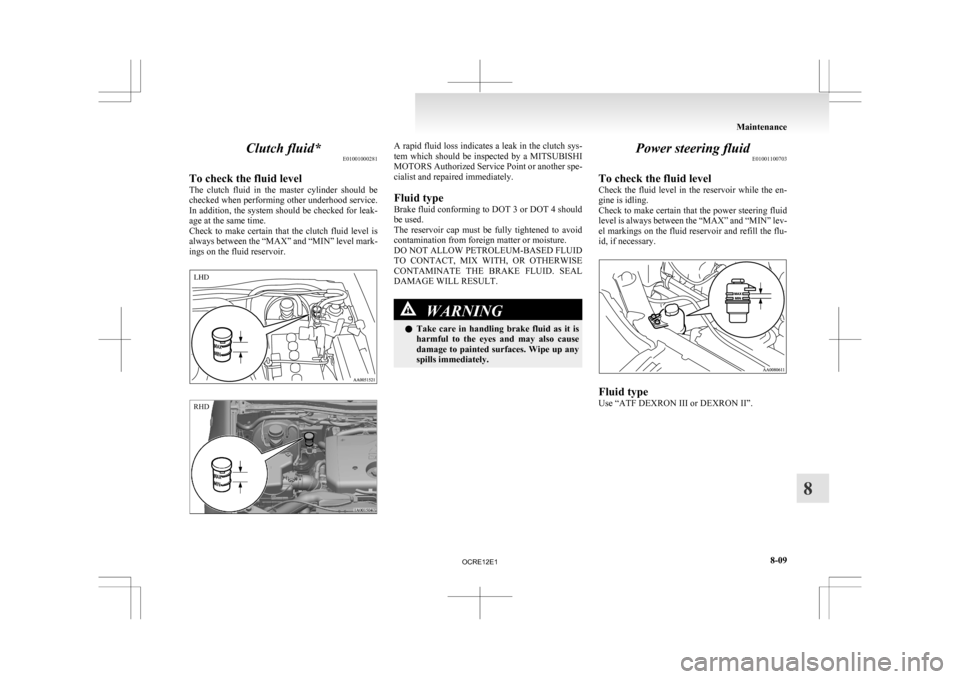
To check the fluid level
The
clutch fluid in the master cylinder should be
checked when performing other underhood service.
In addition, the system should be checked for leak-
age at the same time.
Check to make certain that the clutch fluid level is
always between the “MAX” and “MIN” level mark-
ings on the fluid reservoir. A rapid fluid loss indicates a leak in the clutch sys-
tem
which should be inspected by a MITSUBISHI
MOTORS Authorized Service Point or another spe-
cialist and repaired immediately.
Fluid type
Brake fluid conforming to DOT 3 or DOT 4 should
be used.
The reservoir cap must be fully tightened to avoid
contamination from foreign matter or moisture.
DO NOT ALLOW PETROLEUM-BASED FLUID
TO CONTACT, MIX WITH, OR OTHERWISE
CONTAMINATE THE BRAKE FLUID. SEAL
DAMAGE WILL RESULT. WARNING
l Take
care in handling brake fluid as it is
harmful to the eyes and may also cause
damage to painted surfaces. Wipe up any
spills immediately. Power steering fluid
E01001100703
To check the fluid level
Check
the fluid level in the reservoir while the en-
gine is idling.
Check to make certain that the power steering fluid
level is always between the “MAX” and “MIN” lev-
el markings on the fluid reservoir and refill the flu-
id, if necessary. Fluid type
Use “ATF DEXRON III or DEXRON II”. Maintenance
8-09 8 LHD RHD
OCRE12E1
Page 312 of 369

Before fitting tyre chains, we recommend you to
consult
a MITSUBISHI MOTORS Authorized Serv-
ice Point. The max. chain height is as follows. Tyre size Wheel size Max. chain
height [mm] 195R15C,
215/70R15C *
15x6.0 JJ
22205R16C 16x6.0 JJ
205/80R16 16x6.0 JJ
245/70R16 16x7.0 J
245/65R17 17x7.5 J
* :
215/70R15C size should only be used as snow
tyres. The speed limit for tyre chain is 50 km/h (30
mph)
and remove the tyre chains as soon as possible on
snow free roads. WARNING
l DO
NOT use a jack when fitting the
chains, as in thsee conditions, the tyres
may slip on the icy road causing the vehi-
cle to slip off the jack. CAUTION
l
Practice
fitting the chains before you
need them.
Don’t expect help from other people in
the cold.
l Choose a clear straight stretch of road
where you can pull over and still be seen
while you are fitting the chains. CAUTION
l
Do
not fit chains before you need them.
This will wear out your tyres and the
road surface.
l After driving around 100-300 metres,
stop and retighten the chains.
l Drive carefully and do not exceed
50 km/h (30 mph). Remember, fitting
chains is not going to stop accidents from
happening.
l When tyre chains are installed, take care
that they do not damage the disc wheel or
body.
l An aluminium wheel can be damaged by
a tyre chain while driving. When fitting a
tyre chain on an aluminium wheel, take
care that any part of the chain and fitting
cannot be brought into contact with the
wheel.
l When installing or removing the tyre
chains, take care that hands and other
parts of your body are not injured by the
sharp edges of the vehicle body.
l Install the chains only on the rear tyres
and tighten them as tightly as possible
with the ends securely fastened.
NOTE l The
laws and regulations concerning the use
of tyre chains vary. Find out and follow the
laws and regulations of the area you're driv-
ing in.
In most countries, it is prohibited by law to
use tyre chains on roads without snow. Clutch pedal free play*
E01002200222
Press
down the clutch pedal with your fingers until
initial resistance is felt.
This distance should be within the specified range. A- Free play: 3 to 8 mm
If
the clutch pedal free play is not within the stand-
ard range, we recommend you to have it checked. Maintenance
8-15 8
OCRE12E1
Page 350 of 369

Other specifications
E01101000862Fuel system Fuel control
Direct injection common rail systemFuel pump
Electronic controlled rotary typeClutch
Dry single disc clutch with diaphragm spring, hydraulic actionSteering system
Rack & pinion type, power assistedSuspension Front
Independent type, wishbone, coil springRear
Rigid type, leaf springService brakes Type Vehicles without ABS
Hydraulic, front and rear split double circuit system with power assistance Vehicles with ABS
Hydraulic, diagonal split double circuit system with power assistanceFront
Ventilated disc brakesRear
Drum brakesParking brakes
Parking brake acts mechanically on rear wheels Specifications
9-19 9
OCRE12E1
Page 354 of 369

No. Item Quantity Lubricants
1 Engine coolant
8.2 litres
[includes 0.65 litre in the reserve tank] DIA QUEEN SUPER LONG LIFE
COOLANT or equivalent 2 Automatic transmission fluid
9.7 litresDIA QUEEN ATF SP III3 Brake fluid
As requiredBrake fluid DOT3 or DOT44 Clutch fluid
As requiredBrake fluid DOT3 or DOT45 Power steering fluid
As required ATF DEXRON III or DEXRON II6 Engine oil Oil pan 2WD with 15 inch tyres
6.5 litres
Refer to page 8-04. 2WD with 16 inch tyres, 4WD
5.5 litresOil filter
0.8 litreOil cooler
0.1 litre7 Washer fluid
4.8 litres,
4.5 litres *1
—8 Manual transmis-
sion oil 2WD
2.3 litres
Gear oil API classification GL-3 SAE
75W-85 4WD
3.4 litres9 Transfer oil
2.5 litresGear oil API classification GL-3 SAE
75W-85 or Gear oil API classification GL-4 SAE 75W-85 10 Differential oil Front
*2
1.2 litres
Gear oil API classification GL-5 orhigher SAE 80W Rear Standard power en-
gine 2WD with 15 inch tyres
1.5 litres 2WD with 16 inch tyres, 4WD
2.1 litres High power engine
11 Refrigerant (air conditioning)
480-520 g,
535-575 g *3
HFC-134a
*1 : Vehicles with “front (Type 1)” (Refer to “Outside” on page 8-24)
*2 : 4WD vehicles only
*3 : Double cab with capacity up air conditioning Specifications
9-23 9
OCRE12E1
Page 356 of 369
4
4-wheel drive operation 4-39
AAccessory (Installation) 04
Accessory socket 5-72
Active Stability & Traction Control (ASTC)
4-47
Additional equipment 8-19
Air conditioning Automatic air conditioning 5-08
Important operation tips for the air condition-
ing 5-12
Manual air conditioning 5-03
Air purifier 5-12
Airbag 2-27
Antenna 5-50
Anti-lock brake system (ABS) 4-44 Warning lamp 4-45
Armrest (Double cab) 2-07
Ashtray 5-70
Audio Audio system anti-theft feature 5-48
Error codes 5-42
Handling of compact discs 5-48
LW/MW/FM electronic tuning radio with CD
player 5-13
Steering wheel remote control switch 5-40
Automatic air conditioning 5-08
Automatic transmission 4A/T 4-17 Fluid 8-07,9-22
Overdrive control switch 4-18
Selector lever operation 4-17,4-21
Selector lever position 4-18
Selector lever position indicator 4-17
Automatic transmission Sports Mode 5A/T 4-21 Fluid 8-07,9-22 Selector lever operation 4-21
Selector lever position indicator
4-22
Selector lever positions 4-22
Sports mode 4-23
Sports mode indicator 4-23
B Battery 8-10
Discharged battery (Emergency starting)
6-02
Specification 9-17
Bleeding the fuel system 6-05
Bluetooth® 2.0 interface 5-51
Bonnet 8-03
Bottle holder 5-79
Brake Anti-lock brake 4-44
Brake assist system 4-44
Braking 4-43
Fluid 8-08,9-22
Parking brake 4-07
Parking brake lever stroke 8-16
Pedal free play 8-16
Warning lamp 3-08
C Cargo loads 4-54
Catalytic converter
8-02
Cautions on handling of 4-wheel drive vehi-
cles 4-41
Central door locks 1-07
Centre console downlight 5-75 Bulb capacity 8-24
Replacement 8-34
Centre information display 3-10
Changing a fuse 8-22
Changing gears 4-15
Check engine warning lamp 3-08 Child restraint 2-13
Child-protection rear doors
1-08
Cigarette lighter 5-71
Cleaning Exterior of your vehicle 7-03
Genuine leather 7-02
Interior of your vehicle 7-02
Plastic, vinyl leather, etc 7-02
Sunroof 7-05
Waxing 7-04
Clock 3-19,5-73
Clutch Fluid 8-09,9-22
Pedal free play 8-15
Coat hook 5-80
Combination headlamps and dipper switch 3-30
Convenient hook 5-80
Coolant (engine) 8-06,9-22
Cruise control 4-50 Switch 4-50
Cup holder 5-78
Curtain airbag system 2-35
D Demister (rear window) 3-40
Diesel particulate filter (DPF)
4-14
Differential oil 9-22
Digital clock 3-19,5-73
Dimensions 9-03
Dipper (High/Low beam change) 3-31
Door courtesy lamps 5-75 Replacement 8-33
Doors Central door locks 1-07
Child-protection 1-08
Lock and unlock 1-06
Driving, alcohol and drugs 4-02 Alphabetical index
1
OCRE12E1