2010 MITSUBISHI L200 Interior
[x] Cancel search: InteriorPage 292 of 369
Vehicle care precautions
............................................................... 7-02
Cleaning the interior of your vehicle ............................................7-02
Cleaning the exterior of your vehicle ...........................................7-03Vehicle care
7
OCRE12E1
Page 293 of 369
Vehicle care precautions
E00900100870
In
order to maintain the value of your vehicle, it is
necessary to perform regular maintenance using the
proper procedures. Always maintain your vehicle
in compliance with environmental pollution control
regulations. Carefully select the materials used for
washing, etc., to be sure that they do not contain cor-
rosives. If in doubt, we recommend you to consult
a specialist for selection of these materials. CAUTION
l
Cleaning
products can be dangerous.
Some are poisonous. Others can burst in-
to flame if you strike a match or drop
them on a hot part of the vehicle. Some
are dangerous if you breathe their fumes
in a closed space. When you use anything
in a container to clean your vehicle, al-
ways follow the instructions and always
open your vehicle doors or windows when
you’re cleaning the inside. Never use the
following to clean your vehicle: • Petrol
• Paint Thinner
• Benzine
• Kerosene
• Turpentine
• Naphtha
• Lacquer Thinner
• Carbon Tetrachloride
• Nail Polish Remover
• Acetone
l These are all dangerous, and can damage
your vehicle. Cleaning the interior of your
vehicle E00900200288
After
cleaning the interior of your vehicle with wa-
ter, cleaner or similar, wipe and dry in a shady, well-
ventilated area. CAUTION
l
Do
not use organic substances (solvents,
benzine, kerosene, alcohol, petrol, etc.) or
alkaline or acidic solutions.
These chemicals can cause discolouring,
staining or cracking of the surface.
If you use cleaners or polishing agents,
make sure their ingredients do not in-
clude the substances mentioned above.
NOTE l Always
read the instructions on the cleaner la-
bel.
Plastic, vinyl leather, fabric and
flocked parts E00900300377
1. Gently
wipe off with gauze or other soft
cloth soaked with a 3 % aqueous solution of
neutral detergent.
2. Dip cloth in fresh water and wring out well. Using this cloth, wipe off the detergent thor-
oughly. NOTE
l Do
not use cleaners, conditioners, and protec-
tants containing silicons or wax.
Such products, when applied to the instru-
ment panels or other parts, may cause reflec-
tions on the windscreen and obscure vision.
Also, if such products get on the switches of
the electrical accessories, it may lead to fail-
ure of these accessories.
Upholstery E00900500018
1. To
maintain the value of your new vehicle,
handle the upholstery carefully and keep the
interior clean.
Use a vacuum cleaner and brush to clean the
seats. If stained, vinyl and synthetic leather
should be cleaned with an appropriate clean-
er, and cloth fabrics can be cleaned with ei-
ther upholstery cleaner or a 3 % solution of
neutral detergent in lukewarm water.
2. Clean the carpeting with a vacuum cleaner and remove any stains with carpet cleaner.
Oil and grease can be removed by lightly dab-
bing with a clean colourfast cloth and stain re-
mover.
Genuine leather* E00900600817
1. Gently
wipe off with gauze or other soft
cloth soaked with a 5 % aqueous solution of
neutral detergent.
2. Dip cloth in fresh water and wring it out well. Using this cloth, wipe off the detergent
thoroughly.
3. Apply leather protecting agent to the genuine leather surface. Vehicle care
7-02
7
OCRE12E1
Page 294 of 369

NOTE
l If
genuine leather is wet with water or is wash-
ed in water, wipe off water as quickly as pos-
sible with a dry, soft cloth. If left damp, mil-
dew may grow.
l The genuine leather surface may be damaged
if a nylon brush or synthetic fibre is rubbed
hard against it.
l Organic solvents such as benzine, kerosene,
alcohol and petrol, acid or alkaline solvents
may discolour the genuine leather surface.
Be sure to use neutral detergents.
l Remove dirty patches or oil substances quick-
ly as they can stain genuine leather.
l The genuine leather surface may harden and
shrink if it is exposed to direct sun for long
hours. When your vehicle is parked, place it
in the shade as much as possible.
l When the temperature of the vehicle interior
rises in summer, vinyl products left on the
genuine leather seat may deteriorate and
stick to the seat. Cleaning the exterior of your
vehicle E00900700010
If
the following is left on your vehicle, it may
cause corrosion, discolouration and stains, wash
the vehicle as soon as possible.
l Seawater, anti-freeze for road use.
l Soot and dust, iron powder from factories,
chemical substance (acids, alkalis, coal-tar,
etc.).
l Droppings from birds, carcasses of insects,
tree sap, etc.
Washing E00900902016
Chemicals contained in the dirt and dust picked up
from
the road surface can damage the paint coat
and body of your vehicle if left in prolonged contact.
Frequent washing and waxing is the best way to pro-
tect your vehicle from this damage. This will also
be effective in protecting it from environmental el-
ements such as rain, snow, salt air, etc.
Do not wash the vehicle in direct sunlight. Park the
vehicle in the shade and spray it with water to re-
move dust. Next, using an ample amount of clean
water and a car washing brush or sponge, wash the
vehicle from top to bottom.
Use a mild car washing soap if necessary. Rinse
thoroughly and wipe dry with a soft cloth. After
washing the vehicle, carefully clean the joints and
flanges of the doors, bonnet, etc., where dirt is like-
ly to remain. CAUTION
l
When
washing the under side of your ve-
hicle or wheel, be careful not to injure
your hands.
l Refrain from using a car wash as its brush-
es may scratch the paint surface, causing
it to lose its gloss.
Scratches will be especially visible on
darker coloured vehicles.
l Never spray or splash water on the electri-
cal components in the engine compart-
ment, as this may adversely affect engine
starting.
Exercise caution also when washing the
underbody; be careful not to spray water
into the engine compartment.
l Some types of hot water washing equip-
ment apply high pressure and heat to the
vehicle. They may cause heat distortion
and damage to the vehicle resin parts and
may result in flooding of the vehicle inte-
rior. Therefore; observe the following.
• Maintain a distance of approx. 50 cmor more between the vehicle body and
the washing nozzle.
• When washing around the door glass, hold the nozzle at a distance of more
than 50 cm and at right angles to the
glass surface. Vehicle care
7-03 7
OCRE12E1
Page 315 of 369
NOTE
l Do
not allow the wiper arm to fall onto the
windscreen; it could damage the glass.
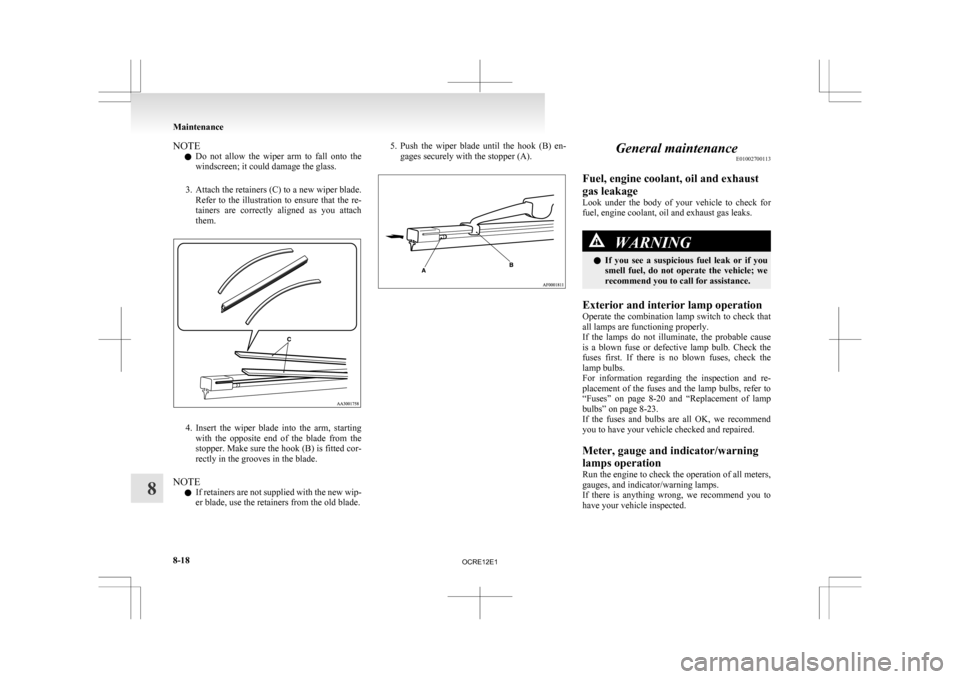
3. Attach the retainers (C) to a new wiper blade. Refer to the illustration to ensure that the re-
tainers are correctly aligned as you attach
them. 4. Insert
the wiper blade into the arm, starting
with the opposite end of the blade from the
stopper. Make sure the hook (B) is fitted cor-
rectly in the grooves in the blade.
NOTE l If retainers are not supplied with the new wip-
er blade, use the retainers from the old blade. 5. Push
the wiper blade until the hook (B) en-
gages securely with the stopper (A). General maintenance
E01002700113
Fuel, engine coolant, oil and exhaust
gas leakage
Look
under the body of your vehicle to check for
fuel, engine coolant, oil and exhaust gas leaks. WARNING
l If
you see a suspicious fuel leak or if you
smell fuel, do not operate the vehicle; we
recommend you to call for assistance.
Exterior and interior lamp operation
Operate
the combination lamp switch to check that
all lamps are functioning properly.
If the lamps do not illuminate, the probable cause
is a blown fuse or defective lamp bulb. Check the
fuses first. If there is no blown fuses, check the
lamp bulbs.
For information regarding the inspection and re-
placement of the fuses and the lamp bulbs, refer to
“Fuses” on page 8-20 and “Replacement of lamp
bulbs” on page 8-23.
If the fuses and bulbs are all OK, we recommend
you to have your vehicle checked and repaired.
Meter, gauge and indicator/warning
lamps operation
Run the engine to check the operation of all meters,
gauges, and indicator/warning lamps.
If there is anything wrong, we recommend you to
have your vehicle inspected. Maintenance
8-18
8
OCRE12E1
Page 333 of 369
Vehicle labeling
E01100101791
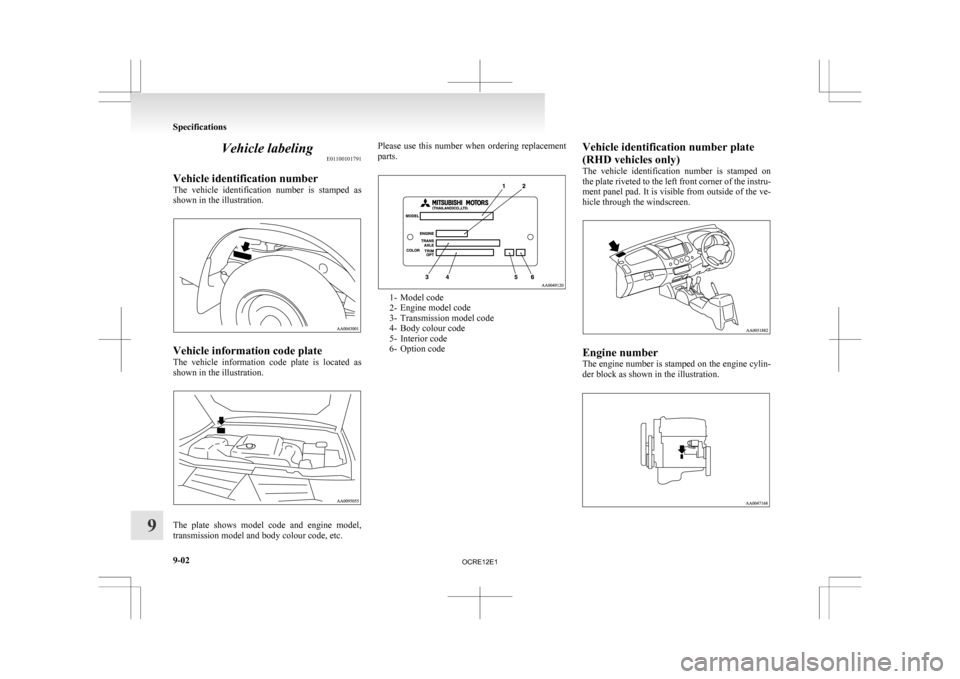
Vehicle identification number
The
vehicle identification number is stamped as
shown in the illustration. Vehicle information code plate
The
vehicle information code plate is located as
shown in the illustration. The plate shows model code and engine model,
transmission model and body colour code, etc. Please use this number when ordering replacement
parts.
1- Model code
2-
Engine model code
3- Transmission model code
4- Body colour code
5- Interior code
6- Option code Vehicle identification number plate
(RHD vehicles only)
The
vehicle identification number is stamped on
the plate riveted to the left front corner of the instru-
ment panel pad. It is visible from outside of the ve-
hicle through the windscreen. Engine number
The
engine number is stamped on the engine cylin-
der block as shown in the illustration. Specifications
9-02
9
OCRE12E1
Page 356 of 369
4
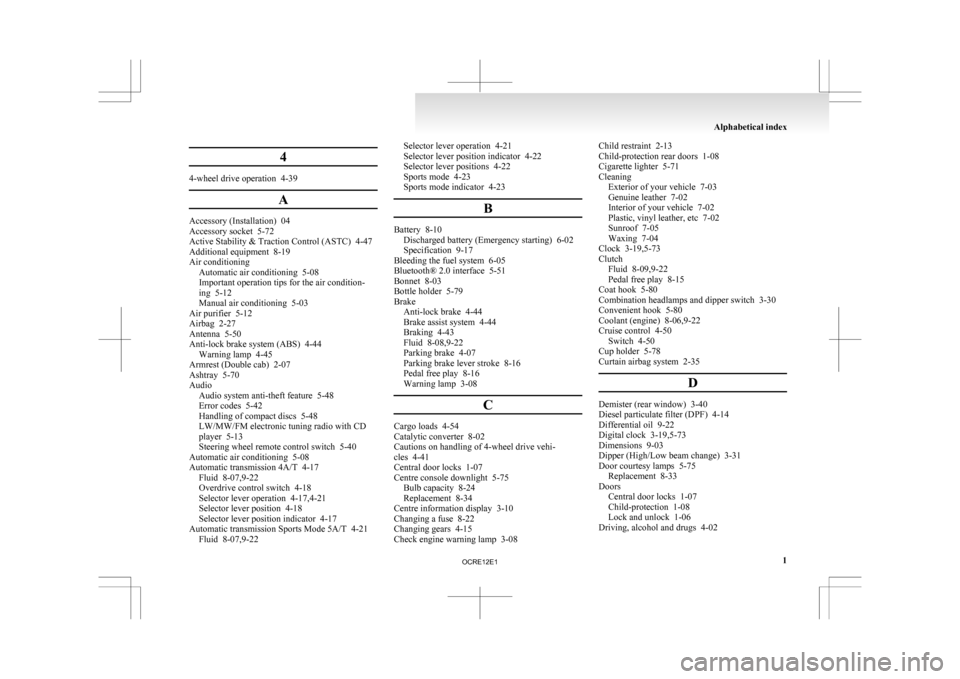
4-wheel drive operation 4-39
AAccessory (Installation) 04
Accessory socket 5-72
Active Stability & Traction Control (ASTC)
4-47
Additional equipment 8-19
Air conditioning Automatic air conditioning 5-08
Important operation tips for the air condition-
ing 5-12
Manual air conditioning 5-03
Air purifier 5-12
Airbag 2-27
Antenna 5-50
Anti-lock brake system (ABS) 4-44 Warning lamp 4-45
Armrest (Double cab) 2-07
Ashtray 5-70
Audio Audio system anti-theft feature 5-48
Error codes 5-42
Handling of compact discs 5-48
LW/MW/FM electronic tuning radio with CD
player 5-13
Steering wheel remote control switch 5-40
Automatic air conditioning 5-08
Automatic transmission 4A/T 4-17 Fluid 8-07,9-22
Overdrive control switch 4-18
Selector lever operation 4-17,4-21
Selector lever position 4-18
Selector lever position indicator 4-17
Automatic transmission Sports Mode 5A/T 4-21 Fluid 8-07,9-22 Selector lever operation 4-21
Selector lever position indicator
4-22
Selector lever positions 4-22
Sports mode 4-23
Sports mode indicator 4-23
B Battery 8-10
Discharged battery (Emergency starting)
6-02
Specification 9-17
Bleeding the fuel system 6-05
Bluetooth® 2.0 interface 5-51
Bonnet 8-03
Bottle holder 5-79
Brake Anti-lock brake 4-44
Brake assist system 4-44
Braking 4-43
Fluid 8-08,9-22
Parking brake 4-07
Parking brake lever stroke 8-16
Pedal free play 8-16
Warning lamp 3-08
C Cargo loads 4-54
Catalytic converter
8-02
Cautions on handling of 4-wheel drive vehi-
cles 4-41
Central door locks 1-07
Centre console downlight 5-75 Bulb capacity 8-24
Replacement 8-34
Centre information display 3-10
Changing a fuse 8-22
Changing gears 4-15
Check engine warning lamp 3-08 Child restraint 2-13
Child-protection rear doors
1-08
Cigarette lighter 5-71
Cleaning Exterior of your vehicle 7-03
Genuine leather 7-02
Interior of your vehicle 7-02
Plastic, vinyl leather, etc 7-02
Sunroof 7-05
Waxing 7-04
Clock 3-19,5-73
Clutch Fluid 8-09,9-22
Pedal free play 8-15
Coat hook 5-80
Combination headlamps and dipper switch 3-30
Convenient hook 5-80
Coolant (engine) 8-06,9-22
Cruise control 4-50 Switch 4-50
Cup holder 5-78
Curtain airbag system 2-35
D Demister (rear window) 3-40
Diesel particulate filter (DPF)
4-14
Differential oil 9-22
Digital clock 3-19,5-73
Dimensions 9-03
Dipper (High/Low beam change) 3-31
Door courtesy lamps 5-75 Replacement 8-33
Doors Central door locks 1-07
Child-protection 1-08
Lock and unlock 1-06
Driving, alcohol and drugs 4-02 Alphabetical index
1
OCRE12E1
Page 357 of 369
E
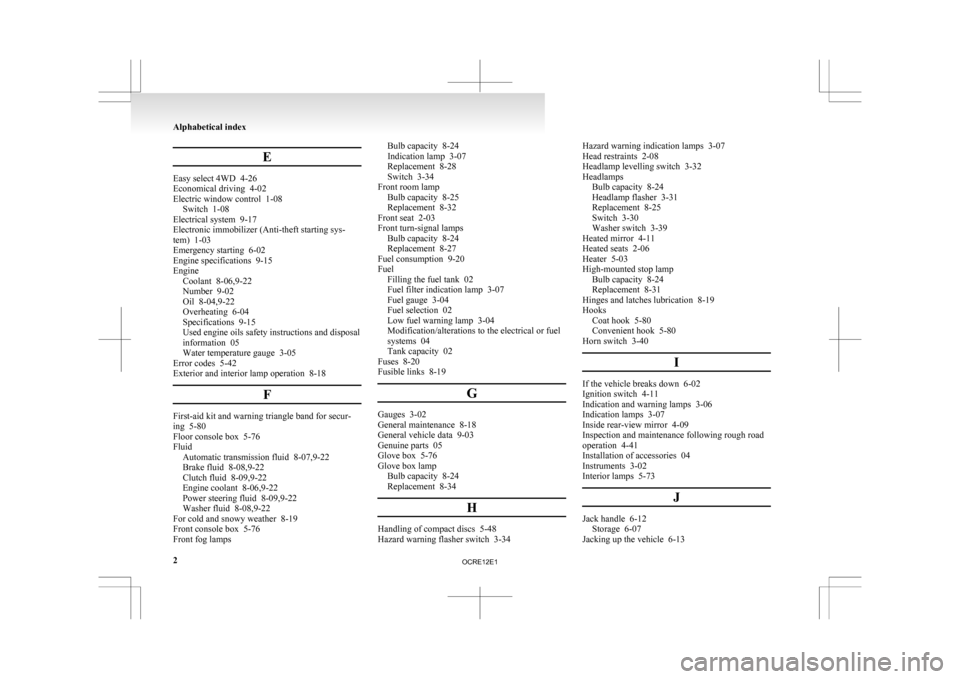
Easy select 4WD 4-26
Economical driving
4-02
Electric window control 1-08 Switch 1-08
Electrical system 9-17
Electronic immobilizer (Anti-theft starting sys-
tem) 1-03
Emergency starting 6-02
Engine specifications 9-15
Engine Coolant 8-06,9-22
Number 9-02
Oil 8-04,9-22
Overheating 6-04
Specifications 9-15
Used engine oils safety instructions and disposal
information 05
Water temperature gauge 3-05
Error codes 5-42
Exterior and interior lamp operation 8-18
FFirst-aid kit and warning triangle band for secur-
ing 5-80
Floor console box 5-76
Fluid
Automatic transmission fluid
8-07,9-22
Brake fluid 8-08,9-22
Clutch fluid 8-09,9-22
Engine coolant 8-06,9-22
Power steering fluid 8-09,9-22
Washer fluid 8-08,9-22
For cold and snowy weather 8-19
Front console box 5-76
Front fog lamps Bulb capacity 8-24
Indication lamp
3-07
Replacement 8-28
Switch 3-34
Front room lamp Bulb capacity 8-25
Replacement 8-32
Front seat 2-03
Front turn-signal lamps Bulb capacity 8-24
Replacement 8-27
Fuel consumption 9-20
Fuel Filling the fuel tank 02
Fuel filter indication lamp 3-07
Fuel gauge 3-04
Fuel selection 02
Low fuel warning lamp 3-04
Modification/alterations to the electrical or fuel
systems 04
Tank capacity 02
Fuses 8-20
Fusible links 8-19
G Gauges 3-02
General maintenance
8-18
General vehicle data 9-03
Genuine parts 05
Glove box 5-76
Glove box lamp Bulb capacity 8-24
Replacement 8-34
H Handling of compact discs 5-48
Hazard warning flasher switch 3-34Hazard warning indication lamps 3-07
Head restraints 2-08
Headlamp levelling switch
3-32
Headlamps Bulb capacity 8-24
Headlamp flasher 3-31
Replacement 8-25
Switch 3-30
Washer switch 3-39
Heated mirror 4-11
Heated seats 2-06
Heater 5-03
High-mounted stop lamp Bulb capacity 8-24
Replacement 8-31
Hinges and latches lubrication 8-19
Hooks Coat hook 5-80
Convenient hook 5-80
Horn switch 3-40
I If the vehicle breaks down 6-02
Ignition switch 4-11
Indication and warning lamps
3-06
Indication lamps 3-07
Inside rear-view mirror 4-09
Inspection and maintenance following rough road
operation 4-41
Installation of accessories 04
Instruments 3-02
Interior lamps 5-73
J Jack handle 6-12
Storage 6-07
Jacking up the vehicle
6-13Alphabetical index
2
OCRE12E1